
Use this fillable trading plan template to remove discretionary guessing and enforce risk rules every session. It comes in PDF, Google Sheet, and Excel formats, each built around the same seven components: goals, markets, edge, entry, exit, risk, and review. Fill it once, test it small, then let the checklists below do the enforcing for you.
TL;DR:
- Traders should enforce fixed per-trade risk, a daily loss cap, and an invalidation price to prevent small losses from escalating.
- The trading plan must include clear, conditional setups, entry, and exit rules based on specific triggers and pre-established invalidation points.
- Regularly testing the plan with small trades and revising it weekly based on actual journal review enhances discipline and effectiveness.
- Focusing on process-oriented goals and a concise market regime description helps traders avoid overcomplication and untested setups.
- Using decision scoring and behavioral review tools can reinforce adherence to the plan and reveal subconscious biases before executing trades.
Table of Contents
- What's Inside the Trading Plan Template
- Who This Template Is For
- How to Use the Template Step-by-Step
- The Seven Components, Written the Way They Actually Work
- Pre-Market and Per-Trade Checklists You Can Copy Today
- Trading Journal and Review: What Actually Teaches You Something
- How Decision Intelligence Reinforces the Written Plan
- Why Most Trading Plans Fail in Week One
- Put the Template to Work With a Decision Intelligence Platform
- Sources
What's Inside the Trading Plan Template
A trading plan only works if it forces a decision before the market does. The strongest templates follow a seven-part structure that guides goals, markets, edge, entry, exit, risk, and review, so no session starts without a boundary already drawn around it, a format multiple guides converge on. Here's what belongs in each section and why skipping it causes trouble later:
- Goals and constraints: Process goals ("follow the checklist on 90% of trades") beat outcome goals ("make $500 this week") because you can control the former and not the latter.
- Markets and schedule: Name the instruments you trade and the hours you're actually watching a screen. Outside those hours, you sit out.
- Edge and setup: The specific pattern, catalyst, or condition that gives you a statistical reason to enter, not a hunch.
- Entry rules: Trigger, order type, and confirmation signal, written so a stranger could execute it.
- Exit rules: Where you get out if you're wrong, and where you take profit if you're right, decided before you're in the trade.
- Risk rules: Fixed per-trade risk, a daily loss cap, and a hard stop on total open exposure.
- Review process: How and when you grade your own decisions, separate from how the trade actually performed.
Two of these deserve non-negotiable status. Fixed per-trade risk and a written invalidation price aren't optional add-ons. Templates that skip either one tend to produce traders who "manage" losers by moving the stop, which is the single fastest way to turn a small loss into a large one. If you trade options, add fields for implied volatility context and defined-risk structure preference. Swing traders should add a multi-day catalyst calendar. Systematic traders need a section for backtest parameters and live-versus-backtest deviation tracking.
Who This Template Is For
Not every trader needs every field filled out on day one. Match your effort to your style so the plan stays usable instead of becoming a document you write once and never open again.
- Day traders need the pre-market and per-trade checklists doing most of the heavy lifting, since decisions happen fast and there's no time to reread a long strategy section mid-session.
- Swing traders should lean on the markets/schedule and review sections, since positions run over days and the catalyst thesis matters more than intraday triggers.
- Options traders need an added risk layer for defined-risk versus undefined-risk structures, plus a field for implied volatility rank at entry.
- Beginners should fill out every section but keep the edge simple, one setup, clearly defined, tested small before adding a second.
- Systematic traders need the review section built around expectancy tracking rather than subjective grading, since the edge is supposed to be mechanical already.
Account size changes how strictly you enforce the risk envelope. Smaller accounts should treat the daily loss cap as sacred, since a string of three bad days can do outsized damage. Whatever your style, pick one or two core strategies. A plan trying to cover five setups usually enforces none of them well.
How to Use the Template Step-by-Step
Filling out a template once and never touching it again defeats the purpose. Treat it as a working document that gets tested, tightened, and updated on a schedule.
- Fill your constraints and risk envelope first. Before you write a single setup, lock in your fixed risk per trade, daily loss cap, and trading hours. This section governs everything else.
- Define one or two setups, not five. Write each as a conditional statement: the catalyst, the read, and the invalidation price. If you can't write the invalidation price, the setup isn't ready.
- Build your checklists. Turn the plan's rules into a short pre-market checklist and a per-trade checklist you complete before every order.
- Test small or on paper first. Run the plan for at least two weeks with reduced size before trusting it with full risk. This is where you find the rules that sound good on paper but fall apart under real conditions.
- Enforce with circuit breakers and a journal. Hit your daily loss cap, you're done for the day. No exceptions, no "one more trade to get it back."
Revisit the plan weekly, not daily. Daily edits usually mean you're rewriting the plan to justify a bad trade, not improving it. A real revision cycle looks at a full week or month of journal entries and asks whether the rules themselves need adjusting, not whether one trade felt unfair.
If you're building this in Google Sheets, keep one tab for the plan and a linked tab for the journal so your position size formula pulls directly from your account balance and risk percentage. Export the finished plan to PDF for a printable version you can pin next to your monitor.
Pro Tip: Lock your risk envelope cells in Google Sheets before you touch anything else. If the position size formula can be edited mid session, you'll edit it the first time a trade feels "too good to size normally."
The Seven Components, Written the Way They Actually Work
Generic advice to "manage risk" or "have an edge" doesn't survive contact with a live order ticket. Every component needs language specific enough that you could hand it to another trader and get the same decision.
Goals: process over outcome
Write goals as behaviors, not dollar figures. "Complete the pre-market checklist before every session" is testable every single day. "Make $2,000 this month" tells you nothing about whether today's decisions were good ones. Process goals are the only kind you can actually control on any given Tuesday.
Markets and regime: know when to sit out
Write a single sentence describing the market regime you trade best in, something like "trending, above-average volume, no major economic releases in the next two hours." When that sentence doesn't describe the current market, the correct action is to do nothing. A concise regime thesis paired with a deliberately narrow instrument universe keeps a plan short enough that you'll actually reread it, instead of writing forty pages nobody reopens after week one.
Edge: the setup has to be conditional
A real edge is written as if-then logic: if the catalyst appears and the price structure confirms it, then the setup is valid, with a clear invalidation. A core strategy needs five interlocking parts: the edge thesis, the setup definition, risk rules, an execution plan, and a review loop. Miss one and the whole thing tends to break down under pressure, even if the setup itself was sound. Traders building a trend-following framework often start here, since trend setups translate cleanly into conditional language.
Entry rules: trigger, order type, confirmation
Spell out exactly what triggers an entry, whether you're using a limit or market order, and what confirms the read before you click. "Buy on a breakout" is not a rule. "Buy on a five-minute close above the pre-market high, with volume at least 1.5 times the twenty-period average, using a limit order at the breakout level" is one.
Exit rules: structural stops, trailing logic, scale-outs
Place your stop where the setup's original thesis is proven wrong, not at a fixed dollar amount. Add a volatility buffer around that level, since a stop placed exactly at a support line often gets clipped by routine noise rather than an actual trend reversal. Decide in advance whether you trail the stop, scale out a portion at a first target, or exit fully at a single level, and write down the rule for each, not just the intention.
Risk envelope: the numbers that actually protect the account
- Fixed risk per trade: commonly around 1% of capital, adjusted only after forward testing shows a stable edge.
- Daily loss cap: commonly around 3%, which forces a stop for the day before a bad streak turns into a disaster.
- Maximum open risk across all positions, so five small trades don't quietly add up to one oversized bet.
- Correlation netting, since two "different" trades on correlated instruments are really one larger position in disguise. Readers building this section out in full deserve the worked examples in a dedicated risk management breakdown.
Review loop: grade the decision, not the outcome
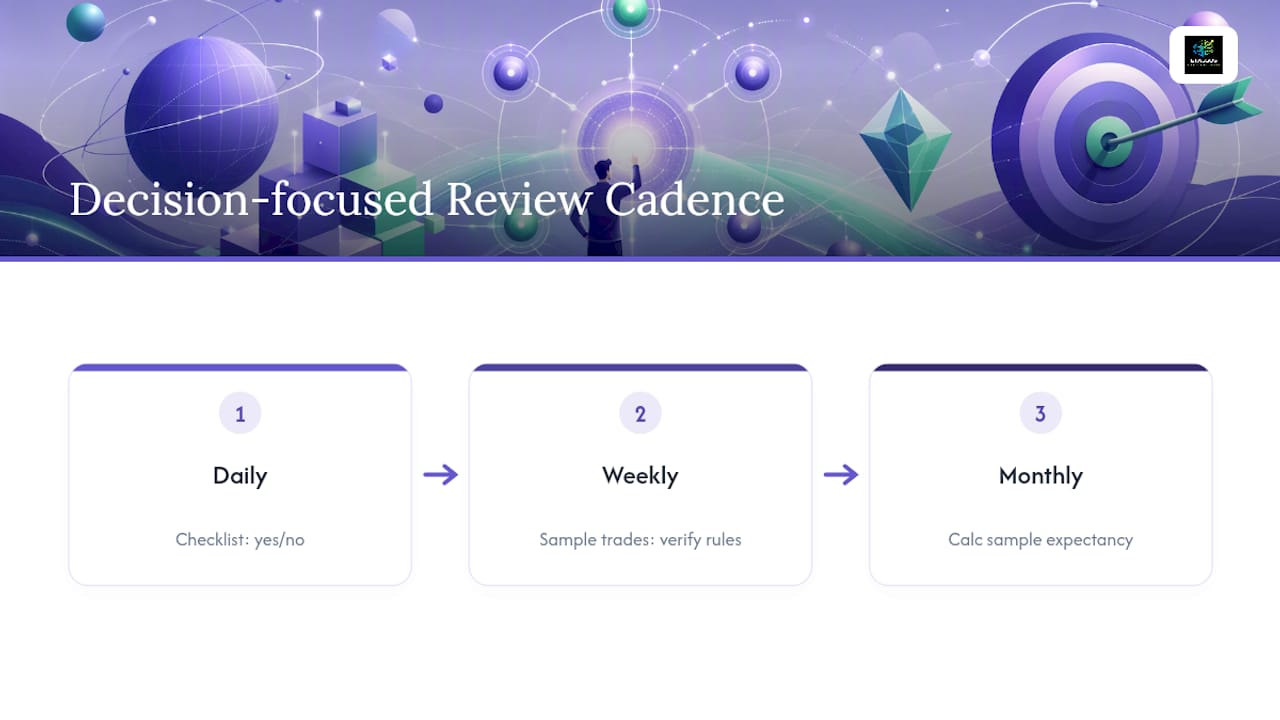
Daily, do a quick pass: did you follow the checklist, yes or no? Weekly, pull a sample of trades and check whether entries and exits matched the written rules. Monthly, calculate expectancy across the sample. Judging decisions against the plan instead of the P&L is what stops you from reinforcing a lucky bad process or abandoning a sound one after one unlucky week.
Pre-Market and Per-Trade Checklists You Can Copy Today
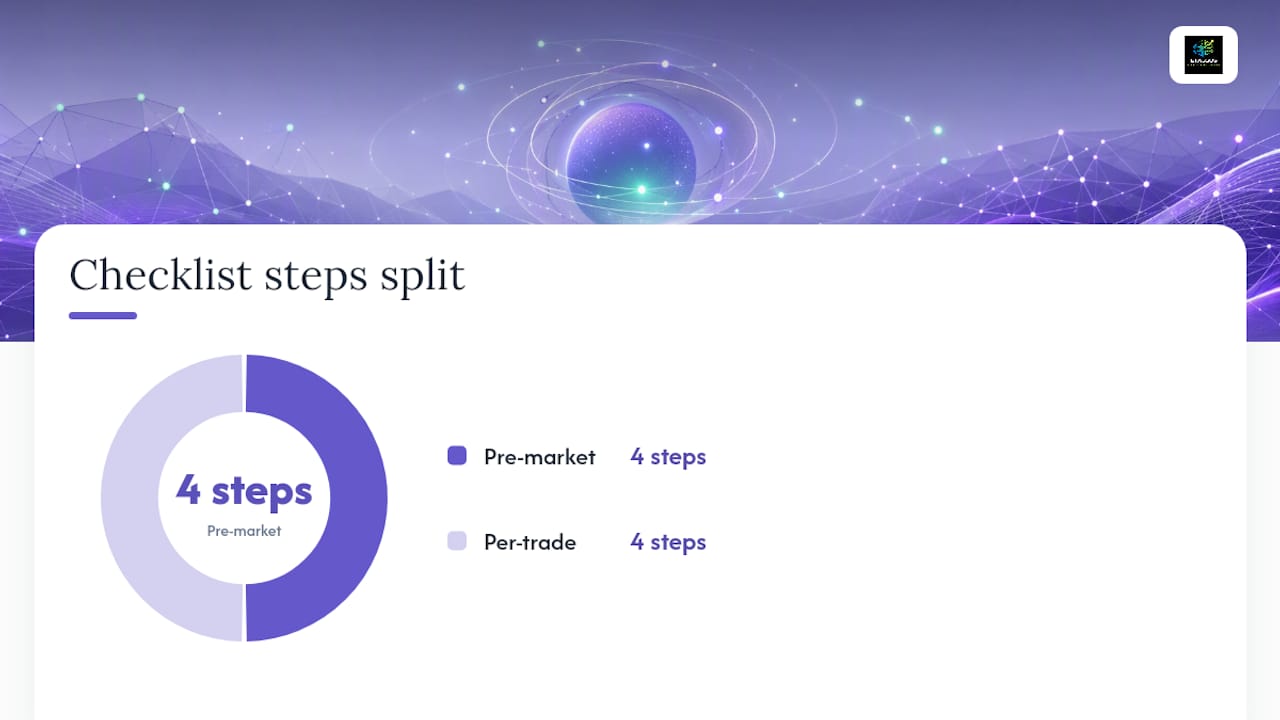
A written plan only changes behavior if it gets converted into something you check against in real time. Two short checklists do most of the work.
Pre-market checklist:
- Write today's market regime sentence in one line.
- Review your watchlist against your instrument universe, not the whole market.
- Check the economic calendar for scheduled news that could invalidate your setups.
- Confirm today's daily risk budget before the first trade goes on.
Per-trade checklist, completed before every order:
- Setup matches a written condition in the plan, not a feeling.
- Invalidation price is set before the entry, not after.
- Position size matches the fixed risk percentage for the account.
- Decision recorded in the journal before the order fills, not after.
A pre-trade checklist built around these exact steps is worth keeping open on a second monitor. On format, fillable PDFs suit traders who print and check boxes by hand, while Google Sheets suits anyone syncing across a laptop and a phone. Excel works best if you already run other trading calculations there and want everything in one workbook.
Trading Journal and Review: What Actually Teaches You Something
Most traders overbuild their journal, then abandon it within two weeks. A short list of fields, kept current, teaches more than a thirty-column spreadsheet nobody finishes filling out.
The fields worth tracking every time: date, symbol, size, entry price, exit price, profit or loss, R multiple, setup name, entry reason, conviction level, execution grade, and one lesson. Of those, three columns deliver most of the learning: profit and loss, why you entered, and what you learned. Everything else supports those three.
Pro Tip: Set up a running expectancy formula in your journal spreadsheet that averages your R multiple across the last twenty trades. Watching that number move week to week tells you more about your edge than any single trade ever will.
A few habits keep the journal useful instead of decorative:
- Log the trade before you check whether it worked, not after, so hindsight doesn't rewrite your reasoning.
- Grade execution against the plan, separate from the profit and loss column, so a lucky winner with bad process still gets flagged.
- Use a spreadsheet template if you want full control over formulas; use a logging app like Betlog if consistency is your bigger problem than customization. Betlog is one option worth a look if you'd rather log outcomes and reasoning outside a spreadsheet. For a dedicated setup with review routines already built in, a ready-to-use journal template saves the setup work.
How Decision Intelligence Reinforces the Written Plan
A template only works if you actually follow it under pressure, and that's the gap most trading plans fall into. Writing "I will only take A-plus setups" is easy. Recognizing, in the moment, that today's setup is really a B minus dressed up as an A, is the hard part.
This is where scoring a setup against fixed criteria before you click, rather than trusting a gut feeling, closes the gap between the plan on paper and the trade you actually take. A six-factor scoring approach evaluates the psychological and behavioral conditions behind a setup rather than issuing a signal, which keeps the decision yours while flagging when your own state of mind doesn't match your written rules.
- Scoring a setup against six behavioral factors surfaces deviations from your plan before you act on them, not after.
- LIANA, the platform's assistant, reviews your patterns over time and flags recurring mistakes, like sizing up after a loss, that are hard to see in the moment yourself.
- The step-by-step scoring workflow pairs directly with the per-trade checklist above, giving you a second check before the order goes out.
None of this replaces the plan. It reinforces the parts of it you're most likely to bend when a trade starts moving against you.
Why Most Trading Plans Fail in Week One
Most new traders overbuild the plan before they've traded a single session under it. They add five setups, three timeframes, and a review process with more columns than a spreadsheet should reasonably have. Keep week one simple: one setup, one invalidation rule, one risk number. Everything else can wait until you've actually traded the plan enough times to know what's missing.
The two mistakes I see most often are a missing invalidation price and variable position sizing. Traders who "eyeball" size based on how confident they feel are, without realizing it, betting more when they're already emotionally compromised, which is exactly backward. A written invalidation price and a fixed sizing formula fix both problems at once, because neither one leaves room for negotiation mid-trade.
If you want one enforcement rule that does more work than any other, make it this: log the trade before you place it, and treat your daily loss cap as a hard stop with zero exceptions. The plan doesn't protect you. Following it does.
— Anantha
Put the Template to Work With a Decision Intelligence Platform
A Decision Intelligence platform gives self-directed traders a way to check a written plan against real behavior before the order fills, not just after the loss shows up in the journal. Where a template tells you what to do, a six-factor scoring engine and AI assistant help confirm whether today's setup and your own state of mind actually match what you wrote down.

A practical workflow looks like this: score the setup against the six behavioral factors, run through your per-trade checklist, log the decision in your journal, then review behavioral insights at the end of the week alongside your own notes. That loop catches the deviations a plan alone can't flag in real time, sizing up after a loss, skipping the checklist when a trade feels obvious, chasing a setup that doesn't actually meet your written criteria.
If you want structured lessons on the psychology behind these decisions, the Knowledge Hub covers the core concepts in depth. Ready to see your own setups scored before you click? Check the subscription plans and start with the free tier to test the workflow against your current plan this week.
Sources
- Stockbrokers
- How to Build a Trading Plan That Survives Contact With the Market — ChartWhisperer
- How to Build a Core Trading Strategy in 2026 — CurvedTrading
- Free Trading Plan Template (PDF + Better Alternative) | TradingPlan