
Run this pre-trade checklist before every entry. Ten binary questions. One NO means no trade. The whole thing takes 30–90 seconds once your pre-market work is done, which is exactly the point: pre-market is where you compute, and pre-trade is where you confirm.
Here are the ten checks. Answer YES or NO to each:
- Market bias confirmed? Higher-timeframe direction aligns with the trade direction.
- Named setup present? You can state the pattern by name (e.g., bull flag, inside bar, VWAP reclaim).
- Exact entry defined? A specific price or bar condition, not a zone.
- Stop/invalidation placed? A structural level, not an arbitrary distance.
- R:R meets minimum? At least 1.5:1 after spread and commissions.
- Position size calculated? Risk dollars divided by stop distance, converted to shares or contracts.
- Spread/cost acceptable? Spread plus commission does not eat more than 20% of the expected gain.
- News window clear? No high-impact release within 30 minutes of entry.
- Correlated exposure checked? No doubling up on the same directional risk across positions.
- Journal entry ready? Timestamp, setup class, and entry/SL/TP written before the order goes in.
One NO = no entry. Move the setup to your watchlist or re-run the check after the next pre-market session. Pin this list at eye level and keep every answer binary.
Table of Contents
- What does a printable pre-trade checklist template look like?
- How pre-market preparation makes your pre-trade check fast
- What risk rules and position-sizing method should you use?
- How does the CSTI framework define your entry, trigger, and invalidation?
- Are you mentally ready to trade right now?
- Three ready-to-use templates for day, swing, and futures/forex trading
- How do you build and test a checklist that actually fits your trading plan?
- What should you record after every trade, and how often should you review?
- How can Decision Intelligence enforce your checklist and reduce behavioral drift?
- Key Takeaways
- The checklist is not the edge — the discipline to run it is
- EI ALGOS keeps your checklist from becoming optional
- Useful sources and tools for implementing your checklist
What does a printable pre-trade checklist template look like?
Copy the block below, print it, and pin it next to your monitor. Fill in the bracketed fields before every trade.
PRE-TRADE CHECKLIST
Date: ________  Instrument: ________  Session: ________

[ ] Market bias confirmed?          Entry price: ________
[ ] Named setup present?            Setup name: ________
[ ] Exact entry defined?            Stop level: ________
[ ] Stop/invalidation placed?       TP level:   ________
[ ] R:R ≥ 1.5:1 (net)?             R:R calc:   ________
[ ] Position size calculated?       Size:       ________
[ ] Spread/cost acceptable?         Cost est.:  ________
[ ] News window clear?              Next event: ________
[ ] Correlated exposure checked?    Open risk:  ________
[ ] Journal entry ready?            Log method: ________

ALL YES? → Submit order.   ANY NO? → No entry.
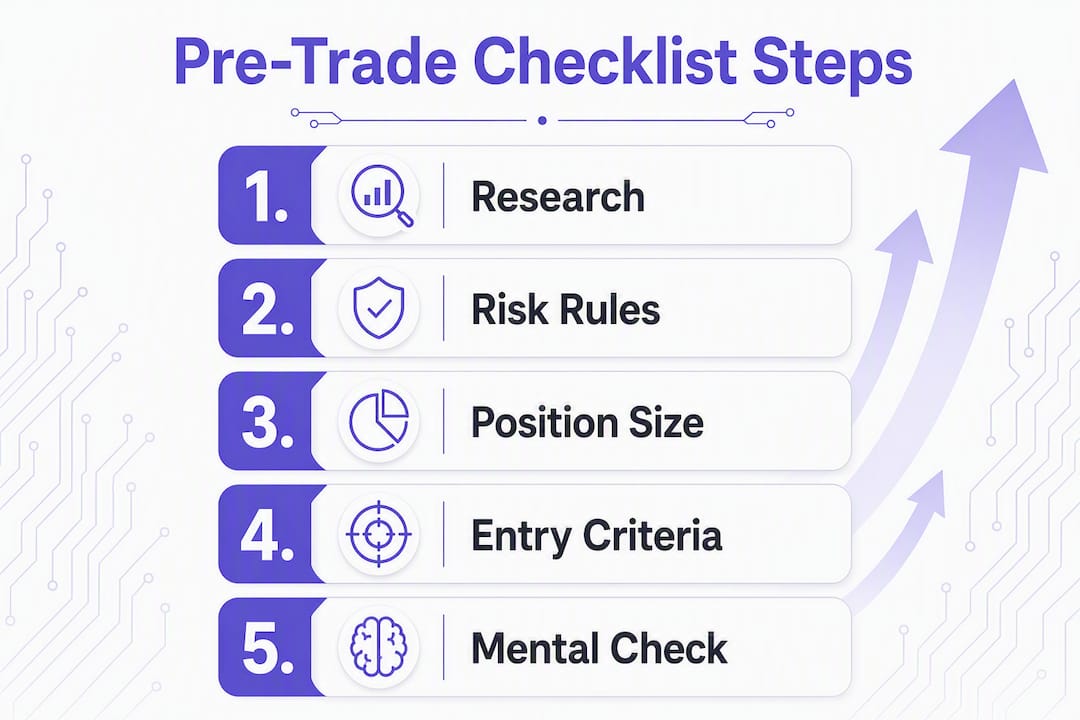
The table below shows how to adapt the checklist length and time budget to your trading style.
| Style | Checklist items | Pre-trade time budget | When to run |
|---|---|---|---|
| Day trading | 10 (full list) | 30–90 seconds | Before each intraday entry |
| Swing trading | 10 + event-window check | 30–90 seconds | Evening before or pre-market |
| Futures / FX | 10 + contract-size step | 30–90 seconds | Before each session entry |
Where to record the result: a paper log works fine. A spreadsheet with one row per trade is better. EI ALGOS process logs are the most auditable option because they timestamp each check and flag behavioral patterns automatically.
How pre-market preparation makes your pre-trade check fast
The 30–90 second runtime is only realistic if you have already done the heavy lifting. Marking key levels or analyzing bias while price is moving leads directly to reactive trading. Those tasks belong in pre-market, before the first candle prints.
A solid pre-market routine covers five areas:
- Higher-timeframe bias: Mark the daily and weekly trend direction. Write it down as a single sentence ("Bias: long above 4,820 on ES").
- Key levels: Support, resistance, VWAP anchors, and overnight highs/lows. Mark them on the chart before the open.
- Catalyst identification: Check earnings, FOMC, CPI, or any macro release scheduled for the session. Investopedia recommends reviewing index futures and macro themes before the open to set session expectations.
- News filter configuration: Block trade windows 30 minutes before and after any high-impact release. Set this in your economic calendar the night before or at least 30 minutes before the open.
- Correlation and portfolio exposure: Tally your open directional risk. If you are already long two correlated equity positions, a third long in a correlated ETF is not a new trade — it is added leverage.
Two quick scenarios that show why this matters:
Equities. You spot a clean bull flag on NVDA at 9:45 AM. But you skipped pre-market and did not notice CPI prints at 10:00 AM. The setup passes nine of ten checklist items, but the news-window check fails. No entry. The stock drops 4% on the release. Pre-market prep saved the trade.

EURUSD. You have a long bias from the daily chart. Pre-market, you note ECB minutes at 2:00 PM EST. You set a hard block from 1:30–2:30 PM. A setup triggers at 1:45 PM. News-window check: NO. You skip it. Price spikes 80 pips against the long. The checklist did its job.
Pro Tip: Do all position-sizing math and cost estimates during pre-market. When the pre-trade check runs, you are confirming a number you already computed, not calculating under pressure.
What risk rules and position-sizing method should you use?
Concrete numbers matter here. Vague guidance like "risk a small amount" is not a rule — it is a suggestion you will override the moment a setup looks good enough.
Risk-per-trade percentage
For most retail accounts, a range of risk per trade is recommended. Use lower risk percentages when testing new setups or recovering from a drawdown, and higher risk percentages on well-vetted, high-conviction trades with positive expectancy. Avoid exceeding your predefined maximum risk per trade until you have sufficient documented performance of the setup.
Position-size calculation
The formula is the same across instruments:
Position size = (Account value × Risk %) ÷ Stop distance in dollars

Equities example: $50,000 account, 0.5% risk = $250 risk. Stop distance = $2.00 per share. Position size = $250 ÷ $2.00 = 125 shares.
Futures example: $50,000 account, 0.5% risk = $250 risk. ES micro contract tick value = $1.25. Stop = 4 ticks = $5.00. Position size = $250 ÷ $5.00 = 50 micro contracts (or 5 standard micros, depending on your broker's minimum).
Minimum R:R guidance
A 1.5:1 baseline is the floor. For A+ setups with strong confluence, target 2:1 or better. Always compute R:R after subtracting spread and commission from the expected gain.
| Instrument | Typical spread | Commission (round-trip) | Net R:R impact at 1.5:1 target |
|---|---|---|---|
| US equities (retail) | ≤ $0.05/share | — | Minimal; commission matters more at small size |
| Futures (ES micro) | 4 ticks | $1.25 | Minimum R:R baseline is 1.5:1. |
| FX majors (EURUSD) | 0.5–1.5 pips | — | 1-pip spread on a 10-pip stop cuts R:R by 10% |
Pro Tip: Always verify your stop order is server-side before submitting the entry. A mental stop is not a stop. It is a plan you will abandon the moment price approaches it.
How does the CSTI framework define your entry, trigger, and invalidation?
The Condition–Setup–Trigger–Invalidation (CSTI) model turns a vague "I like this chart" into a precise, auditable decision. Interactive Brokers notes that checklists reduce human error by converting complex judgment into binary, auditable steps — CSTI is the decision model that makes that possible.
The one-line rule: Condition = higher-timeframe bias; Setup = named pattern; Trigger = specific entry signal; Invalidation = structural stop.
The four CSTI steps before order submission
- Condition: State the higher-timeframe bias in one sentence. "Daily trend is up; price is above the 20 EMA and last week's high."
- Setup: Name the pattern. "Bull flag on the 15-minute chart, consolidating at the 50% retracement of the prior impulse."
- Trigger: Define the exact entry condition. "Break and close above the flag's upper trendline at $184.50, confirmed by a volume spike above the 20-period average."
- Invalidation: Set the structural stop. "Below the flag's low at $182.80. If price closes below that level on any 15-minute bar, the setup is void."
A short CSTI trade walkthrough
Instrument: SPY (neutral example)
- Condition: Daily uptrend; SPY above 200-day SMA and prior week's high.
- Setup: 15-minute bull flag after a morning impulse from $520 to $524.
- Trigger: Break above $524.20 on a 15-minute close with volume 30% above average.
- Invalidation: Close below $522.80 (flag low).
- Entry: $524.20. Stop: $522.80. Stop distance: $1.40.
- TP (measured move): $524.20 + $4.00 (prior impulse height) = $528.20.
- R:R: $4.00 gain ÷ $1.40 risk = 2.86:1 before costs.
Stop placement follows the invalidation level, not an arbitrary dollar amount. That structural anchor is what lets you size correctly — because the stop distance is real, not guessed.
Are you mentally ready to trade right now?
The technical checklist is useless if you sit down angry, exhausted, or chasing a loss from yesterday. Emotional state is not a soft consideration — it is a hard filter.
The single rule: if you cannot answer YES to all of the following, do not trade.
- Sleep and focus: Did you get adequate sleep? Are you able to concentrate without distraction for the full session?
- Loss bias: Did you take a significant loss in the last 24 hours? Are you trading to recover it?
- Win bias: Did you have a big winning day yesterday? Are you feeling invincible right now?
- FOMO urgency: Are you entering because price is moving and you feel like you are missing it?
- Confirmation bias: Are you seeing the setup because you want it to be there, or because it actually is?
- Distractions: Is there anything in your environment right now that will pull your attention mid-trade?
One practical enforcement rule: after a 3R drawdown in a single session, mandatory one-hour cooldown before any new entry. After two consecutive losing trades, reduce size by 50% for the next two trades. These are not suggestions — write them into your checklist as hard rules.
Pro Tip: Use an external enforcement mechanism for emotional rules. A cooldown timer on your phone, a checklist lockout in your trading journal, or EI ALGOS behavioral scoring all work better than willpower alone. The rule has to be non-negotiable before you need it.
Three ready-to-use templates for day, swing, and futures/forex trading
Day trading checklist
Built for speed. Most items are confirmed in pre-market; the pre-trade check is pure confirmation.
- Intraday bias matches higher-timeframe direction?
- Named setup present on 5-minute or 15-minute chart?
- Exact entry price or bar condition defined?
- Structural stop placed (server-side)?
- R:R ≥ 1.5:1 net of spread and commission?
- Position size calculated using today's account balance?
- Spread within acceptable threshold (e.g., ≤ $0.05/share for equities)?
- No high-impact news within 30 minutes?
- No correlated position doubling directional exposure?
- Journal entry written before order submission?
Example pass: AAPL bull flag on 15-minute chart. Entry $192.40, stop $191.20, TP $194.80. R:R = 2:1. Size = 65 shares (0.5% risk on $50K). No news until 2:00 PM. All YES. Order submitted.
Swing trading checklist
Slower pace, bigger stops, multi-day holds. The event-window check covers the next 3–5 days.
- Weekly and daily trend aligned with trade direction?
- Named setup on daily or 4-hour chart?
- Entry defined at a specific level (not a zone)?
- Stop below/above a structural level (not a percentage)?
- R:R ≥ 2:1 net of overnight financing and spread?
- Position size adjusted for wider stop (smaller shares/contracts)?
- No earnings, FOMC, or major macro event in the next 3 trading days?
- Correlated positions reviewed for total directional exposure?
- Overnight gap risk acceptable given position size?
- Journal entry written with multi-day management rules noted?
Example pass: MSFT daily inside bar at 20-week SMA. Entry $415.00, stop $408.00, TP $429.00. R:R = 2:1. Size = 18 shares (0.5% risk). No earnings for 22 days. All YES.
Futures / FX checklist
Includes contract-specific sizing and correlation limits for leveraged instruments.
- Session bias confirmed (Asian/London/NY overlap)?
- Named setup on 1-hour or 4-hour chart?
- Exact entry price or level defined?
- Structural stop placed server-side in ticks or pips?
- R:R ≥ 1.5:1 after spread (in pips or ticks)?
- Contract/lot size calculated from tick value and stop distance?
- Spread within session norms (e.g., EURUSD ≤ 1.5 pips during London)?
- No high-impact release within 30 minutes (check DailyFX or Forex Factory calendar)?
- Correlated pairs checked (e.g., EURUSD and GBPUSD not both long)?
- Journal entry written with contract size and pip value noted?
| Style | Sample entry | Stop | TP | R:R | Size |
|---|---|---|---|---|---|
| Day (AAPL) | $192.40 | $191.20 | $194.80 | 2:1 | 65 shares |
| Swing (MSFT) | $415.00 | $408.00 | $429.00 | 2:1 | 18 shares |
| FX (EURUSD) | — | — | — | 2:1 | 0.5 standard lot |
How do you build and test a checklist that actually fits your trading plan?
A checklist copied from an article is a starting point, not a finished product. The ForexMechanics operational model recommends capping pre-trade checks at 10 binary questions and making every answer a confirmation of pre-computed values — not a live calculation. That design principle is the constraint your custom checklist must respect.
The four-step build process:
- Design: Start with the 10-item template above. Remove any item that does not apply to your instrument or style. Add one item specific to your edge (e.g., "Volume above 20-period average?" for a breakout trader).
- Pre-market roll-out: Run the checklist in pre-market for two weeks on paper trades. Note every item that causes hesitation — those are ambiguous items that need sharper wording.
- Controlled testing: Forward-test on a demo account for 20 trades. Record checklist pass/fail alongside trade outcome. Calculate your pass rate and compare win rates on passed vs. failed setups.
- Iterate using metrics: If a checklist item has a 90%+ pass rate but no correlation with outcome, it may be redundant. If a failed item predicts a losing trade 70% of the time, it is load-bearing — never remove it.
Metrics to track during testing:
| Metric | What it tells you | Target |
|---|---|---|
| Checklist pass rate | How often setups meet all criteria | Track trend; rising = improving selectivity |
| Skipped-opportunity rate | How often you passed on a setup that would have worked | Keep below 30% to avoid over-filtering |
| Win rate by setup class | Which named setups have positive expectancy | Focus on top 2–3 setup classes |
| Avg R per trade | Profitability per unit of risk | Target ≥ 0.5R average across all trades |
| Drawdown post-implementation | Whether the checklist reduces loss clusters | Should decline after several weeks. |
Pro Tip: A/B test checklist variants on 20 saved historical setups before changing a live checklist. Changing rules mid-session based on one bad trade is how checklists get abandoned.
Tools that support this process: a position-size calculator (many brokers provide one; TradeStation and Thinkorswim both have built-in calculators), a free economic calendar (Forex Factory or the CME Group's economic calendar for futures), a demo account for forward testing, and EI ALGOS for logging checklist runs and detecting behavioral patterns across your trade history.
What should you record after every trade, and how often should you review?
The checklist generates data. The journal is where that data becomes process improvement.
Minimum post-trade journal fields:
- Timestamp (entry and exit)
- Instrument and setup class
- Entry price, stop level, TP level
- R taken (actual risk in dollars)
- Result (win/loss in R)
- Checklist pass/fail items (note any NO that was overridden)
- Notes (what you saw, what you felt, what you would change)
EOD and EOW schedule:
Daily entries take 10–15 minutes. Write them immediately after the session closes, while the trade is fresh. Weekly audits take 30–45 minutes and focus on patterns: which checklist items failed most often, which setup classes underperformed, and whether any rule needs sharper wording.
| Metric | Review frequency | Action trigger |
|---|---|---|
| Win rate | Weekly | Below 40%: review setup selection criteria |
| Average R | Weekly | Below 0.3R: review stop placement and TP methodology |
| Expectancy | Monthly | Negative: pause live trading; return to demo |
| Checklist pass rate | Weekly | Below 60%: setups are too marginal; tighten filters |
| Common failure items | Weekly | Any item failing >30% of the time: rewrite or remove |
Feed EOW corrections back into your pre-market rules the following Monday. If "news window clear?" fails repeatedly because you are not checking the calendar until the pre-trade moment, the fix is a pre-market rule, not a checklist change. The checklist should confirm; the pre-market routine should prevent.
How can Decision Intelligence enforce your checklist and reduce behavioral drift?
The hardest part of any checklist is not designing it. It is running it honestly when a setup looks perfect and you want to skip the items you know will fail.
EI ALGOS addresses this directly. The platform logs each checklist run, scores the setup on a six-factor behavioral and analytical engine, and flags when a decision pattern suggests emotional override — overconfidence after a win streak, revenge entries after a loss, or FOMO-driven size increases. That scoring is not a signal. It is a mirror.
Specific use cases:
- Automated checklist logs: Every pre-trade check is timestamped and stored. You cannot retroactively edit a NO into a YES.
- Behavioral error detection: The six-factor engine identifies patterns like repeated entries during news windows or consistent oversizing after losses.
- Live trade management: Tools that confirm server-side stop placement and flag when a trade is being managed emotionally (e.g., moving a stop against the plan).
- LIANA assistant: Provides personalized process feedback based on your logged history — not generic advice, but observations specific to your setup classes and failure patterns.
Integration path: Export your checklist questions and map each one to the corresponding factor in EI ALGOS's engine. Run the platform alongside your existing journal for two weeks. Use LIANA's weekly summary to identify which checklist items you override most often — those are your highest-priority behavioral risks.
Pro Tip: Use EI ALGOS not as a replacement for your checklist but as its enforcement layer. The checklist is the rule; the platform is the audit trail that makes the rule non-negotiable.
Disclaimer: Decision Intelligence tools like EI ALGOS improve decision quality and process adherence. They do not generate trading signals and do not guarantee profitable outcomes.
Key Takeaways
A consistent pre-trade checklist, run in 30–90 seconds on pre-computed values, is the single most reliable way to reduce impulsive entries and protect your edge across every session.
| Point | Details |
|---|---|
| One NO = no entry | Every checklist item is binary; a single failed check blocks the trade, no exceptions. |
| Pre-market does the math | Compute bias, levels, sizing, and costs before the session so pre-trade is confirmation only. |
| Risk per trade: 0.5% (typical, with a range from 0.25%–1% based on setup quality and recovery status) | Size every position using account value, stop distance, and a fixed risk percentage. |
| CSTI defines the trade | Name the Condition, Setup, Trigger, and Invalidation before submitting any order. |
| Eialgosinc enforces adherence | EI ALGOS logs checklist runs, scores behavioral factors, and surfaces override patterns via LIANA. |
The checklist is not the edge — the discipline to run it is
Most traders who lose consistently are not losing because they lack a strategy. They lose because they know their rules and break them anyway. A pre-trade checklist is the mechanism that makes rule-breaking visible and, over time, less frequent.
The conventional wisdom is that a better setup or a better indicator will fix performance. It rarely does. What actually changes outcomes is the moment between seeing a setup and clicking the button. That moment is where discipline lives, and a checklist is the only tool that operates in exactly that space.
There is also a subtler point worth making: a checklist that is too long gets skipped. One that is too vague gets gamed. The 10-item binary format recommended here is not arbitrary — it reflects the operational design principle that pre-trade checks should be runnable in 30 seconds under live pressure, which means every item must be a confirmation, not a calculation. If you find yourself computing anything during the pre-trade check, the pre-market routine is incomplete.
The traders who benefit most from checklists are not beginners. They are experienced traders who already know what they should do and need a system that prevents them from doing otherwise.
EI ALGOS keeps your checklist from becoming optional
Every trader eventually faces the moment when a setup looks too good to run through the checklist. That is precisely when the checklist matters most, and precisely when willpower fails.
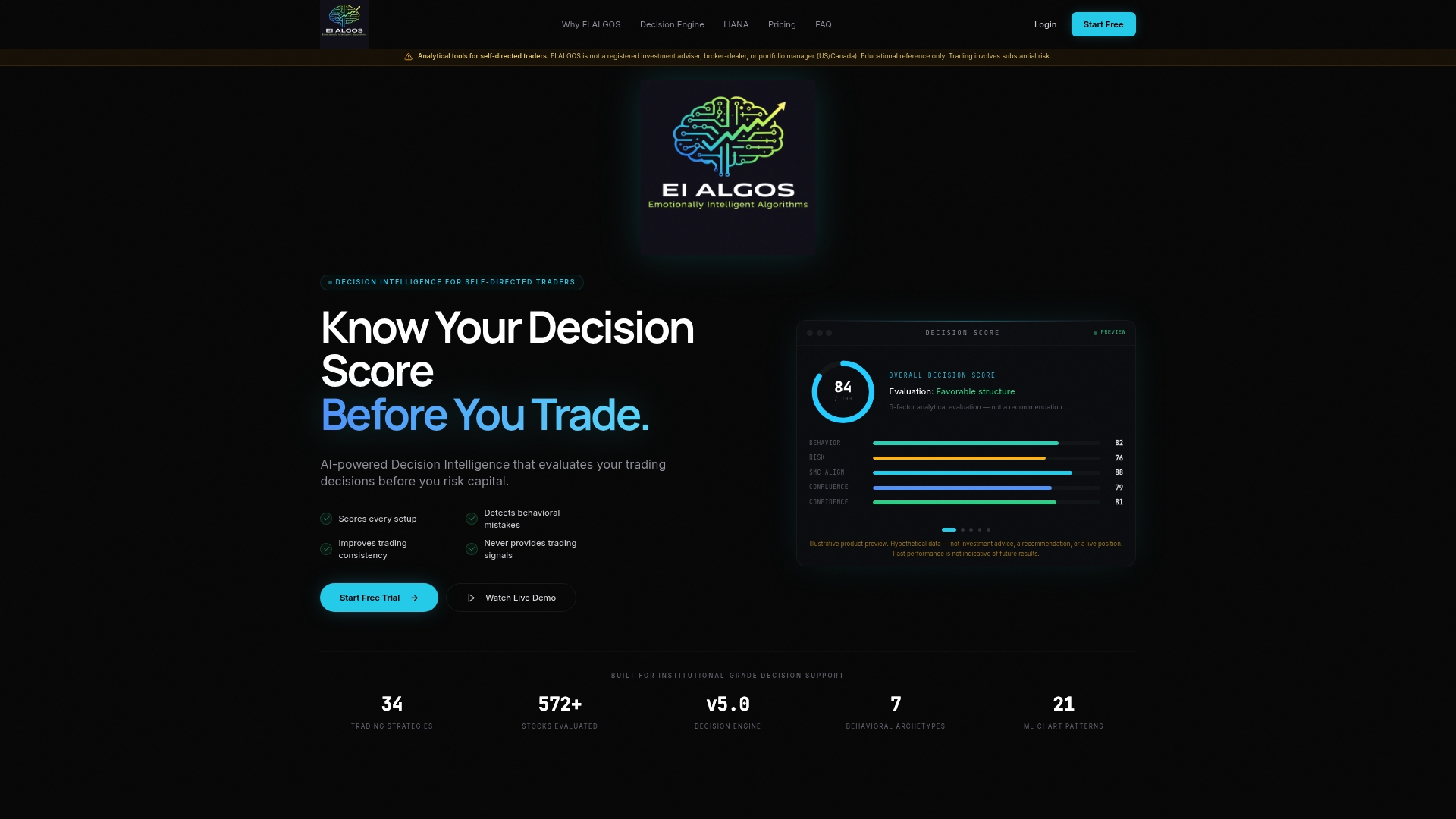
EI ALGOS is built for that moment. Rather than offering signals or market forecasts, the platform scores your trade setup against six behavioral and analytical factors, logs every pre-trade check with a timestamp, and uses the LIANA assistant to surface the specific patterns where your process breaks down. If you consistently override the news-window check or increase size after a winning streak, LIANA identifies it. You get a personalized audit of your own decision-making, not generic coaching.
The platform operates on a free tier with paid upgrades for advanced scoring, unlimited logging, and full LIANA access. There are no trading signals and no recommendations. The only thing EI ALGOS improves is your process.
Start using EI ALGOS and run your first scored checklist today.
Useful sources and tools for implementing your checklist
- Interactive Brokers: Importance of a Trading Checklist — covers the rationale for binary checklist design and error reduction in trading.
- Investopedia: Pre-Market Routine Sets the Stage for the Trading Day — practical guidance on pre-market preparation, index futures review, and news filtering.
- FINRA: Investing Basics — regulatory context for retail traders on risk, broker selection, and account protections.
- Investor.gov: Introduction to Investing — SEC-backed resource for understanding risk management fundamentals.
- Economic calendars: Forex Factory (FX and macro), CME Group economic calendar (futures), and the Federal Reserve's release schedule at federalreserve.gov for FOMC dates.
- Process logging and behavioral scoring: EI ALGOS for timestamped checklist logs, six-factor setup scoring, and LIANA assistant feedback.