
Optimism bias in trading is the habit of rating your own trade as likelier to win, and less likely to hurt, than the evidence supports. It rarely feels like a bias. It feels like conviction. The fix is not pessimism. It is a process that forces the downside onto the page before you click buy, and that scores each setup the same way every time. That is the idea behind how we built EI ALGOS: it scores your decision process instead of predicting the market.
TL;DR
- Optimism bias is overestimating good outcomes and underestimating bad ones, and it operates unconsciously, so you cannot rely on noticing it.
- In trading it shows up as oversized positions, missing or moved stops, thin downside planning and too many trades.
- Research on retail accounts links overconfident, high-turnover trading to lower net returns.
- Two evidence-backed checks help: a premortem and a short written pre-trade checklist.
- A scored, repeatable process makes the checks automatic instead of optional.
Table of Contents
- What optimism bias means
- Optimism bias vs. overconfidence
- Optimism bias examples in trading
- What the research says about cost
- How to counter optimism bias before you enter
- Where a scored process helps
- Our perspective
- FAQ
- Sources
What optimism bias means
The National Cancer Institute's cancer control division defines optimistic bias as the mistaken belief that your chances of a negative event are lower, or a positive one higher, than other people's. It can also mean being overconfident about the objective odds of an event, whatever your peers do.
A peer-reviewed primer on unrealistic optimism splits this into two types:
- Absolute optimism: your own forecast is rosier than the base rate justifies.
- Comparative optimism: you believe you will beat other people.
Traders use both. "This breakout will work" is absolute. "Most people lose, but I won't" is comparative.
Optimism bias vs. overconfidence
The two overlap and feed each other, but they are not identical. Optimism bias is about the outcome you expect. Overconfidence is about how much you trust your own skill, information and judgment. Daniel and Hirshleifer describe overconfidence as a cluster of effects, including overplacement, overprecision and self-attribution bias: crediting wins to talent and losses to bad luck.

In practice, optimism picks the happy ending and overconfidence tells you that you are the one who can deliver it. If you want the overconfidence side in depth, see our piece on why win streaks are statistically dangerous.
Optimism bias examples in trading
These are common patterns, described as behaviors you can check in your own journal.
- The target is specific, the stop is vague. You know exactly where you will take profit. When asked where you are wrong, you say "we'll see."
- Sizing for the good case. Position size is set by what you could make, not by what a stop-out costs.
- Moving the stop. The trade goes against you, and you widen the stop because the setup "still looks good."
- Averaging down on a story. You add to a loser because the thesis is intact in your head, even though price disagrees.
- Reading ambiguous news as positive. A mixed earnings report becomes a reason to hold. Optimists, as one study notes, like to ignore negative information about their holdings.
- Assuming the last good week is the new normal. A hot streak becomes your forecast for next month.
- Options with an assumed payoff. You pick the strike and expiry for the move you hope for and give little weight to time decay or a flat market.
The FINRA Investor Education Foundation report Overcoming Biases to Promote Wise Investing describes people as unrealistically optimistic about future wealth, and making investment choices riskier than they can afford. It also says optimistic overconfidence occurs unconsciously, so investors may not know it is influencing them.
What the research says about cost
The strongest evidence is on overconfident trading, the behavioral cousin of optimism.
- Barber and Odean's study of discount-brokerage accounts found an average round-trip trading cost of about 5.9 percent in their 1987 to 1993 sample. Stocks the households bought underperformed the ones they sold by 3.2 percentage points over one year.
- In the same paper, for 78,000 households from 1991 to 1996, the stocks bought underperformed those sold by 2.35 percentage points over the following 252 trading days. The authors attribute high trading volume to overconfidence.
- Daniel and Hirshleifer summarize that individual investors who trade more typically lose more. In that 78,000-client sample, net returns in every turnover quintile except the lowest trailed an S&P 500 index fund.
- A 2023 study in the Journal of Risk and Uncertainty found that optimism affects risk taking mainly by shifting attention to positive outcomes rather than by distorting probabilities. The more often people looked at the high outcome, the less likely they were to choose the safe payoff.
That last finding is useful. If optimism works through attention, you can counter it by forcing attention onto the downside before you act.
These are historical samples, and your results depend on your own process. The point is the mechanism: when the story in your head gets more weight than the base rate, cost and turnover rise.
How to counter optimism bias before you enter
Run a premortem
Imagine the trade has already failed. Write down why. Then decide what you would change about the plan. Gary Klein's paper on premortems on Wall Street describes the method as working backward from an imagined failure to its causes, and says it can reduce overconfidence. It also warns that a premortem can turn defeatist unless you then act on the weaknesses you found. So do not stop at the list. Turn each failure into a rule: a smaller size, a tighter invalidation level, or a pass.
Spain's securities regulator offers the same pair of checks in its investor guide Behavioural economics for investors: take the opposite view by stating reasons the decision could fail, and imagine it has already failed.
We walk through a trading-specific version in One Trade Premortem.

Use a short written checklist
The same guide recommends a short, personal, updatable pre-investment checklist. Adapted for a trade, it might ask:
- Do I know exactly what I am trading and how it behaves?
- Do I know the risks, in dollars, if I am wrong?
- Does the position fit my plan and my risk limits?
- Is my time horizon consistent with the instrument?
- What would make me exit, and is that level set before I enter?
Keep it to a handful of questions. A checklist you skip because it is long does nothing.
Set the exit before the entry
Decide your stop and your maximum loss before you think about the target. Optimism bias is weakest when the loss is already a number on the screen.
Review in batches, not trade by trade
One trade tells you little. Thirty tell you a pattern: how often your stated confidence matched results, and whether your stops hold. A 30-day behavioral trading analysis is a practical way to run it.
Where a scored process helps
The hard part is that you will not reliably notice the bias in the moment. Checklists and premortems work only if you do them every time, in the same way, including on the trade you are most excited about.
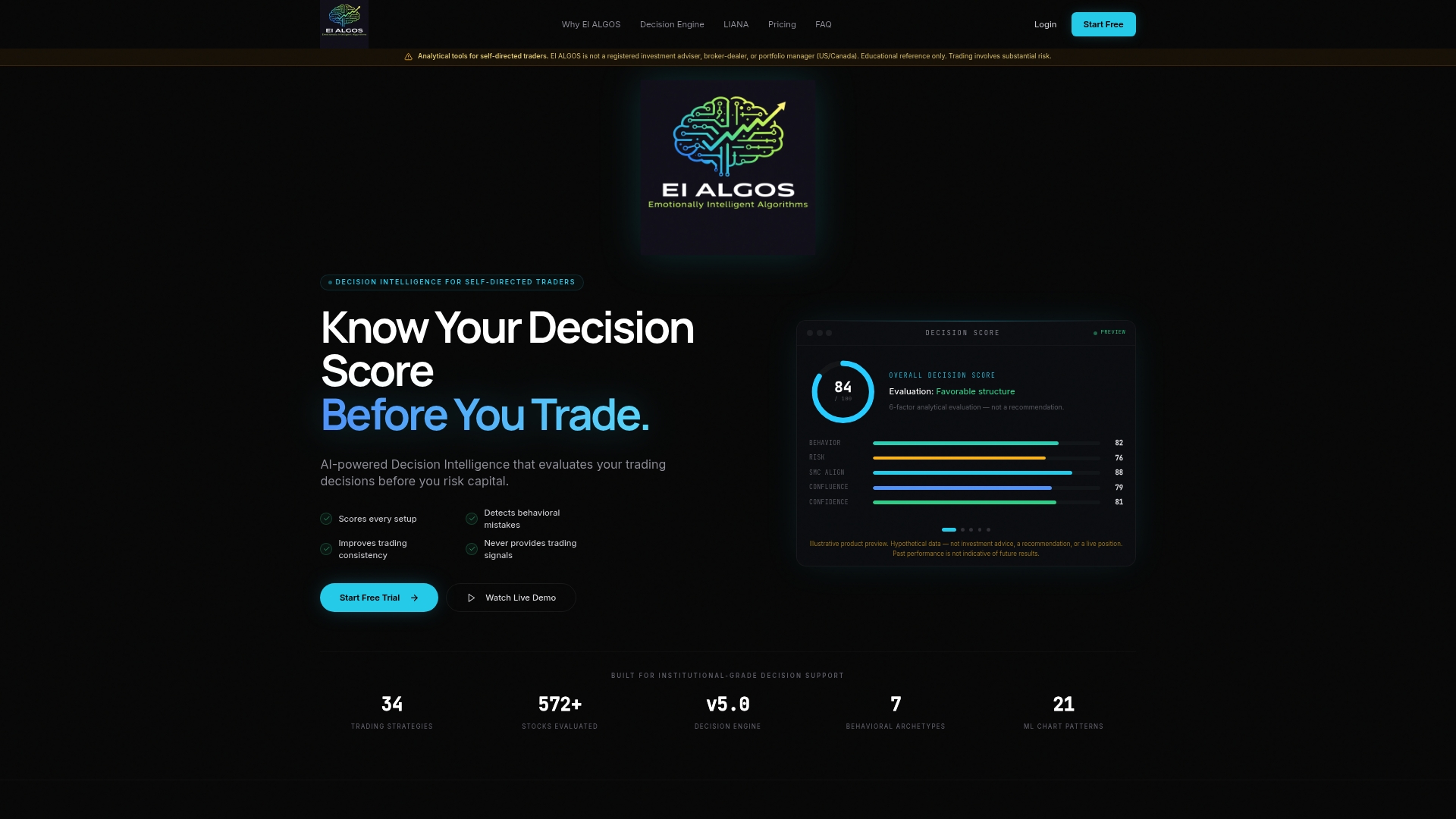
EI ALGOS is a web-based Decision Intelligence platform built around that problem. It does not issue trade signals or predictions. It scores each setup on a six-factor analytical engine that evaluates the behavioral and psychological factors behind the decision, detects behavioral errors, and includes live trade management tools and options analysis. Our LIANA assistant gives personalized feedback on your process based on your own history, so you can see where your habits drift. You can read more about how it works, or about trader behavior analysis.
A free plan is available. Paid plans are Starter at $49 per month, Pro at $129 per month and Elite at $229 per month.
Start on the EI ALGOS plans page and score your next setup before you place it.
Our perspective
Most traders think their problem is finding better entries. In our view the problem is the judgment wrapped around the entry. A signal service hands you someone else's forecast, and optimism bias happily attaches itself to it.
We built EI ALGOS to look at the decision instead: how you sized, where you put the stop, how much you leaned on the good case. Scoring every setup on the same six factors turns the premortem and the checklist from good intentions into a habit you can measure over time.
That is why we focus on process. When you can see your own patterns, optimism stops being a feeling and becomes a data point you can correct.
Anantha
FAQ
Is optimism bias the same as overconfidence?
No, though they travel together. Optimism bias is expecting better outcomes than the odds support. Overconfidence is overrating your own skill and information. Both can lead to oversized positions and excess trading.
Is optimism bad for trading?
Optimism itself is fine, and you need some to take risk at all. The problem is unexamined optimism that replaces base rates and planned exits. Write down the downside first, then trade the plan.
How do I know if I have it?
Look at your journal. If your targets are precise and your stops vague, if you widen stops on losers, or if your average loss is much larger than you planned, optimism is likely at work. Reviewing a batch of trades shows this better than any single one.
Is normalcy bias the same thing?
No. Normalcy bias is assuming things will keep going as they always have and underreacting to a threat. Optimism bias is expecting a better result than the evidence supports. They can combine, for example when you assume a calm market will stay calm.
Sources
- Optimistic Bias, National Cancer Institute
- A Primer on Unrealistic Optimism
- Overconfident Investors, Predictable Returns, and Excessive Trading
- Overcoming Biases to Promote Wise Investing
- Barber and Odean, Trading Is Hazardous to Your Wealth
- On the psychology of the relation between optimism and risk taking
- The Misuse of Premortems on Wall Street
- Behavioural economics for investors, CNMV