
A pre-mortem imagines a trade has already failed and asks why, before you've risked a dollar. Instead of forecasting what might go wrong, you reframe the question in the past tense: "This position failed. What happened?" That shift surfaces specific, concrete failure modes instead of vague worry, and it directly informs how you size, hedge, or add checks before entering. Run one for 5 to 20 minutes before your next meaningful position.
TL;DR:
- Run the exercise after building your thesis but before sizing or execution, allowing two minutes of private writing before round robin discussion.
- Research on prospective hindsight found that treating an outcome as settled increased accurate identification of its causes by about 30%, compared with ordinary prediction.
- Rank each failure mode by probability and impact, then assign an owner, measurable check, and specific exit trigger before placing the trade.
- A 15% chance of a 30% position loss implies 4.5% expected loss; halving position size reduces that figure to roughly 2.25%.
Table of Contents
- What a pre-mortem is and why it works
- Why pre-mortems matter for trading decisions
- How to run a pre-trade premortem step by step
- Common premortem mistakes and how to avoid them
- Templates you can copy right now
- Turning premortem findings into measurable trading signals
- A note on actually using what you find
- Put your premortem findings to work
- FAQ
- Sources
What a pre-mortem is and why it works
A pre-mortem is a structured exercise where you treat a future failure as an already-completed fact, then work backward to explain it. The mechanism behind it is called prospective hindsight: when people imagine an outcome has definitely happened, they generate more specific, concrete reasons than when asked to simply predict what could go wrong. Gary Klein formalized this into a practical protocol in his Harvard Business Review piece, where a leader announces the failure as settled, team members write privately, then share in a round-robin.
The research behind this is strong enough to change how you approach any high-stakes decision.
- Framing failure as fact, not possibility, produces sharper answers than asking "what could go wrong?"
- Private writing before group discussion prevents the loudest voice from anchoring everyone else's thinking.
- A short, structured session beats an open-ended worry list for generating usable failure modes.
A foundational study found that imagining an outcome has already occurred increases correct identification of the reasons for that outcome by about 30%, according to research on prospective hindsight. That's the evidence base the entire technique rests on.
Why pre-mortems matter for trading decisions
Trade theses rarely fail for the reason you spent the most time researching. They fail because of something you glossed over: a correlation that held for years until it didn't, an earnings date you forgot was two days after entry, a thin order book that turned a small position into a slippage problem, or a regime shift that quietly broke your backtest's assumptions.
A pre-mortem forces you to name these before they cost you money, not after.
- Correlation breaks: the hedge you're counting on moves with your position instead of against it.
- Corporate events: earnings, dividends, or index rebalancing you didn't check before sizing.
- Liquidity windows: a position that's easy to enter but expensive to exit under stress.
- Regime changes: the volatility or rate environment shifts and your edge quietly disappears.
Beyond spotting risks, the exercise has a behavioral payoff: it legitimizes dissent. On a trading desk or in a solo checklist, stating failure as fact gives you permission to argue against your own conviction without it feeling like self-sabotage. Each discovered failure mode then maps to a concrete fix: smaller size, a specific hedge, an added pre-trade check, or a hard stop tied to a trigger you named in advance.
How to run a pre-trade premortem step by step
Run this after you've built your thesis and plan, but before you size or execute. That sequencing matters: a premortem run too early has nothing concrete to critique, and one run after execution is just a post-mortem with extra steps.
Solo or team version (10 to 30 minutes):
- Set a horizon. Pick a window, say one to six months, and state it out loud or in writing.
- State the failure as fact. Write: "It's now [date]. This trade lost money or hit its stop. Why?"
- Write privately for two minutes. No discussion yet, just your own list of reasons.
- Share round-robin, leader first. Going first with your own answer signals that naming real risks is safe, not a sign of weak conviction.
- Run a two-minute action round. For each failure mode raised, ask what you'd do differently right now.
- Prioritize and assign owners. Rank items by how likely and how costly they are, and decide who checks what before entry.
Once you have a prioritized list, convert it into numbers. Think in terms of probability multiplied by impact: a failure mode with a meaningful chance of happening and a large potential loss deserves a smaller position, a defined hedge, or a monitoring check, not just a mental note. Translate the riskiest items into kill criteria: a price level, a news event, or a data release that, if it happens, ends the trade regardless of how you feel about it that day.
Pro Tip: Write your kill criteria as a specific trigger, not a feeling. "Exit if the 50-day average breaks" works. "Exit if I get nervous" doesn't.

Common premortem mistakes and how to avoid them
The protocol only delivers its benefits when it's run correctly, and documented critiques of premortem misuse on Wall Street show how often it gets diluted into a box-checking exercise.
- Soft framing. Asking "what could go wrong?" invites generic hedging instead of specific failure modes. Fix: state the failure as an accomplished fact, in the past tense, before anyone speaks.
- Leader domination. If the most senior voice shares first or shapes the discussion, everyone else just agrees. Fix: the leader writes first to set the tone, but shares in turn, not out of turn, and private writing time is enforced for everyone.
- No follow-through. A list of risks that never becomes an action is just a worry session. Fix: before execution, every identified failure mode gets an owner, a trigger, and a measurable check tied to it.
Skipping the follow-through step is the single most common way traders waste the exercise entirely.
Templates you can copy right now
Use these as-is. The point is to lower the friction to running one, not to design a perfect session.
- Solo 5-minute checklist. State the failure as fact, write three reasons it happened, pick the single most likely one, and decide your size or stop based on that answer alone.
- Team 20-minute script. Leader says: "This position is now closed at a loss. Write down why, privately, for two minutes." Then go around the room, leader first, followed by a two-minute actions round per person.
- Worked sizing example. Say a premortem surfaces a failure mode with a 15% chance of happening and a 30% loss if it does. That's an expected loss of 4.5% of the position. Cutting your position size in half cuts that expected loss to roughly 2.25%, a direct, quantifiable benefit from the exercise alone.
For readers whose premortem surfaces macro-level risk such as currency or policy uncertainty, a broader economic uncertainty checklist can help frame those risks alongside your trade-specific ones.
Turning premortem findings into measurable trading signals
A premortem gives you a list of words. Turning that list into a number you can act on is a separate step, and it's where most traders stop too early.
- A structured scoring system can convert qualitative failure modes, like "this correlation might break," into a measurable factor you track across every setup.
- Logging premortem findings in a decision journal, tagged by failure mode, lets you see which risks you actually predicted correctly over time.
- Setting an automated alert tied to a specific trigger removes the need to remember your own kill criteria under pressure.
A platform with a six-factor analytical engine can evaluate the behavioral and psychological patterns behind a setup rather than forecasting price, making it a natural place to log what a premortem surfaces and watch for it recurring. An AI assistant then helps connect that pattern back to your own trading history over time.
A note on actually using what you find
I'd rather see a trader run a messy five-minute premortem before every meaningful position than a polished one once a quarter. The exercise is worthless if the failure modes it surfaces don't change your size, your hedge, or your stop. Write the list, then act on it before you place the trade, not after.
— Anantha
Put your premortem findings to work
Knowing your failure modes and acting on them are two different habits, and the second one is harder to build alone. We built EI ALGOS as a Decision Intelligence platform specifically for self-directed traders who want to turn what a premortem surfaces into something they track and check automatically, rather than a note that gets forgotten by the next trading day.
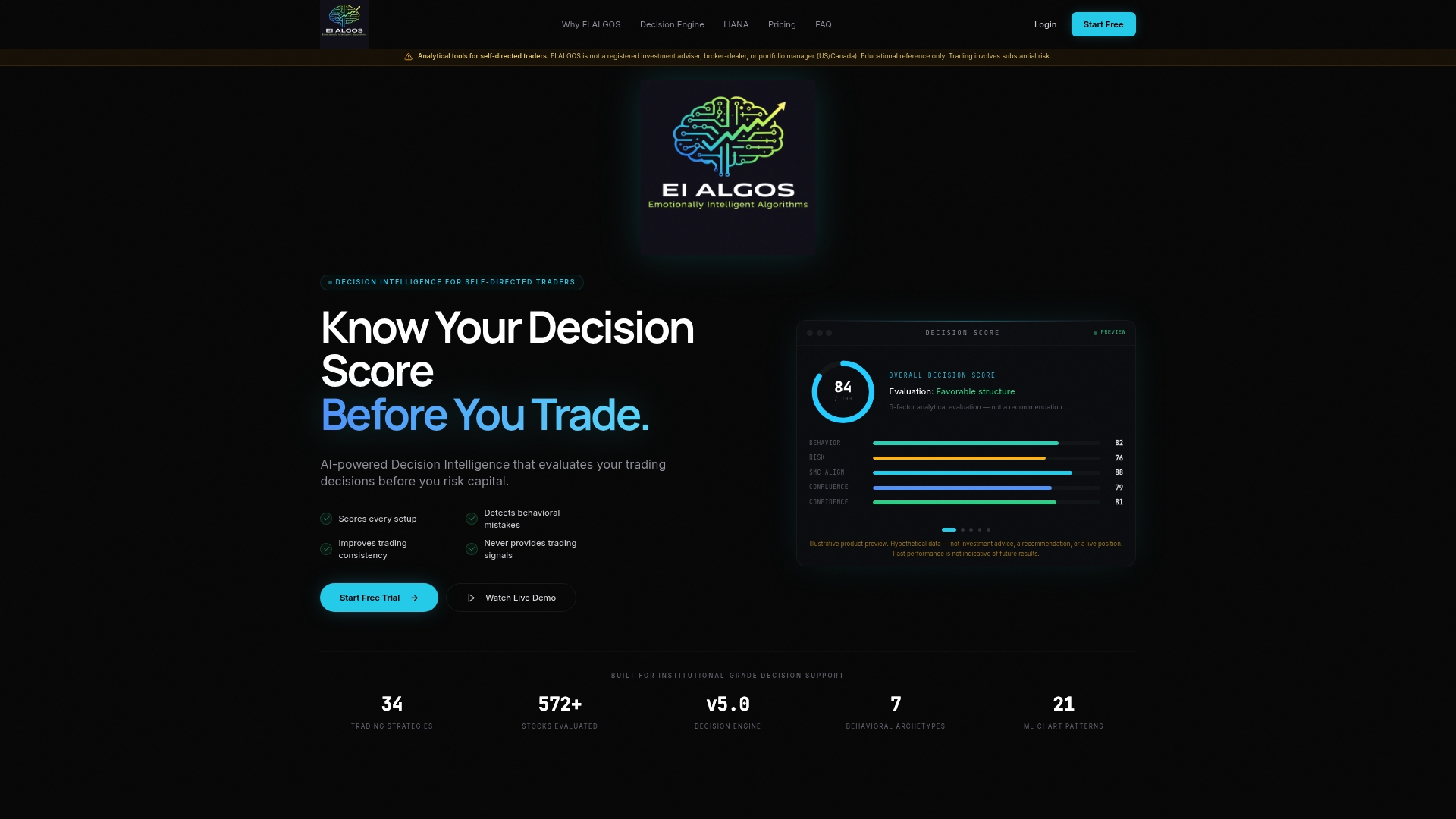
Instead of generating trade signals, such a platform scores each setup across behavioral factors, flags patterns tied to past mistakes, and uses an AI assistant to walk users through what's driving their decisions. If a premortem uncovers a recurring failure mode, it can be logged and flagged the next time the pattern shows up.
| Plan | Price | Fits |
|---|---|---|
| Free | $0 per month | Trying the platform and logging first premortem findings |
| Starter | $49 per month | Traders building a consistent review habit |
| Pro | $129 per month | Active traders wanting deeper behavioral scoring |
Start on our free plan and see what your own trading patterns reveal.
FAQ
What does "pre-mortem" mean?
A pre-mortem is an exercise where you imagine a decision has already failed and work backward to explain why, before you've committed resources. The past-tense framing, known as prospective hindsight, produces more specific and useful reasons than simply asking what might go wrong.
What is a pre-mortem strategy?
A pre-mortem strategy applies this exercise to a specific decision, like a trade, by setting a time horizon, stating the failure as fact, and generating concrete failure modes before execution. The strategy only works when those failure modes get converted into real actions, like smaller size or a defined stop.
How to run a pre-mortem session?
Set a horizon, state the failure as an accomplished fact, have everyone write privately for a couple of minutes, then share round-robin with the leader going first. Follow with an actions round where each failure mode gets an owner and a trigger, based on the protocol described in Gary Klein's original framework.
What are common premortem mistakes?
The most common mistakes are soft framing ("what could go wrong?" instead of stating failure as fact), a leader who dominates the discussion instead of writing first and then listening, and a lack of follow-through that leaves the exercise as a list nobody acts on. Documented critiques of premortem misuse show these errors are common even among experienced teams.