
Confirmation bias in trading is the habit of favoring information that supports a position you already hold, while dismissing evidence that contradicts it. It quietly erodes P&L by keeping you in losing trades, blinding you to exit signals, and turning research into cheerleading. The single most useful fix is mechanical: before you click buy or sell, write down your invalidation level and submit a real stop order.
TL;DR:
- Writing and signing a clear invalidation level before entering a trade is essential to counteract confirmation bias and enforce discipline.
- Relying on mechanical stop orders prevents emotional decision-making and stops bias from influencing exit points.
- Limiting information sources to credible opposing views and regularly auditing ignored signals reveal bias patterns and improve decision accuracy.
- Automated rules help reduce execution bias but do not address hypothesis and parameter selection, which still need mindful oversight.
- Persistent confirmation bias during momentum moves or earnings reports often causes traders to dismiss warning signs, leading to costly reversals.
Table of Contents
- How Confirmation Bias in Trading Shows Up in Real Decisions
- Why the Error Locks In: Overconfidence, Loss Aversion, and Stress
- A Priority Protocol for Pre-Trade and In-Trade Discipline
- What to Track in a Trading Journal to Reveal Bias Patterns
- Where Automation Helps and Where Bias Still Hides
- How EI ALGOS Applies These Ideas to Everyday Trades
- Where Confirmation Bias Comes From in the Brain
- How Confirmation Bias Undermines Risk Management and Diversification
- Real Trading Scenarios Where Confirmation Bias Cost Money
- Mindfulness, Peer Review, and Other Behavioral Safeguards
- Why Market Sentiment and News Feed the Same Bias
- An Editorial Take: Progress Over Perfection
- Explore EI ALGOS for Structured Decision Scoring
- Sources
- FAQ
How Confirmation Bias in Trading Shows Up in Real Decisions
Confirmation bias rarely announces itself. It hides inside routines that feel like normal research.
- Timeframe cherry-picking. You go long, then flip to the daily chart because the hourly chart just turned red. The trend didn't change. Your window did.
- The echo chamber after entry. Once positioned, you gravitate toward bullish Twitter threads, bullish analyst notes, bullish subreddit posts. Bearish takes get skimmed and dismissed as "noise."
- Exit drift. The stop you planned at $48 quietly becomes $46, then $44, because each new low "makes sense" once you've decided the thesis still holds.
- Comfort research during a losing trade. Instead of checking your invalidation trigger, you search for reasons the trade is still good. That's not analysis. That's reassurance-seeking dressed up as diligence.
Trading psychology research describes this pattern precisely: after opening a long position, traders tend to seek out bullish analysis and downweight bearish signals, even when the bearish signals arrived first. The bias doesn't just affect which information you read. It changes how much weight you give information you already have, which is why two traders looking at the same chart can reach opposite conclusions and both feel certain they're right.
Why the Error Locks In: Overconfidence, Loss Aversion, and Stress
Confirmation bias rarely operates alone. It's reinforced by a cluster of biases that feed each other, which is part of why it's so hard to self-correct in real time.
A winning streak breeds overconfidence, and overconfident traders search less and confirm more. Recent research links overconfidence and confirmation bias directly, showing how the two amplify each other and produce worse decisions than either bias alone would cause. Loss aversion adds a second layer: because losses hurt more than equivalent gains feel good, traders delay exits and sometimes add to losing positions rather than accept the loss outright. That's the sunk-cost trap working alongside confirmation bias, not instead of it.
Stress narrows attention further. Under pressure, the brain defaults to familiar narratives rather than fresh analysis, which is why the same setup that looked risky on a calm Tuesday suddenly looks fine during a volatile Friday close. Memory compounds all of it. Traders tend to recall their winning calls more vividly than their losing ones, which reinforces a false sense of being right more often than the record shows.
A Priority Protocol for Pre-Trade and In-Trade Discipline
Reducing bias isn't about willpower. It's about removing the moments where willpower is required. Here's the order that matters most, based on where bias does the most damage.
- Write the full thesis before entry. Document the bull case, the bear case, and the specific price or event that invalidates the trade. Date it and sign it, literally. A thesis without a written invalidation trigger isn't a plan, it's a hope.
- Submit a physical stop-loss order immediately after entry. Mental stops get negotiated with in real time. A working order in the market doesn't care how you feel. Record your position size in R (risk units) before you enter, not after.
- Install a bias circuit breaker. The moment you catch yourself searching for reassurance mid-trade, stop. The only question worth asking is whether price has hit your invalidation trigger. If it hasn't, hold. If it has, exit. No new research allowed.
- Limit your information diet. Read one credible opposing view every day, on purpose. Resist the urge to re-run backtests mid-session just to feel better about a position already open.
- Log ignored signals right after the trade closes. While it's fresh, write down what warning signs you noticed and dismissed. This single habit does more to expose confirmation bias in trading than almost anything else on this list.
Pro Tip: Keep your invalidation trigger and your stop order at the exact same price. Any gap between the two is where confirmation bias slips back in.
Practical mitigations like written pre-trade notes and enforced stop-loss discipline consistently reduce the measurable impact of cognitive bias on trading outcomes, and a process-oriented framework makes each of these steps repeatable instead of aspirational.
What to Track in a Trading Journal to Reveal Bias Patterns
A journal only exposes bias if it captures the right fields, recorded at the right moment.
- Date and time, instrument, and timeframe used for the setup
- Written thesis, entry trigger, and invalidation trigger
- Stop level expressed in R, plus position size
- Sources read before and during the trade
- Emotional state at entry and at exit
- Post-trade notes, including any signal you noticed and ignored
R-multiples matter because they normalize outcomes across different position sizes, letting you see whether your average loser is bigger than your average winner regardless of how much capital was at risk. A trading journal built around consistent fields turns vague self-assessment into comparable data.
Review weekly, and run a deeper bias audit monthly. Track your average number of ignored signals per trade and the percentage of trades where the stop got moved after entry. If either number climbs, that's a red flag demanding a process change, not more willpower.
Where Automation Helps and Where Bias Still Hides
Automated rules remove the temptation to move a stop mid-trade, which is real progress. But automation doesn't remove bias. It relocates it upstream, into hypothesis selection and parameter tuning.
A backtest built by someone convinced a strategy works will often get curve-fit until it confirms exactly that. Automation reduces execution-level bias but can hide design-level bias behind a clean equity curve. The safeguards that actually work: pre-register your backtest specs before running them, hold out a genuine out-of-sample period you don't touch during development, get a second set of eyes on the code, and keep a dated log of every model change and why you made it.
Treat backtest results as suggestive until they survive out-of-sample data and independent review. Treat them as actionable only after that.
How EI ALGOS Applies These Ideas to Everyday Trades
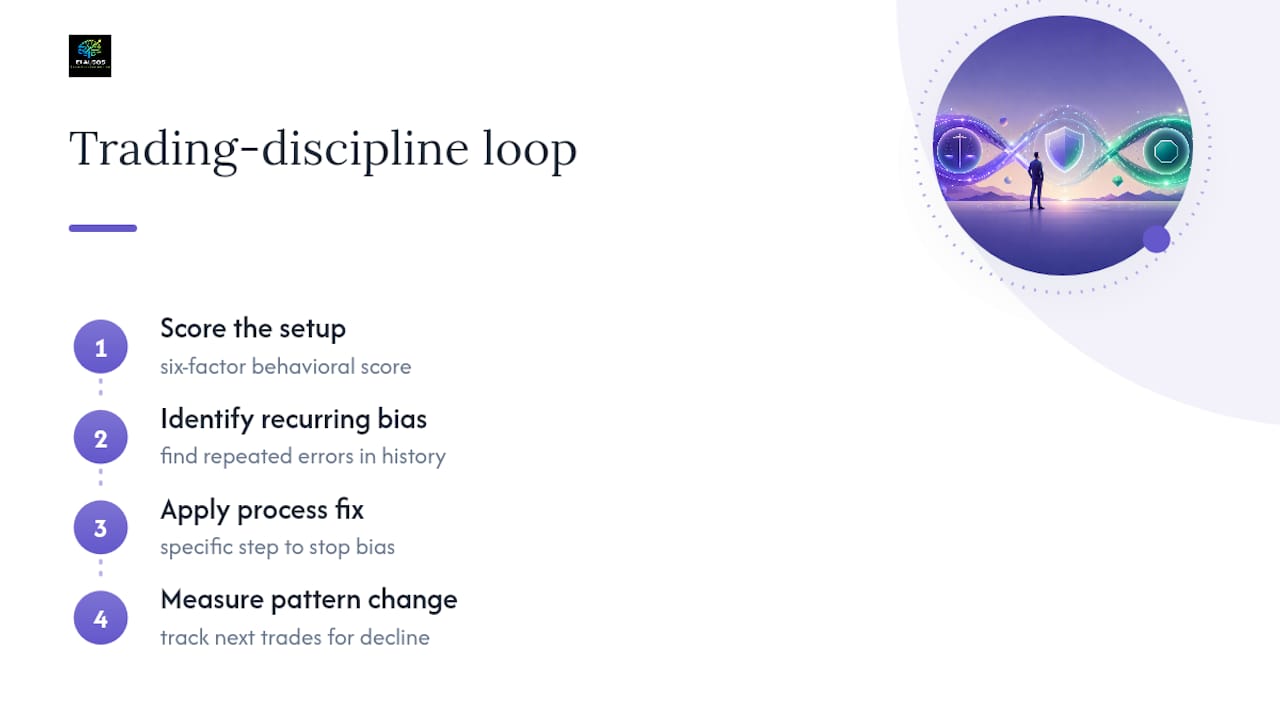
Eialgos built its platform around a straightforward idea: score the decision, not just the outcome. Its six-factor analytical engine evaluates a setup across behavioral dimensions, surfacing patterns like repeated late exits or a habit of skipping invalidation checks, the same errors a manual journal exposes but often too slowly.
The LIANA assistant turns that scoring into personalized feedback, flagging recurring mistakes across trade histories rather than making individual trade recommendations. The typical flow: score the setup, identify which bias keeps recurring, apply a specific process fix, then measure whether the fix actually reduced the pattern over the next set of trades. It's a way to make scoring every trade concrete rather than something you meant to do but never got around to.
Where Confirmation Bias Comes From in the Brain
Confirmation bias isn't a trading-specific flaw. It's a general feature of how human cognition manages uncertainty. The APA's definition describes it as the tendency to search for, interpret, and recall information in ways that confirm existing beliefs, a pattern documented across decision-making generally, not just markets.
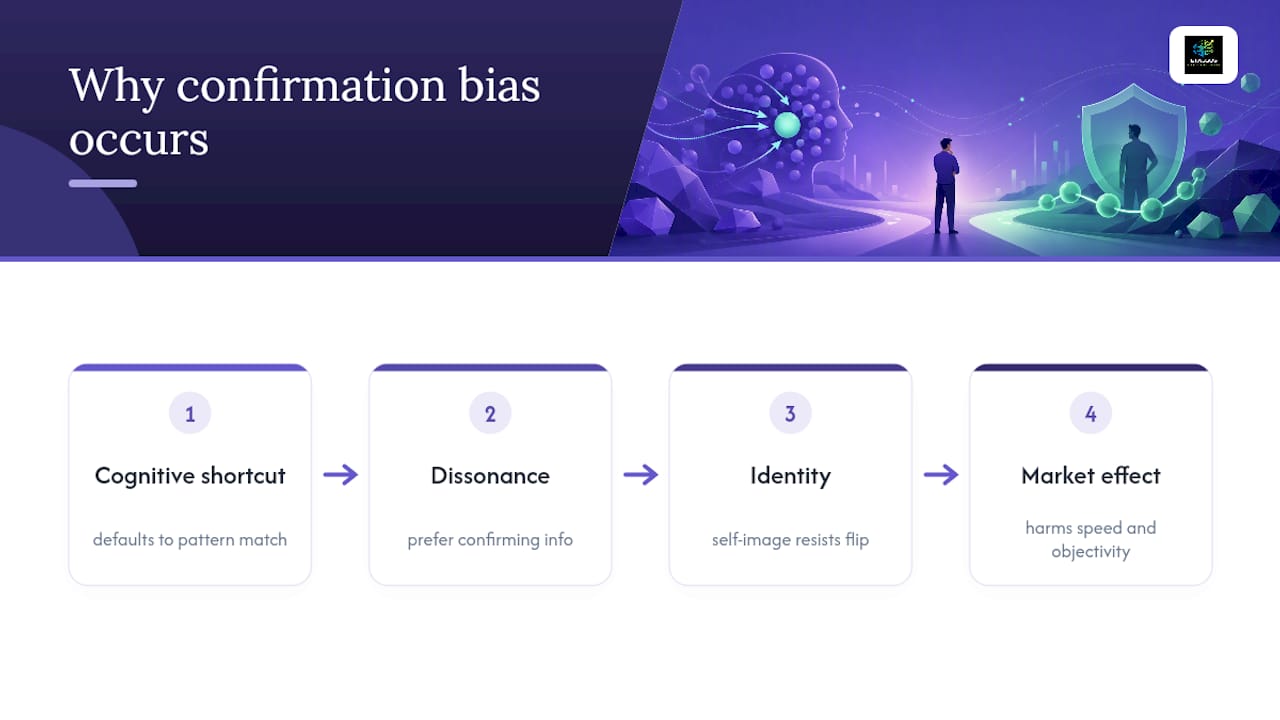
The mechanism traces back to cognitive efficiency. Evaluating every new piece of information from scratch is expensive for the brain, so it defaults to pattern matching against what you already believe. That shortcut works fine for low-stakes decisions. In trading, where speed and objectivity both matter, it becomes a liability, because the market has no obligation to confirm anything you believe about it.
Dissonance plays a role too. Holding two conflicting ideas at once (my trade is losing, but my thesis was correct) creates psychological discomfort. The easiest way to resolve that discomfort isn't to update the belief. It's to find evidence that makes the discomfort go away, even if that evidence is thin. This is why traders often describe a losing position using more analytical language than a winning one; they're not just tracking price, they're managing the tension between the position and the ego attached to it.
Identity fuses into this quickly. A trader who has publicly stated a bullish view, even just to themselves in a journal entry, now has a self-image tied to being right. Reversing course doesn't just mean closing a trade. It means admitting an error, which the brain resists by default, and that resistance is precisely what confirmation bias exploits.
How Confirmation Bias Undermines Risk Management and Diversification
Confirmation bias doesn't just distort individual trades. It corrodes the two structural defenses meant to protect a portfolio when a single trade goes wrong: risk limits and diversification.
Risk management depends on treating your stop-loss as a fixed constraint, not a suggestion. Confirmation bias attacks that constraint directly by supplying a steady stream of reasons why "this time is different" and the stop should move. Once a trader accepts one such exception, the next one comes easier, and risk management stops functioning as a system and starts functioning as a negotiation.
Diversification suffers a subtler version of the same problem. Traders convinced of a particular macro thesis (rates are heading lower, a sector is about to break out) tend to build correlated positions that all express the same underlying bet, even when the position labels look diversified on paper. Five different tickers tied to the same interest-rate thesis aren't five independent risks. They're one risk, sized five times over, because confirmation bias filtered out the setups that would have argued against that thesis.
The interaction compounds during drawdowns. A portfolio built on confirmed beliefs rather than genuinely independent positions loses across the board at once, right when capital preservation matters most. Traders who track correlation across their open positions, not just direction, catch this pattern before it costs real money rather than after.
Real Trading Scenarios Where Confirmation Bias Cost Money
Confirmation bias tends to show up most visibly during momentum phases, when a rising or falling market provides a constant stream of evidence that appears to confirm whatever a trader already believes.
Consider a trader who buys a stock breaking out to new highs on strong volume. The initial thesis is sound. But as the stock keeps climbing, the trader starts dismissing every warning sign, an RSI reading in extreme territory, a slowing rate of advance, insider selling reported in a filing, because each one individually seems minor next to the larger trend. By the time the reversal comes, the trader has accumulated a mental list of reasons the pullback is "just noise," reasons manufactured specifically to preserve the original thesis rather than test it.
A second familiar pattern involves earnings season. A trader holds a position into an earnings report expecting a beat, based on channel-check chatter and bullish analyst previews. When the report comes in mixed, the trader searches the transcript specifically for the one sentence that sounds encouraging, ignoring the guidance cut two paragraphs later. The position gets held, then added to on the post-earnings dip, based on a read of the report that a neutral observer would not recognize as balanced.
Neither scenario requires a dramatic market event. Both require nothing more than a trader who had already decided the answer before the new information arrived, and who used that information to defend the decision rather than test it.
Mindfulness, Peer Review, and Other Behavioral Safeguards
Mechanical rules like stop orders and invalidation triggers handle the moments when bias tries to override a decision already made. Behavioral practices handle the moments before that, when bias is still forming.
A short mindfulness pause before entering a trade, even thirty seconds of noticing your emotional state, creates enough distance to ask whether you're trading the setup or trading your attachment to being right about it. That distance is where the bias circuit breaker described earlier actually becomes usable in practice, rather than just a good idea on paper.
Peer review works for a different reason: it introduces a person with no emotional stake in your position. Sharing your thesis, including your invalidation trigger, with another trader before you enter forces you to articulate the bear case out loud, not just acknowledge it exists in a private journal entry. Traders who do this consistently report catching flawed theses earlier, simply because explaining a weak argument to someone else is harder than convincing yourself of it silently.
Periodic audits of your own decision logs serve the same function on a longer timescale. Reading three months of journal entries in one sitting reveals patterns invisible trade by trade, like a tendency to abandon stops specifically on Fridays, or a pattern of comfort-searching only after third losing trades in a row. These behavioral layers don't replace the mechanical protocol. They catch what the protocol alone would miss.
Why Market Sentiment and News Feed the Same Bias
Financial news and social sentiment don't create confirmation bias, but they supply it with an almost unlimited amount of raw material. Fear, greed, and FOMO drive crowd behavior in markets, and a trader already leaning bullish or bearish can always find a headline, a tweet, or an analyst note that appears to validate that lean, regardless of which direction the market actually moves next.
The mechanism is selective exposure combined with selective interpretation. A trader scrolling financial news after opening a position isn't reading neutrally. They're scanning for validation, and algorithmic feeds on social platforms make this worse by learning what a user engages with and serving more of the same. A trader who clicks on bullish content gets shown more bullish content, which starts to feel like a market consensus even when it's really just a personalized echo chamber built by an engagement algorithm.
Group sentiment compounds it further. When a large number of traders hold the same position, the volume of confirming commentary increases, which makes the thesis feel more validated even though crowd size says nothing about whether the thesis is correct. This is part of why the most crowded trades often see the sharpest reversals: the confirming noise was loudest exactly when the underlying support was thinnest. Treating a wall of agreement as evidence, rather than as a lagging indicator of a trade that's already crowded, is one of the more expensive versions of confirmation bias in trading.
An Editorial Take: Progress Over Perfection
Bias management isn't a switch you flip. It's a practice you repeat, and the honest goal is reducing frequency and severity, not claiming you've eliminated confirmation bias from your trading entirely. Fewer moved stops this month than last month is real progress, even if it's not dramatic. Cleaner journal entries count too. Build in peer review and a periodic audit of your own decision logs, because the patterns you can't see in a single trade tend to be obvious across thirty.
— Anantha
Explore EI ALGOS for Structured Decision Scoring
The checklist and journaling habits above work best when something is actually tracking whether you're following them. That's the gap Eialgos fills: a Decision Intelligence platform that scores each trade setup across six behavioral factors, rather than handing you another price forecast to second-guess.
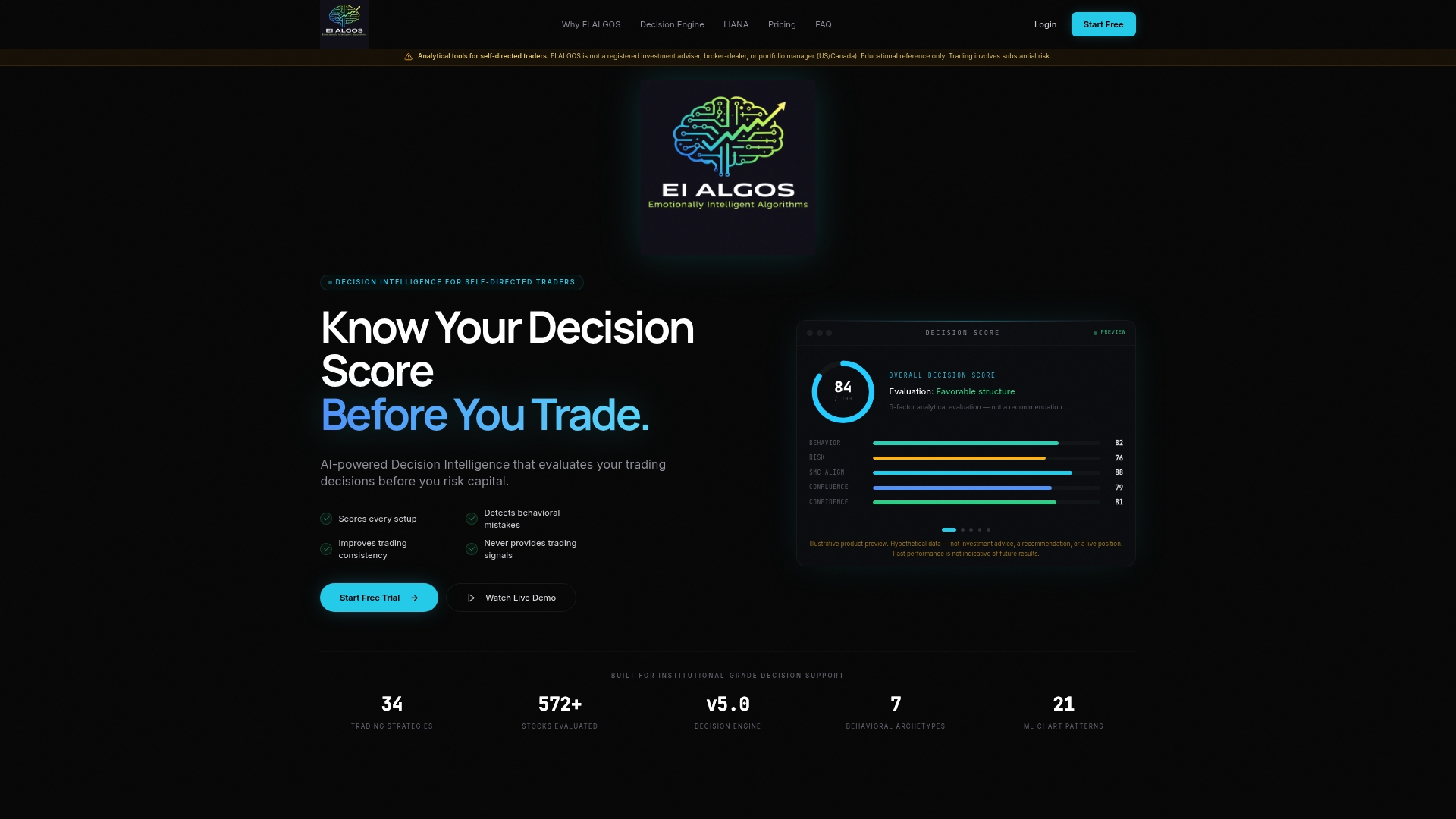
Instead of another signal service telling you what to trade, the platform evaluates how you're deciding to trade it, catching the same exit drift and comfort research patterns covered above before they repeat for the tenth time. The LIANA assistant turns your history into specific, personalized feedback, and the Knowledge Hub walks through the behavioral concepts behind the scoring in plain language. If you want to see your own decision score before your next trade, the subscription plans start with a free tier, no trading outcomes promised, just a clearer look at your own process.
Sources
For deeper background on the concepts covered here, Investopedia's overview of trading psychology and Britannica's explanation of market sentiment drivers are strong starting points. The APA Dictionary offers the formal cognitive-science definition, and Capital.com's guide to cognitive bias covers practical mitigation steps in more depth.
This article is general information, not a substitute for advice from a qualified financial advisor. Consult a qualified financial professional about your own circumstances before acting on anything here.
FAQ
What Is a Good Example of Confirmation Bias in Trading?
A trader who buys a stock and then only reads bullish analyst notes while ignoring a guidance cut in the same earnings report is a textbook example: the search for information becomes a search for validation.
Why Do Most Day Traders Lose Money?
Most losses trace back to a mix of behavioral errors, including confirmation bias, overconfidence after early wins, and poor risk management like moving stops, rather than a single bad strategy; research links overconfidence and confirmation bias as compounding drivers of these losses.
Can AI Tools Like ChatGPT Show Confirmation Bias?
Yes, in the sense that a large language model can reflect the framing of the question asked, so a trader who asks a leading question searching for validation is likely to receive an answer that echoes that framing back, which is why tools built to score decisions objectively, like Eialgos, take a different approach than general-purpose chat assistants.
How Do I Start Overcoming Confirmation Bias in My Trading?
Start with one written invalidation trigger per trade, backed by a real stop order, and log every ignored signal in a journal immediately after the trade closes.