
Availability bias is the habit of judging how likely something is by how easily an example comes to mind. In trading, that means last week's crash, yesterday's big winner or the headline you just read gets more weight than the full record of how often such events happen. The fix is to replace memory with data: log every setup, review the whole sample, and check each decision against a fixed process. EI ALGOS is built around that idea, scoring each setup on a six-factor engine so a vivid memory is not the deciding input.
TL;DR
- Availability bias means treating easy-to-recall events (recent, vivid, heavily reported) as more probable than the data says.
- US investor surveys found people put the chance of a severe crash far above the historical rate, with a median estimate near 10% over six months against about 1.7% historically.
- Typical trading forms: fearing a crash after a loss, chasing the asset everyone is talking about, and overrating a strategy because of one memorable win.
- The correction is structural: a written checklist, a full-sample review, and a base rate for every claim you act on.
- EI ALGOS scores setups on a six-factor engine and does not issue signals, so you see your own process rather than someone's forecast.
Table of Contents
- What availability bias is
- Why markets make it worse
- What the research shows about crash fear
- Availability bias examples in trading
- How availability bias differs from similar biases
- How to spot it in your own trading
- A practical routine to reduce availability bias
- A worked example: the same setup, two reviews
- Where a decision-intelligence platform fits
- Perspective
- Try it on your own trades
- FAQ
- Sources
What availability bias is
The availability heuristic is a mental shortcut. When you need to estimate how likely something is, your mind searches for examples. If examples come quickly, the event feels common. If they come slowly, it feels rare. The shortcut is useful in daily life, but it misfires when the examples that come to mind are not a fair sample.
Academic work on investors defines it the same way: the probability of an event is estimated from how easily related examples come to mind, not from complete base-rate evidence. A base rate is simply how often something actually happens across a large sample, such as how often a breakout holds or how often the market falls 10% in a day.
The CFA Institute's 2026 reading on individual behavioral biases classifies availability as an information-processing bias. The idea: people use mental shortcuts in complex decisions, and those shortcuts can lead to suboptimal financial outcomes. That is a useful framing for a trader. The problem is not emotion alone. It is a processing error in how you weigh evidence.
Why markets make it worse
Trading is nearly a perfect environment for this bias, for three reasons.
- Markets produce vivid events. Gaps, halts, limit-down days and 300% squeezes are memorable. The thousands of ordinary sessions are not.
- You see results in real time. The most recent trade or news item is always the freshest memory, and fresh feels frequent.
- Media and social feeds select for the dramatic. What is repeated gets recalled, and what is recalled feels likely.
Your own trade history adds a fourth. You remember the trade where you sold too early and the stock doubled. You forget the nine times selling early was right. Your memory is a highlight reel, not a ledger.
What the research shows about crash fear
The cleanest evidence comes from a long-running series of US investor surveys. In research by Goetzmann, Kim and Shiller, respondents assessed the probability of a severe one-day market crash much higher than the data supported. The median estimate was 10% for a crash on the scale of Black Tuesday or Black Monday within six months. The historical likelihood was 1.7%.
Yale's write-up of the same work puts it in annual terms: the historical chance of a massive crash in any given year was about 2%, while investors' six-month estimates were closer to 10%.
The same summary reports what moved those estimates. Negative financial coverage raised perceived crash risk, and so did a moderate earthquake nearby, which has nothing to do with markets. The survey period covered 1989 to 2015, so these are findings about how people judge risk, not a forecast about any particular month.
For a trader, the lesson is practical. If surveyed investors overestimate tail events by roughly five times, your gut feeling after a scary week is not a measurement. It is a recall effect.

Availability bias examples in trading
The examples below are illustrative scenarios, not case studies of real accounts. Each shows the pattern so you can spot it in your own log.
After a loss, you avoid the next valid setup
You take a stop-out on a gap-down breakout failure. The next week a clean setup of the same type appears, with the same rules, and you skip it. The loss is vivid, so failure feels like the typical outcome. If your history shows that setup works 55% of the time at a positive expectancy, skipping it is a decision made by memory, not data.
After a win, you oversize
You catch a fast 15% move in an options position. That trade is now the example your mind reaches for whenever you see a similar chart. Position size creeps up because the big win feels typical. One memorable result is standing in for a sample of fifty.
You chase what everyone is discussing
A ticker dominates your feed for three days. Because you keep seeing it, it feels like the obvious opportunity. Discussion volume is not an edge. It only makes the name easy to recall, and that is exactly what availability bias rewards.
You overestimate crash risk and exit early
After a week of alarming headlines, you cut a position that still meets every rule in your plan. The survey evidence above describes this directly: coverage raises perceived crash risk beyond what history supports.
You judge a strategy by its most recent month
A strategy with a long-run record has a bad four weeks. Those four weeks are the freshest data in your head, so you abandon it. Or the reverse: a lucky month makes a weak strategy feel proven.
You remember the dramatic sector story
A well-known blowup in one sector makes every name in it feel dangerous, even when the setup in front of you is unrelated to the story. The vivid case outweighs the relevant one.
How availability bias differs from similar biases
Traders often blur availability with other biases. They overlap, but the fix differs.
| Bias | What drives it | Typical trading symptom |
|---|---|---|
| Availability | Ease of recall | Overweighting recent or dramatic events |
| Confirmation | Seeking agreement | Reading only news that supports your position |
| Anchoring | Fixation on a reference number | Holding to your entry price or an old high |
| Hindsight | Rewriting what you knew | "I knew it" after the move |
| Overconfidence | Overrating skill | Larger size after a win streak |
If you want to go deeper on the neighbors, we cover confirmation bias in trading, anchoring bias, hindsight bias and overconfidence after win streaks separately. In practice they stack: a vivid win (availability) feeds a belief that you are skilled (overconfidence), which you then protect by ignoring contrary data (confirmation).
How to spot it in your own trading
CFA Institute guidance says that understanding and detecting a bias is the first step. It also notes that cognitive errors, which come from faulty reasoning, are generally more correctable than emotional biases. Availability is a cognitive error. That is good news: it responds to better process.
These are the signs to look for in your journal.
- Skipped valid setups after a loss. Count how many setups met your rules but went untaken in the week after a stop-out.
- Size changes that follow your last result. Position size should follow your risk rules, not your most recent P&L.
- Reasons that cite a single story. If the note on a trade says "like that one in March," you are using one example as a sample.
- Entries triggered by what you saw today. A trade prompted by a headline or feed rather than a scan or plan.
- Strategy changes after short windows. Rule edits made after two or three trades.
Ask of each trade: was this decision made from my rules and my data, or from the example I remembered first?
A practical routine to reduce availability bias
The goal is not to stop remembering vivid events. It is to stop letting them stand in for statistics. This routine does that.
1. Write the base rate before you act
Before a trade, write down how often this setup has worked in your own history, with the sample size. If you do not have the number, you are about to trade on memory. Note that for your own history, "it usually works" is a recall statement, not a measurement.
2. Use a pre-trade checklist with fixed criteria
List the factors that must be true before you enter: trend context, risk-to-reward, position size within your limit, a defined stop, and so on. A fixed list forces you to look at the same evidence every time, instead of the evidence that happens to be freshest.
3. Review the full sample, not the highlights
Once a week, review every trade, not just the best and worst ones. Sort by setup type. The aim is to see the distribution of outcomes, which memory compresses into a few stories. Our walkthrough of a 30 day behavioral trading analysis shows how to structure that review, and five bias-detection metrics gives you numbers to track.
4. Delay decisions after extreme events
After a big loss, a big win or a dramatic news day, add a rule: no new position for a set time, and no rule changes. Vivid events are most distorting while they are fresh.
5. Check the claim against the data
When you catch yourself thinking a crash, squeeze or reversal is likely, ask what the actual frequency is. Pull a long price history and count. The investor-survey gap, 10% perceived against 1.7% historical, is a reminder that the feeling and the figure often differ widely.
6. Separate the process from the outcome
Grade each trade on whether you followed your rules, then on the result. A well-executed trade that lost is a good decision. A sloppy trade that won is a bad one. If you only score outcomes, the memorable ones will rewrite your rules.
The same logic appears in other fields where decisions repeat under uncertainty. A guide on risk management in property investing makes a similar point: structured rules and data protect you from decisions driven by what feels familiar.
A worked example: the same setup, two reviews
Take a trader with 40 trades on one pullback setup over six months. The trader remembers three: a large loss in week two, a big win in week five and a messy stop-out last Thursday.
From memory, the setup feels mixed and risky, mostly because of the large loss and last Thursday. The trader is inclined to skip the next one.
Now run the full sample. Suppose 23 of 40 trades hit target, the average win is 1.6R and the average loss is 1R, where R is the amount risked per trade. Expectancy per trade is (23/40 × 1.6) − (17/40 × 1) = 0.92 − 0.425 = 0.495R. The numbers here are made up for the exercise, but the method is real: the full sample shows a positive edge that three memorable trades obscured.

If the full sample had shown a negative expectancy, the same review would catch it just as early. The point is that data decides, not recall.
Where a decision-intelligence platform fits
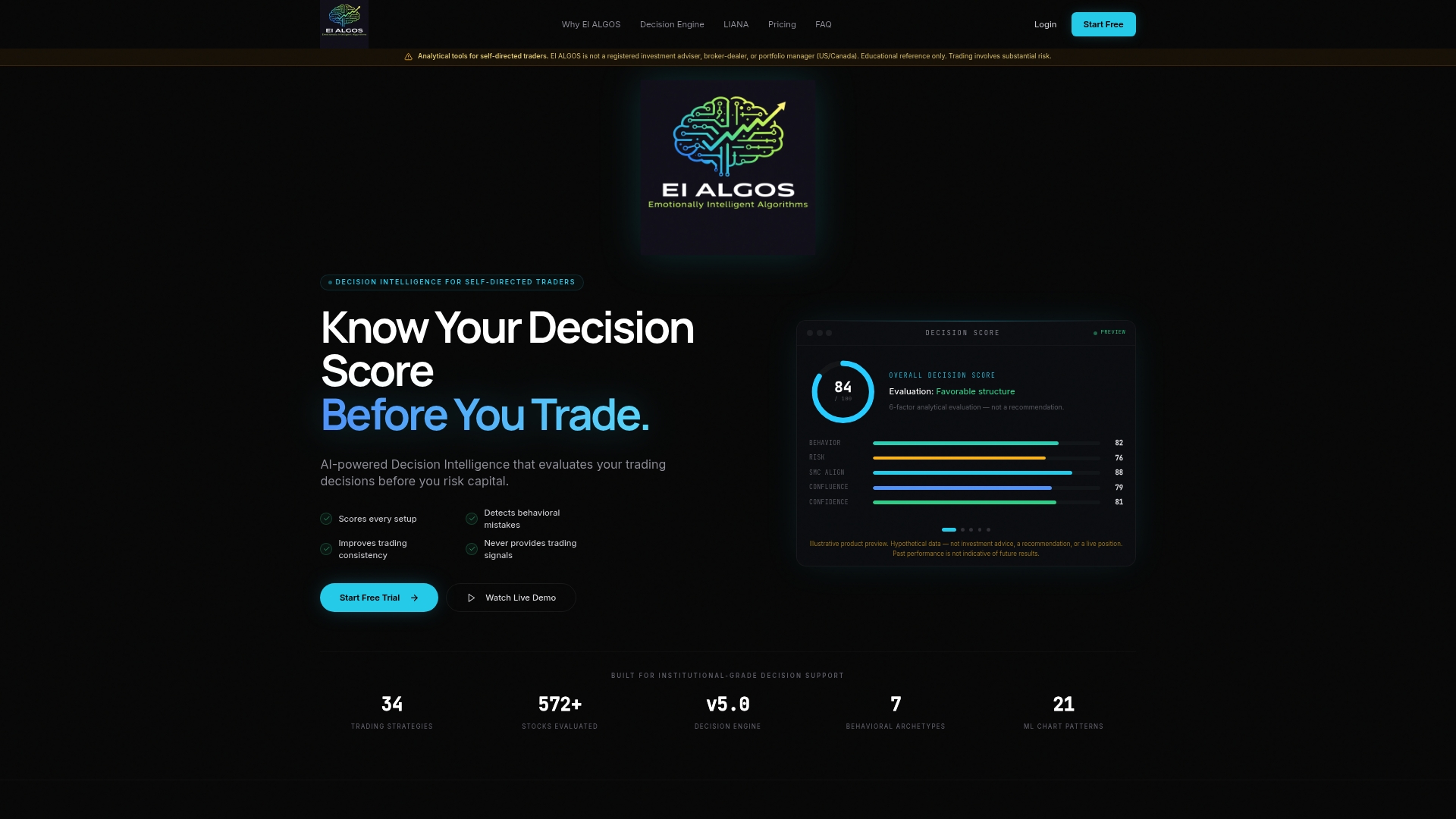
Doing this review by hand is possible but tedious, and the hardest part is noticing bias in the moment. That is the gap EI ALGOS was built for. It is a web-based Decision Intelligence platform for self-directed traders that scores each trade setup on a six-factor analytical engine focused on the behavioral side of the decision. It does not give trade signals or recommendations. It looks at how you decide, so you can see where recall, not rules, is steering you.
Three parts matter for availability bias:
- Setup scoring. Each setup is evaluated against the same six factors, so the inputs stay constant even when your memory of last week is loud.
- Behavioral error detection. The platform is designed to identify behavioral mistakes in your trading, which makes patterns like post-loss avoidance and post-win oversizing visible in your own history. See how trader behavior analysis works.
- LIANA, the AI assistant. LIANA gives personalized feedback on your process based on your own trading patterns, so the review is about your record rather than generic advice. Learn more about LIANA.
If you already keep a log, the AI-coached trading journal turns the full-sample review from a chore into something you can act on.
Perspective
We built EI ALGOS on a simple observation: most self-directed traders do not lack information. They lack a consistent way of using it. Availability bias is a clear case. The trader who sat through a bad week remembers it vividly and trades the next month around it, while the data in their own history says something different.
That is why we do not publish signals or market forecasts. A forecast adds one more vivid input to a head already full of them. Our approach is to score the decision itself on six factors, show where behavior departs from the plan, and let LIANA reflect your own patterns back to you.
If you take one thing from this article, take this: replace "it feels likely" with "my record says." Every tool and habit we describe exists to make that swap easy to do.
Anantha
Try it on your own trades
If you want to see where memory is steering your decisions, start with the free plan at EI ALGOS. Paid plans are Starter at $49 per month, Pro at $129 per month and Elite at $229 per month, and they add advanced feature sets and unlimited usage. You can read how EI ALGOS works before you sign up.
For a deeper look at the thinking behind it, the Behavioral Decision Intelligence framework paper sets out the approach.
FAQ
What is an example of availability bias in trading?
A common one is skipping a valid setup after a stop-out because the loss is still fresh. The loss feels like the usual result, even if your full history shows the setup is profitable. Another is chasing a ticker everyone is discussing because its name keeps coming to mind.
Is availability bias the same as recency bias?
They overlap but are not identical. Recency bias weights the latest events too heavily. Availability bias covers anything easy to recall, including events that are vivid, emotional or heavily reported, even when they are not recent. Recent events are often the most available, which is why the two get mixed up.
Can experienced traders still be affected?
Yes. The shortcut is part of ordinary human judgment, and the investor-survey research described above covered a broad range of US investors over 26 years. Experience gives you more memorable events to draw on, so a written process and full-sample reviews matter at every level.
How do I reduce availability bias quickly?
Write down the base rate for your setup before each trade, use a fixed pre-trade checklist, and review all trades weekly instead of only the standouts. Add a waiting period after unusually large wins or losses so fresh emotion does not set the next decision.
Does a trading journal help with availability bias?
Yes, if you review it as a full sample. A journal replaces selective memory with a record, so you can compare what you remember with what happened. EI ALGOS pairs the journal with behavioral analysis and LIANA to highlight the patterns for you.
Sources
- Goetzmann, Kim and Shiller, investor survey research (NBER working paper)
- Why So Many Investors Believe Trouble Lies Ahead (NBER Digest)
- Do We Know When We're Headed for a Crash? (Yale Insights)
- The Behavioral Biases of Individuals (CFA Institute, 2026)
- Risk Management in Property Investing