Overconfidence bias is one of the most costly habits in retail trading. It correlates with higher trade frequency, larger positions, and lower net returns once you account for transaction costs. Willpower doesn't fix it. The single most effective corrective is process discipline: scoring decisions before you act, enforcing rules automatically, and auditing outcomes on a schedule instead of on impulse.
TL;DR:
- Traders who trade excessively and hold oversized, concentrated positions due to overconfidence experience lower net returns after accounting for costs.
- Overconfidence persists because traders attribute wins to skill and blame losses on bad luck, often ignoring objective performance metrics.
- Market conditions like bull phases and high volatility amplify overconfidence, leading to more frequent overtrading, risky bets, and revenge trading.
- Implementing process discipline through automated rules, pre-trade mental exercises, and regular review significantly reduces overconfidence-driven errors.
- Using decision-scoring platforms and maintaining a trading journal helps identify behavioral red flags before they cause substantial financial losses.
Table of Contents
- What Overconfidence Bias in Trading Actually Looks Like
- The Evidence: What the Research Actually Shows
- How Overconfidence Shows Up in Your Actual Trades
- Detecting Overconfidence in Your Own Trading
- A Prioritized Playbook to Reduce Overconfidence-Driven Errors
- Turning the Playbook Into a Repeatable Process
- Where Overconfidence Bias Actually Comes From
- How Market Conditions Change the Way Overconfidence Shows Up
- Overconfidence Across Asset Classes
- Why Feedback and Learning Matter More Than Experience Alone
- Case Studies: What Overconfidence Actually Costs
- A Short Experiment Worth Running This Week
- A Platform Option for Enforcing the Process
- Sources
What Overconfidence Bias in Trading Actually Looks Like
Overconfidence bias in trading isn't one thing. Researchers break it into three distinct patterns, and each one shows up differently in your trade blotter.
Overestimation is thinking your win rate or edge is better than it actually is.
Overplacement is ranking yourself above other traders without evidence. It's the "I'm better than most retail traders" belief that rarely survives a real performance comparison.
Overprecision is excessive certainty about a specific price target or timing call. It shows up as oversized positions on "sure thing" setups, because the trader believes their forecast has almost no error band.
- Overestimation inflates your sense of skill after a string of wins.
- Overplacement skips the comparison to a real benchmark or peer group.
- Overprecision drives outsized position sizing on single-trade convictions.
These patterns persist because markets deliver noisy feedback. A profitable trade doesn't confirm a good process, and a losing trade doesn't confirm a bad one. Traders resolve that ambiguity with self-attribution: crediting wins to skill and blaming losses on bad luck or manipulation. That asymmetry is well documented in self-attribution research, and it's the mechanism that keeps overconfidence alive trade after trade.
The Evidence: What the Research Actually Shows
The strongest empirical case against overconfidence in trading comes from Terrance Odean's work on discount brokerage accounts. Traders who traded most frequently earned meaningfully lower net returns than those who traded less, once transaction costs eroded their gross gains. Overconfidence, not skill, explained the turnover.
Overconfident traders tend to trade more, often taking positions with poorer risk-adjusted profiles, resulting in costs from both fees and increased volatility.
A related study found that men, on average, traded more frequently than women and reduced their net returns more as a result, a pattern consistent with overconfidence models rather than differences in information access.
Lab experiments back this up mechanistically. A 2020 study on feedback and trading found that the type of feedback traders received directly changed how much they traded and how overconfident they became. When misleading or overly positive feedback was reduced, overtrading dropped too. That's a strong signal the bias is at least partly environmental, not fixed.
- Odean's brokerage data links trading frequency to lower net returns after costs.
- Bregu's experimental work shows feedback design shapes how much people overtrade.
- Early psychometric overconfidence measures in young men predicted higher lifetime trading frequency, suggesting a persistent trait component.
One caveat matters here: these studies rely on retail brokerage samples, which carry selection bias. People who open frequent-trading accounts may already be more overconfident than the general investing population, so the effect sizes shouldn't be read as universal.
How Overconfidence Shows Up in Your Actual Trades
Research explains the mechanism. Your trade history shows the damage. Overconfidence rarely announces itself. It shows up as a pattern of small decisions that compound into a large problem.
- Overtrading. You take setups that don't meet your criteria because you feel "in the zone." Each extra trade adds commissions, spread cost, and slippage, all of which erode net returns even when your win rate looks fine on paper.
- Oversized positions. A high conviction setup gets 3x your normal risk allocation. When it works, it reinforces the belief that big bets on high conviction ideas are smart. When it fails, the drawdown is disproportionate to the original edge.
- Concentrated bets. Overconfident traders cluster capital in one asset, one sector, or one directional thesis instead of spreading risk. This isn't a diversification strategy. It's a bet that one view is right enough to bear the concentration risk.
- Weak stop discipline. Confidence in a thesis makes traders move stops further away "to give it room," rather than admitting the setup failed at the original invalidation point.
The "beginner's luck" scenario is the clearest illustration. A new trader takes a few early trades, gets lucky on market direction, and interprets the result as skill. Early profitable trades are one of the most reliable triggers for dangerous overconfidence, because there's no track record yet to contradict the story the trader is telling themselves.
The causal chain to worse performance runs through three channels: transaction costs from excess frequency, concentration risk from oversized single bets, and volatility drag from holding positions past their original thesis. None of these show up clearly in a single trade. They show up in the account equity curve over months.
Detecting Overconfidence in Your Own Trading
You can't fix what you don't measure, and overconfidence is specifically the bias that convinces you measurement is unnecessary. A handful of numbers will tell you more than your gut feeling ever will.
Start with turnover rate against your own strategy benchmark. If your stated strategy calls for 5 to 10 trades a month and you're averaging 30, that gap is data, not a coincidence. Track average trade duration too. A pattern of holding times shrinking week over week often means impatience is creeping into entries and exits. Compare average position size to your stated risk budget, and watch your win rate against risk-adjusted returns rather than raw win percentage, since a high win rate with poor risk-adjusted returns usually means you're cutting winners short and letting losers run.
The qualitative signals are just as telling:
- You "explain away" losses as bad luck, manipulation, or someone else's fault.
- You skip post-trade review on winning trades because "it worked, so why analyze it."
- You scale upsize immediately after a winning streak instead of after a demonstrated statistical edge.
Pro Tip: Run a five-minute Sunday audit: pull your last 10 trades, compare actual position size to your risk budget on each one, and flag any trade you didn't write a reason for before entering. Three or more flags in a row is your signal to cut size, not increase it.
A Prioritized Playbook to Reduce Overconfidence-Driven Errors
Fixing overconfidence isn't about trying harder to stay disciplined in the moment. Stress and emotional arousal impair rule-following exactly when you need rules most, which is why automated exits and hard circuit-breakers outperform "just be disciplined" advice. Build the fix into your process, in this order.
- Automate the rules first. Predefine entry and exit criteria before you're in a trade. Set automated stops rather than mental ones. Add a cool-off rule that blocks new entries for a fixed period after a loss streak, so a bad afternoon can't turn into a bad week.
- Add evidence-anchored cognitive tools. Run a pre-mortem before entering a setup: write down every reason the trade could fail before you click. Prospective hindsight exercises like this generate roughly 30% more failure scenarios than standard forward analysis, which directly counters overprecision. Pair that with affect labeling. Naming the emotion you're feeling (not suppressing it) has been shown to calm amygdala activity and restore prefrontal control, which is the opposite of what happens when traders try to power through anxiety or excitement by ignoring it.
- Measure and add outside accountability. Keep a trading journal that records the reason for entry, not just the result. Score each decision on process quality separately from outcome. Periodic blind reviews, where you or a peer evaluate a trade's logic without knowing the result, break the self-attribution loop that credits wins to skill and blames losses on luck.
Operationally, treat new tactics like a controlled experiment. Paper trade a new strategy for a fixed window before risking capital on it. Use a written checklist for every setup, not just the ones that feel uncertain, since overconfidence hits hardest on the trades that feel obvious. Adopt new rules on a time-boxed basis, four weeks is a reasonable test period, then review the data before deciding whether the rule earns a permanent place in your process.
Pro Tip: If you only implement one rule this month, make it the cool-off period after a loss. It's the cheapest circuit-breaker you can build, and it directly targets the moment overconfidence is most likely to spike.
Systematic risk monitoring matters here too. Tools built for tracking exposure across positions, like the frameworks described in how to monitor market risk effectively, reinforce the same principle: numbers catch what feelings miss.
Turning the Playbook Into a Repeatable Process
The hard part of any mitigation playbook isn't knowing the steps. It's applying them consistently on the trade that feels different, the one where your gut says the rules don't apply this time.
A six-factor analytical engine that scores a setup before entry works as a real-world example of process enforcement: it forces a structured evaluation instead of a gut check, which is exactly the pre-mortem discipline described above, applied automatically. A personalized assistant like LIANA reviews your scoring patterns over time and flags drift, such as position sizes creeping up after winning streaks, the same red flag your Sunday audit should catch manually.
- Scoring before entry ties your behavior to a process metric, not the outcome you're hoping for.
- Journal integration turns your trade history into the same self-attribution check researchers use in lab studies.
- Pattern detection surfaces the overconfidence red flags before they show up in your equity curve.
Readers who want a structured explanation of how decision-scoring works can start at the Knowledge Hub.
Where Overconfidence Bias Actually Comes From
Overconfidence bias in trading arises from predictable mental processes related to how the brain handles uncertainty and reward. Two main cognitive mechanisms contribute significantly.
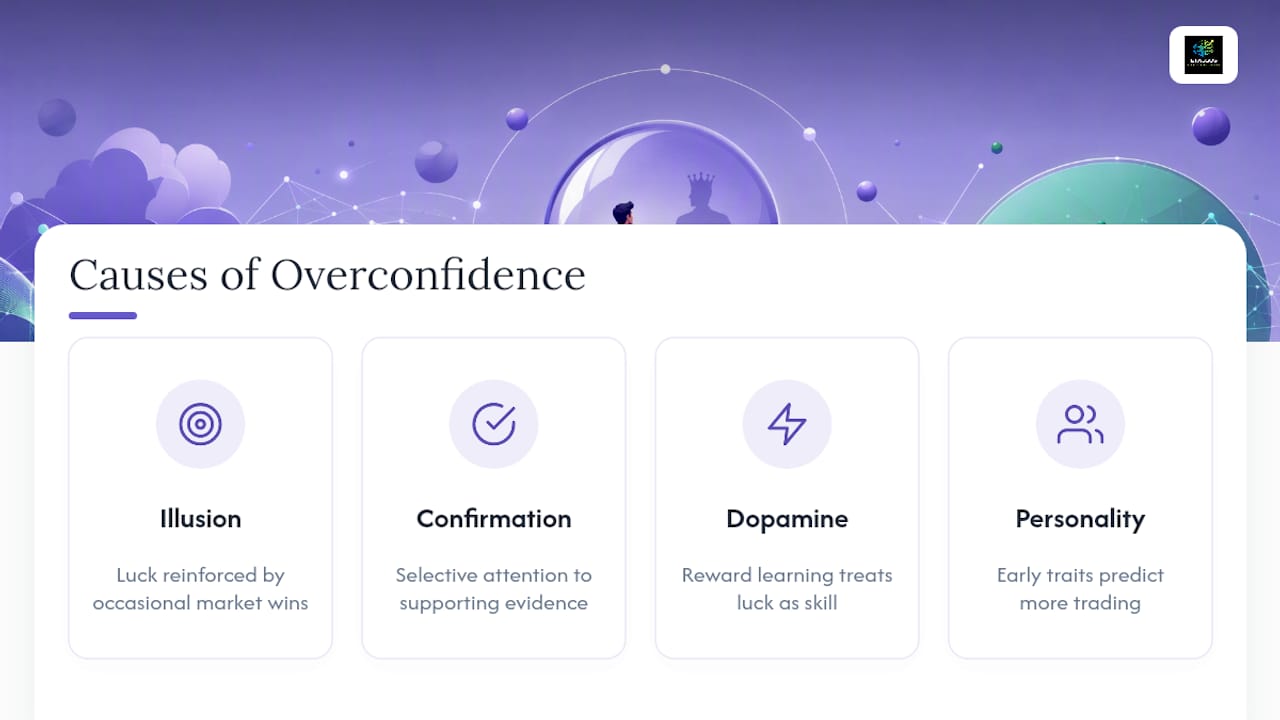
The first is the illusion of control, the tendency to believe you have more influence over random or partly random outcomes than you actually do. Markets reward this illusion just often enough to reinforce it. A trader who buys before an earnings report and gets lucky on direction internalizes the win as a forecasting skill, not a coin flip that landed their way.
The second is confirmation bias working alongside overconfidence rather than separately from it. Once a trader forms a thesis, they notice information that supports it and discount information that contradicts it. This isn't willful denial. It's how attention naturally filters incoming information once a belief is in place, and it means overconfident traders often feel like they're being objective even as they cherry-pick evidence.
Dopamine-driven reward learning compounds both effects. A winning trade triggers a reward response similar to other forms of variable-ratio reinforcement, the same mechanism that makes slot machines compelling. That reward doesn't distinguish between a skillful decision and a lucky one, so the brain reinforces the behavior that preceded the win regardless of whether the behavior was sound.
Personality also plays a role. Early psychometric measures of overconfidence in young traders predicted meaningfully higher trading frequency later in life, which suggests some of this is trait-level, not purely situational. That doesn't mean it's fixed. It means the traders most prone to overconfidence need stronger external structure, not less, because their internal signal for "I've got this" is less reliable than they think.
How Market Conditions Change the Way Overconfidence Shows Up
Overconfidence doesn't behave the same way in every market environment. It amplifies in specific conditions and recedes in others, which is why the same trader can look disciplined in one quarter and reckless in the next.
Bull markets are the most dangerous incubator. Rising prices generate broad-based wins that have little to do with individual skill, but traders interpret sustained gains as validation of their process. This is when overplacement peaks, traders start believing they're outperforming peers when in fact the whole market is doing the lifting.
High-volatility regimes trigger a different flavor of the bias. Overprecision spikes because rapid price swings create an illusion of clear, decisive signals. A trader watching a stock move 8% in an hour feels like the pattern is obvious, when in reality the noise-to-signal ratio has gotten worse, not better.
Low-volatility, range-bound markets tend to suppress overtrading somewhat, simply because fewer setups meet a trader's criteria. But they introduce a subtler risk: boredom-driven trades that get rationalized after the fact as legitimate setups, which is overestimation dressed up as patience finally paying off.
Losing streaks and drawdowns produce the opposite failure. Instead of overconfidence, traders swing into overcorrection, but the underlying bias often resurfaces as "revenge trading," an overconfident bet that the next trade will make back the loss immediately. The emotional driver is different, but the behavioral signature, oversized risk taken on insufficient evidence, is identical to what shows up during a bull run high.
Overconfidence Across Asset Classes
The bias is universal, but its intensity and expression shift depending on what you're trading.
Equities see overconfidence expressed mainly through overtrading and stock-picking overplacement, the belief that you can consistently beat a benchmark through individual stock selection. Odean's brokerage research, largely built on equity accounts, is the clearest evidence base for this pattern.
Options amplify overprecision specifically. Because options require a view on direction, magnitude, and timing simultaneously, a trader has to be right on three dimensions at once. Overconfident options traders often underestimate how narrow that window actually is, leading to concentrated bets on short-dated contracts that require near-perfect timing.
Forex and leveraged instruments magnify the position-sizing dimension. High leverage means a modest overconfidence-driven sizing error turns into a large percentage loss quickly, and the 24-hour market structure removes the natural cool-off period that closing bells provide in equities.
Digital assets combine high volatility with thinner historical data, which weakens a trader's ability to benchmark their own skill against a stable track record. That data scarcity feeds overestimation, since there's less objective history available to contradict an inflated self-assessment.
The common thread across all four is that instruments with faster feedback loops and higher leverage don't just increase the financial damage from overconfidence. They shorten the window a trader has to notice the bias before it compounds into a real loss.
Why Feedback and Learning Matter More Than Experience Alone
Experience alone doesn't reliably reduce overconfidence. The type of feedback a trader receives does. This is one of the more counterintuitive findings in the research, and it has direct implications for how you should structure your own review process.
Laboratory experiments on feedback and trading found that when subjects received feedback that made their actual performance more visible and harder to misattribute, overtrading decreased. When feedback was ambiguous or allowed for self-serving interpretation, overconfidence and excess trading persisted. Markets, by nature, deliver the ambiguous kind of feedback most of the time. A profitable trade could reflect skill, luck, or broad market conditions, and the trader rarely gets a clean signal about which.
That's why structured, deliberate feedback loops outperform passive experience. Years of trading without a journal or scoring system mostly teaches a trader to rationalize outcomes, not to evaluate decisions. A trader who reviews the reasoning behind each trade, separate from the profit or loss it produced, builds a feedback loop that mimics the controlled conditions researchers use to reduce overconfidence in experiments.
Blind review works particularly well here. Reviewing a past trade's setup and reasoning without first looking at the outcome forces an honest assessment of the decision quality, stripped of the self-attribution bias that creeps in once you already know whether it worked.

Case Studies: What Overconfidence Actually Costs
Real trading histories, even anonymized and aggregated ones from brokerage research, tell a consistent story about how overconfidence compounds.
Consider the pattern Odean's brokerage data revealed at the account level: the highest-turnover accounts didn't just underperform the lowest-turnover accounts by a small margin. The gap was large enough that transaction costs alone explained a meaningful share of it, meaning these traders would have been better off holding their initial positions and doing nothing at all.
A second pattern shows up in the gender-based trading research. Higher trading frequency among the more active group reduced net returns more than it reduced gross returns, meaning the underlying stock selection wasn't necessarily worse. The frequency itself was the problem, not the picks.
The "beginner's luck" scenario deserves its own case study treatment because it's so common and so under-discussed. A new trader opens an account, takes a handful of trades during a favorable market stretch, and posts strong early returns. That early win record becomes the anchor for future confidence, even though the sample size is too small to mean anything statistically. The trader increases size on the next round of trades, the favorable stretch ends, as favorable stretches eventually do, and the drawdown that follows is disproportionate to the original account size, because position sizing scaled with confidence rather than with a demonstrated, durable edge.
The lesson across all three cases is the same: overconfidence doesn't show up as one catastrophic decision. It shows up as a series of individually defensible choices that only reveal their cost when you look at the aggregate pattern.
A Short Experiment Worth Running This Week
The traders I see recover fastest from overconfidence aren't the ones who resolve to "be more careful." They're the ones who install one mechanical rule and let the data argue with their ego for them.
Try this for seven days: start a trade journal, apply one if-then rule (if I lose twice in a row, I stop trading for the rest of the session), and review every entry blind before checking the result. That's the whole experiment.
— Anantha
A Platform Option for Enforcing the Process
Building this discipline by hand works, but it depends on you remembering to apply it exactly when overconfidence is loudest, which is the hardest moment to trust your own judgment. Some platforms offer structured alternatives that score each setup on multiple factors before you enter, so the process check happens automatically instead of relying on memory or willpower in the moment.
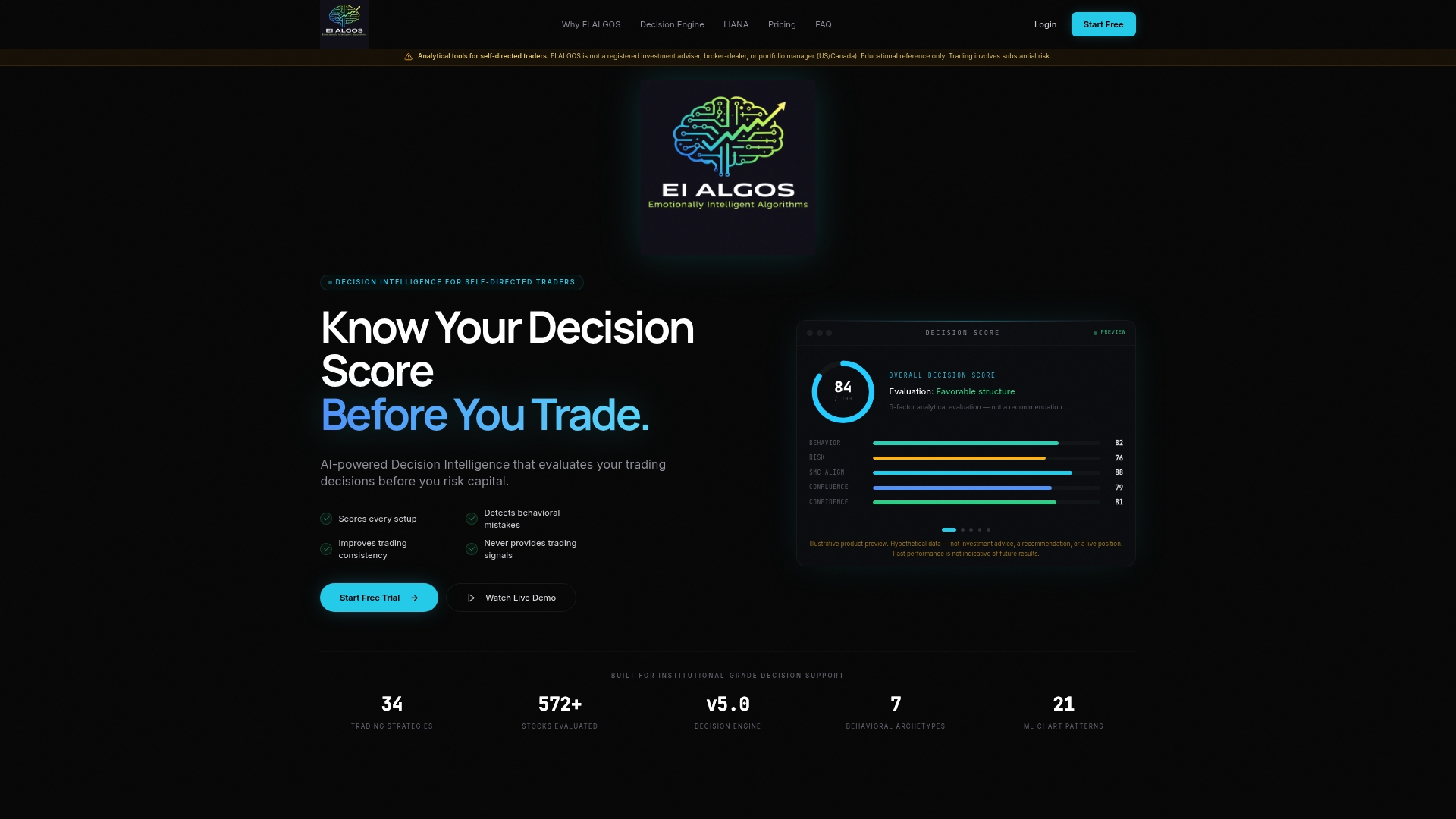
Some AI assistants review scoring histories and flag drift, like position sizes creeping up after a winning streak, which can be a red flag for overprecision. Such platforms typically do not generate signals or tell you what to trade. Instead, they evaluate decision-making processes, focusing on behavioral insights highlighted by research. Whether you build your own checklist system or use a platform-assisted approach is your call. If you want to see how the scoring engine works before committing to anything, start with the subscription details and try the free tier against your next handful of setups.
Sources
- Trading Is Hazardous to Your Wealth (Odean)
- Overconfidence and (Over)Trading: The Effect of Feedback on Trading Behavior (Bregu, 2020)
- Study linking early psychometric indicators to trading behavior
- How to recover from a major trading loss | Charles Schwab