
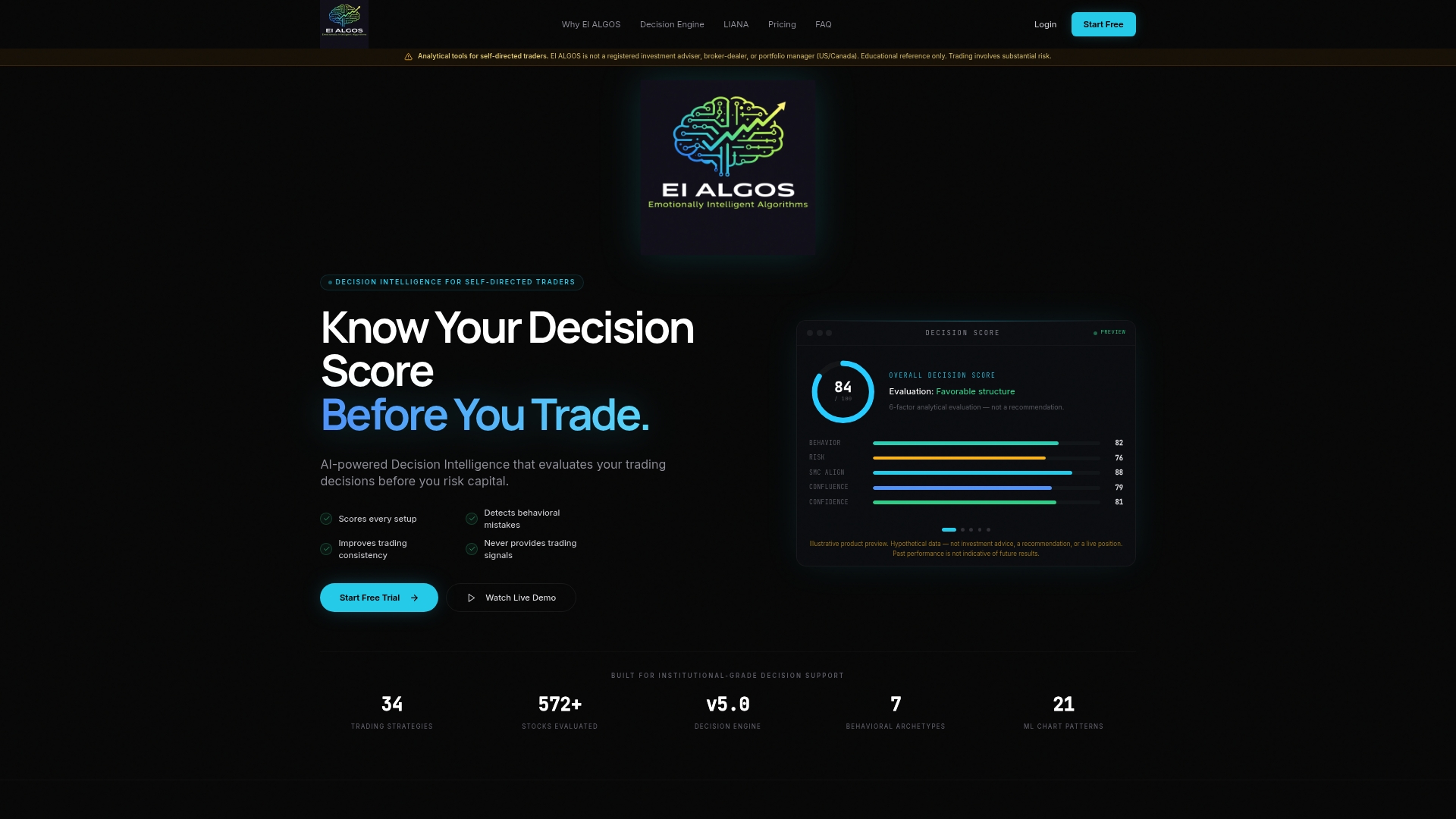
Decision quality in trading is how sound your reasoning was given what you knew when you placed the trade, regardless of whether it made money. You can only improve what you measure, and a profit and loss (P&L) figure measures luck as much as skill. A scored, repeatable record of each decision is what lets you see your process improve. That is the idea behind EI ALGOS, a decision intelligence platform that scores each setup on a six-factor engine instead of handing you signals.
TL;DR
- Decision quality is the soundness of your reasoning at the time of the trade, separate from the outcome. A good decision can lose and a bad one can win.
- Judge process, not single results: record the thesis, risk, emotional state and confidence before you know how the trade ends.
- Set limits in advance (risk per trade, daily loss, stop, minimum risk ratio) so discipline is decided before emotion shows up.
- Review entries in batches to find repeating patterns, not one-off mistakes.
- A free plan on EI ALGOS lets you start scoring your setups without a signal service.
Table of Contents
- What decision quality means in trading
- Why decisions go wrong
- Build the decision before the trade
- Record decisions while they are fresh
- Review the process, not the P&L
- How to tell your decisions are getting better
- Why signals do not fix decision quality
- Perspective
- Start scoring your decisions
- FAQ
- Sources
What decision quality means in trading
The term comes from decision science, where it describes the quality of the choice itself rather than what followed. In trading, decision quality is whether your reasoning was sound given the information and analysis available at the time, independent of the outcome. A good decision can have a bad outcome, and a bad decision can have a good one.
That distinction matters because markets are noisy. Suppose you buy a breakout with a defined stop, a sensible size and a clear thesis, and the trade stops out. The decision was fine. Now suppose you chase a spike, skip your stop and the price keeps running. You made money on a poor decision, and you will probably repeat it.
Traders who judge themselves only by P&L reward the second kind of trade and punish the first. Over many trades that trains the wrong habits.
Outcome quality versus process quality
| Good outcome | Bad outcome | |
|---|---|---|
| Good decision | Earned win: repeat it | Acceptable loss: keep the process |
| Poor decision | Lucky win: the dangerous one | Deserved loss: fix the cause |
The top-right and bottom-left cells are where most traders mislearn. The goal of a decision quality practice is to sort every trade into the correct cell, honestly.
Why decisions go wrong
Most bad trading decisions are not caused by missing information. They come from predictable mental habits. A 2025 systematic review of 63 empirical studies in F1000Research found that research clusters around overconfidence, herding and loss aversion, with regret aversion, anchoring and emotional influences studied less.
In plain terms:
- Overconfidence: trusting your read more than your record justifies, which often shows up as oversized positions.
- Herding: entering because everyone else is, not because your setup qualifies.
- Loss aversion: holding losers too long because realizing the loss hurts.
- Anchoring: fixating on an entry price or a past high.
- Regret and emotion: revenge trades after a loss, or hesitating after a missed move.
The same review notes that few studies test practical remedies such as education, digital tools or reminders, and that much of its evidence comes from emerging-economy markets, so treat it as a map of the problem, not proof of a specific fix for U.S. traders. That is why a personal record of your own behavior is more useful than general lists of biases: it shows which of them actually cost you money.
If you want to go deeper on one of these, our piece on how decision scoring and stop orders prevent confirmation bias shows the mechanics in practice.
Build the decision before the trade
The best time to improve a decision is before you make it. A written plan turns discipline into something concrete. CME Group's futures trade plan worksheet is a good model of what a pre-trade plan contains: risk tolerance, maximum risk per trade, daily loss limits, trade times, break conditions, rules for using stops, and a minimum risk ratio, plus entry, stop and target fields for each trade.
Translate that into a pre-trade checklist you answer every time:
- What is the setup, and why does it qualify? Name the pattern and the conditions that must be true.
- Where am I wrong? Define the stop before the entry.
- What is the target, and what is the reward relative to the risk? If it falls below your minimum ratio, no trade.
- How much can I lose, and is that inside my per-trade and daily limits? Size from the stop distance, not from conviction.
- What state am I in? Note whether you are calm, rushed, or trying to win back a loss.
- What are the alternatives? Another instrument, a smaller size, or waiting.
For the sizing question, our guide to the 2% rule and trade management walks through how self-directed traders cap risk per position.
Where a checklist breaks down
A paper checklist works until you skip it. The usual failure is not ignorance but rationalizing: you answer "yes" to everything because you already want the trade. That is the gap a scoring engine addresses. EI ALGOS scores each setup on a six-factor analytical engine that evaluates the psychological and behavioral factors behind the decision, so the question shifts from "do I feel good about this?" to "how does this setup score against my own process?" You can see how the approach works on our decision intelligence page.
Record decisions while they are fresh
A journal is the foundation of any decision quality practice, but only if it captures reasoning, not just prices. The Finance & Quant Society recommends logging the trade, its timing and size, the thesis, your emotional state and confidence, the outcome and the lessons. A journal written at the time also reduces hindsight distortion and lets you assess reasoning on the information available then, apart from the result.

Hindsight is the enemy here. Once you know how a trade ended, your memory quietly rewrites why you took it. A note made before the outcome is the only reliable witness.
Fields worth logging on every trade:
- Date, time, instrument, direction and size
- Setup name and the thesis in one or two sentences
- Entry, stop, target and planned risk-to-reward
- Confidence from 1 to 5 and emotional state
- Whether you followed your plan
- Result, then a lesson written separately from the result
Our complete trading journal guide covers what to log and why each field matters. If you would rather not maintain a spreadsheet by hand, the EI ALGOS trading journal offers AI-coached trade review, and our trade analysis tools provide structured review of each setup.
Review the process, not the P&L
Single trades tell you almost nothing. Patterns tell you a lot. The question to ask of a batch of trades is: where did my reasoning break down, and how often?
The Finance & Quant Society advises reviewing journal entries over time to identify patterns in mistakes and successes, assessing reasoning on what was known then and separating process quality from each result.
A simple weekly and monthly routine
- Weekly (20 minutes): Sort every trade into the four cells of the table above. Count how many were plan violations.
- Monthly (an hour): Look for repeats. Do losses cluster after a big win? In the first hour? After a third consecutive loss? Do you cut winners early?
- Quarterly: Adjust one rule based on the evidence, not five.
Feedback loops help. In a 2012 PLOS ONE randomized stock-market experiment with 154 students, peer-review feedback improved behavior, non-rote learning and attitudes when review activities continued long enough. The same study did not find statistically significant improvement in trading outcomes, which is the point of this article: review sharpens the process first, and results follow from a better process over a long sample.
If you want a structured way to do this, our 30-day behavioral trading analysis lays out a month-long review, and five bias detection metrics give you numbers to track.
How to tell your decisions are getting better
Because individual outcomes are uncertain, track process indicators that you control:
| Indicator | What improvement looks like |
|---|---|
| Plan adherence | A rising share of trades follow the written plan |
| Stop discipline | Stops are set before entry and not moved wider |
| Risk consistency | Per-trade risk stays inside your limit |
| Setup scores | Fewer low-quality setups taken |
| Emotional tags | Fewer trades logged as rushed or revenge |
| Confidence calibration | High-confidence trades perform better than low-confidence ones |
Expect these to move before your equity curve does. Over a large enough sample, better process should show up in results, but no process removes the risk of loss in markets. Trading carries real risk of losing money; the SEC's investor education materials include a publication called Day Trading: Your Dollars at Risk that is worth reading before you commit capital. For a related look at a specific risk, this piece on SEC trading suspension risks explains what can happen to thinly traded names.
Why signals do not fix decision quality
A signal tells you what to do. It does not tell you why you hesitate, oversize or override your stop. If your trouble is behavioral, borrowing someone else's entries leaves the cause untouched, and you still have to manage the trade with your own psychology.
That is the reason our platform takes the opposite route. EI ALGOS does not provide trade signals or market predictions. It evaluates how you decide, detects behavioral errors, and gives live trade management tools, options analysis and strategy pattern detection. Our behavioral trading and trader behavior analysis pages explain how behavior drives retail P&L and how profiles, patterns and drift are tracked.
Perspective
We built EI ALGOS around one belief: most self-directed traders do not lack information, they lack an honest view of their own process.
A trade result is a single data point with a lot of noise in it. A pattern of decisions is something you can actually work on. When every setup is scored on the same six factors, and every deviation from your plan is recorded, you stop arguing with your memory and start reading your own evidence.
That is why we do not offer signals. Our job is to help you see where your reasoning holds up and where it drifts, so that consistency comes from your discipline and not from our opinion on the market. LIANA, our assistant, gives personalized feedback on your process based on your own trade history, so the guidance fits how you trade.
Start small, score honestly, review on a schedule, and change one thing at a time.
Anantha
Start scoring your decisions
EI ALGOS is a web-based platform for self-directed traders who want to measure decision quality. There is a Free plan at $0 per month. Paid plans are Starter at $49 per month, Pro at $129 per month and Elite at $229 per month, with advanced features and unlimited usage on the upgrades. You can compare them on the EI ALGOS plans page, and meet the assistant that reviews your process on the LIANA page.
Prices are as published on our site and can change, so confirm them there before subscribing.
FAQ
What is decision quality in trading?
It is the soundness of your reasoning given the information available when you placed the trade. It is judged separately from the result, since a well-reasoned trade can lose and a poorly reasoned one can win.
How do I improve my trading decisions?
Write a plan before each trade with entry, stop, target and size. Log your thesis and emotional state at the time, then review batches of trades for repeating mistakes. Change one rule at a time based on what the pattern shows.
Can I measure decision quality without looking at profit?
Yes. Track plan adherence, stop discipline, risk consistency, the share of rushed or emotional trades, and whether your confidence ratings match results over time. These are within your control and tend to improve before the equity curve does.
Do I need trade signals to make better decisions?
No. Signals suggest entries but do not address how you size, hesitate or manage a position. Decision quality is built on your own process, which is what EI ALGOS scores and reviews.
How long before I see improvement?
Process indicators such as plan adherence can move within a few weeks of consistent logging. Results need a larger sample of trades, and markets always carry the risk of loss.
Sources
- Keeping a Trading Journal, Finance & Quant Society
- Unpacking Investor Psychology: A Systematic Review, F1000Research (PMC)
- Master the Trade: Futures Trade Plan, CME Group
- Does Reviewing Lead to Better Learning and Decision Making? PLOS ONE (PMC)
- On-Line Publications by Subject, SEC