
Trading process improvement means building a rules-based, measurable routine and judging yourself on how well you follow it, not on this week's profit and loss. Regulators such as the SEC and FINRA warn that day trading is risky for many individuals, and behavioral research shows memory flatters our results. Start today: pick one pre-trade rule and log every trade.
TL;DR:
- Standardize setup selection, position size, per trade and daily loss limits, execution, trade management, and review cadence so decisions remain repeatable and measurable.
- Investors who checked actual past trade results showed less overconfidence and lower trading frequency; fixed exit rules also counteract selling winners early and holding losers.
- Write one setup’s entry trigger, stop, target, and skip conditions before trading; log each trade before entry, then review notes weekly.
- Automate alerts and order templates for routine work, but keep strategy choices and exceptions manual; require confirmation before orders breach risk limits.
- Track checklist adherence, edge per trade against a benchmark, slippage, PGR/PLR, and trade frequency; set a minimum sample in trades or weeks before changing rules.
Table of Contents
- What are the parts of a trading process you should standardize?
- Which behavioral biases quietly break your process?
- How do you improve your trading process step by step?
- Which tools and workflows make your process repeatable?
- How do you measure process quality without being fooled by noise?
- What common mistakes derail a process, and how do you fix them?
- Why incremental process gains compound
- How does EI ALGOS help you upgrade your trading process?
- FAQ
- Sources
What are the parts of a trading process you should standardize?
A trading process is the set of decisions you make the same way every time. The CFA Institute describes it as strategy selection, risk management, and performance evaluation working together. For a self-directed trader, that breaks into six pieces:
- Idea selection: the setups you trade and the ones you skip.
- Position sizing: how many shares or contracts a given setup earns.
- Risk limits: the most you can lose on one trade and in one day.
- Execution method: market or limit orders, and when you enter.
- Trade management: where you move stops, take profits, or exit.
- Review cadence: when you look back at results and decisions.
Standardizing each piece removes ad-hoc calls, and ad-hoc calls are where behavioral drift sneaks in. A checklist item can be as simple as "Is my stop placed before I enter?" A rule can be as plain as "No new entries immediately after the open." Neither is clever. Both are repeatable, and repeatable is what you can measure.
Which behavioral biases quietly break your process?
Your memory is the first suspect. PNAS experiments found that investors remember past performance more favorably than it was, and that this bias predicts overconfidence and higher trading frequency. When investors looked up their actual past trade results, overconfidence and trading frequency dropped. University of Colorado researchers describe the same finding: checking the record leads to more accurate self-assessment.
The disposition effect adds a second drag. Traders tend to sell winners too early and hold losers too long, partly because of loss aversion. Behavioral finance research links discipline, meaning fewer of these behavioral influences, to better outcomes. Our guide to the disposition effect and tracking PGR and PLR shows how to make it visible.
The antidotes are objective:
- Look up exact past-trade returns before judging your skill.
- Set fixed exit rules before you enter, not after the price moves.
- Complete your pre-trade checklist every time, with no skipped items on "obvious" setups.
- Review behavior with psychology tools instead of gut feel.
How do you improve your trading process step by step?
Work in this order. Each step reduces noise for the next.
- Codify one setup. Pick a single reproducible setup and write its pre-trade checklist: entry trigger, stop location, target, and reasons to skip.
- Standardize sizing and risk. Use a simple template for maximum risk per trade. Our risk rule guide walks through the math. For a wider workflow, this risk management article is a useful companion.
- Automate routine tasks. Use alerts and order templates for the mechanical work, and keep your judgment rules written down.
- Build a note and review habit. Write a short micro-note after each session and hold one weekly review. Never change a rule before you reach your minimum sample size.
- Track a short metric set. Follow adherence, PGR/PLR, and slippage against a benchmark. Keep your exit rules in the review.
Pro Tip: Log the trade before you place it. If you can't fill in the checklist, you don't have a setup yet.
A trading journal makes steps 4 and 5 far easier to sustain.
Which tools and workflows make your process repeatable?
Professional desks solve this problem with systems, and the patterns scale down. Bloomberg's research shows that automation, broker wheels, and integrated pre- and post-trade analytics (TCA) can improve consistency and lower operational effort and slippage when matched to the desk's needs. You may not run a broker wheel, but the idea carries over: route orders the same way and measure what they cost.
Automate high-frequency routine tasks. Keep strategy selection and exception handling manual, because this need judgment. Set up these items first:
- Just-in-time reminders that show your checklist at the moment of entry.
- A confirmation step before any order that breaks a risk limit.
- Price and volatility alerts that replace screen-watching.
- A lightweight automation checklist: what is automated, who checks it, and what happens when it fails.
For more on tightening setups, see this guide to optimizing trading setups.
How do you measure process quality without being fooled by noise?
Judge the process on inputs you control. A compact set of metrics can cover most of it:
- Adherence rate: the share of trades that followed every checklist item.
- Edge per trade: average result versus a chosen benchmark.
- Cost and slippage: your fills versus an execution benchmark.
- PGR/PLR: how quickly you realize gains compared with losses.
- Trade frequency: a rise often signals overconfidence.
Sample size is the discipline that protects you. A practitioner paper from CFM stresses benchmarking, relative cost measures, and giving tests enough time to gather statistics. Decide your minimum, in trades or weeks, before you start, and don't peek early.
For a simple A/B test, alternate two execution styles or one rule tweak across comparable trades, then compare cost or adherence against the benchmark. If the gap is small and the sample is thin, treat it as noise and keep collecting.

What common mistakes derail a process, and how do you fix them?
Most failures come from the same few habits:
- Rewriting rules after a short losing run. Fix: commit to waiting for a set number of trades or weeks before any change.
- Reacting to push notifications. Regulatory commentary in a Morningstar letter to FINRA argues that digital nudges can encourage impulsive trading and that just-in-time disclosures help. Fix: turn off nonessential alerts and add a confirmation step.
- Deep analysis mid-session. It anchors you to a story. Fix: keep session notes to a line or two and save deeper reviews for the weekly session.
Why incremental process gains compound
In my view, the biggest edge most self-directed traders overlook is boring: they never measure how often they follow their own rules. A trader who raises adherence a little each month changes the odds on every trade that follows, while a trader chasing the last result resets to zero each week. Process gains are small and quiet, and they stack. I would rather review a set of honest trades than celebrate one lucky one.
— Anantha
How does EI ALGOS help you upgrade your trading process?
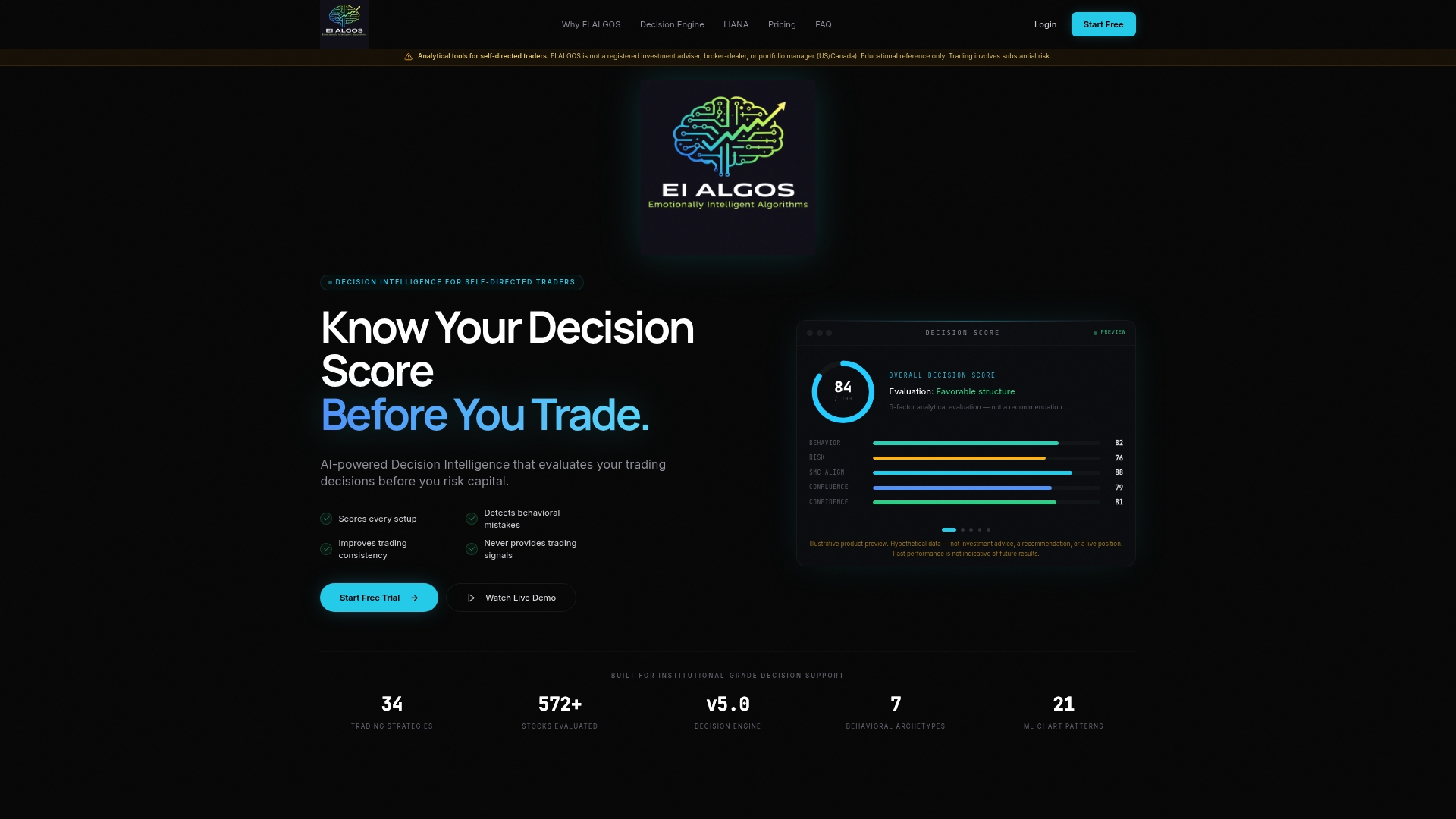
We built EI ALGOS around your decisions, not trade signals. Our engine scores each setup on psychological and behavioral factors, and our LIANA assistant gives personalized feedback on your own patterns, so you can spot and address behavioral errors.
- Score setups before you enter.
- Review trades with AI-assisted feedback.
- See your behavioral patterns over time.
Start on our free tier through our pricing and plans page, or see how trade evaluation works.
FAQ
How can I improve my trading?
Define one repeatable setup, write a pre-trade checklist, and log every trade. Then review weekly and judge yourself on adherence before results. Research on investor memory shows that checking your actual past results reduces overconfidence.
What is the trading process?
It is the full chain of decisions behind a trade: idea selection, sizing, risk limits, execution, trade management, and review. The CFA Institute frames it as strategy selection, risk management, and performance evaluation working together.
What is the 90% rule in trading?
It is a popular saying that most new traders lose money, and it isn't an official regulation. The SEC does warn that many day traders lose money, so protect your capital and size positions conservatively.
Can I make $1000 per day from trading?
No outcome is guaranteed, and a daily income target is the wrong goal for a beginner. FINRA's day-trading disclosure emphasizes the particular risks and special margin rules. Focus on process quality and let results follow.
Sources
- Sec
- Investor memory of past performance is positively biased and predicts overconfidence
- How automation, TCA and broker wheels work together in modern equity EMS | Insights | Bloomberg Professional Services