
A trader self-assessment is a structured review of how you make decisions, not only how much you made. Do it in three parts. Define your own rules and risk limits. Score each trade against them before and after you act. Review the pattern every week. This guide gives you the questions, the metrics and the schedule. (It is not about tax filing. It is about the quality of your trading process.)
- ✓Six-factor setup scoring
- ✓Behavioral insights
- ✓Personalized LIANA assistant
TL;DR
- Self-assessment judges your process (plan, risk, execution, behavior), not just profit and loss.
- People overrate their own self-awareness, so write things down instead of trusting memory.
- Score each trade on a fixed checklist, then review sets of 20 to 30 trades, not single results.
- Run a short weekly review and a deeper monthly one, and change one thing at a time.
- Eialgos scores each setup on a six-factor engine and flags behavioral errors, with a free plan to start.
Table of Contents
- What a trader self-assessment actually measures
- Step 1: Know your starting profile
- Step 2: Understand the biases that distort your decisions
- Step 3: Score every trade against a process checklist
- Step 4: Keep a journal that captures behavior, not just numbers
- Step 5: Judge samples, not single trades
- Step 6: Set a review schedule you will actually keep
- Step 7: Turn findings into rules, then test them
- Where beginners and experienced traders differ
- Make the review easier with Eialgos
- FAQ
- Sources
What a trader self-assessment actually measures
Self-assessment means reflecting on what kind of trader you are: your risk tolerance, your goals, how you react when markets turn, how you research, and where your emotions get in the way. Standard Chartered's thematic report on investor types describes self-assessment this way and recommends an investment diary to understand decision-making and track performance.
The diary matters because we are poor judges of ourselves. The same report cites a Harvard study in which 95% of people believed they were self-aware, yet only 10% to 15% actually were. If you rate your discipline from memory, you are probably grading generously.
A useful self-assessment answers four questions:
- Plan: Did I have a written setup and exit before I entered?
- Risk: Was the size within my rule?
- Execution: Did I do what the plan said, including the stop?
- Behavior: What state was I in when I clicked?
Profit and loss does not appear in that list on purpose. It is the result of the process plus a lot of luck.
Step 1: Know your starting profile
Before reviewing trades, write down a one-page profile. Educational material on trader self-assessment from FXStreet suggests researching which attributes markets reward and punish, avoiding both underestimating and overestimating your abilities, and considering psychological tests for discipline, self-confidence, motivation, patience and organization.
Keep the profile concrete:
- Account and goal: the size you trade, and what you want it to do.
- Risk limit: the maximum percent of the account you will lose on one trade and in one day.
- Instruments and timeframes: stocks, options, or both; day, swing or longer.
- Known weak spots: revenge trading, moving stops, oversizing after a win, trading out of boredom.
You will revisit the weak-spot list often. Be specific. "Poor discipline" is vague. "I add to losers after 2 p.m." is something you can measure.
Step 2: Understand the biases that distort your decisions
A self-assessment without a list of likely errors becomes a pat on the back. Academic research gives you a short list to check against.
Overtrading. Barber and Odean's classic paper on individual investors links overconfidence to excessive trading and describes a disposition effect: holding losers too long and selling winners too soon. A 2024 review in Financial Markets and Portfolio Management reports that investors with the disposition effect underperform by 2.35% per year, and that overtrading makes purchases underperform sales by an average of 3.31% per year.
Skill versus bias. An experimental study by Corgnet, DeSantis and Porter found that behavioral biases such as overconfidence significantly explain trader performance, while standard cognitive skills had only a marginal effect. Being smart is not the same as being disciplined.
Reacting to the morning. A CFA Institute digest of a study of Chicago Board of Trade traders found that traders with morning losses took above-average risk 31.2% of the time, versus 27% for those with morning profits. Your last trade changes your next trade, even when it should not.

A 2025 systematic review in PubMed Central notes that research concentrates on overconfidence, herding and loss aversion, while biases like regret aversion and anchoring are less studied. In practice, you can start with these three and add your own patterns as the data shows them.
How to spot them in your own trades
| Bias | What it looks like in your log | Question to ask |
|---|---|---|
| Overconfidence | Larger size or more trades after a winning streak | Did my size follow the rule or my mood? |
| Disposition effect | Winners closed early, losers held past the stop | Did I exit at the planned level? |
| Loss aversion | Extra risk right after a loss to get even | Did I enter within minutes of a loss? |
| Herding | Entry triggered by chat, news or social posts | Was the setup in my written plan? |
Step 3: Score every trade against a process checklist
The most useful change you can make is to grade the decision separately from the outcome. IG's trading checklist splits review into three stages: before the trade (market conditions, trend, news, risk-reward), during the trade (stick to your risk plan, manage the stop, keep a clear exit) and after the trade (document the decision and analyze the result).
A broker education lesson on good decisions versus good outcomes offers a five-question process check:
- Is the setup one your written plan allows?
- Is the risk within your rule (1% or less in their example)?
- Was the stop placed with the order?
- Was the reason written down before entry?
- Were you free of a trigger, such as entering right after a loss or a news spike?
In that framework a decision is good only at 5 out of 5. Any "no" is a bad decision, even if the trade made money. That sounds strict, and it is useful: it stops a lucky breach of your rules from becoming a habit.
Adapt the questions to your own plan. The number to track is your process score over time, for example the share of trades that scored full marks this month.
Step 4: Keep a journal that captures behavior, not just numbers
Price, size, entry and exit are the easy part. Add fields that expose decisions:
- Your reason for entry, written before you click.
- Your emotional state and a confidence rating from 1 to 10.
- Whether you followed the plan, yes or no.
- One line on what you would do differently.
- A short tag for the mistake type, such as "early exit", "moved stop" or "no setup".
Tags let you separate a bad idea from bad execution. A strategy that fails according to its rules is a different problem from a good strategy you did not follow. Treat them separately, or you will fix the wrong thing.
Record results in R (multiples of the amount you risked) as well as dollars. R lets you compare a $50 risk trade with a $500 risk trade on equal terms.
Step 5: Judge samples, not single trades
One trade tells you almost nothing. Investopedia's article on winning and losing trades quotes trader Jouflas saying that a well-executed trade is defined by process, not outcome, and that you should review 20 to 30 trades before drawing conclusions. Only change your plan when a behavior repeats across multiple trades, not after one bad week. The goal is a feedback loop, not a reaction to every result.
There is a second trap when you review a lot of data: finding patterns that are only noise. Understanding data snooping bias in backtests helps you avoid building rules from a pattern that appeared by chance in a small sample. Require a pattern to repeat before you act on it.
Step 6: Set a review schedule you will actually keep
Charles Schwab's trade plan guidance says that after you close a trade you should compare its performance with your plan, your portfolio size and a benchmark such as the S&P 500, note what worked and what did not, and decide what to try next time. It recommends building daily, weekly and monthly routines.
A simple version:
| Cadence | Time | What to look at |
|---|---|---|
| After each trade | 2 minutes | Process checklist score, emotion tag, one-line lesson |
| Weekly | 20 to 30 minutes | Win rate, average R, rule compliance, best and worst trade, one action item |
| Monthly | 1 to 2 hours | Results by setup, mistake tags, expectancy, max drawdown, behavior patterns |
| Quarterly | Half a day | Does the strategy still fit? Are goals and risk limits still right? |
Choose one action item per week. Five fixes at once means none of them stick. Examples: "No entries within 15 minutes of a loss" or "Stop goes in with the order, every time."
Step 7: Turn findings into rules, then test them
A finding becomes useful when it becomes a rule you can check. Convert each repeated mistake into an if-then statement:
- If I take a loss that exceeds my daily limit, then I stop trading for the day.
- If I cannot write the setup in one sentence, then I do not enter.
- If a trade has no stop, then it does not get placed.
Then watch your compliance rate next month. If it moves from 60% to 85%, you are improving where it counts, whether or not the equity curve has caught up yet.
Where beginners and experienced traders differ

If you are new, keep it small. Use the five-question checklist, log every trade, and do the weekly review. You are building the habit, and the first 30 trades are your baseline. Do not judge yourself on that sample.
If you are experienced, your risk is blind spots. You have routines, so you rarely examine them. Segment your results by setup, time of day and the state you were in. A strategy that works in the morning and bleeds after lunch is a behavior finding, not a strategy failure.
Our perspective
Most tools in this space answer the question "what will the market do?" We think the more useful question for a self-directed trader is "how did I decide?" That is why Eialgos does not give trade signals or recommendations. It evaluates the decision itself.
Our platform scores each setup on a six-factor analytical engine built around the psychological and behavioral side of trading. Our aim is to help you see your own mistakes, build consistency and strengthen discipline, using your own trade history rather than generic advice.
A journal records what happened. We want the review to show you why, and to do it while you can still act on it. LIANA, our assistant, gives personalized feedback on your process so patterns become visible sooner and are easier to correct. Traders who judge themselves on process, not on one lucky or unlucky week, are the ones who get better.
Anantha
Make the review easier with Eialgos
Doing this by hand works, and it also takes discipline you may not have on a bad day. Eialgos is a web-based Decision Intelligence platform for self-directed traders. It scores trade setups on a six-factor engine, detects behavioral errors, offers live trade management tools and options analysis, and uses LIANA for personalized feedback on your process.
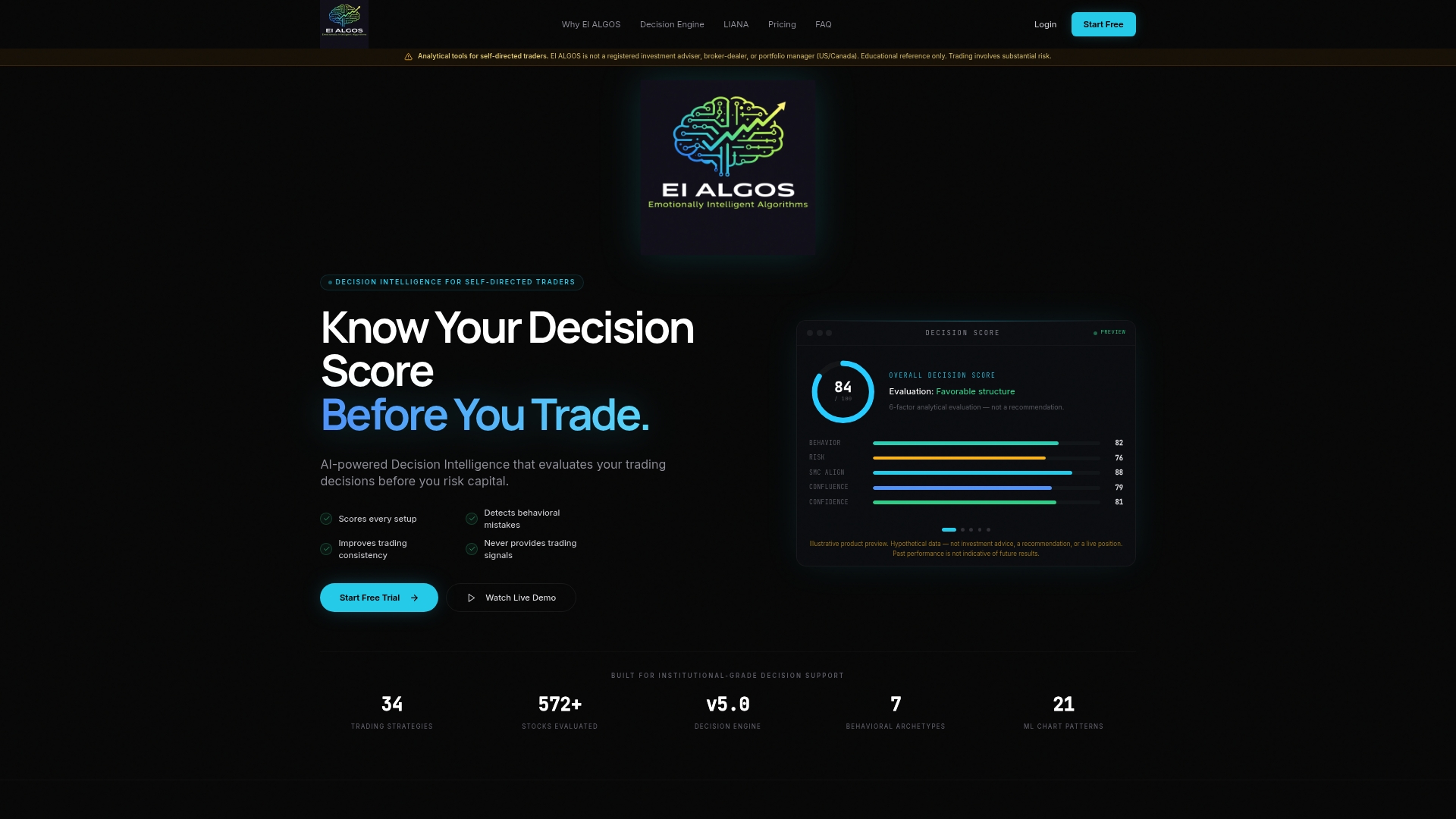
You can start on the Free plan at $0 per month. Paid plans are Starter at $49 per month, Pro at $129 per month and Elite at $229 per month. See the plans on Eialgos and run your next setup through the engine before you place the trade.
FAQ
How often should I do a trader self-assessment?
Do a quick check after every trade and a fuller review once a week. Add a deeper monthly review of your results by setup and mistake type. Daily reactions to single results lead to overreaction, so keep the formal review on a fixed schedule.
What should a self-assessment include besides profit and loss?
Include whether the setup was in your plan, whether risk stayed within your rule, whether the stop was placed, why you entered, and what state you were in. Track rule compliance as a percentage. These show whether your process is improving even in a losing month.
How many trades do I need before drawing conclusions?
A commonly cited guideline from trader Jouflas, reported by Investopedia, is 20 to 30 trades. Change your plan only when a behavior repeats across several trades, not after one bad week.
Can a beginner do a self-assessment without a long trading history?
Yes. Start with the one-page profile and the five-question checklist from your first trade. The first 30 or so trades become your baseline, and the habit of recording your reasoning is the most valuable thing you build early.
Sources
- Know thyself: What type of investor are you? (Standard Chartered)
- Self Assessment, Learning Center (FXStreet)
- Barber and Odean, individual investors and trading
- Measuring costly behavioral bias factors in portfolio management (Springer, 2024)
- What Makes a Good Trader? (Chapman University)
- Do Behavioral Biases Affect Prices? (CFA Institute)
- Unpacking Investor Psychology (PubMed Central)
- The Essential Trading Checklist (IG)
- Good Decision vs Good Outcome in Trading (KCM Academy)
- What Your Winning (and Losing) Trades Are Trying To Tell You (Investopedia)
- Data Snooping Bias for Traders (Backtestify)
- Elements of a Smart Trade Plan (Charles Schwab)