
Anchoring bias causes traders to overweight the first price they see — an entry price, an opening print, a prior high — and that fixation routinely harms returns. The fix starts before you open a position: write your target range and stop level on paper before you view live prices. Kahneman and Tversky's foundational research on cognitive heuristics established that arbitrary numbers shift subsequent estimates in predictable ways, a finding later confirmed in equity markets by research from Bayes Business School showing that anchoring materially affects stock valuation, portfolio choices, and trading strategies. Platforms like Eialgos are built specifically to score the behavioral quality of each trade setup before you act, giving you a structured check against exactly this kind of bias.
Key Takeaways
Anchoring bias in trading is a structural decision risk, not a personality flaw, and it requires structural process changes, not just awareness, to reduce its effect on your P&L.
| Point | Details |
|---|---|
| Anchoring is systematic | Kahneman and Tversky showed arbitrary numbers shift estimates; equity market research confirms the same effect in stock valuation and trading. |
| Entry price is the most common anchor | Fixation on cost basis drives holding losers too long and cutting winners early, the two most damaging performance patterns. |
| Pre-trade rules are the primary fix | Writing your stop and target before viewing live prices is the highest-impact, lowest-effort debiasing step available. |
| Journal data makes it visible | Tracking anchor source, adjustment magnitude, and rule breaches over 30 trades reveals your specific anchoring patterns. |
| Eialgos scores behavioral quality | Eialgos's six-factor engine and LIANA assistant identify anchor-driven decision patterns in your trade history before they compound. |
Table of Contents
- What is anchoring bias and why does it matter for traders?
- Why traders are especially susceptible to anchoring
- Common anchoring bias examples you will recognize from your own trading
- How anchoring distorts your decisions and degrades performance
- How to recognize anchoring red flags in your trading process
- Practical techniques to overcome anchoring bias in your trading
- How to embed debiasing into your trading workflow
- What the research says, and how decision intelligence fits in
- The psychological mechanisms that make anchoring so persistent in traders
- What most traders get wrong about debiasing
- Eialgos scores your decision quality before the anchor takes hold
- Sources
What is anchoring bias and why does it matter for traders?
Anchoring bias is the tendency to rely too heavily on the first piece of numerical information you encounter when making a subsequent judgment. Kahneman and Tversky demonstrated this in their 1974 wheel-of-fortune experiment: participants spun a rigged wheel that landed on either 10 or 65, then estimated the percentage of African countries in the United Nations. Those who saw 65 guessed significantly higher than those who saw 10, even though the wheel result was completely unrelated to the question. The number stuck.
In trading, the same mechanism operates on prices. The first figure you see for a stock, whether that is yesterday's close, an analyst's target, or the opening print, becomes a reference point your brain uses to evaluate every subsequent price. That reference point is the anchor.
Anchoring differs from confirmation bias, which is the tendency to seek out information that supports a view you already hold. Anchoring is narrower: it is a fixation on one specific number, not a general preference for agreeable information. It also differs from recency bias, which overweights the most recent data. An anchor can be old, arbitrary, and completely irrelevant to current fundamentals, yet still exert force on your decision.
Common anchor types traders encounter include:
- Internal anchors: Your own entry price or cost basis; a prior average-down level; a mental stop you set but haven't written down
- External anchors: Pre-market whispers or overnight futures prints; analyst price targets; prior 52-week highs or lows; round numbers ($50, $100, $500); the opening print on a given session
- News-driven anchors: IPO reference prices; headline earnings figures; consensus estimates published before a report
Harvard's Program on Negotiation notes that sellers use anchors deliberately in pricing and negotiation, and the same dynamic plays out when market makers and institutions defend levels that have become widely known reference points.
Why traders are especially susceptible to anchoring
Speed is the primary amplifier. Pre-market preparation compresses into minutes, and the opening bell arrives before most traders have completed a full independent valuation. Under time pressure, the brain defaults to the most available number, which is almost always the last price or the overnight print. Research on anchoring and time pressure confirms that urgency increases reliance on initial anchors because there is no cognitive bandwidth left for adjustment.
Decision fatigue compounds the problem across a trading session. A trader who has already made a dozen sizing and entry decisions by midday has depleted the mental resources needed to evaluate a new setup from scratch. The anchor fills that gap. The entry price from the morning becomes the reference for every afternoon adjustment, even when the market structure has changed completely.
Loss aversion interacts with anchors in a particularly damaging way. Once a position moves against you, the entry price becomes an emotionally charged anchor: it represents the level at which you were "right," and every tick below it feels like a temporary deviation rather than a real loss. Investopedia's trading psychology framework links this directly to the behavior of holding losers too long, because the anchor keeps the original entry price feeling like the "true" value of the asset.
Performance pressure adds another layer. When a trader is down on the week, the P&L anchor (the level needed to break even) starts shaping position sizing and risk tolerance in ways that have nothing to do with the trade's actual setup quality. The number on the screen becomes the reference point for every subsequent decision.
Common anchoring bias examples you will recognize from your own trading
-
The first print anchor (day trading). A stock opens at $47.20 after closing at $46.00. You note the open and spend the next two hours evaluating every move relative to $47.20, even as the stock builds a new structure. The open is your anchor, not the current range.
-
The entry price anchor (swing trading). You buy at $82 and the stock drops to $76. Rather than evaluating whether $76 is a good entry on its own merits, you average down to "improve your cost basis." The $82 anchor is driving the decision, not the chart.
-
The cost-basis anchor (long-term investing). You bought a position at $150 two years ago. It trades at $95 today. You hold because $150 feels like the real value, even though the fundamentals have deteriorated. Behavioral Edge's analysis cites the Lehman Brothers situation as a case where institutional desks anchored to prior trading ranges long after the underlying credit picture had changed.
-
The analyst target anchor. A sell-side firm publishes a $200 price target. You buy at $160 and set a mental target of $200 because that number is now in your head, not because your own analysis supports it.
-
The round-number anchor. A stock approaches $100. You hesitate to short above it because $100 "feels like support," even though there is no structural reason for that level to hold. Round numbers attract order flow precisely because they function as shared anchors.
-
The IPO reference price anchor. A company prices its IPO at $18. It opens at $26. You evaluate every subsequent move relative to $18, treating it as a floor, even though the IPO price was set by bankers, not by market supply and demand.
How anchoring distorts your decisions and degrades performance
The most direct consequence is holding losers too long. When your entry price is the anchor, a position trading below it feels temporary rather than structural. You wait for a return to the anchor instead of cutting the loss at your pre-defined stop. Over time, this produces a portfolio of underwater positions that consume capital and attention.
The mirror image is cutting winners too early. If you bought at $50 and the stock moves to $65, the $50 anchor makes $65 feel "expensive," even if the next resistance is at $80. You sell because the gain feels large relative to your entry, not because the trade has reached its logical target.
Anchoring also distorts stop placement. Traders frequently set stops just below their entry price because the entry is the reference point, not because that level reflects the actual invalidation point for the trade thesis. A stop placed at "below the last swing low" is a structure-driven stop. The difference in outcomes over hundreds of trades is substantial.
Position sizing suffers too. When a stock has dropped from an anchor you remember ($200 high, now at $120), it can feel cheap, leading to oversizing relative to your actual risk parameters. The anchor creates a false sense of value that bypasses your normal sizing rules.
The Bayes Business School working paper on anchoring in equity markets documents that these effects are not limited to retail traders. Anchoring materially influences institutional valuation and portfolio decisions, which means the bias is baked into the prices you trade against as well.
How to recognize anchoring red flags in your trading process
The fastest diagnostic is your post-trade notes. If you find yourself writing "waiting for it to come back to my entry" or "it's only down from my cost basis," anchoring is present. The entry price is dominating your language, which means it is dominating your decisions.
Red flags to watch for:
- You average down more than once on the same position without a new trade thesis
- Your winners are held for shorter periods than your losers, on average
- Your stop levels cluster near round numbers or your entry price rather than near structural levels
- You reference analyst targets or prior highs in your trade rationale without your own independent valuation
- You feel reluctant to add to a winning position because it "has already moved too much"
Add these fields to your trading journal to make anchoring visible in your data:
| Journal Field | What to Capture | Why It Matters |
|---|---|---|
| Anchor source | Entry price / analyst target / prior high / round number | Identifies which anchor type is most active in your process |
| Pre-trade anchor | The specific number you noted before entering | Creates a record you can compare to your actual decision |
| Adjustment magnitude | How far your stop or target moved from your pre-trade plan | Quantifies how much the anchor pulled you off your rules |
| Emotional state | Calm / pressured / FOMO / revenge-trading | Correlates anchor strength with emotional context |
| Rule breach | Yes / No | Tracks whether anchoring produced a process violation |
TradingSim's trading psychology primer recommends mandatory journaling as one of the core process-oriented defenses against bias-driven errors. The fields above make that journal specific enough to catch anchoring, not just general emotional states.
Practical techniques to overcome anchoring bias in your trading
Priority order for implementation:
- Write your target range and stop before viewing live prices (immediate, highest impact)
- Add anchor-source and rule-breach fields to your journal (this week)
- Introduce one competing quantitative anchor per trade (VWAP, a DCF estimate, or a peer multiple) to dilute the primary anchor
- Practice "consider the opposite" before sizing: ask what would have to be true for this trade to fail
- Set platform alerts at structural levels, not at your entry price
- Use a time delay of at least 5 minutes before adjusting a stop or target during a live trade
- Review journal data monthly with an accountability partner or a behavioral scoring tool
Forbes' anchoring explainer confirms that "consider the opposite" and deliberate re-anchoring reduce the bias's effect, though neither eliminates it entirely. The goal is dilution, not eradication.
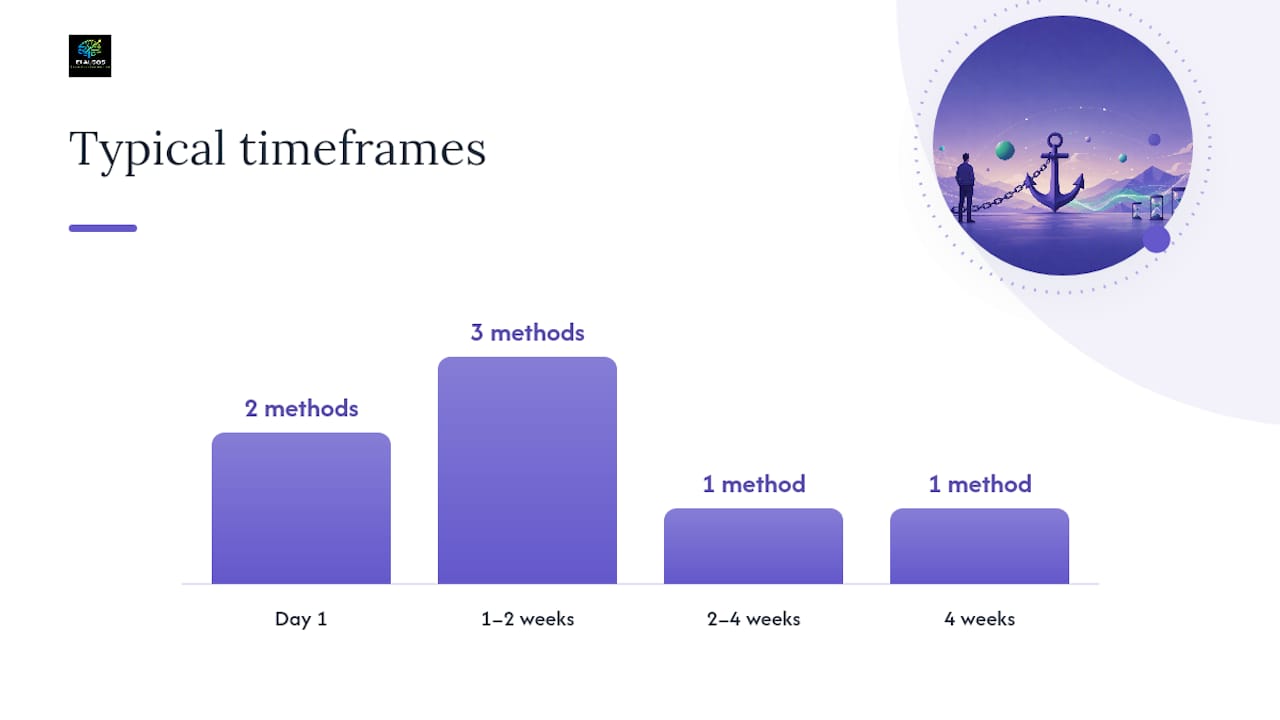
| Debiasing Method | Ease of Implementation | Immediate Impact | Typical Timeframe |
|---|---|---|---|
| Pre-trade written range | High | High | Day 1 |
| Journal anchor-source field | High | Medium | 1–2 weeks |
| Multiple competing anchors | Medium | High | 1–2 weeks |
| Consider-the-opposite exercise | Medium | Medium | 2–4 weeks |
| Time delay before adjustments | High | Medium | Day 1 |
| Rule-based stop placement | Medium | High | 1–2 weeks |
| Accountability partner review | Low | Medium | 4 weeks |
Pro Tip: Before the market opens, write down a number completely unrelated to the stock you are trading, such as yesterday's closing price of an unrelated index. Deliberately noting a competing number dilutes the power of the opening print as your primary anchor, a technique supported by the research on anchor dilution through competing reference points.
How to embed debiasing into your trading workflow
A debiasing routine only works if it runs before you are exposed to the anchor. Here is a pre-trade checklist you can copy directly into your platform or journal:
- State your thesis in one sentence before looking at the current price.
- Set your stop at a structural level (swing low, ATR-based, or volatility band) and write it down.
- Set your target at a structural level (next resistance, measured move, or valuation estimate) and write it down.
- Identify your anchor source: what number are you most likely to fixate on today? Name it.
- Add one competing anchor: VWAP, a 20-day average, or a peer-derived fair value estimate.
- Run the consider-the-opposite check: in one sentence, describe the scenario where this trade fails.
- Confirm your position size using your standard risk formula, not a gut feel adjusted for the anchor.
For your journal template, capture these fields on every trade: ticker, date, thesis (one sentence), anchor source, pre-trade stop, pre-trade target, actual stop, actual target, rule breach (yes/no), and outcome notes. Comparing pre-trade stops to actual stops over 30 trades will show you exactly how much anchoring is pulling you off your plan.
Two automation suggestions that reduce anchor-driven adjustments in live trading: first, set platform alerts at your structural stop and target levels immediately after entry, so you receive a notification before you manually move an order. Second, use bracket orders or OCO (one-cancels-other) order types to lock in your pre-trade stop and target at entry, removing the option to adjust them in the heat of the moment. Process-oriented trading frameworks consistently show that removing the manual adjustment option is more effective than relying on willpower alone.
What the research says, and how decision intelligence fits in
Kahneman and Tversky's 1974 heuristics-and-biases research established that anchoring is a systematic feature of human judgment, not a random error. The Bayes Business School working paper extends that finding directly into equity markets, reporting that anchoring significantly affects stock valuation, portfolio decisions, and trading strategies. This is not a retail-only problem. The bias operates at every level of the market.
Behavioral Edge's case analysis adds a practical dimension: in live trading, anchors gain force from social and algorithmic feedback loops. When order flow defends a well-known level and social media narratives reinforce it, the anchor becomes self-fulfilling for a period, which makes it even harder to dismiss. Inserting competing quantitative anchors, such as VWAP, DCF-derived fair value, or peer multiples, helps traders make more balanced adjustments rather than simply reacting to the dominant anchor.
It is worth noting that prediction market prices carry their own anchoring risk. Research on how traders interpret market-derived numbers shows that a price on a prediction market is often read as a probability anchor, even when the underlying signal quality is poor, which can skew a trader's interpretation of external data.
Eialgos addresses this directly through its six-factor Decision Intelligence engine. Each trade setup is scored on behavioral and psychological dimensions before execution, and the LIANA assistant surfaces patterns in your historical decisions, including anchor-driven rule breaches. A practical workflow: after a week of trading, review your LIANA feedback for repeated stop adjustments near entry prices. If the pattern appears, add the anchor-source field to your pre-trade checklist and set a platform alert at your structural stop before you enter the next position.
The psychological mechanisms that make anchoring so persistent in traders
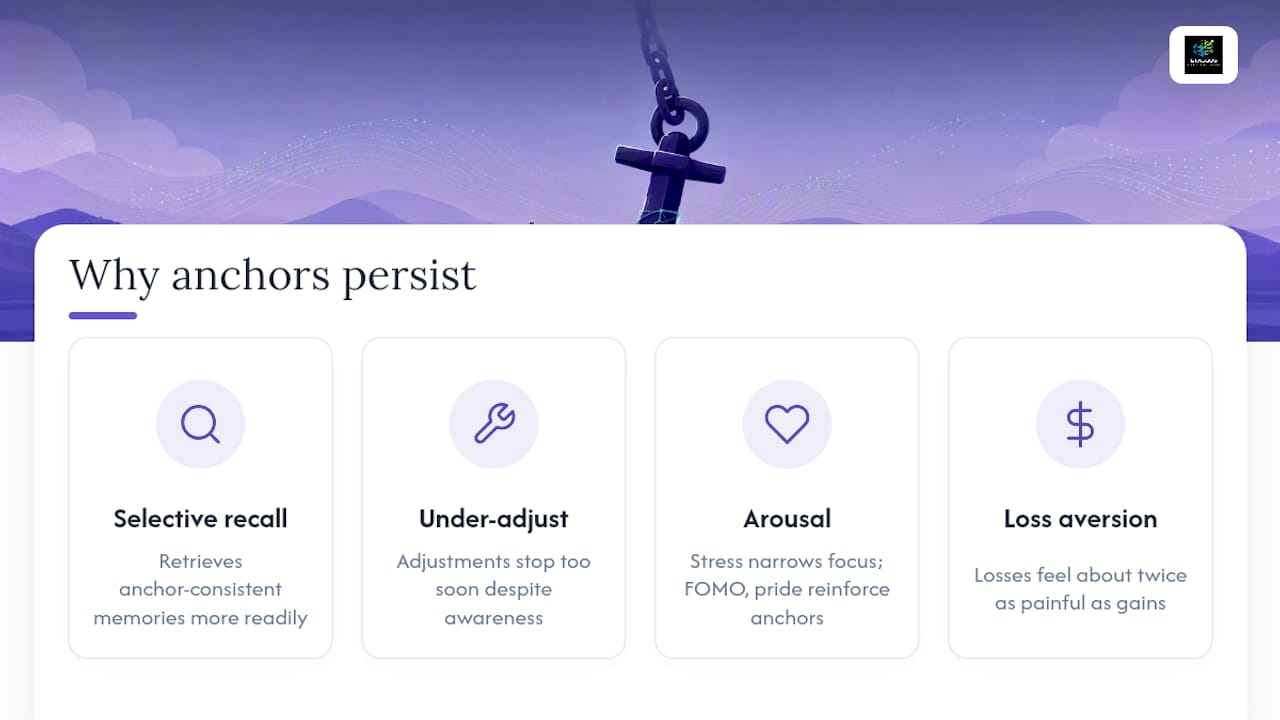
Anchoring operates through two cognitive processes that run largely below conscious awareness. The first is selective accessibility: once an anchor is set, your memory retrieves information that is consistent with it more readily than information that contradicts it. If your entry price is $80 and the stock drops to $72, your brain more easily recalls reasons the stock should return to $80 than reasons it might fall further. This is not confirmation bias, it is a memory-retrieval effect triggered by the anchor itself.
The second process is insufficient adjustment. Even when traders recognize an anchor and try to move away from it, they typically stop adjusting too soon. The adjustment feels effortful, and the brain signals "close enough" before reaching a truly independent estimate. This is why awareness alone is not sufficient: knowing you are anchored does not automatically produce a large enough correction.
Emotional factors amplify both mechanisms. Stress and arousal narrow attention, which means the anchor occupies a larger share of your cognitive field under pressure. Fear of missing a move causes traders to anchor to the last price they saw before deciding, because that price represents the opportunity cost in their mind. Pride in a prior analysis anchors traders to their original thesis even after the market has provided clear contradicting evidence.
The interaction between loss aversion and anchoring is particularly durable. Because losses feel roughly twice as painful as equivalent gains feel rewarding (a finding from Kahneman and Tversky's prospect theory work), the entry price anchor is defended with disproportionate emotional energy. Cutting a loss means accepting that the anchor was wrong, which triggers a loss of both capital and self-assessment. Traders who understand this mechanism can catch themselves in the moment: the reluctance to cut is often the anchor talking, not the trade.
What most traders get wrong about debiasing
Most traders treat anchoring as a knowledge problem: once you know what it is, you assume you will stop doing it. The research says otherwise. Awareness reduces anchoring, but it does not eliminate it, and the reduction is modest without structural process changes. The traders who make measurable progress are the ones who change their workflow, not just their mindset.
The second common mistake is trying to debias in real time, during a live trade. That is the worst possible moment. Your cognitive load is highest, your emotional state is most activated, and the anchor is already embedded. Debiasing has to happen before the anchor forms, which means the pre-trade checklist is not optional. It is the only intervention that consistently works.
There is also a tendency to focus exclusively on entry price as the anchor, when in practice, analyst targets, prior highs, and round numbers often exert more force because they are shared across many market participants. A level that thousands of traders are watching becomes a self-reinforcing anchor through order flow, as Behavioral Edge's analysis documents. Your personal entry price is a private anchor; a widely published price target is a market-wide one. Both require the same structural defense: an independent valuation completed before you see the anchor.
Eialgos scores your decision quality before the anchor takes hold
Most traders know anchoring is a problem. The harder part is catching it in your own process, trade after trade, without a structured system to surface the pattern.
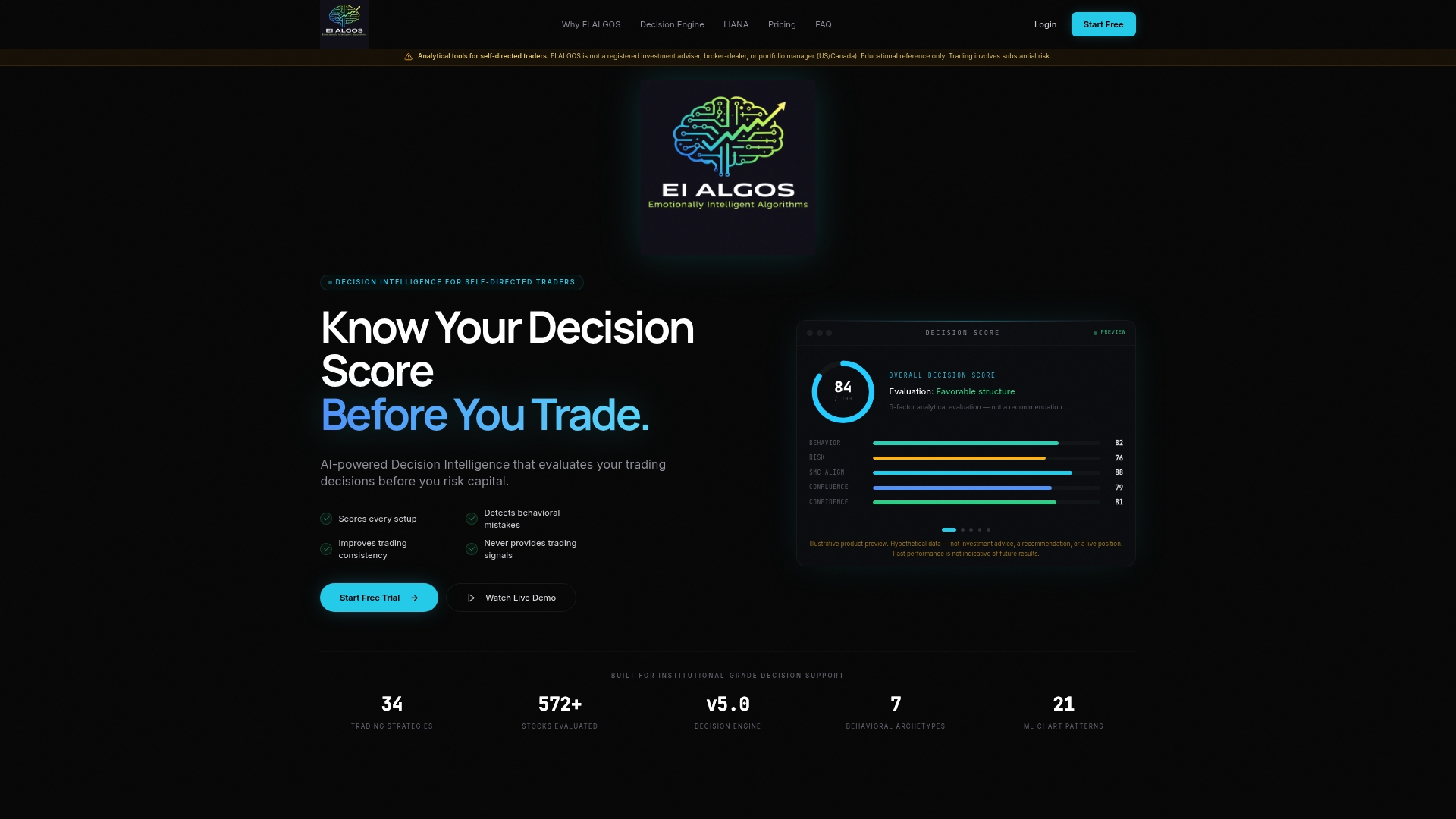
Eialgos is built for exactly that. Its six-factor Decision Intelligence engine scores each trade setup on behavioral and psychological dimensions, including the specific patterns that signal anchor-driven decisions: stop placement near entry rather than structure, repeated averaging down, and target adjustments that trail the anchor rather than the trade thesis. The LIANA assistant reviews your decision history and flags these patterns with specific, personalized feedback, so you are not guessing at what to fix. Start with the free plan to see your behavioral score on your next ten trades, or review the subscription options to access full behavioral diagnostics and live trade management tools. If you want a structured introduction first, the Eialgos Decision Intelligence guide walks you through the framework before you commit to a plan.
Sources
The sources below cover the academic foundations of anchoring, its specific effects in financial markets, and practical frameworks for reducing its impact. Reading the working paper alongside one of the practitioner-focused explainers gives you both the evidence base and the applied toolkit.
- The Role of Anchoring Bias in the Equity Market:
- Trading Psychology: Definition, Examples, Importance in Investing
- Anchoring Bias in Trading: Why the First Price You See Controls Your Decisions - Behavioral edge
- Trading Psychology: The Mental Edge Updated May 2026
- The Anchoring Bias: Consumers, Beware! - PON - Program on Negotiation at Harvard Law School
This article is general information, not a substitute for advice from a qualified financial advisor. Consult a qualified financial professional about your own circumstances before acting on anything here.