
A trading mindset reset is a switch from outcome-focus to process-focus, and it only counts once you prove it with action. The moment you notice tilt, hesitation, or the urge to "make it back," stop trading. Run a short reset protocol: a timer, a physical break, one breathing pass. Then take your next trade only if it meets your written criteria. That trade, executed correctly, is the reset. Nothing you feel or say beforehand counts.
TL;DR:
- A trading mindset reset involves a strict process, including physical and emotional regulation, to prevent impulsive decisions driven by tilt or stress.
- Repeated rule violations, size increases after losses, and fixation on P&L are clear indicators that a reset is necessary, especially under acute stress.
- Implementing routine protocols like timed breaks, emotion labeling, and predetermined entry criteria help reinforce discipline and avoid decisions based on feelings.
- Building a process with pre-trade checklists, journaling behavior, and gradual reintroduction of real trades ensures that resets lead to lasting behavioral improvements.
- External coaching and AI decision tools can support ongoing discipline, especially when internal protocols repeatedly fail or tilt spills into non-trading decisions.
Table of Contents
- Signs You Need a Trading Mindset Reset
- How to Run a Fast Trading Psychology Reset Right Now
- Rebuilding the Process So the Reset Actually Sticks
- Behavioral Tools That Actually Change In-Session Decisions
- Common Biases That Quietly Wreck a Trading Mindset
- Keeping a Healthy Trading Mindset Beyond the Immediate Reset
- Adjusting Your Reset for Different Market Conditions
- When Self-Reset Isn't Enough
- Why We Frame This as Process Restoration, Not Motivation
- How EI ALGOS Turns Your Reset Into a Repeatable Habit
- Sources
- FAQ
Signs You Need a Trading Mindset Reset
Tilt rarely announces itself. It shows up as a pattern you can name if you're paying attention.
The clearest signal is repetition: breaking the same rule twice in a row, usually within the same session. A second sign is sizing that drifts upward after a loss, not because your setup improved but because you want the next win to erase the last loss. Hesitation on a valid entry, staring at your P&L instead of your chart, and a running mental tally of "what I need to make back today" round out the list.
Watch for these in-session:
- Two or three consecutive rule violations, even small ones
- Position size increasing right after a losing trade
- Delayed entries or exits on setups that would normally trigger instantly
- Checking account balance more than checking price action
- A specific dollar figure in your head you're trying to "get back"
This isn't just bad habit. Under acute stress, the amygdala ramps up threat response while the prefrontal cortex, the part of your brain responsible for weighing rules and consequences, loses relative influence. That shift happens fast and without your permission, which is why willpower alone rarely works in the moment.
Before your next trade, ask yourself three questions: Am I trading this setup because it meets my criteria, or because I want to feel different? Have I broken a rule in the last thirty minutes? Would I take this trade if my account were flat for the day? If any answer troubles you, that's your signal to stop, not to trade smaller and hope it passes.
How to Run a Fast Trading Psychology Reset Right Now
The protocol below works whether you're intraday or holding positions overnight. It has five stages, and none of them require you to "feel calm" before moving to the next.
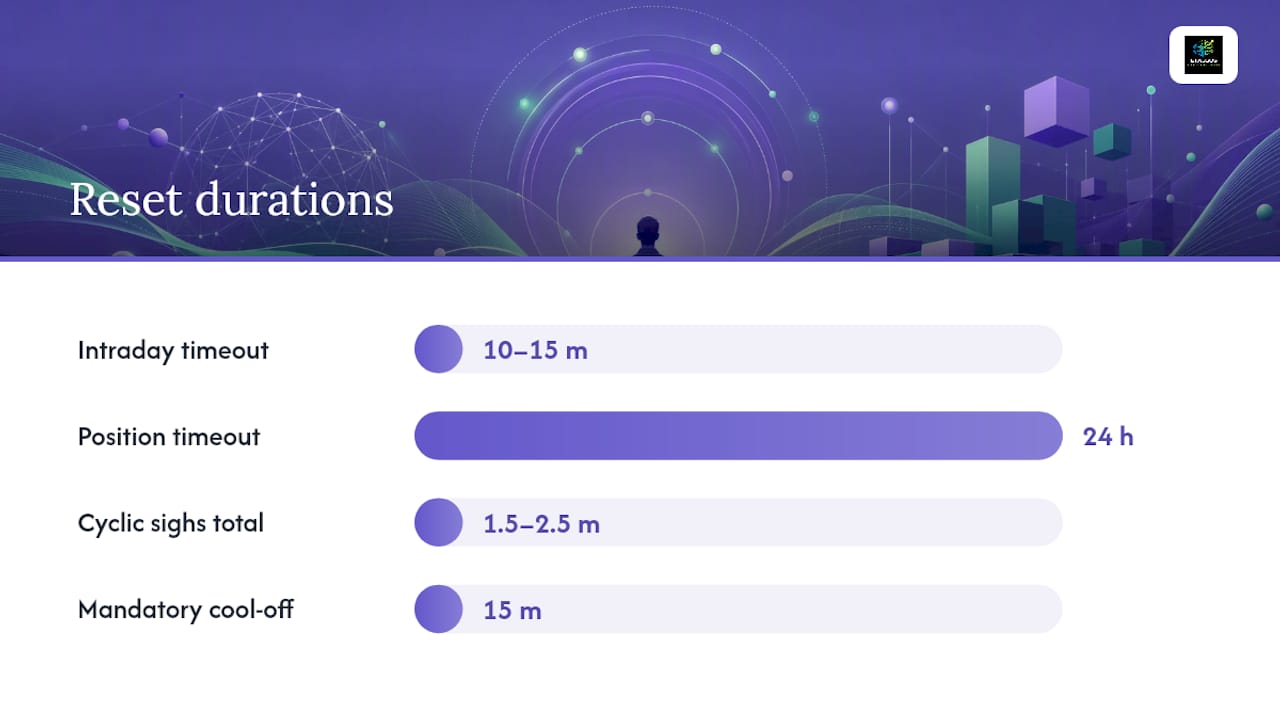
- Step away with a timer. Intraday traders need 10 to 15 minutes away from the screen. Position traders should give it a full 24 hours before touching the position again. A written recovery protocol built around a forced timeout interrupts the cycle that leads to revenge trades.
- Interrupt the body, not just the mind. Walk outside, drink water, or do anything physical. A body under stress stays reactive even after your thoughts have quieted down.
- Run one cyclic sigh. Inhale through your nose in two pulses, then exhale slowly through your mouth for twice as long. Thirty seconds, repeated three to five times, measurably downshifts physiological arousal.
- Take the micro-test trade, or don't trade at all. Write your entry criteria before you look at the chart again. If the next setup meets every criterion, take it at your normal size or smaller. If it doesn't, stay flat. Your willingness to sit out is itself part of the proof.
Layer in two non-negotiable risk rules while you rebuild: a hard daily loss limit that shuts down your platform for the day once hit, and a mandatory cool-off of at least fifteen minutes after any two consecutive losses. If you resume after tilt, cut size by half until you've strung together several rule-following trades in a row.
Pro Tip: Write your micro-test criteria on a sticky note before the session starts, not after you've already lost money. Decisions made in advance survive stress better than decisions made in the moment.
Rebuilding the Process So the Reset Actually Sticks
A single reset fixes one bad afternoon. A rebuilt process keeps the next one from happening as often.
Start with a pre-trade checklist you fill out before every entry, not after. It should force three answers: your defined risk in dollars or percent, the specific setup criteria being met, and an implementation intention in "if this, then that" form (for example, "if price closes below my stop level, I exit, no exceptions"). Writing this down before you're emotionally invested in the outcome removes the decision from a compromised moment later.
Post-session journaling matters more than most traders admit, and the format matters too. Skip the trade-by-trade P&L recap and focus on behavior instead:
- What emotional state was I in during my best and worst decisions today?
- Which rules did I follow, and which did I bend?
- What is the one corrective rule I'll apply tomorrow?
Tracking behavior instead of outcomes gives you a clearer diagnostic than your account balance ever will, since P&L on any single day reflects variance as much as decision quality.
When you're rebuilding after a rough stretch, follow a strict progression: simulator first to confirm your mechanics are clean, then micro-sized live positions to reintroduce real financial pressure gradually, and only then back to your normal size once you've held discipline through several sessions. Resist the temptation to fix everything at once. After a damaging sequence, implement exactly one new rule, not five. Stacking multiple changes after a bad week makes it impossible to tell which adjustment actually worked, and it usually means you're overfitting your process to one unlucky stretch rather than a real pattern.
A structured trading journal template makes this routine easier to sustain, and reading through the case for process-oriented trading will clarify why behavior, not P&L, is the metric worth obsessing over.
Behavioral Tools That Actually Change In-Session Decisions
Most trading psychology advice stays vague. These four techniques don't.
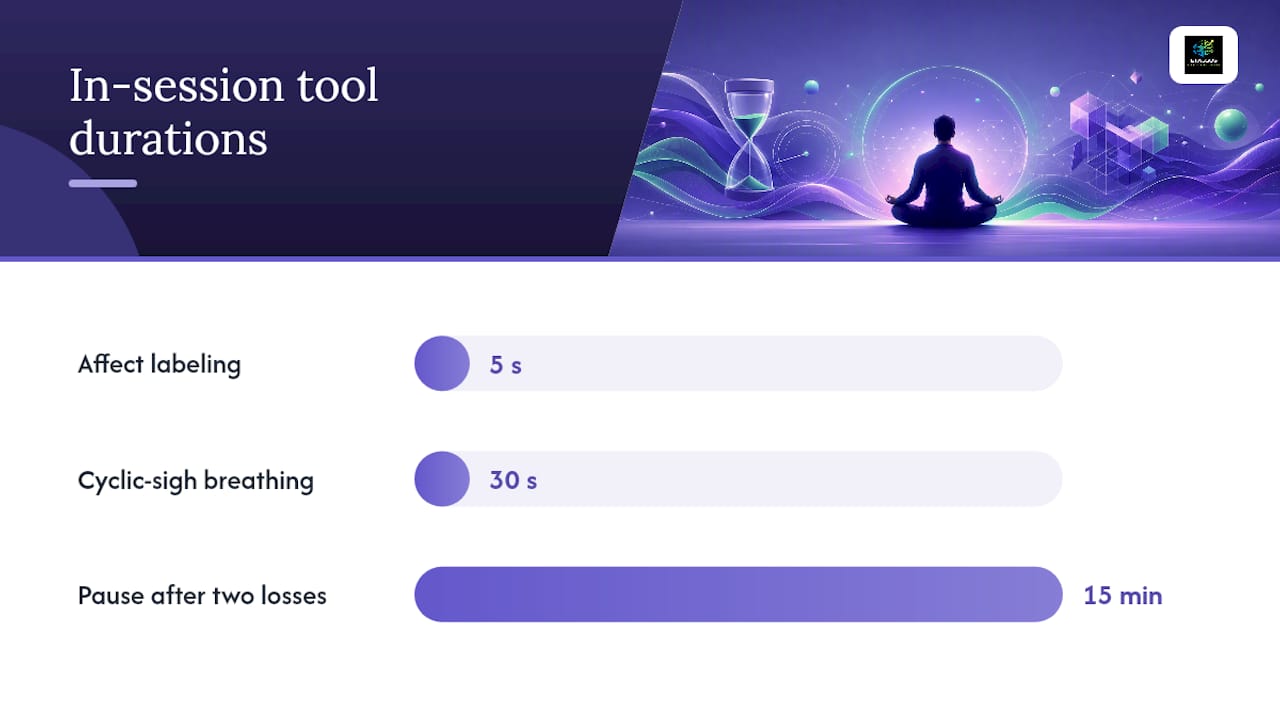
Affect labeling is the fastest one. Simply naming what you feel, out loud or in writing, activates prefrontal regulatory regions and reduces amygdala response, based on UCLA research cited in trading psychology coaching work. It takes about five seconds and requires no special training.
Implementation intentions work because they move the decision out of the heat of the moment. Structure them as simple if-then statements written before you trade:
- If I hesitate on an entry that meets my criteria, I take it at reduced size rather than skip it entirely.
- If I hit two consecutive losses, I stop trading for 15 minutes minimum.
- If my P&L drops below my daily loss limit, I close the platform for the day.
Research on implementation intentions shows they produce a meaningfully larger effect on follow-through than simply deciding to "be more disciplined," because they pre-load the response before the stressful cue ever appears.
Cyclic-sigh breathing, the double-inhale followed by an extended exhale, downshifts physiological arousal in about 30 seconds and works well as a between-trade reset even when you can't leave your desk.
One thing to avoid: suppressing the emotion instead of naming it. Telling yourself "don't feel angry" tends to backfire, while labeling and accepting the feeling actually restores control. Trading is fundamentally probabilistic, and treating outcomes as probabilities rather than personal failures reduces the psychological weight of any single loss. Layering emotional pressure gradually, simulator first, then small live size, then normal size, trains you to apply these tools when it actually matters.
Common Biases That Quietly Wreck a Trading Mindset
Biases don't feel like biases while they're happening. They feel like conviction.
Loss aversion makes losses feel roughly twice as painful as equivalent gains feel good, which is exactly why traders hold losers too long and cut winners too early. Confirmation bias shows up when you seek out news or chart patterns that support a position you already hold, ignoring signals that would tell you to exit. Recency bias convinces you that the last two or three trades represent your true edge, when in reality a handful of trades tells you almost nothing statistically.
Overconfidence creeps in after a winning streak, pushing size up right when discipline should be tightening, not loosening. The sunk cost fallacy keeps you in a losing position because you've already "put so much into it," as if additional risk could somehow retroactively justify the risk you already took.
Recognizing a bias in real time is harder than reading about it. A workable check: before adding to a position or breaking a rule, ask whether you'd make this exact decision if you'd just opened this trade fresh, with no history attached. If the honest answer is no, a bias is likely driving the decision rather than your process.
Keeping a Healthy Trading Mindset Beyond the Immediate Reset
A reset gets you back to zero. Staying there requires habits that run independent of any single bad day.
Build a weekly review separate from your daily journal, one that looks at patterns across five or ten sessions rather than any single trade. This is where recurring tilt triggers, certain times of day, certain instruments, certain news events, become visible in a way daily notes miss.
Treat your trading rules like they're written in ink, not pencil, but revisit them on a fixed schedule (monthly is reasonable) rather than adjusting them mid-drawdown. Rules that change under pressure aren't really rules. Separate your identity from your P&L: a losing week reflects variance and process gaps, not your worth as a trader, and treating it as a personal indictment is what turns a normal drawdown into a psychological spiral.
Physical health matters more than most trading education admits. Sleep debt and decision fatigue compound every bias listed above, and traders who protect sleep and exercise consistently report fewer tilt episodes than those running on caffeine and adrenaline. Finally, build in deliberate low-stakes practice, reviewing old trades, running new setups through a simulator, so your skill and discipline keep improving even in weeks when live conditions aren't offering much opportunity.
Adjusting Your Reset for Different Market Conditions
The reset protocol stays the same. What triggers it, and how often you need it, changes with the market.
In high-volatility conditions, tilt arrives faster because losses and wins both come bigger and quicker. Shorten your cool-off threshold in these stretches, maybe one loss instead of two, and cut position size preemptively rather than waiting for a losing streak to force your hand.
Choppy, range-bound markets create a different failure mode: boredom-driven overtrading. You start taking marginal setups just to feel active, and a practical playbook for identifying and stopping overtrading is worth reviewing specifically during these stretches. Trending markets bring their own trap, overconfidence from a string of easy wins, which is exactly when the sunk cost and overconfidence biases from the previous section tend to surface.
The common thread: match your reset triggers to what's actually stressing your process in that regime, not a generic checklist. A trader running options strategies faces added complexity here, since time decay and volatility shifts create pressure that a simple price chart doesn't show, and systematically tracking options trades becomes especially useful for separating a bad process from an unlucky outcome.
When Self-Reset Isn't Enough
Sometimes the protocol stops working, and that's information, not failure.
If you find yourself running the reset multiple times a week, breaking your daily loss limit anyway, or noticing the tilt spilling into decisions outside trading, entirely, that's a signal to bring in outside help. A trading coach who focuses on behavior and process, not signal generation, can spot patterns in your decision-making that are nearly impossible to see from inside your own head. Some traders benefit from working with a therapist experienced in behavioral or cognitive approaches, particularly when trading losses are tangled up with broader stress, financial pressure, or compulsive behavior patterns.
There's no shame threshold here. Professional athletes work with coaches specifically because self-assessment has blind spots, and trading psychology is no different. If your self-reset protocol keeps failing under the same conditions, that repetition itself is the data telling you it's time for a second set of eyes.
Why We Frame This as Process Restoration, Not Motivation
Most trading psychology content sells confidence. We'd rather sell proof. The whole premise behind this piece, and behind how Anantha and the EI ALGOS blog approach trader behavior, is that feelings are unreliable evidence and actions aren't. We skipped naming specific competing platforms deliberately, because the fix here isn't a better signal service. It's better instrumentation of your own decisions.
— Anantha
How EI ALGOS Turns Your Reset Into a Repeatable Habit
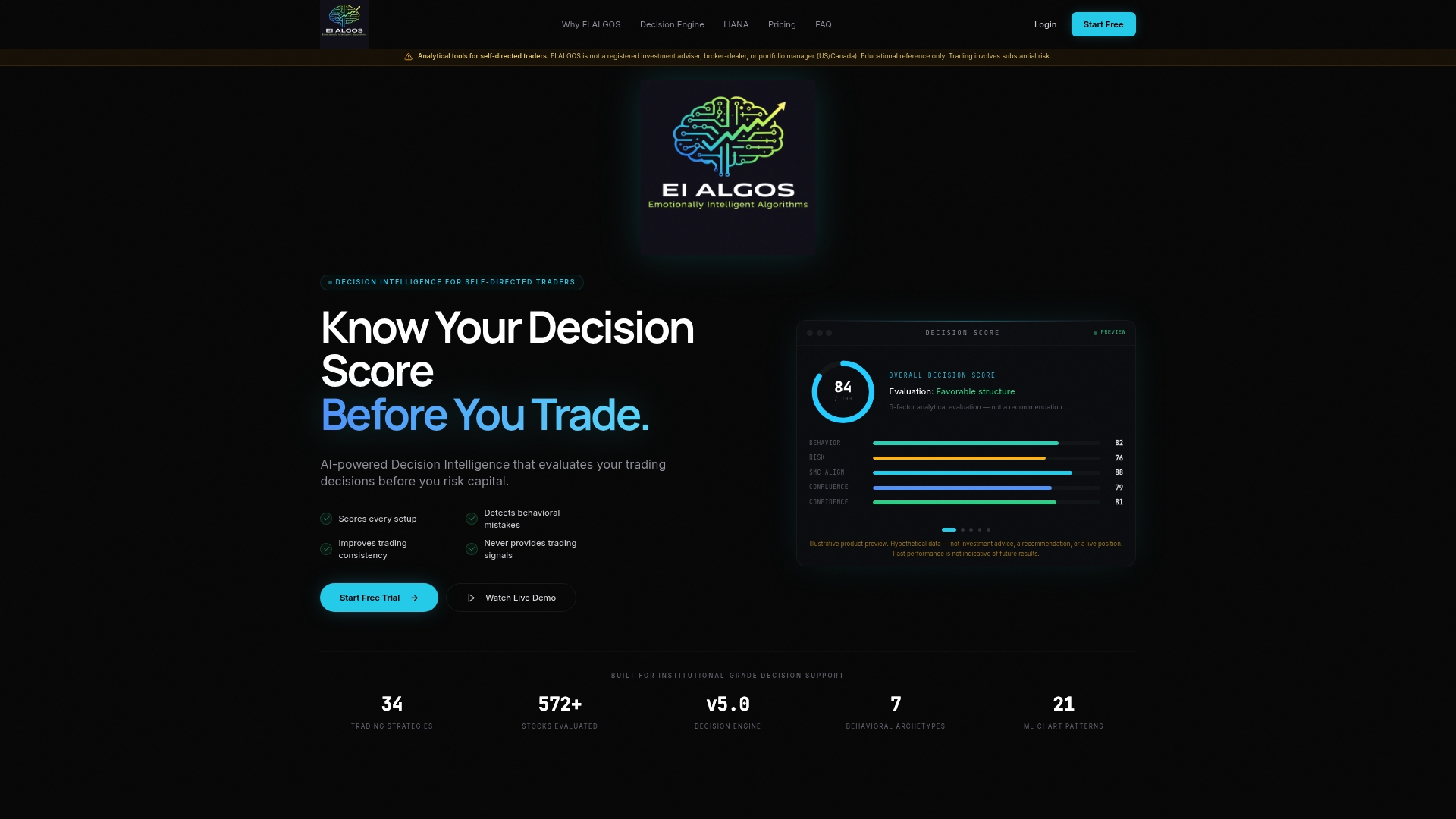
A reset only holds if something is actually watching your behavior after the timer runs out, and that's the gap most traders hit within a week. A six-factor decision engine can score each setup on the behavioral and psychological factors behind it, not on price forecasts, providing a decision score that flags rule breaks and hesitation patterns before they compound into a losing streak.
An AI assistant can review your patterns over time and surface specific habits that may be costing you, such as oversized entries after a loss or hesitation on valid setups, helping to make your post-session journaling more measurable. If you're serious about making a reset stick past the first good week, start with the Knowledge Hub to see how the decision-scoring framework works, or head straight to the subscription page to try the platform on your own trades.
Sources
- Trading Tilt Recovery - Trading Psychology Blog | FOMO, Tilt & Discipline | The Trading Reset
- Trading Psychology: The Mental Edge Updated May 2026
- Trading psychology: recovering from big losses — Charles Schwab
FAQ
What Are the Signs I Need a Mindset Reset?
Repeated rule breaks within a single session, sizing up after a loss to "make it back," hesitation on valid setups, and fixating on your P&L instead of your process are the clearest signals.
Why Do Most Day Traders Lose Money?
Most losing traders abandon their process under emotional pressure, chasing losses, oversizing after wins, and skipping their own rules, rather than lacking a viable strategy in the first place.
How Do I Prove a Trading Mindset Reset Actually Worked?
The only real proof is the next trade: if it meets your written criteria and you take it (or correctly sit out when it doesn't), the reset held; feeling calm without that follow-through proves nothing.
Can a Platform Like EI ALGOS Help With a Trading Reset?
Yes. A decision-scoring tool that flags behavioral errors in real time, rather than just price signals, gives you an objective check on whether your reset is actually changing your decisions or just your mood.