
Trading consistency means following your written rules the same way regardless of whether the last trade won or lost. It is not about making money every day. Your first move today: pull your last 30 trades and calculate your plan-adherence rate, the percentage where you followed every rule you had written down before entering.
That single number tells you more about your long-term odds than your win rate does.
- Log today's session now, while the details are fresh, including entry reason and exit reason.
- Rate your emotional state from 1 to 5 before you look at P&L.
- Calculate plan-adherence on your last 30 trades: rules followed divided by total trades.
Pro Tip: If your plan-adherence rate is low, stop adjusting your strategy and fix your execution first. A great strategy run inconsistently will underperform a mediocre strategy run the same way every time.
Key Takeaways
Consistent trading results come from measuring plan-adherence rate first, controlling position size with a fixed formula, and building repeatable pre-market and post-session habits.
| Point | Details |
|---|---|
| Plan-adherence rate comes first | Calculate rules-followed trades divided by total trades and target 80 to 85% before optimizing anything else. |
| Best-day share matters for funded accounts | Keep any single day's profit under common prop-firm thresholds, often 20 to 30% of total profit. |
| Six pillars build the foundation | A tested strategy, written rules, fixed risk, daily routine, journal, and self-awareness together produce consistency. |
| Recovery beats denial | Cut size in half and enforce a cooling-off day the moment FOMO or revenge trading shows up. |
| Score your setups before entering | Eialgos scores each trade across six behavioral factors so weak decisions get flagged before the loss, not after. |
Table of Contents
- What Trading Consistency Actually Means
- How Prop Firms Measure and Enforce Consistency
- How to Measure Your Own Consistency
- Daily and Weekly Habits That Build Trading Consistency
- Risk Rules That Protect Your Process
- Behavioral Traps That Quietly Break Consistency
- A Six-Factor Approach to Decision Quality
- Build a Decision Score Into Every Session With Eialgos
- Sources
What Trading Consistency Actually Means
Consistency is the stability of your decision process across changing outcomes, not the smoothness of your account balance. SDK Trading frames it as reviewable process stability, meaning you could hand your rules to another trader and they would make the same call you did.
That definition kills two myths fast.
- Consistency does not mean winning every day, or even most days.
- It does not mean identical profit and loss figures across sessions.
- It means the same entry criteria, the same risk per trade, and the same exit logic every single time you act.
Process consistency comes first. Results consistency (stable weekly or monthly profit) follows from it, sometimes over dozens of trades, sometimes over a couple hundred. Traders who chase results consistency directly tend to override their own rules the moment a losing streak hits, which destroys the very process that was working.
How Prop Firms Measure and Enforce Consistency
Funded trading programs care about a specific risk: a trader who gets lucky on one huge day, passes the evaluation, then blows up the account. Their fix is a best-day cap, a rule that limits how much of your total profit can come from a single session, often expressed as a percentage of overall gains.
A consistency calculator checks this by dividing your best single day's profit by your total profit across the evaluation period.
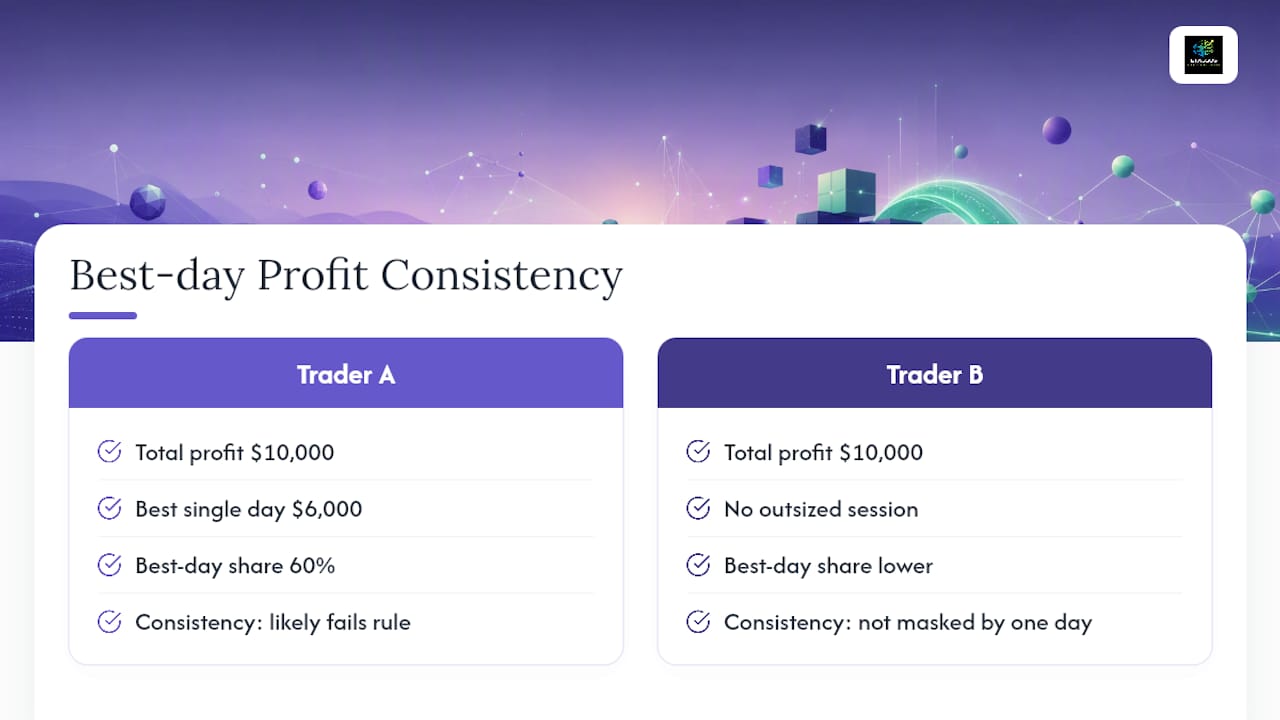
Here is a worked example. Say you earned $10,000 total profit over an evaluation, and $6,000 of it came from a single day. That is a large best-day share.
Trader A made the same total money as Trader B but likely fails a consistency rule anyway, because one outsized session masked an otherwise unreliable process.
How to Measure Your Own Consistency
You do not need a prop firm's evaluation to run this math on yourself. The metrics that matter are plan-adherence rate, equity-curve smoothness, win-rate stability across weeks, expectancy, profit factor, and max drawdown.
Plan-adherence rate deserves the most attention early. DayTradingToolkit recommends pushing it above roughly 80 to 85% before you spend energy optimizing anything else, since it is the one metric fully within your control regardless of what the market does. Sample size matters too: a handful of trades tells you almost nothing, so treat very small samples of trades as noise rather than signal.
- Export your trade history from your broker or journal for the last 30 to 60 trades.
- Tag each trade as "followed rules" or "deviated," and note why.
- Calculate plan-adherence: rules-followed trades divided by total trades.
- Plot your equity curve and look for one session dominating the whole gain.
- Compare your best single day's profit as a percentage of total profit against common prop-firm thresholds, even if you never plan to get funded.
Cadence matters as much as the metrics themselves. DayTradingToolkit suggests checking plan-adherence daily, reviewing win rate and profit factor weekly, and saving expectancy and equity-curve analysis for a monthly review.
- Daily: plan-adherence rate, emotional rating.
- Weekly: win rate, profit factor, biggest single-day contribution.
- Monthly: expectancy, max drawdown, equity-curve shape.
Pro Tip: Keep your tracking in one place, whether that is a spreadsheet or a dedicated trading journal. Jumping between broker reports and memory is where most self-assessment breaks down.
Daily and Weekly Habits That Build Trading Consistency
Habits do the heavy lifting that willpower cannot. Traders who stay consistent tend to protect sleep, pre-plan every entry, and log trades without exception, according to FXStreet's reporting on consistent trader behavior. None of that is exotic. It is boring, repeated, and it works.
Pre-market routine:
- Set fixed session hours and stick to them, even when a setup tempts you outside that window.
- Run a checklist against your predefined A+ setup criteria before entering anything.
- Rate your emotional state before the first trade. If it is a 4 or 5 on a 1 to 5 stress scale, sit the session out.
In-session rules:
- Time-box your trading window instead of watching charts all day.
- Cap your maximum trades per session so boredom does not masquerade as opportunity.
- Take a two-minute breathing pause after any loss before considering the next trade.
Post-session review:
- Tag each trade for setup quality, emotional state, and execution accuracy.
- Write one sentence capturing the day's biggest lesson while it is fresh.
- Review your full week's metrics on a fixed schedule, not whenever you remember.
Start small. Add one habit, like tagging emotion next to each trade entry, and only stack a second habit once the first one runs automatically. CompleteTradersEdge frames this as one of six pillars of consistent performance, alongside a tested strategy, written rules, consistent risk sizing, a daily routine, and a trading journal.
Pro Tip: Habit stacking works because it does not ask you to change your whole process overnight. One new habit, run for two weeks, beats five new habits abandoned after three days.

Risk Rules That Protect Your Process
Risk management is what keeps a bad session from becoming a bad month. The simplest fix for inconsistent position sizing is a fixed percent-of-account rule, commonly a small percentage of your account risked per trade, so you never negotiate size in the moment based on how confident you feel.
Position size follows a fixed formula: account risk divided by stop distance, with your risk-per-trade defined before you enter, not after.
- Set a daily loss limit and step away the moment you hit it, no exceptions.
- Enforce a rule for stepping back after two or three consecutive losses, even if the limit itself has not been reached.
- Place your stop where your trade thesis is proven wrong, never where the loss simply becomes uncomfortable to hold.
Forex Mentor Pro argues that most struggling traders lack process rather than knowledge, and risk-first sizing is usually the fastest fix available. A trader tracking portfolio performance alongside these risk metrics gets a clearer read on whether losses are process failures or normal variance.
Behavioral Traps That Quietly Break Consistency
FOMO, revenge trading, and overtrading share a pattern: each starts with one rule broken, then compounds fast. A trader who chases a missed move (FOMO) often oversizes the next entry to "catch up," which turns one skipped setup into a much larger loss than the original missed opportunity ever represented.
Revenge trading follows the same arc after a loss, and overtrading usually shows up when a trader mistakes activity for productivity.
- Reduce position size by half immediately after noticing any of these patterns.
- Enforce a one-day cooling-off period, no trading, after a revenge-trading episode.
- Review your journal specifically for the trigger, not just the trade outcome.
- Restore your normal daily loss limit only after a clean session.
Pro Tip: If the same trigger shows up three sessions in a row, that is not a bad week, that is a process gap. Consider a longer break and a full rules reset rather than another quick repair.
A Six-Factor Approach to Decision Quality
Habits and metrics tell you what happened. A decision-intelligence framework tells you why, before you place the trade. Eialgos built its platform around a six-factor scoring engine that evaluates decision quality, emotional state, risk adherence, execution quality, pattern-match strength, and context fit for every setup you consider.
Instead of another signal telling you to buy or sell, the score reflects how sound your own decision process looks right now, at this moment, for this specific setup.
- A threshold-based rule can gate trades entirely, for example skipping any setup scoring below your own personal cutoff.
- The LIANA assistant inside the platform turns repeated low scores into a personalized flag, so a recurring emotional-state problem gets surfaced instead of ignored.
- Traders can use score trends over weeks to see whether a specific habit change is actually improving decision quality or just feels like it is.
| Point | Details |
|---|---|
| Score before you trade | Running a decision score against six factors flags weak setups before entry, not after the loss. |
| Threshold gating reduces noise | Skipping any trade below your personal score cutoff removes impulsive, low-quality entries. |
| Pattern feedback compounds | LIANA surfaces recurring behavioral flags across sessions instead of one-off trade notes. |
Why Consistency Matters More Than It Looks
Traders remember the account that survived a bad streak because the rules held, not because the strategy was clever. Small, boring habits, repeated without exception, are what compound into an account that is still standing a year later.
Build a Decision Score Into Every Session With Eialgos
Eialgos gives self-directed traders something the habits and metrics above cannot on their own: a live, six-factor score on every setup before you enter, so you catch a process breakdown in the moment instead of in next week's review.
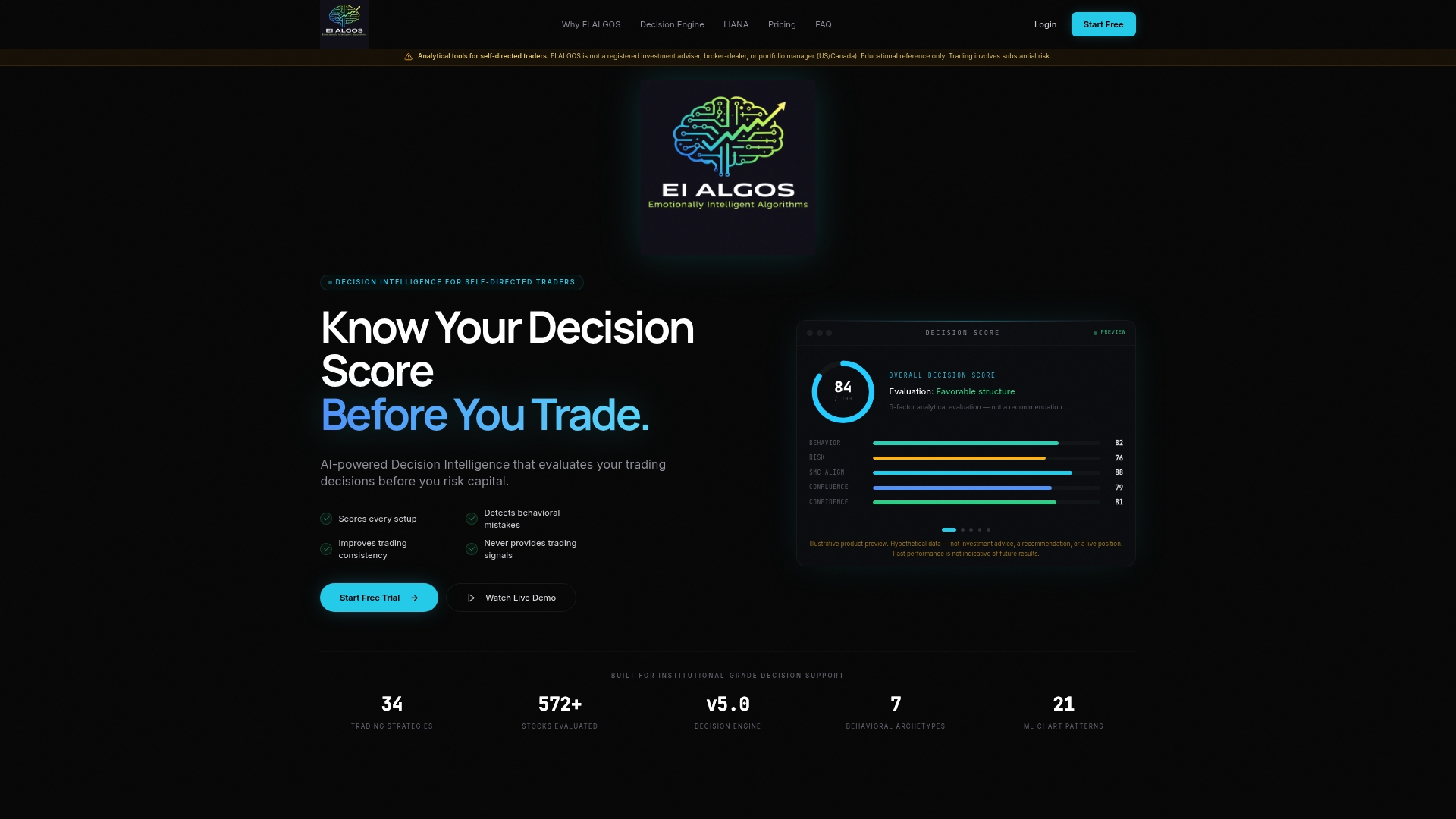
The platform evaluates decision quality, emotional state, risk adherence, execution quality, pattern-match strength, and context fit for each trade you're considering, then the LIANA assistant turns your recurring patterns into specific, personalized feedback rather than generic tips. That maps directly onto the plan-adherence tracking and emotional pre-flight checks covered above, except it runs automatically, in real time, instead of relying on you remembering to fill out a spreadsheet at night.
If you want to see how your current session scores, start with the free plan and run today's setups through the decision engine, or read the full breakdown of how the six-factor score works before you commit to a subscription tier.
Sources
- The habits that actually separate consistent traders from everyone else — FXStreet
- Consistency Calculator for Funded Traders — Myfxbook
- Building trading consistency: how to track & measure progress — DayTradingToolkit
- How to Achieve Consistency in Trading: The Six Pillars — CompleteTradersEdge
- Consistency in trading — SDK Trading
This article is general information, not a substitute for advice from a qualified financial advisor. Consult a qualified financial professional about your own circumstances before acting on anything here.