
Stop overtrading by setting three pre-committed rules before you touch your platform: a max-trades-per-session cap, a hard daily loss limit that triggers an automatic walk-away, and a written pre-market playbook that defines what a valid setup actually looks like. Do this now, before your next session, not after your next loss.
Here's the one-line action to take immediately: write your max trade count and your daily loss ceiling on a sticky note, put it on your monitor, and close the platform the second either number is hit. No exceptions, no "just one more."
Before you sit back down at your screen, lock in these three emergency rules:
- Set a hard number. Decide the maximum trades you'll take today and the dollar amount that ends your session if lost, and write both down before market open.
- Build in a kill switch. Use your broker's daily loss alert or a simple phone timer to force a shutdown when your limit hits, removing the decision from your hands in the moment.
- Write one sentence of criteria. Define, in writing, what a valid setup looks like today, so "I felt like it" can never again count as a reason to enter.
Key Takeaways
Overtrading is fixed by structural pre-commitment, not willpower: set hard caps while calm, enforce them with friction and a kill switch, and measure your process weekly starting with trades per day against your baseline.
| Point | Details |
|---|---|
| Set hard caps before the session | Write your max trades and daily loss limit down before market open, not after a loss. |
| Use a kill switch | Tie your daily loss limit to an automatic shutdown, whether a broker alert or closing the platform. |
| Tag every trade | Journal each trade as "planned" or "impulse" to reveal your true overtrading rate. |
| Use the 15-minute drill | Write one observation sentence every 15 minutes you don't trade to curb action bias. |
| Track trades per day first | Compare daily trade count to your baseline weekly; it's the single fastest signal of relapse. |
| Automate enforcement with Eialgos | Eialgos scores decision health before entry and automates journaling and kill-switch logic to enforce these rules consistently. |
Table of Contents
- How to Stop Overtrading: What It Actually Means
- What Are the Signs You're Overtrading?
- Why Your Brain Keeps Pushing You Back Into the Market
- Rules and Friction That Actually Stop Impulsive Trades
- Is Not Trading Actually the Right Move?
- A Copyable Daily Playbook You Can Use Today
- What Metrics Actually Show You're Improving
- Overtrading Pattern or Burnout: How to Tell the Difference
- Why Structural Fixes Beat Discipline Every Time
- An Honest Option for Enforcing Your Rules Automatically
- Frequently Asked Questions
- Sources
How to Stop Overtrading: What It Actually Means
Overtrading is trading more often, or in larger size, than your edge or your plan actually justifies. It's not about a specific number of trades. A market maker or a systematic scalper might place hundreds of trades a day and be perfectly disciplined, because every one of those trades comes from a tested rule set executed the same way every time.
The difference is the driver behind the trade. Edge-driven frequency comes from a strategy that has been tested and defines exactly when to act. Overtrading comes from emotion: boredom, frustration after a loss, or the itch to "make something happen" when the market isn't offering anything. Investopedia's definition of overtrading draws this same line, and it notes something most traders never consider: brokers can be guilty of overtrading too, through churning, which regulators explicitly prohibit. You don't have a regulator watching your own account. You're the only one who can catch it.
The cost is measurable and it's severe. Barber and Odean's landmark research on individual investors found that the most active traders underperformed the market by more than 6% annually after trading costs. That gap isn't from bad picks alone. It comes from commissions and spreads eating into every round trip, a risk profile that creeps wider as trades stack up, an expectancy that erodes because rushed entries have worse risk-to-reward than planned ones, and the slow burnout that turns a sharp trader into a reactive one by 2 PM.
What Are the Signs You're Overtrading?
Overtrading shows up in your behavior before it shows up in your account statement, if you know where to look.
Watch for these behavioral signs:
- Entering a trade within minutes of closing a loser, without a new setup forming.
- Increasing your position size mid-session to "win back" what you just lost.
- Feeling restless, jittery, or almost desperate to have a position on, even when nothing on your watchlist qualifies.
- Refreshing charts every few seconds instead of waiting for your alert to trigger.
- Justifying a trade after you've already clicked buy, instead of before.
The account-level numbers matter more than the feeling, because feelings lie and journals don't. Track these against your own baseline:
- Trades per day versus your plan. If your strategy calls for 2 to 4 quality setups and you're taking 10, that gap is your clearest signal.
- Win rate on a rolling basis. A sudden drop of 10 to 15 percentage points from your normal average usually means entries have gotten sloppy.
- Percentage of trades tagged "impulse" in your journal. If more than 20% of a week's trades fall into that bucket, treat it as an immediate stop signal, not a footnote.
- Round-trip costs as a share of gross profit. Rising commissions and spread costs relative to your P&L mean frequency has outpaced edge.
- Sudden jumps in trades per day versus your 20-day average. A doubling in a single session, especially after a loss, is the single most actionable red flag on this list. Act on it the same day, not at the next weekly review.
Why Your Brain Keeps Pushing You Back Into the Market
Willpower is not the problem, and that's actually good news, because it means the fix isn't "try harder." The problem is architecture. Your brain's dopamine system doesn't fire when you win a trade. It fires in anticipation of an uncertain outcome, which is exactly what a live chart provides every second the market is open.
The dopamine surge tied to anticipation and uncertainty is why scanning charts and near-miss trades feel compelling even when they produce no profit at all. The brain treats the possibility of a win the same way it treats the win itself, at least in the moment before the outcome is known.
Research on the VTA-NAc dopamine pathway shows this reward-anticipation circuit activates strongly under uncertainty, which explains why a near-miss, a trade that almost worked, can be just as reinforcing as an actual profit. That's the neurological trap: your brain rewards the act of looking for a trade, not the discipline of waiting for a real one.
Layer decision fatigue on top of that. Every choice you make in a session, whether to check a symbol, whether to enter, whether to widen a stop, draws on the same finite pool of prefrontal cortex control. As that pool depletes over the course of a session, your brain defaults to faster, more automatic, more emotionally driven responses. This is a documented pattern, not a character flaw, and some behavioral analysis of overtrading frames it as a largely subconscious, stress-driven response rather than a conscious choice you're failing to control. That's exactly why the fixes below rely on structure instead of resolve.
Rules and Friction That Actually Stop Impulsive Trades
Structural fixes work because they remove permission rather than testing your resolve in the heat of the moment. A practical rule set for avoiding overtrading centers on exactly this: hard caps, forced pauses, and friction, not motivational willpower.
Core structural rules to set today:
- A max-trades-per-session cap, set before the market opens, not adjusted mid-session.
- A hard daily loss limit tied to an automatic kill switch, whether that's a broker alert or simply closing the platform.
- A mandatory walk-away after 2 to 3 consecutive losses, no exceptions for "the next one feels right."
- A defined session end time, so trading doesn't quietly extend into fatigue-driven hours.
- Added confirmation friction on your platform, like a manual size entry instead of one-click execution, which slows down impulsive clicks.
Process controls that reinforce the rules:
- Write a pre-market playbook the night before or first thing in the morning, defining today's valid setups in plain language.
- Build a 3 to 5 question pre-trade checklist: Does this match my plan? Is my size correct? What's my exit if I'm wrong?
- Journal every trade with an impulse tag, marking each one "planned" or "impulse" at the moment you take it, not after the fact.
- Cap your watchlist at 5 to 10 symbols per session, tightening that further on high-volatility days to cut scanning overload.
- Use price alerts instead of constant screen watching, so the market notifies you instead of the other way around.
To set a realistic daily cap, count your genuine setups from the past 20 sessions and divide by 20. If you averaged three real, plan-qualifying setups a day, your cap is three, not five "just in case."
Pro Tip: Convert your action bias into analytical work instead of trades. Every 15 minutes you choose not to trade, write one sentence describing what you observe in the market. This gives your brain the stimulation it's craving without putting a dollar at risk, and it builds a behavioral data set you can review later.

Is Not Trading Actually the Right Move?
Flat is not the same as failing. When the market doesn't match a single setup in your playbook, sitting on your hands is the highest-value decision available to you, even though it feels like doing nothing.
The 15-minute observation drill mentioned above works because it interrupts the action bias directly. Writing a sentence like "price is chopping in a tight range with no volume expansion" gives your brain a legitimate, low-stakes outlet for the urge to engage. Over a few weeks, those sentences become a record of what non-setups actually look like, which sharpens your entry criteria far more than another 20 impulsive trades ever would.
When the urge to trade hits and nothing on your list qualifies, try one of these instead:
- Reopen your journal and review your last three impulse trades.
- Check whether any of your price alerts have actually triggered.
- Get up, stretch, and drink water away from the screen for five minutes.
- Take a short walk if the urge persists past ten minutes.
A Copyable Daily Playbook You Can Use Today
Paste this into your trading notes before your next session and fill in your own numbers.
Pre-market checklist:
- Review yesterday's journal entries and flag any impulse trades.
- Write today's valid setup criteria in one or two sentences.
- Set your watchlist to 5 to 10 symbols maximum.
- Set your max-trades cap for the session.
- Set your hard daily loss limit and kill-switch method.
- Define your consecutive-loss walk-away rule.
- Set a firm session end time.
Example: momentum scalp trader. Watchlist of 6 symbols, max 5 trades, daily loss cap of 2% of account, walk-away after 2 consecutive losses, session ends at 11:30 AM ET to avoid the midday lull where boredom-driven entries tend to spike.
Print or pin this before you trade:
- Confirm today's playbook criteria are written down.
- Confirm your max-trades number and daily loss limit are visible on your screen.
- Confirm your kill-switch method is active.
- Confirm your watchlist is trimmed to your session limit.
What Metrics Actually Show You're Improving
Feelings of discipline are unreliable. Numbers are not. A practical journaling framework built around weekly reviews of trade quality, timing, emotional state, and rule violations gives you the clearest read on whether you're actually changing behavior.
| Metric | How to measure it | Realistic short-term target | Action if it fails |
|---|---|---|---|
| Trades per day | Count logged trades vs. your session cap | Within 1 trade of your cap, most sessions | Tighten your watchlist and revisit your pre-trade checklist |
| Percent tagged "impulse" | Journal entries marked impulse vs. planned | Below 15% of weekly trades | Add a mandatory pause before every entry |
| Win rate: planned vs. impulse | Compare outcomes by tag over a rolling 20 trades | Planned trades outperform impulse trades by a clear margin | Review what triggers impulse entries and add friction there |
| Average R per trade | Result divided by initial risk, averaged weekly | Positive and stable week over week | Reduce size until expectancy stabilizes |
| Process compliance rate | Percent of trades that followed your written checklist | very high | Shorten the checklist to 3 questions and reassess |
| Expectancy | (Win rate × average win) minus (loss rate × average loss) | Trending upward month over month | Pause and rebuild the playbook before resuming full size |
Review these weekly at minimum, and do a deeper monthly pass looking for trends rather than single bad days. If two or more metrics worsen for two consecutive weeks, that's your cue to cut size and rebuild your process before scaling back up, not to push through and hope the next week fixes itself.
Overtrading Pattern or Burnout: How to Tell the Difference
Not every stretch of overtrading calls for the same fix. A pattern responds to rules. Burnout doesn't, and applying rules to burnout usually just adds more frustration on top of exhaustion.
Watch for these burnout warning signs specifically:
- Persistent exhaustion that doesn't lift after a normal night's sleep.
- Disrupted sleep, especially replaying trades or checking prices at night.
- A noticeable drop in cognitive control, like forgetting your own stop levels.
- Inability to follow even the simplest rule you set for yourself that morning.
If you recognize burnout, the fix is rest, not stricter rules. Some coverage of overtrading points out that persistent overtrading can signal burnout that requires an actual multi-day break, real recovery time, and in some cases professional support, rather than another round of tighter caps.
Use this quick checklist to decide: if exhaustion and rule-breaking persist for more than a week despite your caps holding, pause trading entirely. If your caps are working but frequency still creeps up, that's a pattern to correct with tighter friction, not a reason to stop.
Why Structural Fixes Beat Discipline Every Time
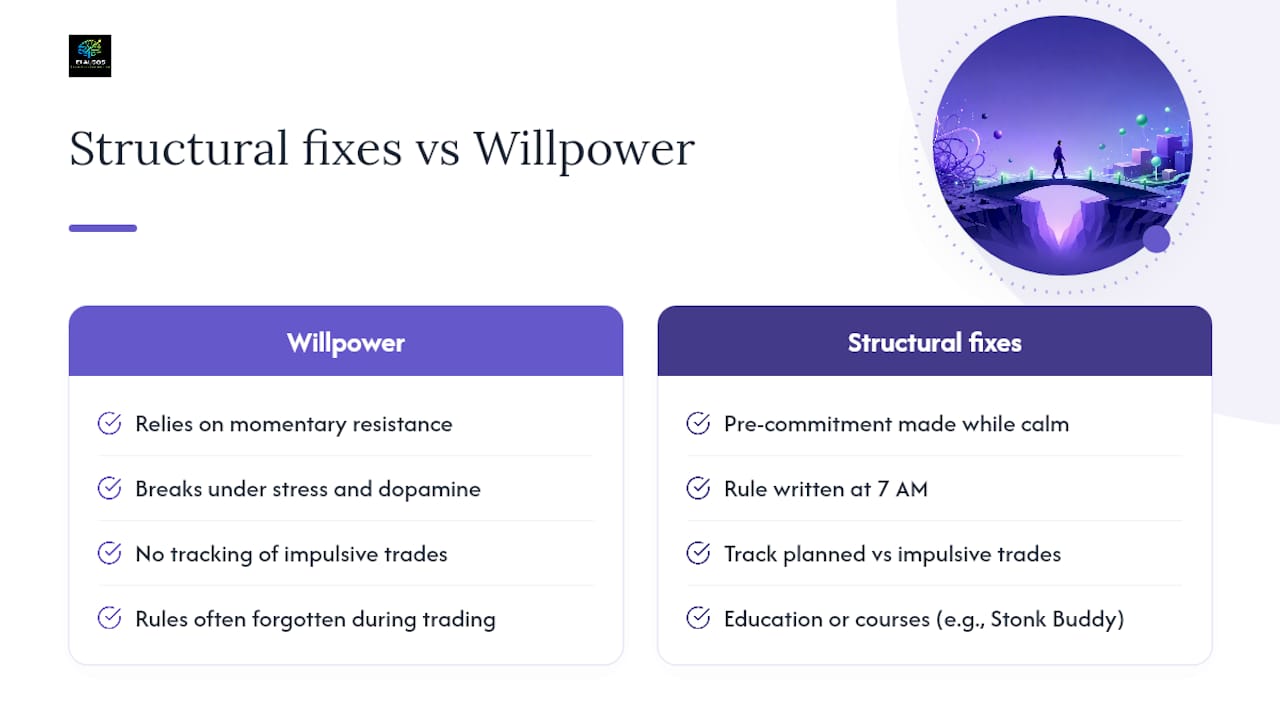
Most trading advice treats overtrading as a willpower problem: try harder, want it more, be stronger next time. That framing sets traders up to fail repeatedly, because it ignores the actual mechanism. Overtrading is a dopamine-driven, stress-triggered pattern that runs beneath conscious decision-making. Telling someone to just resist it is like telling someone to just not get hungry.
What actually works is pre-commitment made while calm, before the market has a chance to hijack your judgment. A rule written at 7 AM survives contact with a loss in a way a rule you're "trying to remember" at 1 PM never will. This is also where most self-directed traders underestimate how much measurement matters. You can't fix what you don't track, and most traders have no real record of how many of their trades were planned versus impulsive until they start tagging them.
The other underestimated piece is education. Working with people who've been through the same behavioral traps, whether through a mentor or a structured course from a resource like Stonk Buddy's trading education marketplace, can shortcut a lot of the trial and error that comes from figuring out your own triggers alone.
Eialgos built its six-factor decision engine around this exact gap. Instead of scoring a chart or a signal, it scores the health of the decision behind the trade, which is a different problem than almost every other trading tool tries to solve. The LIANA assistant then turns that scoring into personalized feedback over time, showing a trader their own patterns instead of a generic rulebook. None of this replaces the caps and playbooks above. It automates enforcing them, which matters, because the whole reason overtrading persists is that enforcement in the moment is hard. Behavior change here is a practice, not a switch you flip once and forget.
An Honest Option for Enforcing Your Rules Automatically
Writing rules on a sticky note works until the tenth trade of the day, when fatigue makes it easy to talk yourself past your own limit. That's the gap a decision-intelligence platform is built to close.
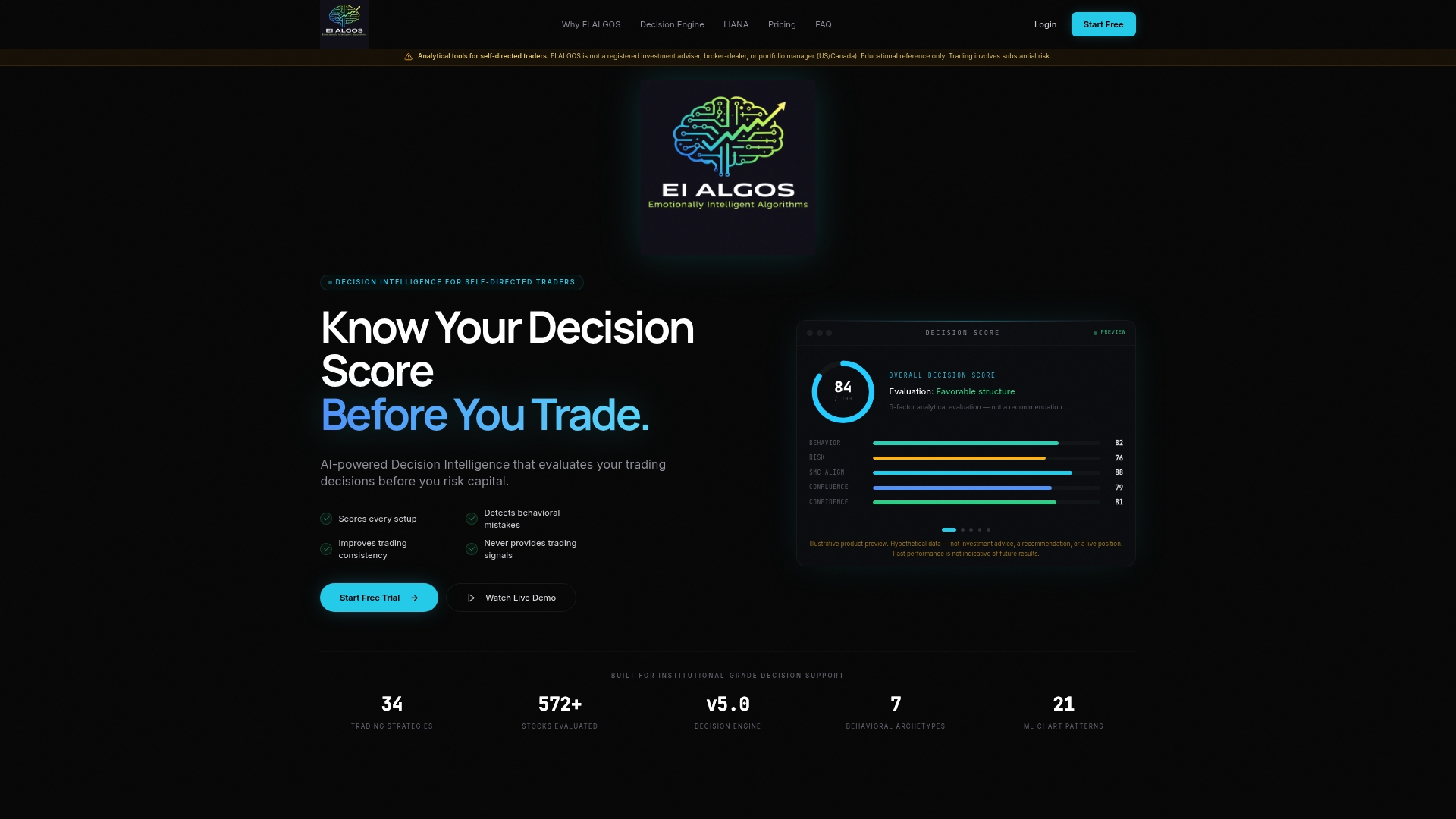
Eialgos evaluates the psychological and behavioral factors behind each setup using a six-factor analytical engine, scoring decision health before you click buy rather than after you've already taken the loss. It automates the exact structural fixes covered above: a decision score that flags a setup before entry, watchlist limits that keep scanning from spiraling, kill-switch logic tied to your own thresholds, and journaling integration that tags planned versus impulse trades automatically instead of relying on you to remember at the end of a long session. The LIANA assistant reviews your patterns over time and surfaces the specific behavioral errors dragging down your results, which is a level of personalized feedback a static spreadsheet or a generic rulebook can't match. If you're ready to see your own decision health scored in real time, check your Decision Score before your next trade or view Eialgos subscription options to get started.
Frequently Asked Questions
How many trades a day counts as overtrading? There's no universal number. What matters is whether your trade count matches genuine setups from your plan. If your strategy typically produces 2 to 4 qualifying setups a day and you're taking 10, that gap itself is the signal, regardless of the raw count.
What's the fastest way to stop overtrading this week? Set a max-trades cap and a hard daily loss limit before your next session, write both down, and enforce them with a kill switch like a broker alert or simply closing the platform. Pair that with tagging every trade "planned" or "impulse" in your journal.
Can overtrading ever be a sign of a good strategy? Yes, if the frequency is edge-driven rather than emotion-driven. A tested strategy that genuinely produces many valid setups a day isn't overtrading. The problem is trading beyond what your specific edge and plan justify.
Does journaling actually reduce overtrading? Journaling won't stop the urge on its own, but tagging trades as planned versus impulse gives you the data to see your real overtrading rate, which is usually higher than traders assume until they track it for a few weeks.
When should I take a break instead of tightening my rules? If exhaustion, sleep disruption, or an inability to follow even simple rules persists for more than a week despite your caps holding, treat it as burnout and take a multi-day break rather than adding stricter rules on top of fatigue.
Sources
- How to Stop Overtrading (And What's Actually Driving It) — The Wall Street Coach
- How to Avoid Overtrading: 8 Practical Rules | Volity
- Overtrading Explained: Causes, Types, and Prevention Methods — Investopedia
- How to Stop Overtrading: A Practical Guide — The Paper Trading Journal