
Trading hesitation is the pause between a setup that meets your rules and the click that takes it. It rarely comes from missing information. It comes from how you have learned to feel about being wrong, and that is a pattern you can measure and fix. The fastest way to loosen it is to stop judging each entry by how it feels and start scoring each setup against fixed criteria, then review what you did. That is the approach behind EI ALGOS, which evaluates the decision process rather than handing you signals.
TL;DR
- Hesitation is usually a symptom of self-doubt and loss avoidance, not a lack of analysis.
- Past losses, especially a second loss in a day, can distort how you read the next valid setup.
- Swinging into recklessness to "beat" fear only swaps one mistake for another.
- A written plan, a pre-entry checklist, fixed position size and a review of skipped trades turn hesitation into data.
- Scoring each setup against the same factors every time gives you a decision basis that does not depend on your mood.
Table of Contents
- What trading hesitation actually is
- Why traders freeze: three common drivers
- Is your hesitation a warning or a reflex?
- Why "just be fearless" does not work
- A practical routine to reduce hesitation
- A worked example
- Do not mistake a streak for a signal
- Where EI ALGOS fits
- Perspective: hesitation is data
- FAQ
- Sources
What trading hesitation actually is
You see the setup. Price is at your level, the trigger has printed, and your plan says go. Then you wait. You re-check the chart, open another timeframe, look for one more confirmation. Price moves without you.
Mark Douglas, in The Disciplined Trader, defines self-trust as knowing what to do at the moment it needs doing and doing it without hesitation. He also argues that fear narrows perception: a frightened trader sees mainly the information that confirms the fear, and can end up immobilized at execution even while knowing exactly what the plan calls for.
That description matters because it changes the problem. If hesitation were an information gap, more analysis would cure it. Since it is a reaction at the moment of execution, the cure lies in the decision process around that moment.
Why traders freeze: three common drivers
Fear of the next loss
Loss feels bigger than an equal gain feels good. This is loss aversion, a core idea in behavioral finance. A 2022 paper in Finance and Stochastics modeled a speculative trader with prospect-theory preferences, where a unit loss hurts much more than a unit gain helps. Depending on the setup, the optimal behavior in the model can be buy-and-hold, buying low and selling high, buying high and selling higher, or not trading at all. In other words, "no trade" is one rational-looking outcome of the same preferences that drive other mistakes.
For a deeper look at how this bias shapes exits, see our piece on loss aversion in trading.
The second loss of the day
Jared Tendler's The Mental Game of Trading gives an example in which a second loss in the same day triggers worry about future losses, and that worry can contaminate how the next trade is executed. The setup in front of you may be identical to the one that worked last week. Your read of it is what changed.
The opposite error exists too. A peer-reviewed study of Chicago Board of Trade proprietary traders (Coval and Shumway, Journal of Finance, 2005) found that traders were highly loss-averse and regularly took above-average afternoon risk to recover morning losses. Hesitation and revenge trading are two faces of the same loss-driven state. If you have ever skipped a clean entry after a loss and then forced a poor one an hour later, you have seen both.

Self-doubt in the plan itself
Douglas treats hesitation as the visible symptom of self-doubt. In his view, to the degree self-doubt exists, fear, anxiety and confusion exist in the same degree, and negative experiences in that state reinforce a belief of inadequacy. A trader who does not trust their own rules will look for reasons not to follow them.
That trust problem is not unique to trading. Writing on rebuilding self-trust without chasing perfection makes a similar point for high performers in general: confidence in acting comes from a track record of keeping your own commitments, not from feeling certain first.
Is your hesitation a warning or a reflex?
Not every pause is a flaw. Sometimes the market has genuinely changed since you wrote the plan. The skill is telling the two apart, and you can do it with a simple test applied in the moment.
Ask three questions before you decide to skip:
- Can I name the specific plan rule that is not met? If a criterion on your checklist is unmet, such as the trend filter, the level or the risk-to-reward minimum, the pause is a valid no-trade.
- Is my reason about the setup or about the last trade? "Volume is below my minimum" is about the setup. "I took a loss on this pattern yesterday" is about you.
- Would I take this trade if my last three trades had been winners? If yes, the hesitation is a reaction, not analysis.
If you can name an unmet rule, you have a documented reason to skip, and that is discipline. If you cannot, you have found a behavioral pattern. Log it either way. Over weeks, the log shows whether your skipped trades would have followed your rules, which is the evidence you need to decide how much to trust the pause.
Why "just be fearless" does not work
The most common advice is to push through: take the trade, ignore the feeling. The research summary above suggests why it backfires. Cecile van der Waal, writing in The Mental Game of Trading, notes that traders often try to break through fear by throwing caution out the window. They swing into defiance, which removes the feeling but creates different mistakes: oversized positions, skipped stops, entries that break the plan. She argues that balance between fear and defiance comes automatically only after the performance flaws that contaminate your perspective on losing are corrected.
So the goal is not to feel nothing. It is to build a process where the feeling no longer decides the outcome.
A practical routine to reduce hesitation
This routine works for beginners and experienced traders alike. Each step removes one reason the pause can win.
Step 1: Write entry criteria as yes/no rules
Vague rules ("strong momentum") invite second-guessing. Replace them with testable ones: price above a defined moving average, a trigger candle closing beyond a level, a minimum risk-to-reward ratio. When every item is yes or no, there is less room for fear to argue. Our guide on how to be a disciplined trader covers building the plan, routine and review in full.
Step 2: Use a pre-entry checklist
Before every entry, run the same list: criteria met, stop level defined, size calculated, no more than your daily loss limit used. A checklist moves the decision from "how do I feel?" to "are the boxes ticked?" If all are ticked, you enter. If one is not, you skip and write down which one.
Step 3: Fix your position size in advance
Hesitation grows with the amount at stake. If a single loss can hurt your account in a way you will replay for days, your mind will protect you by freezing. Set risk per trade as a fixed percentage of the account before the session, so the size is not renegotiated at the click. Our article on trade management and the 2% rule walks through how to apply it.
Step 4: Set a daily loss limit
Because a second loss can distort the third decision, decide in advance what ends your session. A hard stop for the day protects your judgment as well as your capital.
Step 5: Journal the skipped trades, not only the taken ones
Most journals record executions. Hesitation lives in the trades you did not take. For each skip, record the setup, which rule was unmet (or "none"), what you felt and what price did afterward. After 20 to 30 entries you will see whether your pauses cluster after losses, at certain times of day or on certain patterns.
Step 6: Review on a schedule
A weekly review that asks "where did I deviate from my plan?" turns vague guilt into specific fixes. The trader self-assessment gives a seven-step review of your decisions, and a 30-day behavioral trading analysis shows how to look for bias across a full month of trades.
Step 7: Check for fatigue
Late in a long session, choices feel heavier and avoidance feels attractive. If your skipped trades cluster late in the day, read about decision fatigue in trading and consider shortening your window.
A worked example
Say your plan risks 1% per trade on a $20,000 account, so $200. You take two stopped-out trades before 11 a.m. At noon your setup appears again. All criteria are met.
Without a process, the second-loss worry Tendler describes shows up, you tell yourself you will "wait for confirmation," and price runs. With a process, you run the checklist, find every box ticked, confirm your daily loss limit has room (say, 3% or $600, with $400 used), and enter with the same $200 risk. If the trade stops out, you have hit your limit and the session ends by rule, not by emotion.
The outcome of that single trade is not the point. The point is that the decision matched the plan, and that is what you can repeat.
Do not mistake a streak for a signal
After several losses, many traders think a win is "due," or that the strategy has stopped working. Both are inferences from a short sequence. Our article on the gambler's fallacy in trading explains why streaks do not predict reversals, which helps you judge the next setup on its own merits.
Where EI ALGOS fits

A journal and a checklist work only if you apply them consistently while under pressure. EI ALGOS is built for that moment. It is a Decision Intelligence platform for self-directed traders that scores each setup on a six-factor analytical engine focused on the psychological and behavioral side of the decision. It does not issue trade signals or predictions, so the decision stays yours. It also detects behavioral errors, and its LIANA assistant gives personalized feedback on your process based on your own trade history.
There is a free plan at $0 per month, and paid tiers at $49 per month (Starter), $129 per month (Pro) and $229 per month (Elite). See the plans and what each includes, or read how a decision score evaluates a setup before you enter.
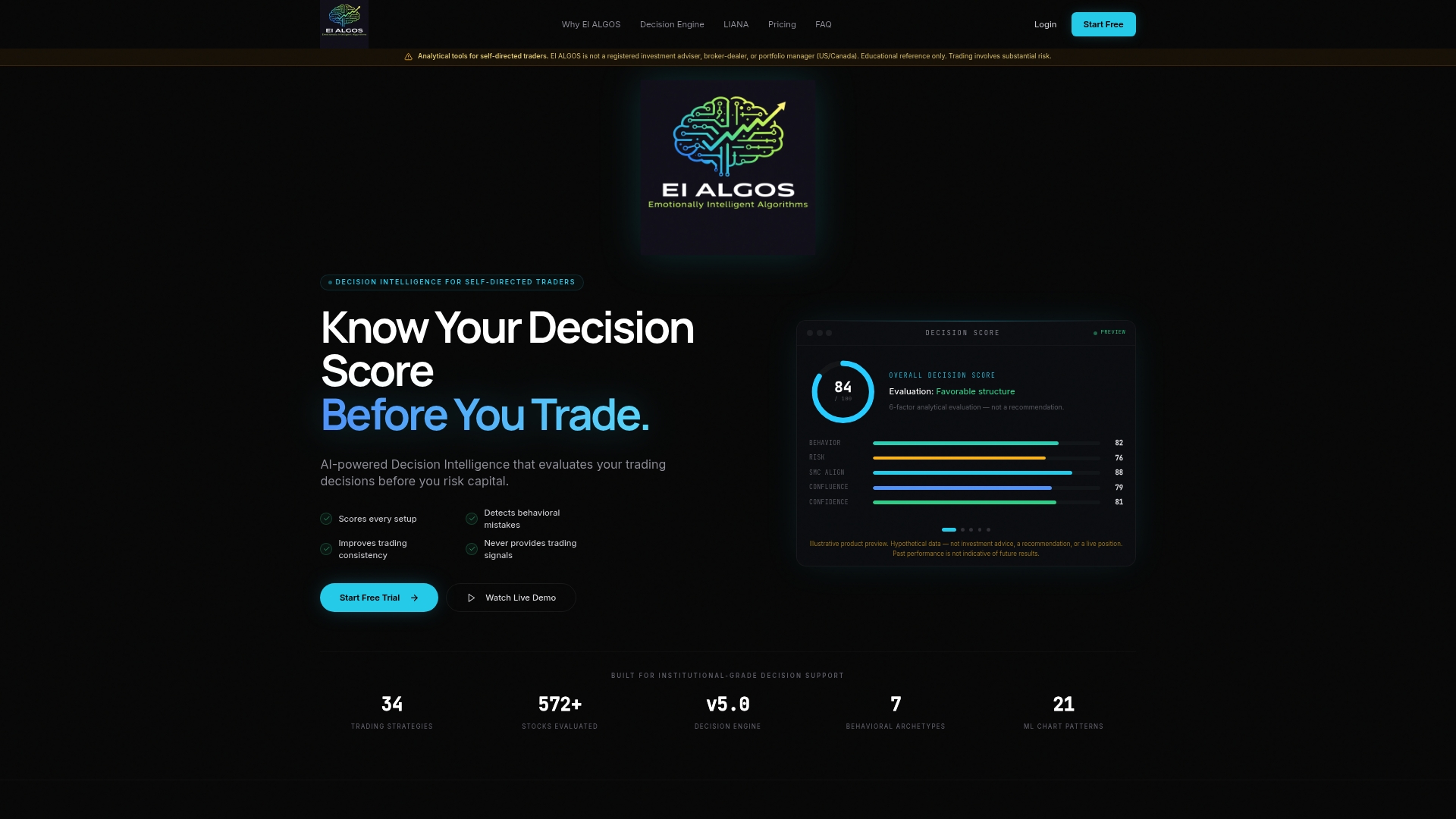
If your pattern is skipped entries after losses, the trading journal with AI-coached trade review and trader behavior analysis are the places to start.
Perspective: hesitation is data
Most traders treat hesitation as an enemy to defeat. We treat it as information about the decision process. When you freeze on a setup that meets your rules, something other than the chart is driving the choice, and that something can be identified.
This is why we built EI ALGOS around decisions rather than predictions. A signal tells you what to do, which leaves your doubt exactly where it was. Scoring each setup against the same six factors, and then reviewing how you responded, shows you which setups you trust, which you avoid and when your behavior drifts from your plan.
The goal is not to remove caution. It is a process in which caution is a documented reason, not a reflex. When your choices are consistent, your results become something you can learn from, and trust in your own method follows from the record, not from willpower.
Anantha
FAQ
How do I get rid of fear in trading?
You reduce it more than you remove it. Fix your risk per trade, write entry rules as yes/no criteria and run a checklist before every entry. Reviewing your trades weekly shows where fear changed your decisions, so you can correct those specific behaviors.
Why do I hesitate after a loss even when the setup is clear?
Loss aversion makes a loss weigh more heavily than an equal gain, and a recent loss can color your read of the next setup. A daily loss limit and a pre-entry checklist keep that reaction from deciding the trade. Logging each skip with the rule involved helps you see how often it happens.
Is hesitation ever a good sign?
Yes, when you can name a plan rule that is not met. That is a valid no-trade. If you cannot point to a specific criterion, the pause is likely a reaction, and it belongs in your journal as a behavioral pattern to review.
Should I just force myself to take every setup?
Forcing trades without changing the process tends to swap fear for defiance, which produces its own mistakes such as oversizing or ignoring stops. A better approach is to make the rules specific and the size fixed so that taking a valid setup is routine.
Sources
- The Disciplined Trader, Mark Douglas (1990)
- The Mental Game of Trading, Jared Tendler (2021)
- Do Behavioral Biases Affect Prices? Coval and Shumway, Journal of Finance (2005)
- Speculative trading, prospect theory and transaction costs, Finance and Stochastics (2022)