
Paralysis by analysis is the inability to decide because you are thinking too much, holding too much information or fearing the wrong choice. Investopedia describes it as a pattern that leads to missed opportunities and delayed decisions. In trading, it looks like a setup you spot, check five more times and then watch move without you. The fix is rarely more data. It is a defined process with a clear stopping point, and this guide shows you how to build one.
TL;DR
- Paralysis by analysis is a decision problem, not an information problem: more indicators and more checking rarely add clarity once your criteria are met.
- Write your entry criteria, stop-loss and position size before the trade, and keep the criteria list short.
- Use a binary checklist and a decision deadline so research has an endpoint.
- Judge each trade by whether you followed your process, not only by the result.
- Review your own decision patterns over time to see where hesitation starts. That is what our platform is built for.
Table of Contents
- What paralysis by analysis looks like on a trading screen
- Why smart traders get stuck
- How to tell caution from paralysis
- A step-by-step process to decide and act
- Review decisions without judging only by outcomes
- When hesitation follows losses
- Our perspective
- Put a process around your decisions
- FAQ
- Sources
What paralysis by analysis looks like on a trading screen
You know the symptoms. The chart is open, the trend is aligned, the level is clear. Then you add another indicator, open a higher timeframe, scan the news and ask a forum. Ten minutes later you feel less sure than when you started.
Capital.com explains that the trader may fail to enter a setup, delay an exit or stay frozen while the market moves. Monkeytrade describes the same state as being overwhelmed by information, options or the fear of being wrong, and links overanalysis to missed opportunities, inconsistent performance and reduced confidence.
Common forms include:
- The missing entry. The setup meets your rules, but you wait for one more confirmation.
- The late entry. You finally act after the move has started, with a worse risk-to-reward ratio. Monkeytrade calls this taking the same trade under worse conditions.
- The frozen exit. You know where your stop-loss sits, but you keep rechecking instead of managing the position.
- The endless watchlist. You research twenty tickers and trade none.
Why smart traders get stuck
Paralysis by analysis feels like diligence, which is why it lasts. Three mechanisms keep it going.
More information, more confidence, not more accuracy
DayTradingToolkit summarizes research by Tsai, Klayman and Hastie showing that extra information raised people's confidence more than it improved their accuracy. Extra charts can make you feel more prepared without making you more right. When you then notice conflicting signals, that confidence turns into doubt.
Too many choices
CompleteTraderEdge applies Barry Schwartz's paradox of choice to trading: every added indicator brings more conflicting information and more cognitive load, until acting feels impossible. A cluttered chart is a cluttered decision.
Fear dressed up as thoroughness
Monkeytrade notes that the brain treats inaction as protection in uncertain environments, so a trader who feels less confident analyzes more, and then feels even less confident. Capital.com adds that the pattern can reinforce itself: you freeze, watch the trade work, feel regret, and approach the next setup with more pressure and more checking.
CompleteTraderEdge makes a sharp point here. A trader who needs five confirmations is often looking for certainty in a probabilistic market. A strategy with a 55% win rate loses 45% of the time no matter how much analysis came before the entry. The extra work cannot remove that.
How to tell caution from paralysis
Caution reaches a decision in a reasonable time. Paralysis keeps searching even when new information is unlikely to change the answer. Capital.com frames the test well: ask whether the extra analysis is helping the decision or only delaying it.
Use these signals:
- You have stared at the same chart for around 15 minutes and feel less certain than when you began. Monkeytrade treats this as the line between due diligence and overanalysis.
- Your criteria are already met, but you are still opening new tabs.
- You are checking for evidence that confirms a decision you have already made, or for a reason to skip it.
- You have no written point at which research ends.
That last signal matters most. One US financial blog for self-directed investors, Unleashed Financial, argues that the problem is often not missing data but a missing stop condition: a point where you trust your process and execute.
A step-by-step process to decide and act
These steps convert open-ended analysis into a finite routine. Adapt the numbers to your own style.
- Write the plan before the market opens. Define entry criteria, an exit strategy including the stop-loss, and position-sizing rules. A commonly cited guideline is to risk no more than 1% to 2% of account capital per trade, as The Wager Theorem notes. Confirm what suits your account and risk tolerance with a licensed financial professional.
- Keep the criteria short. CompleteTraderEdge suggests defining a setup in three criteria or fewer. DayTradingToolkit likewise recommends no more than three filters: scan rules, setup presence and defined risk.
- Build a binary checklist. Monkeytrade suggests 4 to 6 yes/no questions: does the setup match a predefined pattern, is the trend aligned, is risk-to-reward at least 1:2, is the stop defined, is position size within your limits. Every answer is yes or no. Nothing is "maybe."
- Pre-plan your levels. Write the level, trigger, stop, target and size for each watchlist name before the open. Having support, resistance and invalidation levels marked in advance turns the live decision into a comparison against your plan rather than a fresh investigation.
- Set a decision deadline. DayTradingToolkit proposes acting before the next candle opens after the trigger candle closes. CompleteTraderEdge suggests 60 seconds once your first two criteria trigger. Pick a rule and keep it.
- Limit your information diet. The Wager Theorem recommends two or three core indicators, a few trusted news sources and a scheduled block of time for analysis, such as an hour before the open, rather than constant monitoring.
- Practice in a low-pressure setting. Capital.com notes that a demo account lets you rehearse the decision process before you apply it live.
- Accept the imperfect trade. Some trades will lose by design. A plan that is followed is the goal, not a plan that never loses.
A worked example of the cost of waiting
DayTradingToolkit offers a hypothetical case: four minutes of checking on a stock moved the win rate needed to break even from 34.8% to 64.4%. The numbers are illustrative, but the logic holds for any entry. When price moves while you hesitate, your stop distance, reward and break-even odds change. OptionsNest makes the same point for options: a stock at support with favorable implied volatility will not wait for you to finish a tenth analysis, and by the time you feel ready the bounce may be over.

A simple way to use this: before each trade, note your planned entry and stop. If you enter late, recalculate the risk-to-reward ratio. If it no longer meets your minimum, the checklist gives you a clear answer to skip it. That is a decision, not paralysis.
Review decisions without judging only by outcomes
What you do after the trade determines whether the next one is easier. Trading Academy recommends asking after each trade whether you followed your process, and describing trades as well-executed or poorly executed rather than good or bad. It also advises recording pre-trade reasoning and emotions in a journal, reviewing losses without rewriting history and defining success by execution rather than the equity curve.
A useful review asks:
- Did I enter inside my deadline, or after extra checking?
- Did my checklist answers match what I did?
- How long did I spend on this setup compared with others?
- Which trades did I skip that met every criterion?
The last question is the one most traders skip. Missed valid setups are the most direct record of paralysis, and they rarely show up in a profit and loss statement.
When hesitation follows losses
Overthinking often grows after a losing streak. DayTradingToolkit cites Lo, Repin and Steenbarger (2005), who found that day traders with stronger emotional reactions to losses performed worse. The article reads this as one quiet route to overthinking: fear of another loss feels like caution, while the extra checking is a way to avoid deciding.
If this describes you, shrink the decision. Reduce position size within your plan, keep the checklist unchanged and focus on executing the process once. The aim is to rebuild the link between a decision and a calm routine, instead of a decision and stress.
Our perspective
We built EI ALGOS around one belief: most self-directed traders do not lack information. They lack a clear view of how they decide.
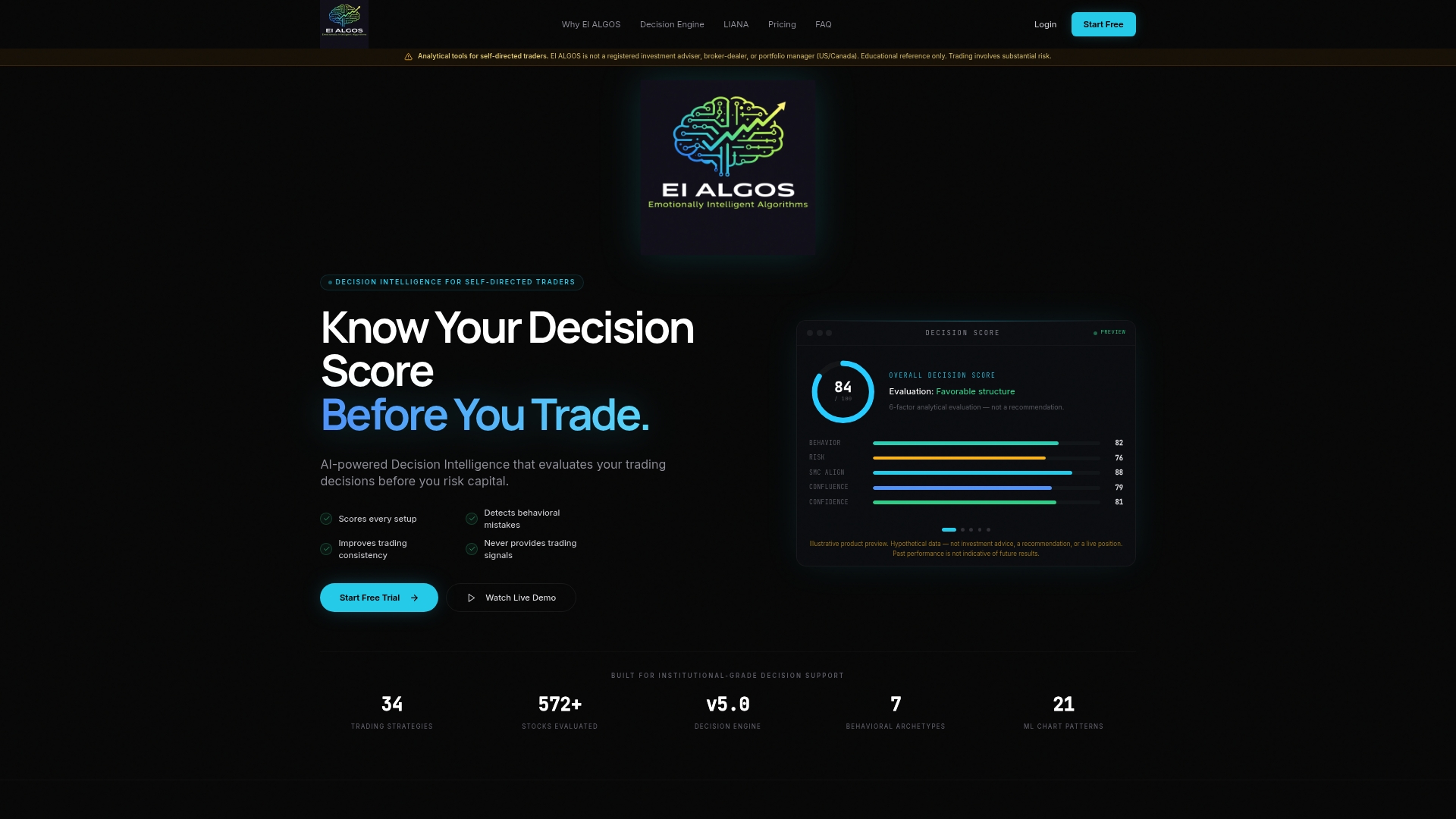
Signals and forecasts add one more input to a screen that is already crowded. Paralysis by analysis grows from that crowding. So our platform does not tell you what the market will do. It scores each setup on a six-factor analytical engine that looks at the psychological and behavioral side of the decision, so you can see whether a setup fits your process.
Our assistant, LIANA, gives personalized feedback based on your own trade history. Over time you can see patterns in your behavior: where you hesitate, where you rush, which kinds of setups you tend to handle well. We designed this to turn a vague feeling of being stuck into something you can name and work on.
The goal is decision clarity and consistency, with education built in, so you can trust your process and act on it.
Anantha
Put a process around your decisions
If you want your checklist, your decision patterns and your behavioral habits in one place, EI ALGOS is a web-based Decision Intelligence platform for self-directed traders. It scores trade setups on six factors, flags behavioral errors, offers live trade management tools and options analysis, and gives you personalized process feedback through LIANA. It does not issue trade signals or recommendations.
You can start on the Free plan at $0 per month. Paid plans are Starter at $49 per month, Pro at $129 per month and Elite at $229 per month. See the plans on the EI ALGOS site.
FAQ
How do I overcome analysis paralysis when trading?
Give research a defined endpoint. Write your entry criteria, stop-loss and position size in advance, use a short yes/no checklist, and set a decision deadline after your trigger. Then review whether you followed the process rather than only whether the trade made money.
How many indicators should I use?
There is no universal number, but several trading educators recommend keeping it small. The Wager Theorem suggests two or three core indicators, and DayTradingToolkit suggests no more than three filters. The point is that each input should change a decision, not merely add reassurance.
Is analysis paralysis the same as being careful?
No. A cautious trader still decides within a reasonable timeframe. Someone in analysis paralysis keeps seeking information that is unlikely to change the decision. If your criteria are met and you are still searching, you have probably crossed the line.
Why do I freeze after a losing streak?
Fear of another loss can make extra checking feel like prudence when it is really avoidance. A smaller position size within your plan, an unchanged checklist and a review of your pre-trade reasoning can help rebuild routine. If stress around trading is affecting your daily life, speak with a qualified mental health professional.
Sources
- Investopedia: Analysis paralysis
- Monkeytrade: Analysis paralysis in trading
- Capital.com: Analysis paralysis
- DayTradingToolkit: Analysis paralysis in trading
- CompleteTraderEdge: Analysis paralysis
- Unleashed Financial: The trap of analysis paralysis for self-directed investors
- The Wager Theorem: Overcoming analysis paralysis in trading
- Trading Academy: You can lose money and still be a great trader
- LevelScan: Reversal risk