
Impulsive trading is entering, exiting or sizing a trade on emotion instead of your written plan. It is often fueled by boredom, a thrill, or a reaction to a loss. You stop it with rules set before the session, forced pauses, hard loss limits and a regular review of your own behavior. This guide covers what it looks like, why it happens, how tilt fits in, and a concrete reset routine.
TL;DR
- Impulsive trading means acting without a plan: no setup confirmation, no stop, no sizing logic, only urgency or emotion.
- Tilt is the same problem after a trigger such as a loss streak, when anger, fear or frustration override your strategy.
- The most reliable fixes are written rules: a trade cap, a per-trade risk limit, a daily loss limit and a pause after each entry.
- To recover, step away, name the trigger, cut size and return gradually.
- Review your decisions, not only your profit and loss, to find the pattern behind the impulse.
Table of Contents
- What impulsive trading is
- Signs you are trading impulsively
- Why impulsive trades happen
- What impulsive trading costs
- Is trading gambling?
- How to stop impulsive trades: rules that work
- Trading on tilt: a reset routine
- Review your decisions, not just your results
- Our perspective
- Put a process around your decisions
- FAQ
- Sources
What impulsive trading is
A planned trade follows rules you set before the market moved. An impulsive trade follows a feeling. One company guide defines an impulse trade as an emotionally driven, hurried reaction that does not follow a trading plan and may skip the stop-loss or position sizing.
A simple test: did your written plan call for this action? If your rules say hold until the target and you sell early because you are scared, that is emotional trading. If your rules say wait for confirmation and you jump in early because it "feels right," that is too. The trade may even win. That is the danger, because a lucky impulse teaches the wrong lesson.
Disciplined traders look different in practice. They wait for their setups without forcing trades, keep to their risk rules, accept losses without chasing them back, and value consistency over excitement. If you want the broader emotional picture, we cover it in our guide to emotional trading.

Signs you are trading impulsively
Impulsive trading rarely announces itself. It shows up as small rule bends that stack up. Common signs include:
- Urgency. A constant feeling that you must catch the next move or hit the big winner.
- Acting before thinking. Clicking buy with no setup, no level and no exit.
- Thrill seeking. Trading because the screen is moving and you want action. One educational guide lists four symptoms: urgency, acting before thinking, lack of confidence about the instrument, and thrill seeking.
- Missing stops or sizing. Entering with no stop, moving a stop away, or sizing by gut feel.
- Overstaying the session. Trading after your planned window because you are down or bored.
- Doubling size after a loss. The classic tilt move.
These last behaviors match what a broker education guide describes as tilt signs: doubling position size after a loss, abandoning stops, entering without setup confirmation and trading beyond the planned session.
If an unfamiliar platform or a stranger is pressuring you to act fast, treat that as a separate problem. Learn the warning signs of trading platform fraud before you put more money in.
Why impulsive trades happen
Most impulsive trades have a trigger you can learn to spot.
Boredom and the need for action
Quiet markets are hard. Zerodha's trading education guide says impulsive behavior can come from abandoning a plan, boredom, seeking a thrill or becoming preoccupied with losses. Its advice is to restrict yourself to high-probability setups with defined plans.
Losses, missed setups and surrendered profits
A surprise loss, a streak of them, a setup you missed, or a winner you gave back can all push you into reactive mode. Tilt triggers named in one guide include unexpected losses, loss streaks, missed setups, surrendered profits and outside stress. That guide describes tilt as anger, frustration, greed or fear overriding your strategy and discipline.
The most familiar version is revenge trading, where you try to win the money back immediately. We break that pattern down in our revenge trading guide.
Tiredness and depleted self-control
Research backs the idea that willpower runs down. In an experimental-market study from the University of Munich, participants with depleted self-control showed more overpricing and more speculative behavior, with stronger emotional arousal and less reliance on cognitive skills. Trading hungry, tired or stressed stacks the odds against you.
Overconfidence after a win
Impulse is not only a losing-streak problem. A win can feel like proof that you can skip the process. A pause after each entry exists to break exactly that chain, from a winner to overconfidence or from a loser to revenge.
What impulsive trading costs
The direct cost is easy to see: trades with no stop and no sizing logic can do outsized damage. One broker guide notes that a single impulsive decision can undo days of solid trading.
The indirect cost is activity. In a University of Amsterdam experiment, subjects traded too much even in a buy-and-hold setting, higher risk preference predicted more trading, and the excess activity hurt individual wealth. More trades do not mean more edge.
The lesson is not that you should trade less out of fear. It is that every trade should earn its place by meeting criteria you set in advance.

Is trading gambling?
It depends on process. The CFA Institute says investing uses analysis and risk assessment to seek long-term positive expected returns, while gambling relies on chance and short-term thrills. Speculative trading blurs the line when decisions ignore fundamentals, and disciplined decision-making and rational risk analysis separate the two.
Impulsive trading is where the line gets crossed. When you have no edge, no stop and no size rule, you are not managing risk, you are hoping. The fix is not a better prediction. It is a better process.
How to stop impulsive trades: rules that work
Rules work because they move the decision to a calm moment. Build these in before the session starts.
1. Review your plan before you open the platform
Read your setups, limits and stop rules every session. Guidance from one broker academy includes reviewing the plan before a session, setting trade limits, pausing before an impulsive entry and waiting when uncertain.
2. Cap your risk per trade
The same guide suggests risking no more than 1 to 2% of available capital per trade and setting the stop before you enter. Run the numbers in advance. On a $25,000 account, 1% is $250 of risk. Your stop distance then decides your size, not your mood. For worked examples, see our risk management guide and the 2% rule walkthrough.
3. Set a daily trade limit and a daily loss limit
Pick a maximum number of trades and a loss at which you stop for the day, and write both down. One approach is circuit breakers that stop additional trading after a defined daily loss. Automating entries and exits, especially exits, takes the in-the-moment decision away.
4. Write if/then rules
The same guide recommends written if-then plans, such as stopping for the day after a specified loss or taking 15 minutes when you feel the urge to break a rule. Our if/then trading plan templates give you a format you can copy.
5. Decide your exit before you enter
A broker education piece says creating an exit strategy before entry can reduce emotion when selling. It also cautions that a stop-limit order can trigger without executing, so know how your order types behave.
6. Build in a pause
Slowing down or taking a break helps distance decisions from emotion. One guide suggests pausing 5 to 10 minutes after each entry to interrupt the chain from a win to overconfidence or from a loss to revenge trading.
7. Protect the basics
Don't trade when you are hungry, tired or under extreme stress. It sounds basic, and it is the cheapest fix on this list.
Trading on tilt: a reset routine
Tilt means you are already off plan. The goal is to stop the damage fast, then return deliberately.
- Close the platform. Flatten open positions if your plan says to, then step away. A cooling-off period restores perspective, and trading while stressed can impair judgment.
- Name the trigger. Write down what flipped you from planned to reactive: the loss, the missed move, an argument, a bad night's sleep.
- Cut size. One recovery guide from a funded-trader program suggests that after two impulsive entries in a row you flatten, close the platform for at least 20 to 30 minutes and cut next-trade risk by at least half. After three losses or two rule breaks, it says to end the day and resume next session at reduced size.
- Know your stop-trading trigger. Another guide recommends stopping after three consecutive losses, after a specified account loss, or whenever frustration is affecting your decisions. Platform alerts or broker daily-loss limits can enforce it.
- Return gradually. After a major loss, consider paper trading before risking real money, and increase size only after you consistently follow your rules.
These numbers are starting points. Adjust them to your account size and strategy, then write your own version down. Our 3-step cool-down is a shorter version you can keep next to your screen.
Review your decisions, not just your results
Impulses repeat. A trader who loses $300 on a planned trade that was well executed made a good decision. A trader who makes $300 on a trade with no setup made a bad one. Profit and loss hides that difference.
A useful journal records more than entries and exits:
- The setup and the reason for entry
- Your stop and target, set before entry
- Your emotional state at the time
- Whether you followed your rules (yes or no)
- One lesson
Then review weekly and count rule breaks by type: early entries, moved stops, oversized positions, trades after the cap. The pattern tells you which rule to tighten. A technical analyst and trader makes a related point: impulsive trades are a mental issue, not a strategy issue, so they follow you from strategy to strategy and can return after disappearing for a while. Keep doing the work every session.
Our perspective
Most advice on impulsive trading ends with "be more disciplined." That is a goal, not a method. Discipline is easier when you can see your own behavior clearly.
We built EI ALGOS around that idea. It does not give trade signals or market predictions. It scores each setup on a six-factor analytical engine that looks at the psychological and behavioral side of the decision, so you can see whether a trade fits your process before you place it.
Over time, the pattern matters more than any single trade. Seeing which setups, times of day and emotional states lead to your rule breaks lets you fix the cause. Our LIANA assistant gives personalized feedback on your process based on your own trade history.
Impulsive trading is a decision problem. We think the answer is better decisions, made with clearer information about yourself.
Anantha
Put a process around your decisions
If you want a second set of eyes on your process, EI ALGOS is a web-based Decision Intelligence platform for self-directed traders. It scores trade setups on six factors, flags behavioral errors and supports live trade management, with LIANA giving personalized process feedback.
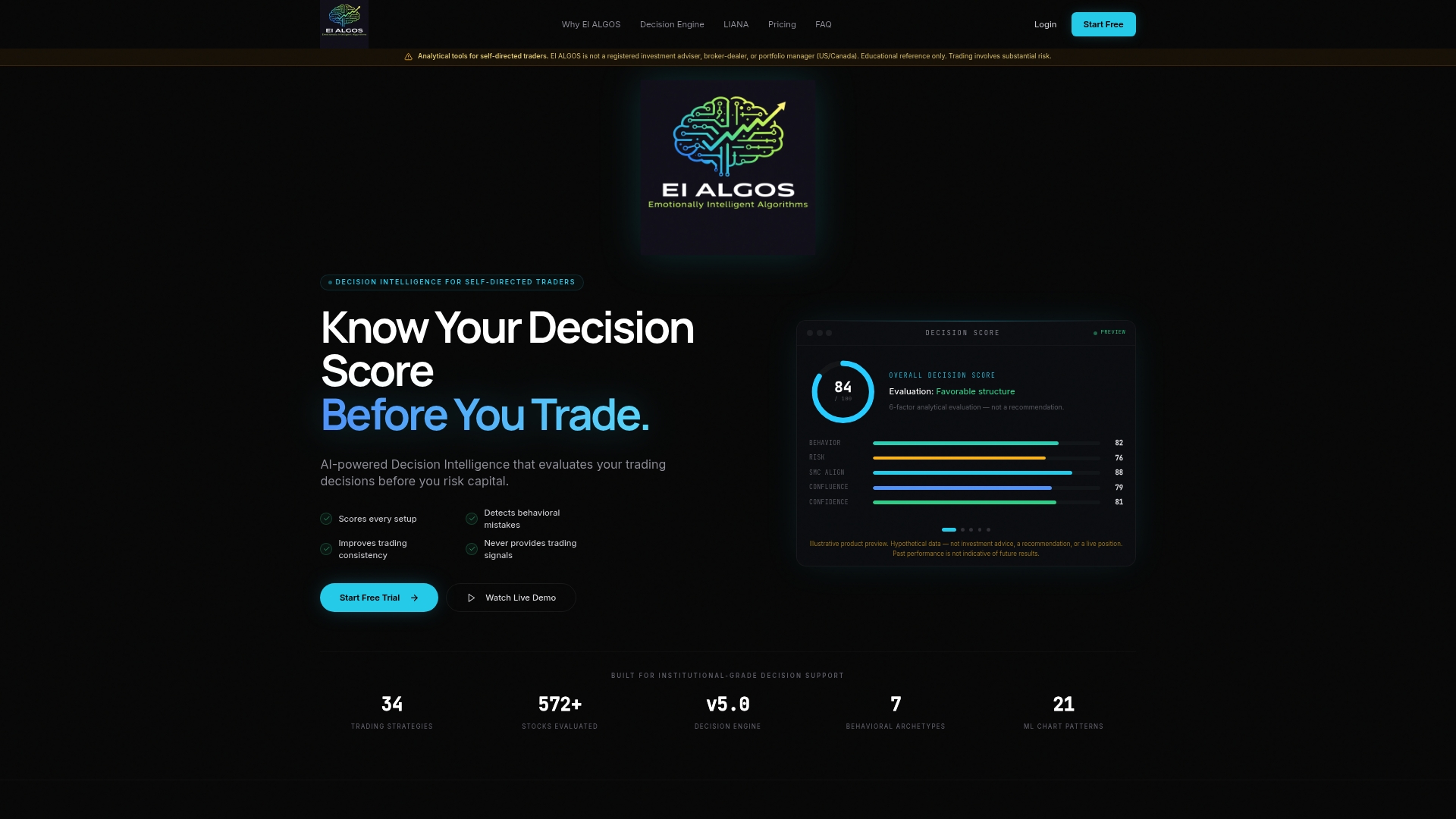
There is a Free plan at $0 per month. Paid plans are Starter at $49 per month, Pro at $129 per month and Elite at $229 per month. See the plans and start with the free one, or read how the platform works first. If you want to see how scoring a setup works, start with the Decision Score page.
FAQ
What is impulsive trading?
It is trading on urge instead of plan: entering without a confirmed setup, skipping the stop or sizing, or overtrading from boredom, fear or excitement. A simple test is whether your written plan called for the action. If not, the trade was impulsive, even if it made money.
What is tilt in trading?
Tilt is a state where anger, frustration, greed or fear override your strategy, usually after a trigger like a loss streak or a missed setup. Typical signs are doubling size after a loss, abandoning stops and trading past your planned session. Stopping trading for the day is the fastest way out.
How long should I stop after impulsive trades?
There is no universal number. One recovery guide suggests closing the platform for at least 20 to 30 minutes after two impulsive entries in a row, and ending the day after three losses or two rule breaks. Pick your own thresholds, write them down and follow them.
Is trading 100% gambling?
No. Trading with an edge, defined risk and a structured process is closer to speculating than gambling, and professional bodies distinguish the two by analysis and risk management. Trading without a process, stops or sizing rules moves toward gambling.
How much should I risk per trade to avoid big impulsive losses?
A common guideline is 1 to 2% of available capital per trade, with the stop set before entry. A smaller fixed risk limits the damage any single impulse can do. Choose a figure that fits your account and your own rules.
Sources
- How to Stop Impulsive Trading (FBS Academy)
- Trading on Tilt: What Is It and How to Avoid It (Switch Markets)
- Impulsive Trading: Possible Causes and Cures (Zerodha Varsity)
- Conquering Impulsive Trading (CMTrading)
- How to recover from a major trading loss (Charles Schwab)
- Breaking Bad Trade Behaviors (Charles Schwab)
- How to Stop Tilt Trading: Quick Reset After a Losing Streak (Tradeify)
- Kocher, Lucks and Schindler, experimental-market paper (University of Munich)
- Do investors trade too much? (University of Amsterdam)
- Is investing gambling? Key differences (CFA Institute)
- How to Eliminate Impulsive Trades With 2 Proven Tactics (Trade That Swing)
- Fraude en plataforma de trading: señales clave (Recovera)