
Trade lifecycle management is the practice of controlling a trade at every stage: the plan before the order, the order and its execution, the management while the position is open, clearing and settlement behind the scenes, and the review afterward. Institutions run it as an operations process. As a self-directed trader, you run two lifecycles at once: the one your broker and the clearing system handle, and the one only you can manage, which is your own decision process.
This guide walks through both, in order, and shows where self-directed traders most often lose control.
TL;DR
- A trade has a brokerage lifecycle (order, routing, execution, confirmation, clearing, settlement) and a decision lifecycle (plan, entry, management, exit, review). Manage both.
- Most avoidable damage happens before the order and after the exit: no defined stop and target going in, no structured review coming out.
- US stock trades settle one business day after the trade date (T+1), so execution is not the same as settlement.
- Use limit orders, confirm fills and cancellations before re-placing anything, and size positions from a fixed risk amount.
- A short written review after every trade turns the lifecycle into a loop that improves consistency.
Table of Contents
- What trade lifecycle management means
- Stage 1: Plan the trade before you touch the order ticket
- Stage 2: Order entry and broker review
- Stage 3: Execution and fills
- Stage 4: Live management while the position is open
- Stage 5: Exit, confirmation, clearing and settlement
- Stage 6: Post-trade review closes the loop
- The whole lifecycle at a glance
- Our perspective
- Put the lifecycle into practice with EI ALGOS
- FAQ
- Sources
What trade lifecycle management means
The term comes from capital markets operations. FINRA describes five steps in the life of an online stock trade: you place the order, your brokerage firm reviews it against legal, regulatory and compliance obligations, the firm decides how to execute it, the trade is executed, and you receive an electronic confirmation. The Corporate Finance Institute defines the wider process as running from initiation through order matching, trade capture, confirmation, custodian instructions, clearing and settlement.
That is the plumbing. It matters, but for a retail trader it mostly runs without your input. The part you control starts earlier and ends later. That is why we split the lifecycle into two layers.
| Layer | Who runs it | Stages |
|---|---|---|
| Brokerage and market lifecycle | Broker, exchanges, clearing firms | Order review, routing, execution, confirmation, clearing, settlement |
| Decision lifecycle | You | Pre-trade plan, entry, live management, exit, post-trade review |
The rest of this article follows a single trade through both layers.
Stage 1: Plan the trade before you touch the order ticket
Every decision you can make cheaply, you make here. Once the position is open, emotion enters and the options narrow.
A pre-trade plan answers a short list of questions:
- What is the setup, and does it match a strategy you actually trade?
- Where is your stop, the level at which the idea is wrong?
- Where is your target, or what conditions will you exit on?
- How many shares or contracts does the risk allow?
- What is the reward relative to the risk?
One widely used sizing rule, described in a pre-trade checklist from K.M.F. Trading Research, risks 1% of the account per trade: risk amount equals account size times 0.01, and position size equals the risk amount divided by the stop distance. The same source suggests a minimum reward-to-risk of 1:1.5, or whatever your own rules specify, and insists you know your stop and target before entry.
Here is a worked example. With a $20,000 account and 1% risk, your risk amount is $200. If your entry is $50.00 and your stop is $48.00, the stop distance is $2.00, so the position size is 100 shares. If your target is $53.00, the reward is $3.00 against $2.00 of risk, a ratio of 1:1.5. The numbers are illustrative; your own rules set the percentage. We cover a related approach in our guide to the 2% rule and trade management strategies.
If you trade options, the plan needs more inputs, such as defined risk, expiration and the structure of the position. Our options trade analysis workflow lays out that process.
Check your own state, too
A plan is only as good as the person following it. Before you enter, ask whether this setup is one you planned or one you are chasing. Revenge entries after a loss, oversized positions after a win and trades taken out of boredom all pass through the same ticket as good trades. This is the point where behavioral scoring of a setup is most useful, and where we spend most of our own product effort. More on that below.

Stage 2: Order entry and broker review
When you submit the order, it goes to your brokerage firm, which reviews it against legal, regulatory and compliance obligations before deciding how to execute it. The firm may execute it itself or route it to an exchange, an alternative trading system or a wholesale broker-dealer.
Your main decision here is order type. The SEC's Investor.gov advises self-directed online investors to set price limits with limit orders rather than market orders, which protects you from buying at too high a price or selling at too low a price. A limit order trades certainty of price for uncertainty of fill, and you should choose that trade-off on purpose.
Investor.gov also flags a common retail error: assuming an order did not go through and placing it again. Check that the order was executed before re-placing it, and confirm that a cancellation actually worked before you place another trade. Duplicate orders are an execution mistake, but they usually start as a decision mistake made in a hurry.
Stage 3: Execution and fills
Most retail stock orders execute without trouble. FINRA notes that trades might be filled partially or not at all when you use stop or limit orders, order a large number of shares or trade less frequently traded stocks. Trading pauses or halts can also prevent execution.
What this means for your lifecycle:
- Partial fills change your math. If you planned 100 shares and got 40, your risk, stop distance and reward ratio all shift. Decide in advance whether you add, cancel the remainder or accept the smaller size.
- Thin stocks cost more. Slippage is the gap between the price you expected and the price you got. One post-trade guide from Bridge Research reports average slippage of 5 to 10 basis points in liquid stocks versus 50 or more in illiquid securities.
- A fill is a data point. Record the actual fill price and time, not the one you intended. You will need them in the review.
If execution quality is a recurring weak spot, this walkthrough on improving trade execution is a good companion to your own fill data.
Stage 4: Live management while the position is open
This is the stage where plans fail. The trade is live, the price moves, and every tick invites a new decision: move the stop, take profit early, add to a loser, hold past the target.
Live management works when you decide the rules beforehand and then follow them:
- Stops move only by rule. Trailing a stop behind a rising price can be a rule. Widening a stop because the price is approaching it is not.
- Targets and scale-outs are written down. If you plan to sell half at the first target, that is in the plan, not improvised.
- Changes are logged. Any deviation from the plan, and the reason, goes into your notes.
- Risk is checked across positions. Several trades that each look fine can add up to one oversized bet if they are correlated.
We go deeper on this in live trade management rules that work, and our live trade management tools are built for this stage of the lifecycle. If you are an active day trader, the pattern day trader rule also shapes how often you can open and close positions, so factor it into your plan.
Stage 5: Exit, confirmation, clearing and settlement
Your exit order follows the same path as your entry: broker review, routing, execution. Then you receive an electronic confirmation, which is your record of what happened. Check it against your platform's fill data.
After execution, the trade is not finished. FINRA states that the clearing firm has one business day to match and settle the trade: shares move from the seller's brokerage firm to the buyer's, and funds move the other way. That one-business-day cycle is what traders call T+1. The "1" counts business days, so a trade made on Friday settles the following Monday, assuming no market holiday.
Why clearing exists: according to the Corporate Finance Institute, neither side's custodian is comfortable transferring assets until it receives the counterparty's assets. A central securities depository acts as the intermediary, and legal ownership changes from seller to buyer only at settlement. The same source identifies the DTCC as the US national central securities depository.
For your practice, three points follow:
- Execution is not settlement. Your P&L moves at execution, but settled cash availability can depend on your account type and the transaction.
- Funding matters. Check your broker's rules for when sale proceeds are available to trade again, particularly in a cash account.
- Reconcile. Compare the confirmation with your records the same day. Errors are cheapest to fix while the trade is fresh.
Stage 6: Post-trade review closes the loop
Most traders stop at the exit. That is the largest gap in trade lifecycle management, because the review is the only stage that changes the next trade.
Bridge Research outlines a six-step post-trade review:
- Centralize your data: fills, timestamps, prices, size and fees.
- Keep a journal with entry and exit prices, rationale, setup type, screenshots, an emotion rating from 1 to 10 and relevant news.
- Classify trades by instrument, strategy and holding period.
- Run a quantitative review: win rate, average R-multiple, maximum drawdown and performance by time and strategy.
- Run a qualitative review that names recurring mistakes and good behaviors.
- Write an action plan with two or three specific rules or changes.
The last step is the one that matters. Without concrete changes, review is only record-keeping.
Judge the decision, not the outcome
Hindsight distorts reviews. A DayTradingToolkit checklist cites Baruch Fischhoff's 1975 experiments on what he called creeping determinism: people told how a situation turned out judged that outcome as more inevitable. In trading, once you know where price went, the right move looks obvious. Grade yourself on what you knew at the moment of decision. A losing trade that followed your plan was a good decision. A winning trade that broke your rules was a mistake that happened to pay.
We lay out a fast routine in our 15-minute post-trade review, and a full trading journal guide covers what to log and why. Win rate alone hides a lot, which is why we also wrote about trader performance analysis beyond win rate.
The whole lifecycle at a glance
| Stage | Your key question | What to record |
|---|---|---|
| Plan | Is the setup defined, with stop, target and size? | Setup type, risk amount, reward-to-risk |
| Order | Is the order type right, and was it executed or cancelled? | Order type, limit price |
| Execution | Did the fill match the plan? | Fill price, time, partial fills, slippage |
| Management | Am I following my rules? | Stop and target changes, with reasons |
| Exit and confirmation | Does the confirmation match my records? | Exit price, fees |
| Settlement | When is cash available? | Trade date, settlement date |
| Review | What will I change? | Mistakes, good behaviors, two or three new rules |
Our perspective
We built EI ALGOS around one observation: most traders do not lack information, they lack a reliable decision process. Charts, scanners and signals all tell you something about the market. Almost nothing tells you something about you.
That is why we do not provide trade signals or market predictions. We score each setup on a six-factor analytical engine that looks at the psychological and behavioral side of the decision, so you can see a mistake forming before the order goes in, not three weeks later in a spreadsheet.
Look at the lifecycle above. The broker handles routing, clearing and settlement. The two stages where self-directed traders have the most control, planning and review, are the two most often skipped. We designed our platform to support exactly those stages, along with live trade management, options analysis and strategy pattern detection.
Our assistant, LIANA, gives feedback on your own process based on your own trade history. The aim is not to tell you what to trade. It is to help you understand your patterns and refine them over time, so consistency becomes something you build on purpose.
Anantha
Put the lifecycle into practice with EI ALGOS
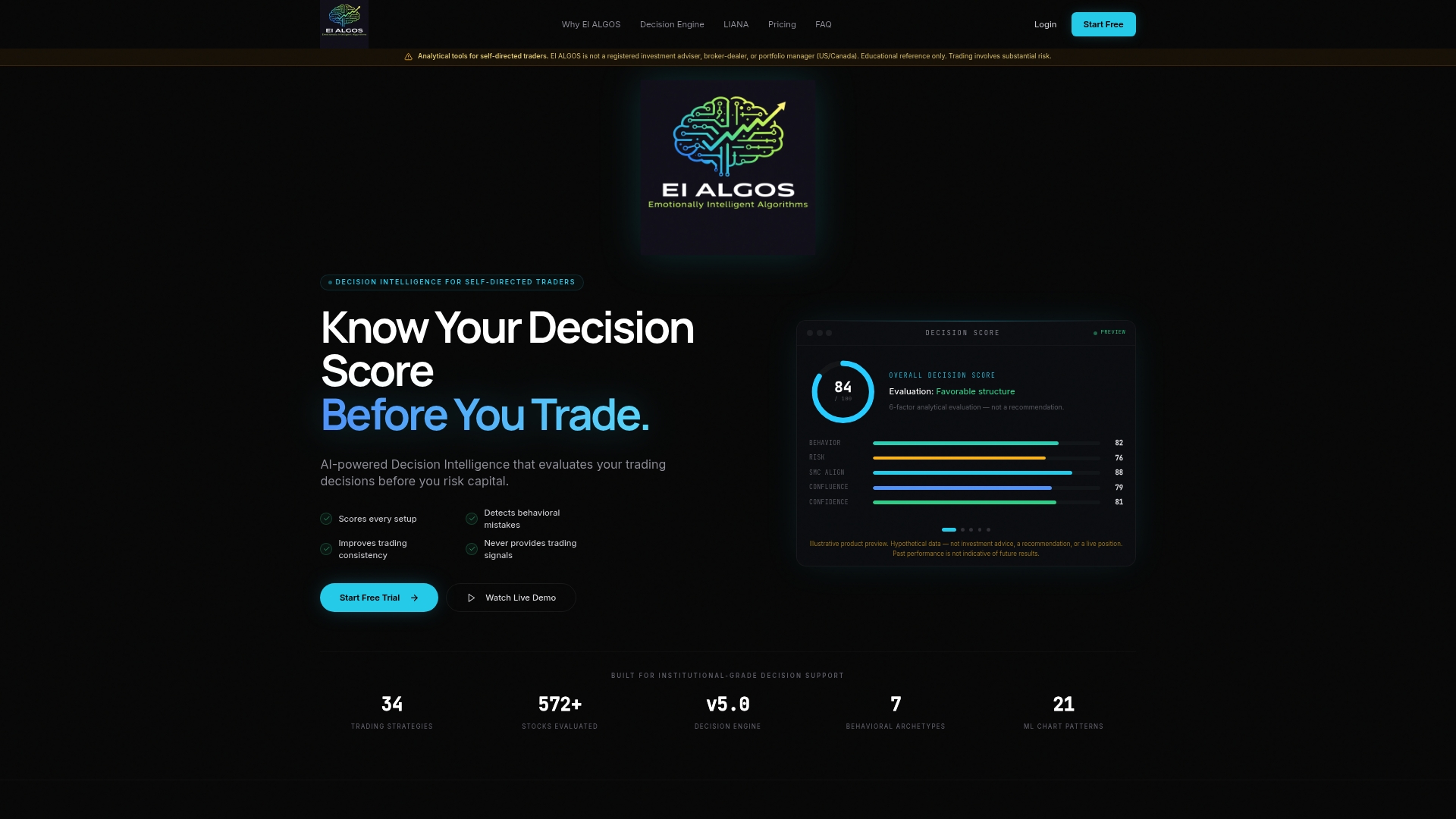
If you want one place to run the decision lifecycle, EI ALGOS is a web-based Decision Intelligence platform for self-directed traders. It scores trade setups, flags behavioral errors, supports live trade management and options analysis, and gives you process feedback through LIANA, our AI trading coach.
You can start on the Free plan at $0 per month. Paid plans are Starter at $49 per month, Pro at $129 per month and Elite at $229 per month. See the details and choose a plan on our site, or read how AI-coached trade review works first.
FAQ
What are the stages of the trade lifecycle?
For a US stock trade, the brokerage side runs through order placement, broker review, routing, execution, confirmation, clearing and settlement. A self-directed trader adds the stages around it: pre-trade planning, live management and post-trade review. Treating all of them as one process is what trade lifecycle management means in practice.
How long does a US stock trade take to settle?
Under the current standard, a stock trade settles one business day after the trade date, known as T+1. FINRA explains that the clearing firm has one business day to match and settle it. Weekends and market holidays do not count, so a Friday trade settles on Monday.
Is execution the same as settlement?
No. Execution is when your order is filled at a price. Settlement is when shares and cash formally change hands between firms. Your account may show the position and the P&L right away, but when proceeds are available can depend on your account and the transaction, so check your broker's rules.
Why use limit orders instead of market orders?
A limit order sets the worst price you will accept. The SEC's Investor.gov recommends limit orders for self-directed investors to protect against buying too high or selling too low. The trade-off is that the order may fill only partially or not at all if the market does not reach your price.
How often should I review my trades?
Review each trade soon after you close it, while the details are fresh, and run a broader review of patterns on a regular schedule that you set. A short daily routine works for many active traders. What counts is that every review ends with two or three concrete rule changes.
Sources
- How Online Stock Trading Works: Understanding the Trade Lifecycle, FINRA
- Online Investing, Investor.gov
- What Is the Trade Lifecycle? Complete Guide, Corporate Finance Institute
- Finance Fundamentals: Post-Trade Analysis and Reporting, Bridge Research
- Pre-Trade Checklist, K.M.F. Trading Research
- How to Review Your Trades: A 15-Minute Daily Checklist, DayTradingToolkit
- How to Improve Trade Execution: 8 Proven Strategies