
A post trade review is a structured process of examining a closed trade against your original plan to grade execution, discipline, and behavior separately from profit or loss. The immediate action: pull up your last closed trade right now and log it into a template before the details fade from memory. Everything else, the scoring, the grading, the pattern hunting, builds from that first entry.
TL;DR:
- Separate grades for execution quality and plan adherence to uncover true trade behavior, avoiding masking mistakes with lucky outcomes.
- Conduct immediate trade reviews post-exit and schedule weekly and monthly assessments to identify patterns over large sample sizes.
- Use a straightforward four-block template to objectively record trade facts, compare planned versus actual actions, and note behavioral signals.
- Grading across four dimensions—execution, adherence, context, and behavior—helps reveal weaknesses before they impact profitability.
- Implementing AI decision tools can automate behavioral scoring, reducing manual effort and enhancing pattern detection across trades.
Table of Contents
- Why Post Trade Reviews Matter More Than Your P&L
- When Should You Actually Review a Trade?
- The Post Trade Review Template You Can Copy Today
- How to Grade Execution, Plan Adherence, Context, and Behavior
- Turning Individual Reviews Into Real Lessons
- Common Pitfalls in Post Trade Reviews
- Tailoring the Review for Your Trading Style
- How Decision Intelligence Tools Speed Up the Review Process
- Three Steps to Start Your Review Cycle Today
- What Most Traders Get Backwards About Reviewing Trades
- A Faster Way to Score the Behavioral Side of Every Trade
- Sources
Why Post Trade Reviews Matter More Than Your P&L
Your account balance tells you what happened. It never tells you why. A trade can lose money and still be a perfectly executed setup that simply didn't work this time. Another trade can make money despite broken risk rules, bad entries, or a stop moved out of fear. If you only track wins and losses, you'll learn the wrong lessons from both.
That's the core reason process and outcome need separate grades. Retail traders who centralize their data and run regular reviews are far better positioned to separate noise from signal than those who eyeball their account curve and call it analysis. A professional trade analysis evaluates at least four dimensions independently, execution quality, plan adherence, market context, and behavioral state, because grading them together lets a lucky outcome mask a broken process.
Unstructured reviews carry a specific risk: post-hoc rationalization. Without predefined criteria, you naturally reconstruct a story where the losing trade "made sense" and the winning trade "was skill." This is exactly the discipline institutional desks have used for decades, translated into something a self-directed trader can run in fifteen minutes:
- Grade the setup and grade the outcome as two different scores.
- Write the plan before you enter, then compare it to what actually happened.
- Flag any deviation from the plan even if the trade won.
When Should You Actually Review a Trade?
Timing determines whether your trade performance review captures real data or fuzzy memory. Three checkpoints work well for most traders:
- Immediately after exit. Capture the fill price, a screenshot of the chart, your emotional state, and any deviation from plan while it's fresh. This takes two minutes.
- After settlement confirmation. For US equities, execution-quality checks tied to final costs should wait until fills are confirmed, since T+1 settlement means the exact numbers you see at close of trading day can still shift slightly before they're locked in.
- On a fixed schedule. Run a quick single-trade note the same day, a pattern check weekly, and a full performance roll-up monthly.
Single-trade notes catch behavior in the moment. The weekly and monthly reviews are where actual trade reconciliation and pattern detection happen, because one trade is an anecdote and twenty trades are a data set.
The Post Trade Review Template You Can Copy Today
Here's a template you can drop straight into a spreadsheet or trading journal. Build four blocks for every trade.
1. Trade facts block Record the symbol, position size, entry and exit timestamps, actual fills, and total fees. This is the objective record nobody can argue with later.
2. Plan freeze checklist Before you touch anything else, write down what you planned before entry, not what you did:
- Setup name (from your playbook, not a vague description)
- Planned entry price and trigger condition
- Planned stop loss level
- Planned position size
- Planned management rule (scale out, trail stop, time exit)
3. Process checks Compare the plan to reality with direct yes/no answers:
- Did you enter at or near the planned trigger, or did you chase?
- Did you use the order type you intended (limit vs. market)?
- Did you move your stop, and if so, in which direction?
- Did you exit according to your rule, or did you improvise?
4. Behavioral notes This block is where most journals fall short, and where post-trade evaluation earns its keep. Note your decision state before entry (calm, rushed, revenge trading after a loss), any compulsion signals (checking the position every thirty seconds, moving size up mid-session), one lesson from the trade, and one specific next action.
Keep phrasing factual. "Entered eight minutes early, before volume confirmation" teaches you something. "Bad trade" teaches you nothing. Retail-focused checklists consistently point to short, factual notes as the difference between a journal that changes behavior and one that just accumulates entries.
Pro Tip: Run a 90-second minimal review right after every trade (facts plus one behavioral line), then reserve the full four-block version for your weekly batch. A 10-question format keeps single trades from triggering impulsive strategy changes.
A minimal review takes under two minutes. The extended version, done once a week across your best and worst five trades, takes closer to twenty minutes per trade. Both matter. One protects your discipline in the moment; the other builds the sample size you need to trust any conclusion.
How to Grade Execution, Plan Adherence, Context, and Behavior
Grading four dimensions separately is what turns a diary into an actual trade outcome evaluation. Use a simple 1 to 5 scale, or letter grades if that fits your style better, with clear triggers for each score.
- Execution quality (1-5): A 5 means your fill matched your intended price within normal spread. A 1 means significant slippage or a chased entry.
- Plan adherence (1-5): A 5 means every rule was followed exactly as written. A 1 means the trade barely resembled the plan.
- Market context (1-5): A 5 means the setup aligned with the broader trend or volatility regime. A 1 means you traded against clear context.
- Behavioral state (1-5): A 5 means calm, patient, rule-following. A 1 means visible emotional interference.
Beyond the grades, three quantitative metrics turn subjective notes into comparable data over time. Slippage measures the gap between your intended and actual fill price. Markout tracks how price moves at fixed intervals, one minute, five minutes, thirty minutes, after your fill, revealing whether your timing itself has an edge. R-multiple expresses your result as a multiple of initial risk, so a $200 win on a $100 stop is a 2R trade regardless of account size.
Institutional post-trade analysis leans on slippage, markout, and implementation shortfall to isolate execution costs from strategy performance. Retail traders rarely separate the two, and end up blaming a strategy for what was actually a bad fill.
Tag every trade with setup name, time of day, and market regime so you can filter later. A trade tagged "breakout, morning session, high volatility" becomes searchable data instead of a buried journal entry.
Turning Individual Reviews Into Real Lessons
A single trade review teaches you almost nothing on its own. The value shows up when you aggregate tags and grades across a sample large enough to reveal a pattern instead of noise.
Structure your rollups like this:
- Weekly report: Total trades, average grade per dimension, most common tag combination, and one recurring behavioral flag.
- Monthly report: Win rate by setup tag, average R-multiple by setup, execution grade trend, and a short list of repeated plan deviations.
- Decision point: Once a tag hits your predefined sample threshold, maybe 20 trades, decide on one of four outputs: continue unchanged, modify one parameter within a set range, suspend the setup, or retire it.
Predefining those thresholds and outputs before you start matters more than most traders realize. A structured review cycle with fixed sample sizes and decision rules prevents the common trap of abandoning a strategy after three losing trades that were actually well within its normal variance.
Pro Tip: Pick exactly one action per review cycle. If your monthly report shows three problems, rank them and fix the biggest one first. Trying to correct five habits simultaneously usually means you correct none of them.
A typical finding: your morning breakout trades grade well on execution but poorly on behavior, tagged with "moved stop early." The single action isn't "trade less." It's "no stop adjustments in the first minutes after entry," tested over a sufficient number of trades before any further change.
Common Pitfalls in Post Trade Reviews
Watch for these behavioral traps as much as the trading mistakes themselves.
Recency bias. Your last three trades feel more important than your last thirty. A monthly roll-up corrects this by forcing you to look at the full sample, not just what happened yesterday.
Sample-size impatience. Changing a strategy after two or three trades is the single fastest way to destroy the statistical value of your data. Predefined thresholds exist specifically to stop this.
Grading outcome instead of process. A losing trade executed perfectly deserves a good process grade. A winning trade that broke every rule deserves a poor one. Confusing the two is the most common error in retail journaling.
Vague language. "Felt off" or "bad market" carries no information for future you. Write what you actually observed.
Skipping settlement checks. Judging execution cost before fills settle can distort your slippage numbers, particularly on volatile days.
Tailoring the Review for Your Trading Style
A day trader closing eight positions before lunch needs a different rhythm than a swing trader holding for two weeks. Day traders should lean on the minimal review after every trade and reserve the extended version for a same-day debrief, since memory decays fast during a high-frequency session. Behavioral notes matter enormously here, because compulsion and revenge trading show up within minutes, not days.
Swing and position traders have more time per trade to fill out the extended template properly, but they need a different weekly focus: market context grading becomes more important than second-by-second execution quality, since a multi-day hold is more exposed to regime shifts than to fill precision. Options traders should add a field for implied volatility at entry and exit, since that variable often explains a result that a simple price chart cannot.
How Decision Intelligence Tools Speed Up the Review Process
Manual journaling works, but tagging, grading, and aggregating trades by hand across dozens of positions a month is where most traders quietly give up. This is the gap a platform like EI ALGOS is built to close.
Instead of scoring trade setups on price action alone, EI ALGOS runs each one through a six-factor analytical engine that evaluates the psychological and behavioral conditions behind the decision, not just the chart pattern. That maps directly onto the behavioral state dimension in the rubric above, except it's scored consistently, trade after trade, without you having to reconstruct your mental state from memory three days later.
The platform's LIANA assistant then turns that scoring into personalized feedback, pointing out recurring behavioral tags across your history the same way a monthly roll-up would, but continuously.
- Six-factor scoring replaces subjective behavioral grading with a consistent framework.
- LIANA surfaces patterns across trades automatically, cutting the manual tagging work.
- Faster pattern detection means less hindsight bias creeping into your monthly reports.
Three Steps to Start Your Review Cycle Today
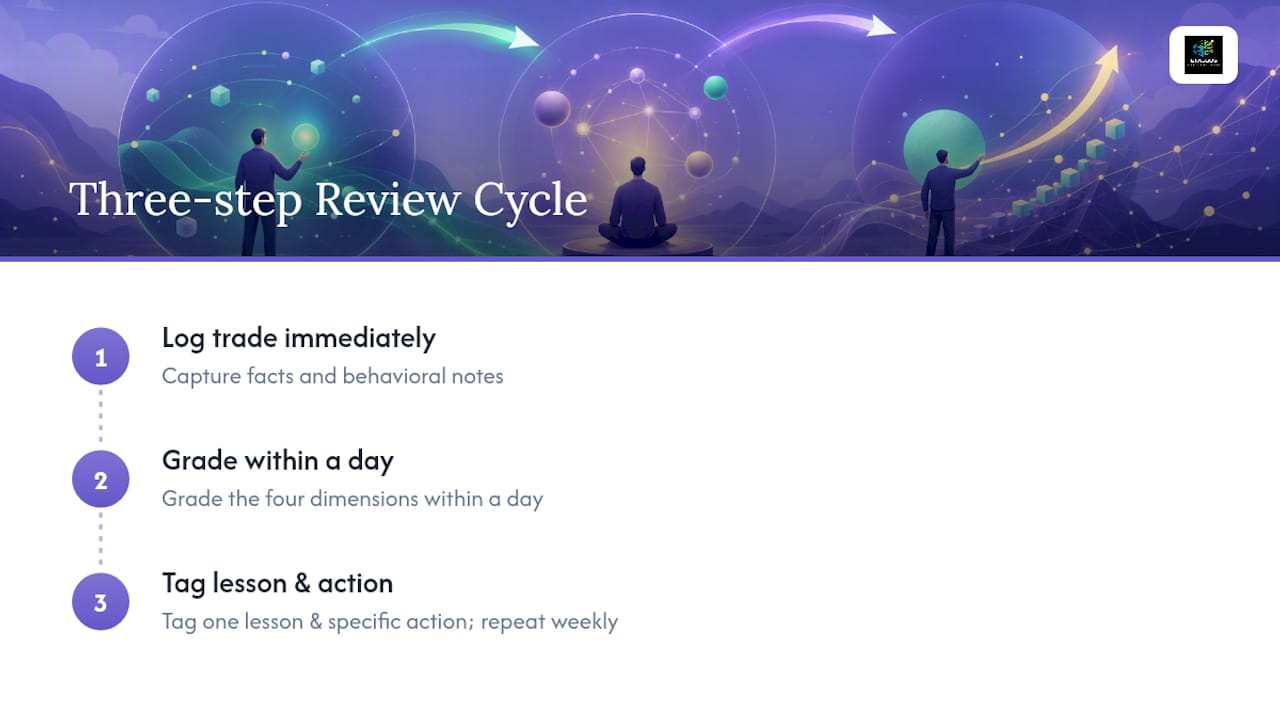
The most useful thing you can do right now is log your last closed trade into the four-block template above before the details blur. From there: capture the facts and behavioral notes immediately, grade the four dimensions within a day, and tag one lesson with one specific next action. Repeat weekly. For downloadable formats, the trading journal template and the Knowledge Hub both have ready-to-use versions.
What Most Traders Get Backwards About Reviewing Trades
Most trading advice treats review as an autopsy: something you do to a dead trade to figure out what killed it. That framing is backwards. The value of a post trade review isn't diagnosing one trade. It's building a sample large enough that patterns outrank your memory of any single outcome.
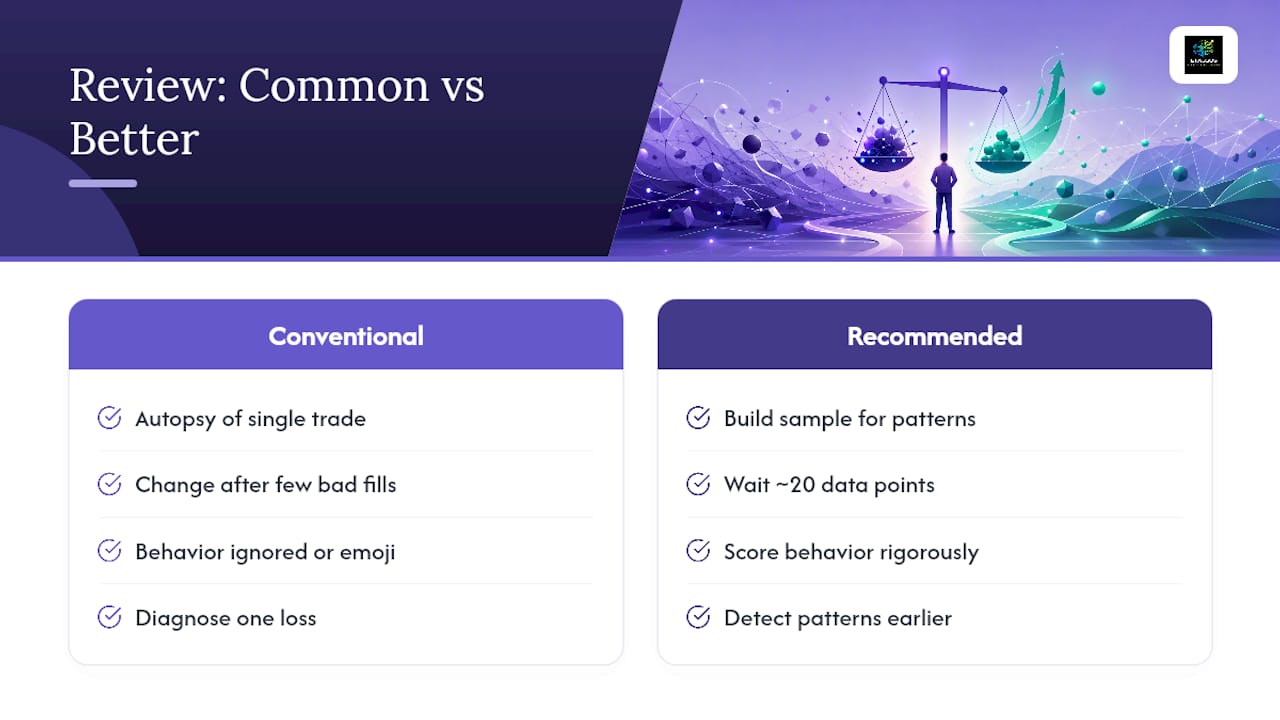
The conventional wisdom oversells the single-trade lesson. One losing trade rarely tells you anything statistically meaningful, yet it's the trade traders obsess over, rewriting their strategy after three bad fills instead of waiting for the twentieth data point. The traders who actually improve are the ones who resist that urge and let sample thresholds, not emotion, decide when a change is warranted.
What deserves more attention than it gets is the behavioral dimension. Execution and plan adherence are relatively easy to grade because they're mechanical. Behavioral state is harder, which is exactly why most journals skip it or reduce it to a mood emoji. That's a mistake. Revenge trading, size creep, and stop tampering rarely show up in your P&L until they've already cost you a month of gains. Score behavior with the same rigor you'd apply to slippage, and the patterns show up months before your account curve confirms them.
— Anantha
A Faster Way to Score the Behavioral Side of Every Trade
Building the four-block template by hand works, but grading behavioral state consistently across dozens of trades a month is where manual journaling breaks down fastest. A six-factor analytical engine can score the psychological conditions behind each setup at the moment you take it, and an AI assistant can turn that history into personalized feedback on the patterns you'd otherwise catch only in a monthly roll-up, three weeks too late.
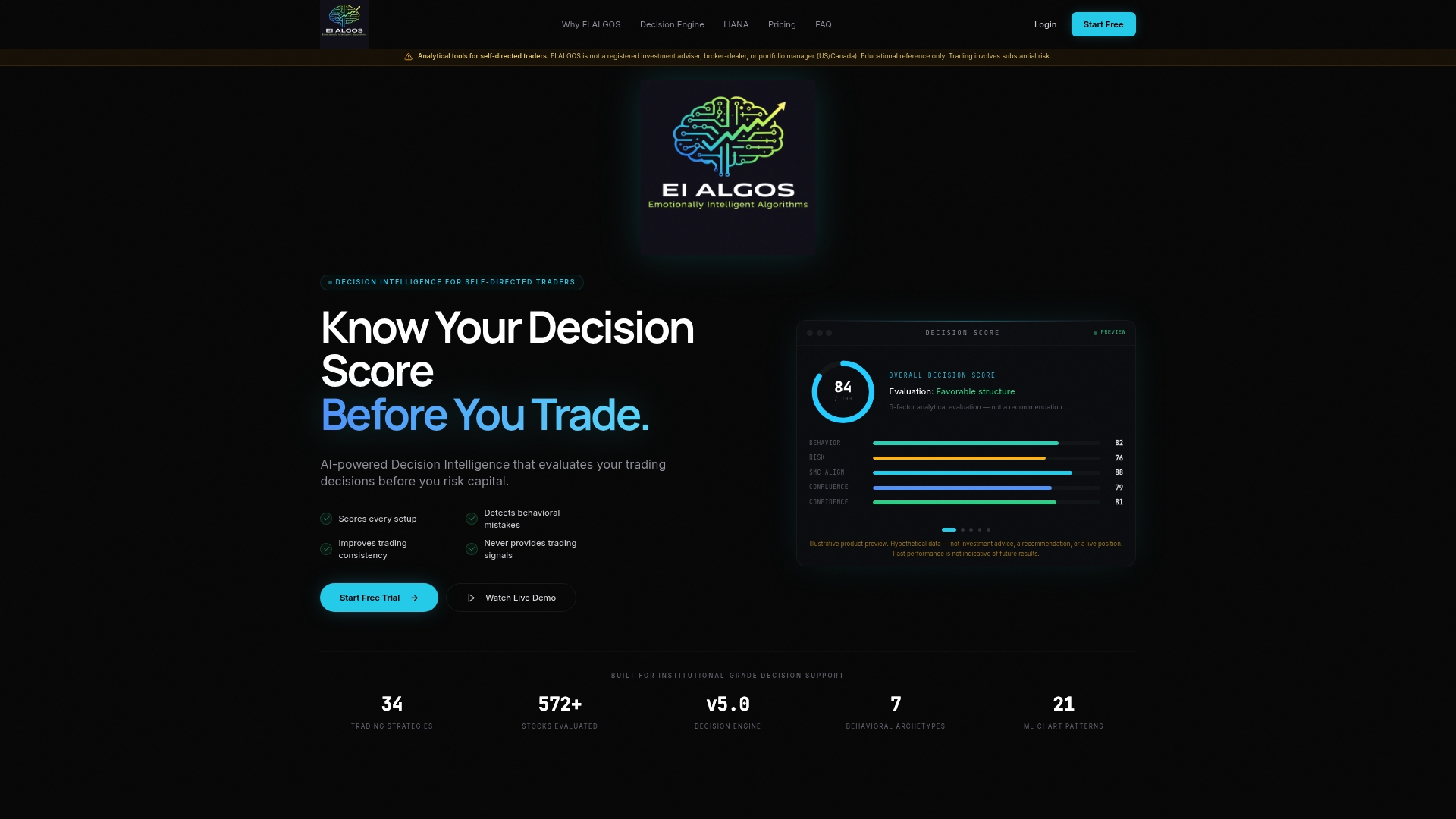
This isn't a signal service and it won't tell you what to trade. It's a way to make the behavioral grading column in your review template automatic instead of guesswork you fill in from memory. If you're already running the template above, visit the Knowledge Hub for additional review resources, or start a free trial on the EI ALGOS platform to see your own decision score before your next trade.
Sources
- Post-trade analysis overview — QuestDB
- A post-trade review without predefined evaluation criteria is not a review — TradeProb
- Understanding settlement cycles | FINRA