
FINRA has eliminated the pattern day trader designation and the $25,000 minimum equity requirement. The new intraday margin standards took effect June 4, 2026, replacing the old trade-count-based framework entirely. If you hold a margin account at a U.S. broker-dealer, the rules governing how much you can trade intraday have fundamentally changed.
Here is what matters right now:
- PDT designation is gone. Executing four or more day trades in five business days no longer triggers a label or a hard equity floor.
- Intraday margin deficits (IMDs) are the new trigger. Your real-time intraday equity position, not your trade count, determines whether you face restrictions.
- Effective date: June 4, 2026, per Regulatory Notice 26-10.
- Broker phase-in window: Firms may implement the new standards through October 20, 2027. Your broker may still be running the old system.
- Cash accounts are unaffected. PDT rules never applied to them, and that does not change.
The core shift: FINRA moved supervision from counting trades to monitoring real-time exposure. More flexibility for traders, but the responsibility for managing leverage now sits squarely with you and your broker's live systems.
Table of Contents
- How the old pattern day trader rule worked
- What exactly did FINRA and the SEC change?
- What brokers can still do under house rules
- Practical impacts: buying power, options, and margin risk
- What to check with your broker right now
- How decision-intelligence tools help under the new regime
- How other countries handle day trading rules
- Day trading vs. swing trading under the new rules
- Key Takeaways
- The discipline gap the PDT rule was hiding
- Fewer guardrails means your process has to carry more weight
- Where to read the official rule and trusted explainers
How the old pattern day trader rule worked
The original PDT framework, established under FINRA Rule 4210, was built around a single, blunt metric: trade count.
- PDT designation triggered when a margin account executed four or more day trades within a rolling five-business-day window, provided those trades exceeded 6% of total trades in that period.
- Minimum equity requirement: $25,000 on any day when day trading occurred. Fall below that threshold and your account faced liquidating-only restrictions.
- Day-trading buying power (DTBP) was calculated using prior-day end-of-day excess equity, typically up to four times that figure for equity day trades.
- Broker discretion existed even then: firms could designate a customer as a PDT if they had "reasonable basis to believe" the customer would engage in pattern day trading, per Investor.gov.
- SEC oversight: The SEC approved the original PDT amendments and retained authority over subsequent changes, including the April 2026 approval of the new intraday margin standards.
The $25,000 floor effectively locked out smaller retail accounts from active intraday trading on margin. That was partly the point. Whether it was the right policy is a separate debate, but it shaped U.S. day trading regulations for over two decades.
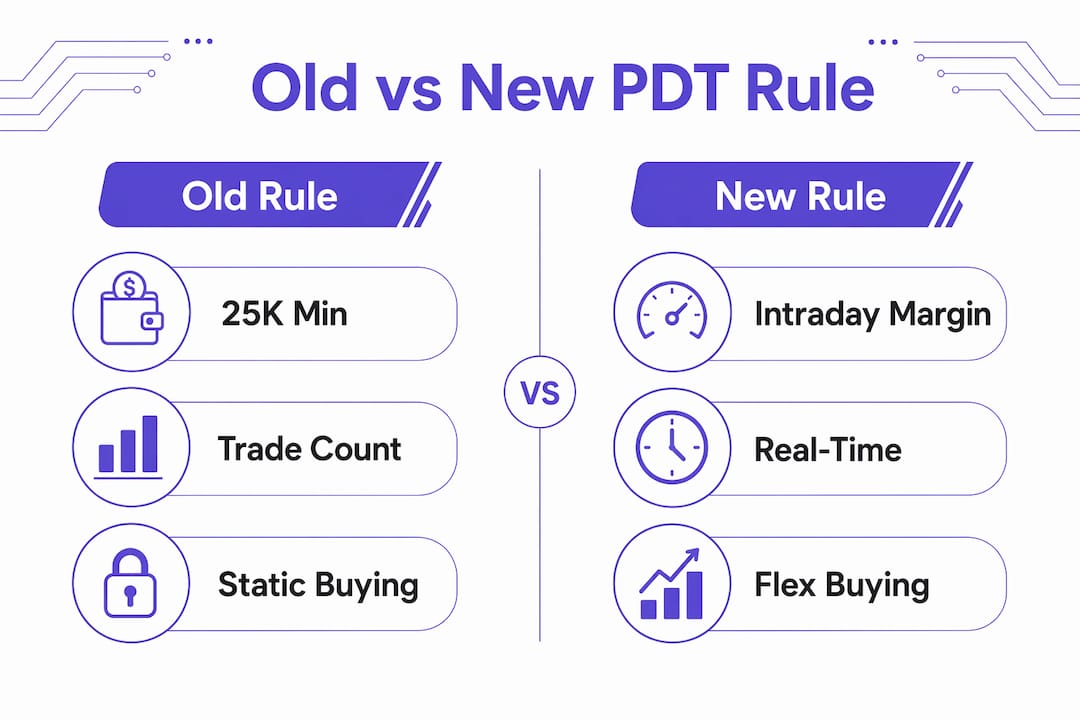
What exactly did FINRA and the SEC change?
The SEC approved FINRA's amendments on April 14, 2026. The changes are not incremental tweaks. They replace the day-trading margin provisions in their entirety.
Old rule vs. new rule at a glance
| Feature | Old PDT Framework | New Intraday Margin Standards |
|---|---|---|
| Designation trigger | 4+ day trades in 5 business days | No designation; no trade-count trigger |
| Minimum equity | $25,000 on day trading days | No fixed minimum (broker house rules may apply) |
| Buying power basis | Prior-day end-of-day excess (up to 4x) | Real-time intraday margin excess |
| Swept cash counted? | No | Yes, if eligible under new rule language |
| Restriction trigger | Falling below $25,000 | Intraday margin deficit (IMD) |
| Effective date | Pre-June 4, 2026 | June 4, 2026 |
Under the new framework, brokers compute an intraday margin level (IML) after each IML-reducing transaction. When your account's real-time equity falls below the required intraday margin, you have an intraday margin deficit. That is the event that matters now, not how many trades you placed.
E*TRADE's explainer confirms that the new rule bases buying power on real-time intraday excess and allows some deposits and intraday profits to be included, a meaningful operational difference from the old end-of-day calculation.
One important addition: eligible cash swept to bank sweep programs can now be included in your intraday margin excess. That gives some accounts more effective buying power than they had under the old system.
What brokers can still do under house rules
The rule change is regulator-level, but it does not flatten broker policies into one uniform standard. Per the FINRA regulatory release, firms retain full authority to impose stricter house requirements.
- Higher equity minimums: A broker can still require $25,000 or more as an internal policy, even though FINRA no longer mandates it.
- Conservative intraday buying-power formulas: Some firms will cap intraday leverage below what the rule technically permits, especially for accounts with volatile trading histories.
- Real-time blocking systems: Brokers may block trades pre-execution if they would create an IMD, rather than allowing the deficit and calling it afterward.
- Phase-in variability: Because firms have until October 20, 2027 to complete implementation, your broker may still be operating under the old PDT rules today. Charles Schwab and E*TRADE, for example, have both published transition guidance, but their specific timelines and house minimums differ.
- Broker communications to watch: Look for updated margin agreements, revised FAQ pages, and account-level notifications. If you have not received anything, call or message your broker directly.
The bottom line: the federal floor is gone, but your broker's floor may not be. Check before you trade.
Practical impacts: buying power, options, and margin risk
How intraday buying power works now

Under the old system, your day-trading buying power was fixed at the start of each session based on prior-day equity. The new framework is live. Your intraday buying power shifts with every position you open or close, reflecting real-time intraday margin excess.

Simple example: Suppose your account has $15,000 in equity and your broker's intraday margin requirement is 25% for the stocks you trade. Your intraday buying power is $60,000 ($15,000 / 0.25). You buy $50,000 of stock intraday. Your remaining intraday excess is $10,000 worth of buying power. If the position drops 5% before you close it, your equity falls and your intraday excess shrinks in real time. Add another position and you may cross into an IMD.
Options and 0DTE exposure
The new framework explicitly covers high-intraday-exposure products. Zero-days-to-expiration (0DTE) options can carry significant intraday margin multipliers. Watch position-level margin requirements carefully; a single large 0DTE position can consume intraday excess faster than a comparable equity trade.
The 90-day restriction
Repeated failure to satisfy intraday margin deficits within a five-business-day window triggers a 90-day restriction on creating or increasing short positions or debit balances. This is a risk-management consequence enforced by your broker, not a regulatory penalty. Still, 90 days of restricted margin access is a serious operational problem for an active trader.
Pro Tip: Treat your intraday buying power display as a live safety buffer, not a static number. Set pre-trade alerts at 80% utilization so you have room to exit before hitting a deficit.
What to check with your broker right now
Do not wait for your broker to contact you. The phase-in window means some firms are still running the old system, and you need to know which side of that line you are on.
- Review your margin agreement. The new intraday margin terms should be reflected in an updated agreement. If yours still references PDT designation, ask when it will be updated.
- Locate your intraday buying-power display. Confirm whether your platform shows real-time intraday excess or still uses the old DTBP figure.
- Ask about swept cash. Confirm whether your broker counts eligible swept bank balances in your intraday excess calculation.
- Get the margin rate schedule. Intraday margin rates may differ from overnight rates; know both.
- Ask about pre-execution blocking. Will your broker block a trade that would create an IMD, or will it allow the trade and issue a deficit call?
- Document responses. Get broker policy answers in writing via support ticket or email. If a restriction occurs during the phase-in, written confirmation of the policy in effect at that time is your reference.
Pro Tip: Test a small intraday position early in the phase-in period to confirm how your broker's system responds before scaling up.
How decision-intelligence tools help under the new regime
The old PDT rule gave traders a blunt behavioral guardrail: stay under four trades or keep $25,000 in the account. That guardrail is gone. What replaces it is real-time equity discipline, and that is harder to maintain without process support.
- Pre-trade buying-power checks: A decision-intelligence platform can flag when a proposed trade would push intraday exposure past a defined threshold, before you execute.
- Behavioral error detection: Impulsive trades taken outside your defined setup criteria are a primary driver of unexpected IMDs. Tools that score each setup against a consistent framework reduce that risk.
- Post-trade pattern detection: Reviewing which trade types or market conditions consistently produce intraday margin pressure helps you adjust position sizing before a deficit becomes a restriction.
- LIANA assistant: EI ALGOS's LIANA assistant uses a six-factor analytical engine to identify recurring behavioral mistakes and recommend process adjustments, giving traders a structured feedback loop that trade-count rules never provided.
With the PDT designation gone, maintaining real-time equity sufficiency depends on disciplined decision workflows. A platform focused on behavioral evaluation, not trade signals, fits that need directly.
How other countries handle day trading rules
The U.S. PDT framework was unusual by global standards. Most major markets never adopted a trade-count-based minimum equity rule.
Canada: The Investment Industry Regulatory Organization of Canada (IIROC, now CIRO) applies margin requirements based on position risk, not trade frequency. No PDT-equivalent designation exists.
United Kingdom: The Financial Conduct Authority (FCA) regulates margin trading through leverage caps and appropriateness assessments, particularly for CFDs and spread betting. There is no trade-count trigger or fixed equity minimum analogous to the old U.S. PDT rule.
European Union: ESMA's product intervention measures cap leverage for retail CFD traders (2:1 for crypto, up to 30:1 for major forex pairs), but again, no trade-count designation.
Australia: ASIC applies similar leverage caps for retail clients trading CFDs. No PDT equivalent.
The U.S. was the outlier. The 2026 shift toward intraday margin standards brings U.S. day trading regulations closer to the risk-based frameworks most other developed markets already use.
Day trading vs. swing trading under the new rules
This distinction matters more now, not less.
Under the old PDT framework, the line between day trading and swing trading was operationally significant: close a position the same day you opened it and it counted as a day trade. Hold overnight and it did not. Traders near the four-trade threshold managed their hold times deliberately to avoid the PDT label.
Under the new intraday margin standards, that counting game is irrelevant. What matters is whether your intraday equity is sufficient to cover your open positions during the trading session.
Day trading still means opening and closing a position within the same trading session. Under the new rules, the risk is an intraday margin deficit if your positions move against you before you close them.
Swing trading means holding positions overnight or across multiple sessions. Swing trades are subject to standard overnight margin requirements, not intraday margin standards. The new framework does not change overnight margin rules. A swing trader who never closes positions intraday is largely unaffected by the June 2026 changes.
The practical implication: if you mix day trades and swing positions in the same margin account, your intraday buying power calculation will reflect the margin already consumed by your overnight holdings. A large swing position can meaningfully reduce the intraday excess available for same-day trades.
Key Takeaways
The PDT designation and $25,000 fixed minimum are eliminated as of June 4, 2026; intraday margin deficits, not trade counts, now determine account restrictions.
| Point | Details |
|---|---|
| PDT designation eliminated | No trade-count trigger; the $25,000 fixed minimum is gone under FINRA's new intraday margin standards. |
| Effective and phase-in dates | Rule effective June 4, 2026; brokers may phase in through October 20, 2027. Confirm your broker's timeline. |
| Intraday buying power is live | Real-time intraday excess drives buying power; eligible swept cash can count if your broker includes it. |
| 90-day restriction risk | Repeated intraday margin deficits within five business days trigger a 90-day margin restriction at your broker. |
| Eialgosinc for behavioral control | EI ALGOS's six-factor engine and LIANA assistant help traders detect behavioral errors and manage intraday exposure before deficits occur. |
The discipline gap the PDT rule was hiding
The $25,000 minimum was a blunt instrument. It kept undercapitalized traders out of frequent margin trading, but it did nothing to improve the decision quality of traders who cleared the threshold. Plenty of accounts with $30,000 or $50,000 still blew up on impulsive trades, poor position sizing, and revenge trading after a loss.
The new intraday margin framework is actually more demanding in one respect: it requires continuous, real-time awareness of your equity position. The old rule let you calculate your day-trading buying power once at the start of the session and largely ignore it until end of day. The new system punishes inattention in real time.
What I find underappreciated in most coverage of this change is the behavioral dimension. Removing the PDT label does not remove the psychological pressure that causes traders to overtrade. If anything, the absence of a hard trade-count guardrail may encourage newer traders to scale up intraday activity before they have the process discipline to manage live margin exposure. The traders who will struggle most are not those who lacked $25,000. They are the ones who never built a consistent pre-trade checklist, never reviewed their own behavioral patterns, and treated trade count as the only risk metric that mattered.
The right response to this rule change is not to trade more freely. It is to build tighter process controls, review your intraday exposure habits, and use every tool available to catch behavioral drift before it creates a deficit.
Fewer guardrails means your process has to carry more weight
If the PDT rule change has you thinking about scaling up intraday activity, the single most useful thing you can do is stress-test your decision process first, not your capital.
EI ALGOS is a decision-intelligence platform built for self-directed traders who want to understand why they make the trades they do, not just which trades to make. The six-factor analytical engine scores each setup against behavioral and process criteria, the LIANA assistant surfaces recurring mistakes in your trading patterns, and live trade management tools give you real-time visibility into intraday exposure. No trade signals, no generic recommendations. Just a structured framework for making better decisions under pressure.
With the PDT designation gone and intraday margin deficits now the primary risk trigger, process discipline is your main defense. Start with a free account at EI ALGOS and see where your decision patterns actually stand.
This article is general information, not financial or legal advice. Confirm current rules and margin requirements with your broker and a qualified financial professional before making trading decisions.
Where to read the official rule and trusted explainers
Primary and authoritative sources for the 2026 intraday margin changes:
- FINRA Regulatory Notice 26-10: The official rule text covering amendments to Rule 4210, the effective date (June 4, 2026), and the phase-in deadline (October 20, 2027).
- FINRA Investor Page: Frequent Intraday Trading: Trader-facing explanation of intraday margin deficits, how firms compute the intraday margin level, and the 90-day restriction consequence.
- FINRA Investor Insights: Frequent Intraday Trading: Covers cash account rules, T+1 settlement, and the distinction between cash and margin account treatment.
- Investor.gov: Pattern Day Trader: SEC-linked investor education page with the old PDT definition and updated language on the transition.
- E*TRADE: PDT Rule Change Explainer: Practical broker-level summary of operational differences between old DTBP and new intraday buying power.
- SEC.gov: Primary source for SEC approval of FINRA's amendments and broader securities regulation context.
Keep copies of your broker's policy statements during the phase-in period. If your account is restricted and your broker is still operating under the old rules, written documentation of the policy in effect at the time of the restriction is your clearest path to resolution.