
Define your trade management rules before you enter, not while you're watching the position move against you. That single discipline separates traders who execute consistently from those who improvise under pressure. The most effective approach to live trade management is a pre-specified rule set, attached to your order ticket before entry and enforced through automation or a strict checklist while the trade is open. Your immediate next step: write one rule right now, for example, "stop at $X, first target at $Y, time-stop at 30 minutes," and attach it as a live order or price alarm. Tools like EI ALGOS score your decision quality before and during a trade, LIANA provides personalized feedback on your behavioral patterns, and real-time data streams from Alpaca or CoinGecko keep your automation current with actual fills.
Key Takeaways
Pre-defining your trade management rules before entry and enforcing them through automation and decision scoring is the most reliable way to improve live trade outcomes and reduce behavioral errors.
| Point | Details |
|---|---|
| Write rules before entry | Define stop, target, size, time-stop, and allowed adjustments on the trade ticket before you enter. |
| Use a decision score gate | Score 0–10 before any mid-trade change; require a minimum threshold before modifying a stop. |
| Backtest your management style | Label past trades as active or passive, simulate counterfactuals, and compute your management delta. |
| Run a 30-day experiment | Track 50 trades with labeled management styles, measure results, and let your own data decide the approach. |
| Eialgos six-factor scoring | Eialgos scores setup quality and LIANA flags behavioral errors, giving you a structured gate for live decisions. |
Table of Contents
- What does live trade management actually cover?
- Active vs. passive trade management: which one fits you?
- Pre-trade rules and templates that make live management repeatable
- What execution tools enforce your live rules automatically?
- How do you test whether active management improves your edge?
- Behavioral safeguards and decision intelligence during a live trade
- Your live trade checklist: what to do while a position is open
- What does active live management actually cost you in time and money?
- Why process-first management is the only approach worth testing
- Eialgos and LIANA: decision intelligence for live trades
- Sources
What does live trade management actually cover?
Live trade management is the pre-specified rule set and in-session actions that govern everything after order entry: stops, targets, partial exits, position adjustments, time stops, and defined exceptions. It is not strategy discovery, signal generation, or broker selection. Those decisions happen upstream. Once you're in a trade, management takes over.
The goals are specific:
- Protect your edge. A well-researched setup can be destroyed by a single impulsive stop-move.
- Preserve capital. Defined stops and position sizing rules prevent one bad trade from damaging your account.
- Capture opportunity. Partial exits and trailing stops let you lock in gains while staying in a winner.
- Reduce emotional improvisation. Pre-written rules replace in-the-moment guessing.
Active vs. passive trade management: which one fits you?
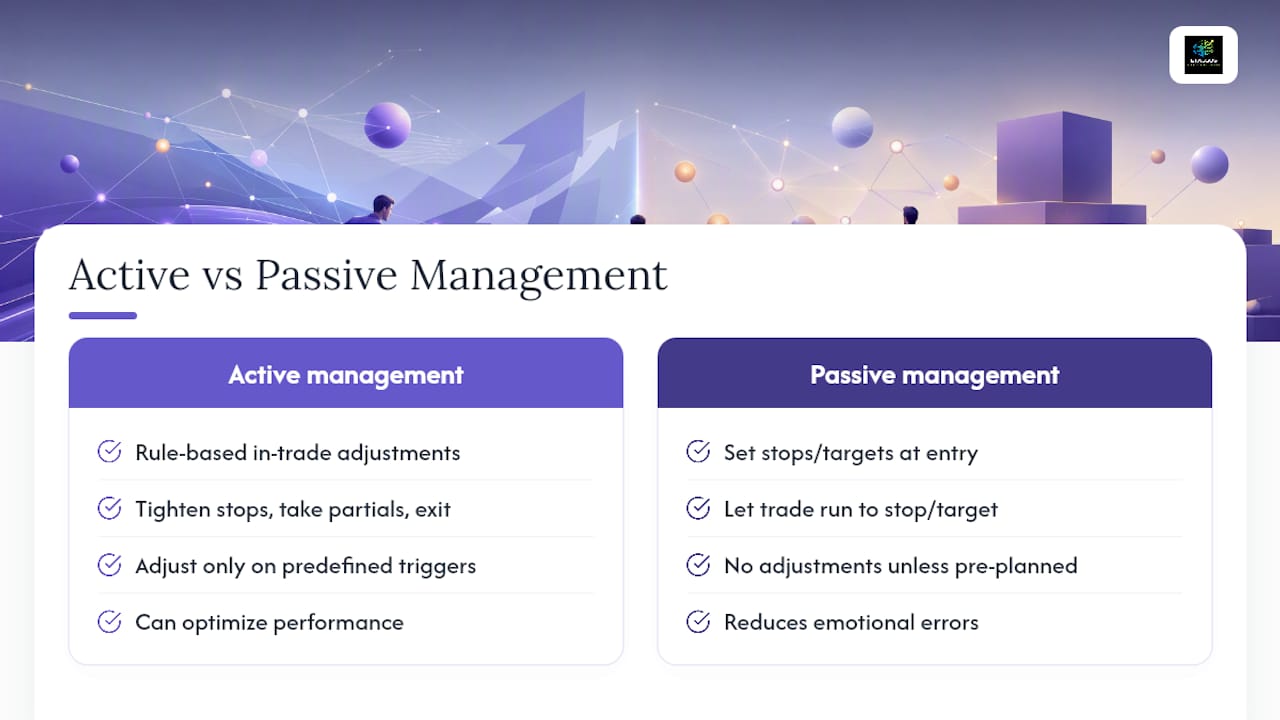
Active management means making rule-based adjustments during the trade: tightening stops on confirmed momentum, taking partials at resistance, or exiting early when the thesis breaks. Passive management, often called "set-and-forget," means placing your stop and target at entry and letting the trade run to one of them without touching it. Neither is universally better. The right choice depends on your discipline, your timeframe, and whether your interventions actually add net value.
Active management can optimize performance in some cases but frequently leads to micromanagement and emotional decisions. Passive management reduces those errors but may cap upside on trades that develop well beyond the original target.
The core rule: only adjust a live trade when a pre-defined condition is met, not when price makes you nervous. Volatility breakouts, volume confirmation, or a specific price level are valid triggers. Random retracements are not.
Pro Tip: Decide in advance which signals permit adjustments. Write them in your pre-trade plan. If a condition isn't on the list, the adjustment isn't allowed.
Short-timeframe traders and those with clearly back-tested intervention rules tend to benefit most from active management. Part-time traders, or anyone who struggles with in-session discipline, usually perform better with a passive approach that gives trades room to develop.
Pre-trade rules and templates that make live management repeatable
A pre-trade plan written before entry removes the need to make decisions under pressure. Use this template for every trade:
- Entry trigger. What specific condition confirms the setup? (Price level, pattern completion, volume threshold.)
- Stop-loss definition. Price-based, volatility-based (e.g., 1.5× ATR), or structure-based (below last swing low).
- Position size rule. Fixed dollar risk per trade, never more than a defined percentage of account equity.
- First target and partial exit plan. Take X% off at the first target; trail the remainder.
- Time stop. If the trade hasn't moved in Y minutes, exit regardless of P&L.
- Allowed in-session adjustments. List them explicitly. Example: "May tighten stop after first target hit. No other adjustments."
Example filled ticket: SPY, entry $530.50, stop $528.00, first target $534.00 (take 50% off), trail remainder with a 1× ATR stop, time-stop at 45 minutes, no size additions allowed.
Pro Tip: Time stops are especially useful for momentum trades expected to move fast. If the trade stalls, the thesis is likely wrong. Exit and preserve capital for the next setup.
What execution tools enforce your live rules automatically?
Automation removes the gap between your plan and your execution. Key order types to use:
- Stop orders to define maximum loss at entry.
- Limit orders for target exits, placed immediately after fill confirmation.
- Trailing stops to lock in gains on trending trades.
- OCO (one-cancels-other) orders where your broker supports them, linking stop and target so one cancels the other on fill.
For US equities, Alpaca's WebSocket trade_updates stream dispatches real-time fill, partial_fill, canceled, and replaced events with timestamp, price, qty, and position_qty. You authenticate with the same API key pair used for REST calls. This lets you build lightweight automation: receive a fill event, confirm position size, then auto-place your stop and target orders via HTTP REST. For crypto traders, CoinGecko's WebSocket API streams continuous real-time prices, trades, and OHLCV data for low-latency alerts and live charting.
The data flow looks like this:
| Stage | Action |
|---|---|
| Market data in | WebSocket stream delivers price, fills, position_qty |
| Rule evaluator | Decision score or rule engine checks pre-trade conditions |
| Order manager | Sends REST call to place, modify, or cancel orders |
| Confirmation | Fill event logged for backtest and journal |
Retail platforms like Fidelity's Active Trader Pro surface streaming quotes, live order status, and quick-click order workflows for traders who prefer a GUI over a custom API setup. Institutional monitoring systems capture every order event, detect anomalies, and trigger automated enforcement. Retail traders can replicate the core logic with broker APIs and conditional alerts.
How do you test whether active management improves your edge?
Label every historical trade as "actively managed" or "passive," then simulate what would have happened if each actively managed trade had been left to hit its original stop or target. The difference in outcome per trade is your management delta.
Metrics to track:
- Realized P&L delta vs. the counterfactual passive outcome.
- Capture rate: percentage of the full move from entry to target that you actually captured.
- Average holding time for active vs. passive trades.
- Drawdown contribution: did active management reduce or increase peak-to-trough drawdowns?
- Slippage: did frequent adjustments increase total slippage costs?
Backtesting tools let you simulate different management techniques on historical fills to compare realized P&L, capture rate, and slippage across approaches. Accurate backtests require real fill data. Alpaca's WebSocket stream captures fill timestamps, partial fills, and position_qty changes, giving you the granular data needed to reconstruct real-time behavior.
A small net improvement from active management may not justify the ongoing time cost. Quantify both the P&L delta and the hours spent managing before deciding which approach to run going forward.
Behavioral safeguards and decision intelligence during a live trade
The hardest part of live trade monitoring isn't the tools. It's staying out of your own way. A structured decision-scoring process gives you a numeric gate before any mid-trade change.
Decision-score factors to evaluate before modifying a live trade:
- Thesis clarity: is the original reason for the trade still intact?
- Time-in-trade vs. expected: are you within the planned holding window?
- Volume confirmation: does volume support the current price action?
- News flag: has a news event changed the risk profile?
- Emotional state tag: are you calm and following the plan, or reacting?
- Risk budget used: how much of your daily or weekly risk limit is already committed?
Pro Tip: Score 0–10 before any mid-trade change. Set a minimum threshold, say 7 out of 10, before allowing a stop adjustment. Below that score, no change is permitted.
Practical guards include automated tags that log every order modification with a timestamp, a rule that only you may move stops (no override without a logged reason), and journaling screenshots at entry, adjustment, and exit for post-trade review. These controls borrow directly from the anomaly-detection and rule-enforcement logic that institutional monitoring systems use.
Your live trade checklist: what to do while a position is open
Copy this into a phone note or trade ticket and run through it on every trade:
- Confirm order fill, price, and position size match the pre-trade plan.
- Attach stop and target orders immediately after fill confirmation.
- Set a price or time alarm for the time-stop threshold.
- Review the list of allowed adjustments. If a condition isn't on the list, do nothing.
- Log a decision score before any mid-trade change.
- Capture a screenshot at exit for post-trade review.
Avoid these: moving your stop farther away to avoid a loss, adding size unless it was pre-planned, and reacting to live commentary or social media without a clear rule.
What does active live management actually cost you in time and money?
| Management style | Daily time commitment | Key cost drivers |
|---|---|---|
| Passive (set-and-forget) | Minutes to set up | Brokerage commissions, spread |
| Light active | 30 minutes per session | Above plus data subscriptions, platform fees |
| Full-time active | Continuous monitoring | Above plus latency-sensitive connectivity, decision-tool subscriptions |
Operational costs include data and API subscriptions, brokerage fees and slippage on additional order modifications, and potential subscriptions to decision-intelligence platforms. For intraday traders, the Pattern Day Trader rule adds a $25,000 minimum equity requirement for US accounts making four or more day trades in five business days. Factor that capital requirement into your cost-benefit analysis before committing to a full-time active approach.
Why process-first management is the only approach worth testing
Most traders who struggle with live management aren't failing because of bad signals. They're failing because they have no written rule for what to do after entry. The decision is made in real time, under pressure, with money on the line. That's the worst possible environment for good judgment.
The experiment worth running: take your next 50 trades, label each as actively managed or passive, record the outcome against the counterfactual, and compute your management delta. Thirty days of data will tell you more about your actual edge than any indicator. If active management adds net value after accounting for time and slippage, expand it. If it doesn't, go passive and redirect that energy to better entries. The answer is in your own data, not in a general rule.
Eialgos and LIANA: decision intelligence for live trades
Eialgos scores every trade setup through a six-factor analytical engine that evaluates the behavioral and psychological quality of your decision, not just the price setup. LIANA, the platform's AI assistant, delivers personalized feedback on your trading patterns over time, helping you identify where your process breaks down under pressure.
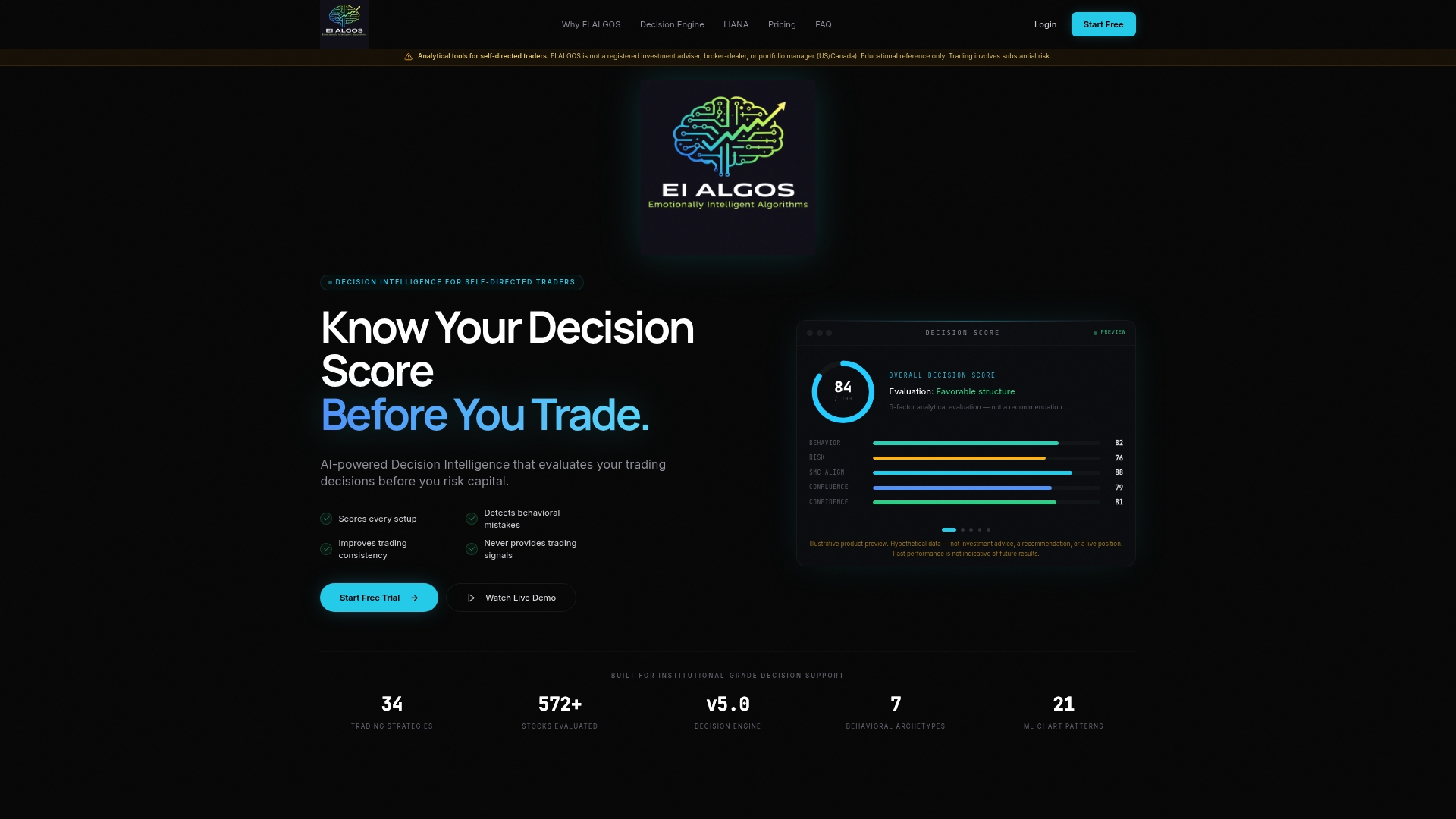
In practice, that means attaching a decision score to your live rules: a score below your threshold blocks a stop adjustment, a score above it permits it. LIANA reviews your journal data and flags recurring behavioral errors, like moving stops on low-scoring setups or adding size outside the plan. The Eialgos guide page includes pre-trade templates and decision-score dashboards you can use in your next session. To access the full six-factor engine and LIANA's personalized feedback, start with a subscription and run the 30-day experiment described above with your own trade data.
Sources
Technical documentation:
- Alpaca websocket streaming documentation
- Trade Management Guide for Active Traders
- The Pros and Cons of Active vs Passive Trade Management
- Should You Actively Manage Your Trades? - by Kyna Kosling
- Trade Monitoring System — Live Trade Tracking for Prop Firms | FXPropTech
- AI Signal Backtester — Historical Performance Analysis | Stonk Buddy
Trade management guides:
Backtesting and platform tools:
Eialgos resources:
This article is general information, not a substitute for advice from a qualified financial advisor. Consult a qualified financial professional about your own circumstances before acting on anything here.