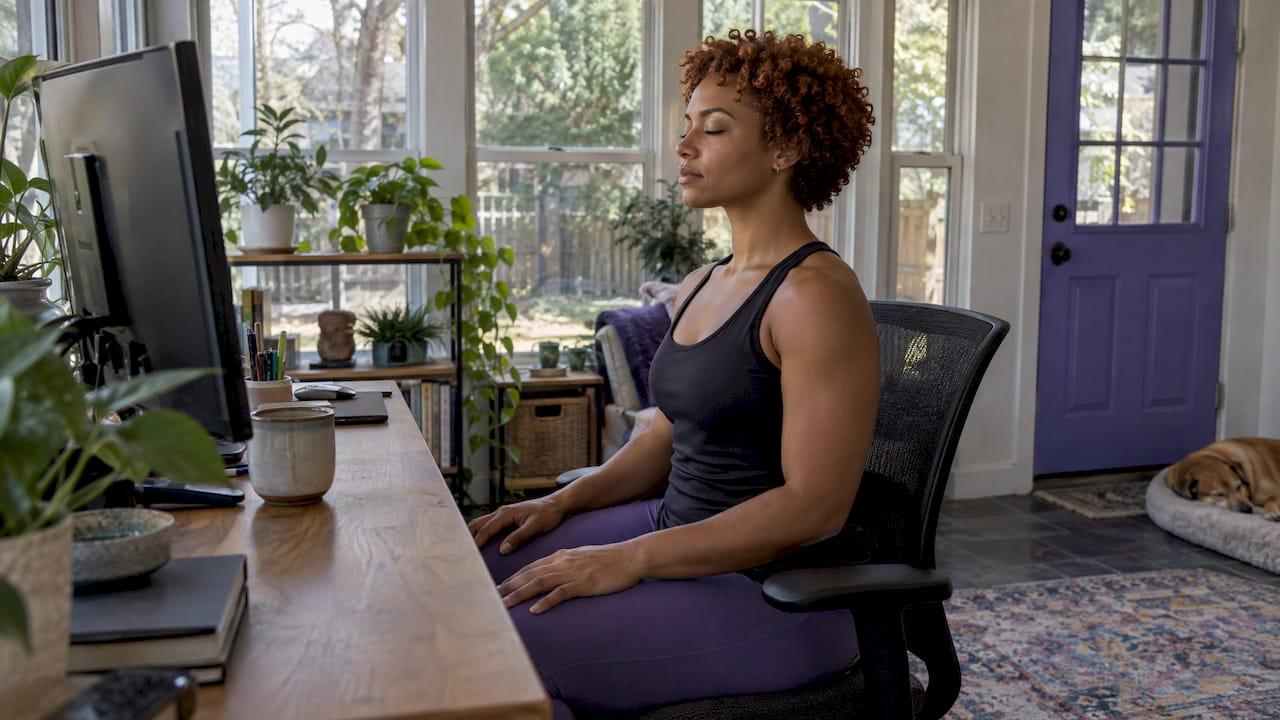
Mindfulness trading means paying deliberate, non-judgmental attention to your body, thoughts and impulses while you trade, so you notice a rushed or emotional decision before you click. It does not predict the market and it is not a signal. It trains the part of your process that you control. Awareness works best when you can also see your patterns in data, which is why we built EI ALGOS to score the decision behind each setup, not the market move.
TL;DR
- Mindfulness in trading is noticing urges, stress and impulses in real time, then choosing your action instead of reacting.
- Start small: five to 15 minutes of daily practice is enough to begin, and even one minute of slow breathing helps.
- Use a three-part routine: a short check-in before the session, a pause rule during it, and a written review after it.
- Awareness fades without a record. Pair the practice with a review of your trades so you can see which states lead to which mistakes.
Table of Contents
- What mindfulness means in trading
- What the research says
- A three-part routine: before, during and after the session
- Build the habit so it lasts
- Where mindfulness needs a record
- Putting your awareness to work with EI ALGOS
- Our perspective
- FAQ
- Sources
What mindfulness means in trading
Mindfulness is the habit of observing what is happening right now without immediately acting on it. For a trader, "what is happening" is usually internal: a tight chest after a loss, an urge to add to a position, a sudden need to get back what you just lost.
Trading psychology is the broader field. It covers how emotions, biases and habits shape your decisions: fear of missing out, revenge trading, overconfidence after a win, hesitation after a loss. Mindfulness is one skill inside that field. It is the skill of noticing, and noticing comes before every other fix. You cannot correct a pattern you do not see.
Two points keep the idea honest:
- It is not a trading signal. Mindfulness does not tell you what to buy or sell. It improves the quality of the person making the decision.
- It is not a guarantee of results. It lowers the odds that stress or impulse makes the call for you. Your edge, risk limits and plan still do the work.
If you already know your emotions cost you money, our guide to emotional trading: signs, causes and how to stop covers the patterns in more depth.
What the research says
Most mindfulness research is not about traders, so it helps to separate three kinds of evidence: studies of traders, studies of trading behavior, and studies of stress in general.
Studies of traders
A 2025 academic study of financial traders found that a brief mindfulness intervention was associated with lower cortisol and higher testosterone. Cortisol is a stress hormone. In the same study, higher testosterone predicted higher earnings among traders whose cortisol fell, but not among those whose cortisol rose. The practical reading: calmer physiology and a confident, active state work together, and mindfulness is one way to get there.
A 2023 peer-reviewed study of stock-exchange traders in Tehran found that mindfulness techniques derived from MBSR and MBCT reduced anxiety and stress and increased emotional control compared with a control group. MBSR and MBCT are standard eight-week mindfulness programs. The sample is from one market, so treat it as encouraging evidence and not a universal rule.

Studies of trading behavior
A randomized trading-simulation study of 820 participants looked at the disposition effect, the tendency to sell winners too early and hold losers too long. State mindfulness did not change that bias overall. However, heightened mindfulness reduced selling of both gains and losses and correlated with less catastrophising, and the author suggests these processes may help reduce overtrading. For you, that points to a specific use: mindfulness helps you slow down and stop reacting to every swing. It is not a switch that removes a named bias.
Studies of stress and emotion
In a randomized trial of 153 stressed adults, a 15-lesson remote mindfulness program that combined monitoring and acceptance led people to notice more positive experiences during acute stress than monitoring alone or a control condition. A separate pre-registered trial of 131 students found that mindfulness training consistently promoted positive reappraisal, meaning people reframed stressful situations more constructively, even without being told to. A drawdown is a stressful situation, so that skill transfers.
The takeaway across these studies is consistent: practice lowers reactivity and gives you room to choose. It works on you, not on the chart.
A three-part routine: before, during and after the session
You do not need a meditation retreat. You need short practices attached to moments you already have: the open, the entry and the close.

Before the session: a two-to-five-minute check-in
Sit away from your screens. Use one of the simplest techniques Mayo Clinic Health System lists: focused breathing, a body scan, or sitting meditation.
- Breathe slowly for one minute. Count each exhale up to ten, then start over. When your mind wanders, return to the count without scolding yourself.
- Scan from feet to head. Note tension in your jaw, shoulders and hands. Tight shoulders before the open often mean you are carrying last session's loss.
- Name your state in one word. Calm, rushed, angry, bored, overconfident. Write it down. The label matters because you will compare it with your results later.
- Read your plan aloud. State your setups, your maximum risk per trade and your daily loss limit. Reading it aloud is a cue to follow it.
If your state is angry or exhausted, the mindful decision can be to trade smaller or not at all.
During the session: the pause rule
The live session is where discipline breaks, so make the practice mechanical.
- Pause before every entry. Take one slow breath and ask: is this one of my setups, or am I reacting? One breath costs you a second and often saves you a bad trade.
- Notice the urge, then wait. A strong urge to chase a move usually peaks and fades. If you feel it, set a short timer before acting. Our 5-second rule for FOMO trading is a ready version of this.
- Use a hard trigger for a longer break. Two losses in a row, a stop hit outside your plan, or a racing heart means you stand up for a few minutes. Our three-step cool-down gives you a sequence to follow so you are not improvising while upset.
- Release tension with a body technique. Progressive muscle relaxation is simple: tense a muscle group for about five seconds, relax for 30 seconds, and move from toes to head. Mayo Clinic recommends using relaxation techniques when stress symptoms begin, not after they take over.
A safety note belongs here. The same Mayo Clinic guidance says that people with serious mental health issues or a trauma history who feel emotional discomfort during these exercises should stop and seek professional help. If trading stress is affecting your sleep, mood or relationships, talk to a doctor or licensed mental health professional.
After the session: a five-minute review
Mindfulness after the close means looking back without judgment. You are collecting facts, not grading yourself.
- Re-read your one-word state from the morning.
- List each trade where you broke your own rules and note what you felt just before it.
- Mark which trades followed your plan, whatever their outcome. A losing trade that followed the plan is a good decision.
- Write one sentence on what you will do differently tomorrow.
This step turns a vague feeling of "I was off today" into evidence. Over a few weeks, patterns appear: the post-lunch trades, the size increase after a win, the trade right after a stop-out.
Build the habit so it lasts
Trading stress rarely comes from one source. Mayo Clinic's stress guidance suggests identifying your triggers, such as anger, tension, headaches, or focus and sleep problems, and then regularly using deep breathing, tai chi, yoga, meditation or mindfulness. It also lists healthy eating, exercise, sleep, less screen time and avoiding alcohol or drugs as part of managing stress.
For a trader, that translates into a few concrete habits:
- Anchor the practice. Attach it to something fixed, like your first coffee or the minute before the market opens.
- Keep it short. A one-minute practice you do every day beats a 30-minute one you skip.
- Protect your sleep. A tired trader is a reactive trader. Set a cut-off time for reviewing charts at night.
- Know your triggers. Fast markets, news releases, a large open position, a bad morning at home. Write your top three and your planned response to each. Our guide on how to control emotions while trading can help you build that list.
How professional desks handle this is also worth a read: how professional traders manage emotion shows that most of it is structure and routine, not willpower.
Where mindfulness needs a record
Here is the practical problem. Mindfulness teaches you to notice in the moment. But memory after a trading day is selective. You remember the big win and the painful loss and forget the six small impulsive entries in between, which are often where the damage accumulates.
A written record fixes that. Your one-word state, your rule breaks and your reasons for each entry give you data about your own behavior. A trading journal that reviews each trade for process, not only profit and loss, is the natural partner to a mindfulness routine. The questions to ask of that record are specific:
- Which emotional states appear before my rule breaks?
- Do my worst trades cluster at a certain time, size or after a certain result?
- Am I improving, or just feeling better about the same mistakes?
These are questions about decision quality, which is the territory of trader behavior analysis. If you want a structured way to do it, our 30-day behavioral trading analysis walks you through the process, and the list of common trading mistakes gives you a checklist of what to look for.
Putting your awareness to work with EI ALGOS
EI ALGOS is a web-based Decision Intelligence platform for self-directed traders. It does not give trade signals or predictions. It scores each setup on a six-factor analytical engine that looks at the psychological and behavioral factors behind your decision, and it helps you detect your own behavioral errors. Our assistant, LIANA, gives personalized feedback on your process based on your own trading patterns, so the noticing you practice in the morning gets backed by evidence at night.
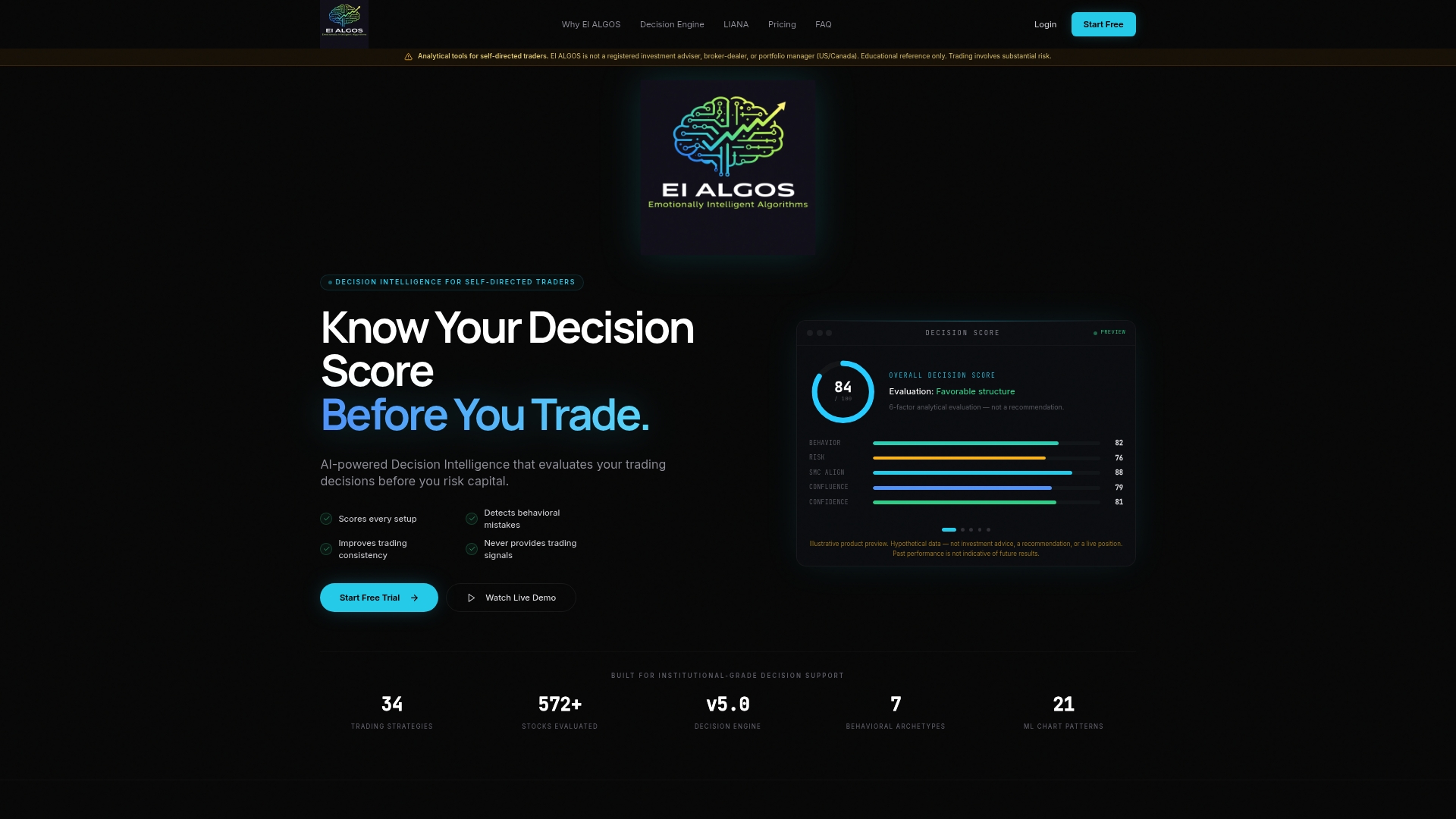
You can start on the Free plan at $0 per month. Paid plans are Starter at $49 per month, Pro at $129 per month and Elite at $229 per month, with advanced feature sets and unlimited usage on the paid tiers. See the plans and the platform or read how EI ALGOS works first. To see how emotion is treated in the platform, look at the Emotion Score.
Our perspective
Most traders we talk to already know they should stay calm. Knowing it has never been the problem. The problem is that in the moment, a rushed entry feels exactly like a good one.
That is why we think about trading as a series of decisions, not a series of predictions. Mindfulness gives you the pause. A scored, reviewed record gives the pause something to learn from. Without the record, you are relying on how the day felt. With it, you can see which setups you took with a clear head and which you took with a racing one.
This is why EI ALGOS focuses on the trader and not on the market. We score each setup on six factors, flag behavioral errors, and let LIANA reflect your own patterns back to you. We offer no signals, because a signal cannot fix a process. Consistency comes from noticing, reviewing and adjusting, day after day.
If you take one thing from this article, take this: practice the pause, write down what you felt, and review it every week. Do that, and your discipline stops being a mood and becomes a measurable habit.
Anantha
FAQ
What is the psychology of trading?
Trading psychology is how emotions, biases and habits influence your decisions about when to enter, exit and size a trade. Common patterns include fear of missing out, revenge trading and holding losers too long. Mindfulness is one tool for spotting these patterns as they happen, and a trade review is the tool for spotting them afterward.
How long should I practice mindfulness before it helps my trading?
Mayo Clinic Health System says five to 15 minutes of daily practice can begin to produce benefits, and even one minute of slow breathing can help. Start with one minute before the open and add the post-session review. Results vary by person, so track your own rule breaks over several weeks.
Can mindfulness replace a trading plan or stop-loss?
No. Mindfulness helps you follow your plan by giving you a pause before you act on impulse. Your setups, risk per trade and stop-loss rules stay in place, and the practice makes it easier to honor them.
Is the 3-5-7 rule in trading a mindfulness technique?
No. The 3-5-7 rule is a risk-management guideline, not a mindfulness practice, and it is not an official standard. Mindfulness fits alongside any risk rule by helping you notice when you are tempted to break it.
What should I do if meditation makes me feel worse?
Stop the exercise. Mayo Clinic advises that people with serious mental health issues or a trauma history who feel emotional discomfort during relaxation exercises should stop and seek professional help. Talk to your doctor or a licensed mental health professional.
Sources
- Mindfulness, the dual-hormone hypothesis, and performance in financial traders
- The effectiveness of mindfulness techniques on reducing anxiety and stress in stock-exchange traders
- Mindfulness and the disposition effect in a trading simulation (Open Research Online)
- Remote mindfulness training and positive experiences during acute stress (Emotion)
- Mindfulness-to-Meaning pathway and positive reappraisal (Emotion)
- Starting mindfulness meditation, Mayo Clinic Health System
- Relaxation techniques: Try these steps to lower stress, Mayo Clinic
- Stress management In-Depth, Mayo Clinic