
Accountability in trading means building visible, enforceable systems and social checks that make following your rules easier than breaking them. It replaces willpower with design. Start today: pick one enforceable guardrail, like a daily loss cap or a pre-trade checklist, and track your adherence to it starting with your very next session.
TL;DR:
- Using mechanical guardrails like bracket orders and broker-enforced loss limits prevents emotional decision-making during stressful trading situations.
- Tracking violation-only P&L reveals that rule-breaking trades typically underperform compliant ones by a wide margin.
- Building a simple accountability system within five days involves setting 2-3 strict rules, visual dashboards, and weekly reviews, not overloading with data.
- Relying solely on external accountability or pure willpower increases burnout and reduces system effectiveness, so balance is essential.
- Combining automated alerts, decision scoring tools, and mechanical order controls creates the most reliable framework for maintaining discipline in trading.
Table of Contents
- What Are the Core Pillars of Accountability in Trading?
- How Do You Build an Accountability System This Week?
- When Should You Use Enforceable Guardrails Like OCO or Daily Loss Caps?
- How Do You Measure Rule Compliance in Trading?
- What Should You Do When You Break a Rule?
- How Do EI ALGOS and Decision Intelligence Support Accountability?
- Why Does Accountability Improve Emotional Control in Trading?
- What Are the Most Common Accountability Mistakes Traders Make?
- How Should Accountability Fit Into Your Trading Strategy?
- What Tools Go Beyond Basic Habit Trackers for Accountability?
- An Editorial Note on Practicing What This Guide Preaches
- Ready to Put a Decision-Scoring System to Work?
- Sources
What Are the Core Pillars of Accountability in Trading?
Real accountability in trading rests on four pillars: visibility, process habits, reflection, and external checks. Skip one and the whole structure gets shaky, because each pillar covers a failure point the others miss.
Visibility means your commitments live somewhere you have to look at them, not just in your head. A dashboard showing today's loss cap, your open risk, and your rule list keeps intentions in front of you during the exact moment you're tempted to ignore them. A pre-market plan works the same way: write down your bias, your setups, and your exit criteria before the first candle prints, and you've already made today's toughest decisions while calm.
Habits and process turn intentions into repeatable action. A habit tracker that logs whether you followed your checklist, not whether you made money, shifts your attention to what you actually control. Traders who check off "followed entry criteria" or "waited for confirmation" every day for a month start doing it automatically by week three.
Reflection converts one day's experience into tomorrow's improvement. A short nightly note on one win and one thing to fix, paired with a deeper weekly audit of your trades against your rules, closes the loop that most traders leave open. Without it, you repeat the same mistake for months without noticing the pattern.
External accountability adds a cost to rule-breaking that your own conscience can't. A structured routine of written goals and weekly updates drives dramatically higher follow-through than working alone, according to a widely cited 2007 study by Dr. Gail Matthews at Dominican University: A significant study found that people who wrote down goals and provided weekly progress updates were much more likely to complete their goals than those who considered their goals only mentally.
Here's how the four pillars work together in practice:
- Visibility keeps the rule in front of you before you can rationalize breaking it.
- Habits turn a one-time decision into a default behavior.
- Reflection catches drift before it becomes a pattern.
- External checks make the social cost of breaking a rule higher than the temptation to break it.
A trading discipline system that only has one of these pillars is a to-do list you'll eventually ignore. All four together is a structure your future self can't easily talk his way out of.
How Do You Build an Accountability System This Week?
You don't need a month to put a working system in place. Most self-directed traders can have a functional structure running within five trading days if they follow a tight, prioritized sequence instead of trying to overhaul everything at once.
- Pick 2 to 3 non-negotiable rules and write them down. Choose the rules that cause the most damage when broken, typically a daily loss cap, a maximum position size, and a rule about not adding to losers. Fewer rules enforced consistently beat ten rules you ignore by Thursday.
- Build a visible dashboard and a pre-trade commit note. This can be a spreadsheet, a whiteboard, or a note pinned to your trading screen. The format matters less than whether you actually see it before you click "buy."
- Automate enforcement wherever your platform allows it. Bracket orders and OCO (one-cancels-the-other) orders remove the moment-to-moment decision of whether to honor your stop. System design that relies on mechanical enforcement rather than willpower consistently outperforms rules you have to remember to follow under pressure.
- Choose an accountability partner or community, and set a weekly check-in. This doesn't need to be formal. A fifteen-minute call or a shared spreadsheet with one other trader creates real social friction against quietly breaking your own rules, and community visibility often does more than a private journal ever will.
- Schedule daily reflection and a weekly rule-adherence audit. Ten minutes at the close of each session, plus thirty minutes every weekend reviewing the week's trades against your written rules, is enough to catch drift early.
If you trade crypto or juggle multiple asset classes, a structured journaling setup built for multi-asset trading can give you a workable template rather than starting from a blank page. For a broader routine and ready-to-use formats, a trading journal template saves you the setup work entirely.
Pro Tip: Hide your running intraday P&L on your trading screen for the first hour of the session. Watching the number swing in real time is one of the fastest ways to trigger emotional decisions, and traders who can't see it tend to stick to their plan longer.
When Should You Use Enforceable Guardrails Like OCO or Daily Loss Caps?
Soft rules fail under pressure. Mechanical guardrails don't ask for permission, and that's exactly why they work when you're stressed, tired, or chasing a loss.
OCO and bracket orders remove discretionary stop management entirely. Once you place a bracket order, your stop and target are locked in at trade entry, before emotion has a chance to argue with you mid trade. This is the single most effective defense against revenge trading, because the decision to exit was already made when you were calm.
Broker-enforced daily loss limits beat soft, self-imposed limits because they can't be overridden in the moment. A mental note to "stop at negative $500" evaporates the instant you're down $480 and convinced the next trade will fix it. A broker-level lock doesn't care how convinced you are.
Position-size locks and time-based cutoffs protect session quality specifically. Capping your maximum position size prevents a single bad trade from wiping out a week of gains, and a hard cutoff time (say, no new trades after 11:00 AM) protects you from the fatigue-driven mistakes that cluster late in a session.
A few situations call for escalating a soft rule into a hard guardrail immediately:
- You've broken the same soft rule twice in one week despite good intentions.
- The rule protects against catastrophic loss rather than a minor inefficiency.
- You notice the break happens specifically during emotionally charged sessions.
Regulatory guidance around futures markets also reinforces why mechanical controls matter beyond personal discipline. Exchange rules on self-matching expect market participants to actively monitor their own activity and use automated functionality to minimize accidental wash trades, not to rely on manually catching the problem after the fact. The same logic applies to your personal risk controls: automate what you can't trust yourself to catch in real time.
How Do You Measure Rule Compliance in Trading?
You can't improve what you don't track, and most traders only track P&L. Tracking rule adherence separately is what actually reveals where the damage is coming from.
A basic compliance scorecard needs just a handful of fields tracked per trade:
- Rule name (which specific rule applied to this trade)
- Date and session time
- Adhered: Yes/No
- Emotional state before entry (calm, anxious, frustrated, confident)
- Trade P&L
- Violation type, if any (sized too big, moved a stop, ignored a signal, traded outside plan)
The most revealing number most traders never calculate is violation-only P&L. Tag every trade where you broke a rule, then sum just those trades' results separately from your compliant trades. Isolating violation trades this way routinely shows that rule-breaking trades underperform compliant ones by a wide margin, turning a vague sense of "I should be more disciplined" into a specific dollar figure that's hard to ignore.
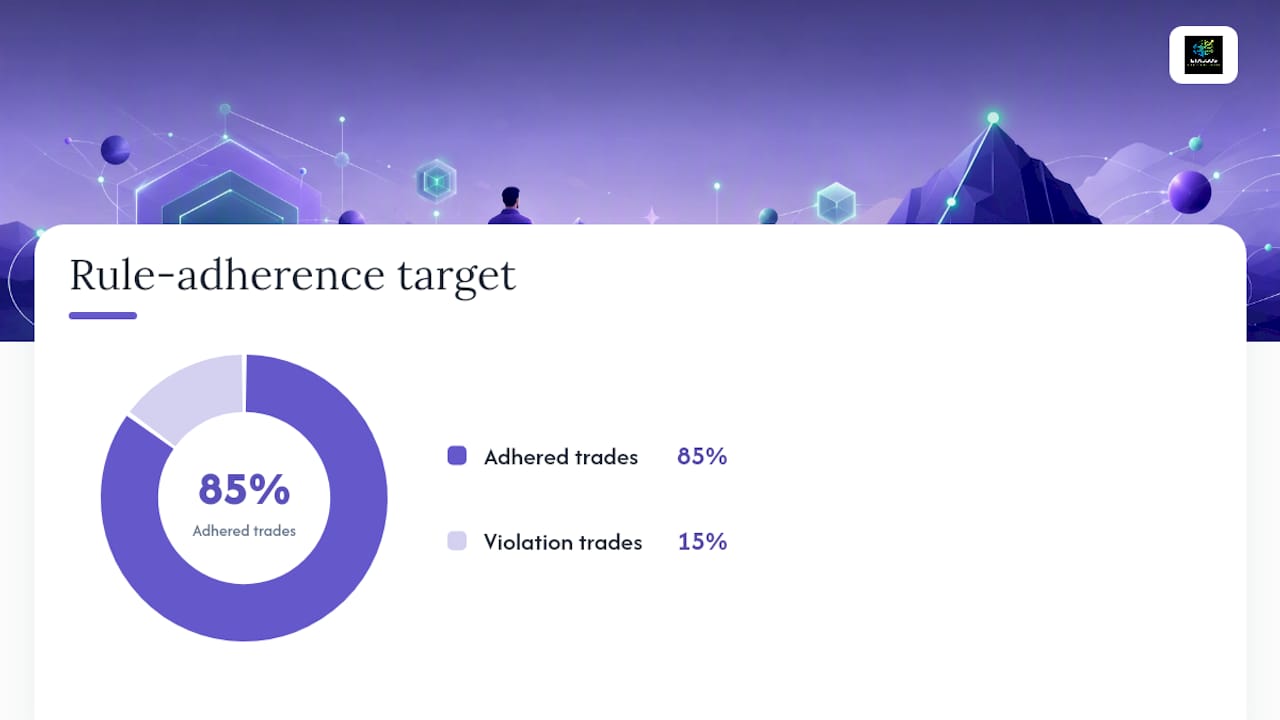
Aim for a rule-adherence rate above 85% as a working benchmark. Below that, your risk management is compromised regardless of how good your strategy is on paper, because the strategy you're actually trading isn't the one you designed. A trading scorecard built around decision quality rather than just outcomes helps pre-filter setups before you're even in a trade, cutting down on impulsive entries at the source. Tracking this consistently over time is also where measuring consistency becomes concrete instead of aspirational.
What Should You Do When You Break a Rule?
Breaking a rule isn't the failure. Not having a plan for what happens next is.
- Contain it immediately. Stop trading for the session if the break involved risk (oversized position, moved stop, revenge entry). Close the position if it's still open and within your control to exit cleanly.
- Review the cause before you do anything else. Was this a gap in your system (the rule wasn't specific enough), a conscious override (you knew the rule and broke it anyway), or external stress (a bad morning, poor sleep, a personal issue bleeding into your trading)?
- Escalate appropriately. A first-time break might just need a documented note. A repeated break on the same rule should trigger a mandatory pause, a report to your accountability partner, or moving that rule to a broker-level restriction if one is available.
- Update the rule itself. Vague rules get broken more than specific ones. If "don't oversize" keeps failing, replace it with a hard position cap enforced by your platform, not by your memory.
Pro Tip: Write your incident review the same day, while the emotional context is still fresh. A review written three days later tends to rationalize the break instead of diagnosing it.
How Do EI ALGOS and Decision Intelligence Support Accountability?
Most tools built for self-directed traders focus on predicting the market. EI ALGOS focuses on the decision itself, which is the part accountability actually depends on.
Its six-factor analytical engine scores each trade setup based on psychological and behavioral factors, not price forecasts. That distinction matters for accountability specifically: a decision score surfaces patterns in how you're trading, like impulsive entries or repeated overrides of your own plan, that a human reviewing trades manually at the end of the week often misses entirely.
The LIANA assistant adds a personalized layer to this. Instead of generic tips, it gives process-focused feedback tied to your own trading patterns, which is useful both for pre-trade checks (does this setup match your stated plan?) and structured post-session reviews.
EI ALGOS doesn't replace the guardrails and habits covered above. It supports the parts of the playbook that benefit from consistent, structured scoring: evaluating setups, tracking adherence over time, and giving you something concrete to review each week. Placing the daily loss cap, closing the losing trade, and having the hard conversation with your accountability partner are still on you.
Why Does Accountability Improve Emotional Control in Trading?
Accountability works on your psychology before it works on your P&L. That's the part most trading education skips.
Knowing a rule is visible, tracked, and shared with someone else changes how a trade feels in the moment. The decision to override a stop stops being a private negotiation with yourself and becomes something you'll have to explain later, whether that's to a dashboard, a partner, or a weekly scorecard. That shift alone reduces the emotional charge behind impulsive decisions, because the cost of breaking the rule is no longer abstract.
Discipline also compounds on itself in a way that's easy to underestimate. Every time you follow a rule under pressure and see the outcome, whether the trade wins or loses, you reinforce the belief that your system works and that you can trust it. Traders who skip this reinforcement loop tend to trust their gut more than their process, which is exactly the pattern that produces inconsistent results.
The emotional benefit isn't calmness for its own sake. It's that calm traders execute their plan more precisely, and precise execution is what turns a good strategy on paper into a good strategy in practice. Accountability structures are, in a real sense, an emotional regulation tool disguised as a compliance tool.
What Are the Most Common Accountability Mistakes Traders Make?
Two failure patterns show up constantly, and both come from good intentions taken too far in one direction.
Overreliance on external discipline happens when a trader outsources all responsibility to a partner, a coach, or a community, and stops building internal judgment. External accountability is a multiplier on your own systems, not a replacement for them. If your partner disappears for a week, your discipline shouldn't collapse with them. The goal is a system where external checks catch the rare slip, not a crutch you lean on for every decision.
Burnout from over-tracking is the opposite mistake. Traders who try to log fifteen fields per trade, join three communities, and audit every session in exhaustive detail often quit the whole system within a month, because the overhead outweighs the benefit. Start with two or three rules and a simple scorecard. Add complexity only once the basics are automatic, not before.
A third, quieter pitfall is treating accountability as punishment rather than diagnosis. If every rule break turns into self-criticism instead of a system fix, traders start hiding mistakes from their own tracker, which defeats the entire point. The fix for a repeated violation is almost always a system change, like a tighter guardrail or a clearer rule, not a harsher tone with yourself.
How Should Accountability Fit Into Your Trading Strategy?
Accountability isn't a separate practice bolted onto your strategy after the fact. It should be part of how you design the strategy in the first place.
When you're building or refining a trading strategy, write your accountability rules alongside your entry and exit criteria, not after them. A strategy that says "buy on this pattern" but says nothing about position sizing under stress or maximum daily loss isn't a complete strategy. It's a partial one waiting to be broken.
Backtesting and forward-testing periods are also the right time to establish your compliance benchmarks. If your strategy has an expected win rate and average risk-to-reward ratio, decide in advance what percentage of trades you expect to follow your own rules exactly, and treat any month below that threshold as a signal to review the system, not just the market conditions.
Strategy development and accountability development should also share the same review cycle. When you update a strategy, ask whether your guardrails need updating too. A new setup type might need its own specific rule rather than being forced into an existing one that doesn't quite fit. Traders who treat strategy and accountability as one integrated process tend to catch mismatches between what they planned and what they're actually doing far earlier than those who review each separately.
What Tools Go Beyond Basic Habit Trackers for Accountability?
Spreadsheets and habit trackers cover the basics, but a growing set of tools adds layers that manual tracking can't match.
Automated alerts flag rule proximity before you cross the line, not after. A platform alert that fires when you're approaching your daily loss cap, or when your position size exceeds your stated maximum, catches the moment before the violation instead of documenting it afterward.
AI-driven coaching and scoring tools analyze patterns across dozens or hundreds of trades faster than a manual weekly review ever could. Decision Intelligence platforms that score behavior across multiple factors can surface a recurring behavioral weakness, like a tendency to override stops specifically during high-volatility sessions, that would take a human reviewer months of manual review to notice with the same clarity.
Broker-side automation, including bracket orders, daily loss locks, and cooldown periods after a loss streak, remains the most reliable enforcement layer because it operates independently of your mental state. No amount of motivation beats a control that simply won't let the trade execute.
The right combination depends on how much structure you already have. A trader with strong manual habits might only need automated alerts as a backstop. A trader who has broken the same rule five times this month probably needs broker-level enforcement, not another app.
An Editorial Note on Practicing What This Guide Preaches
The habit that's done more for my own consistency than anything else is a two-minute premarket mental-state check paired with a written trade-commit note. Rating your stress and focus honestly before the first trade, then writing down exactly what setup you're looking for and why, catches more bad decisions than any post-session review ever will, because it happens before the money is at risk.
The trap I'd flag hardest is relying on willpower to enforce a rule that clearly needs a mechanical control instead. If you've broken the same rule three times, the answer isn't trying harder. It's moving that rule to a bracket order or a broker-level lock. The second trap is escalating punishment rather than fixing the system. Beating yourself up after a rule break feels like accountability, but it rarely changes behavior. Adjusting the rule, or the guardrail enforcing it, actually does.
— Anantha
Ready to Put a Decision-Scoring System to Work?
Everything in this guide, from dashboards to weekly audits, gets easier when the setup itself gets scored before you risk anything on it. Some platforms evaluate the psychological and behavioral factors behind each setup through a six-factor engine, then hand you a score you can actually act on.
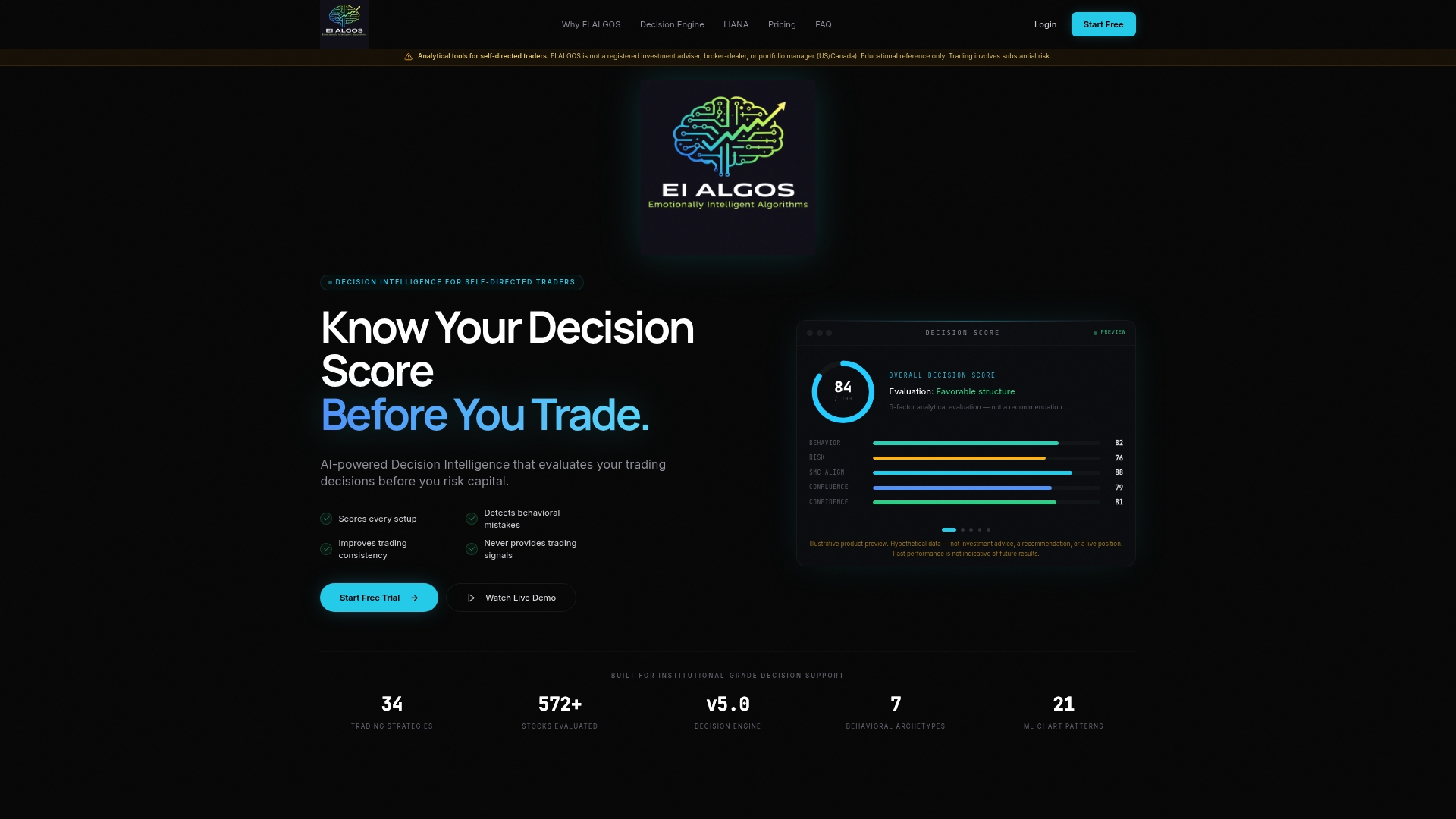
If you want to see how the scoring and reflection tools map to the accountability structure covered above, the Knowledge Hub walks through the pillar concepts, including dashboards and decision scoring, in plain language. The LIANA assistant then applies that same framework to your own trading patterns, flagging behavioral drift before it turns into a costly week. When you're ready to see your own decision score in action, you can start on the subscription page and try it against your next setup before you place the trade.
Sources
- Wash trades — responsibility and implications (CME Group)
- Trading Discipline: The System-Based Framework That Works (The Wall Street Coach)
- Trading Discipline and Rule Following: System Design Over Willpower (NexusFi)
- Trading Accountability: Stop Breaking Your Own Rules (Power Trading Group)