
A calendar spread is easy to open and harder to manage well. The position profits from the gap in time decay between two expirations, so the decisions that matter come after entry: when to hold, when to adjust, when to roll the short leg and when to close. The best way to manage one is to write the rules before you enter, then score each change against those rules instead of against your mood. That is the approach we build EI ALGOS around: it evaluates the decision behind a trade, not the market forecast.
This guide covers what drives an open calendar, what to watch each day, how adjustments and rolls work, the assignment checks that catch people out, and how to review your own decisions afterward.
TL;DR
- A long calendar sells a near-term option and buys a later one at the same strike. Its profit comes from the short leg decaying faster than the long leg, not from direction.
- Manage it on three inputs: distance of the underlying from the strike, implied volatility across both expirations, and days left on the short leg.
- Write down your hold, adjust, roll and close triggers before entry. Changing the plan mid-trade is where most calendar losses become avoidable ones.
- Check liquidity, ex-dividend dates and assignment risk on the short leg before every roll.
- Review each management decision afterward, so patterns like closing too early or rolling out of fear show up in your own data.
Table of Contents
- What you are actually managing
- The three inputs that move an open calendar
- A monitoring routine you can repeat
- Hold, adjust, roll or close: decision rules
- Calendar spread adjustments
- Rolling a calendar spread
- Liquidity, exercise and assignment checks
- Why reactive management costs more than the market does
- Where EI ALGOS fits
- Our perspective
- FAQ
- Sources
What you are actually managing
A long calendar spread consists of selling a near-term option and buying a longer-term option, both calls or both puts, with the same strike. CME Group's options education describes the appeal as limited risk with profit potential from the passage of time, for example when a known event such as an economic report is expected to move the market less than feared.
The maximum loss on a long calendar is the net debit you paid. That makes sizing simple, but it does not make management optional. A position can sit at a 40% loss for days and still recover, or give back a good gain in one volatility drop. Your job is to know which situation you are in.
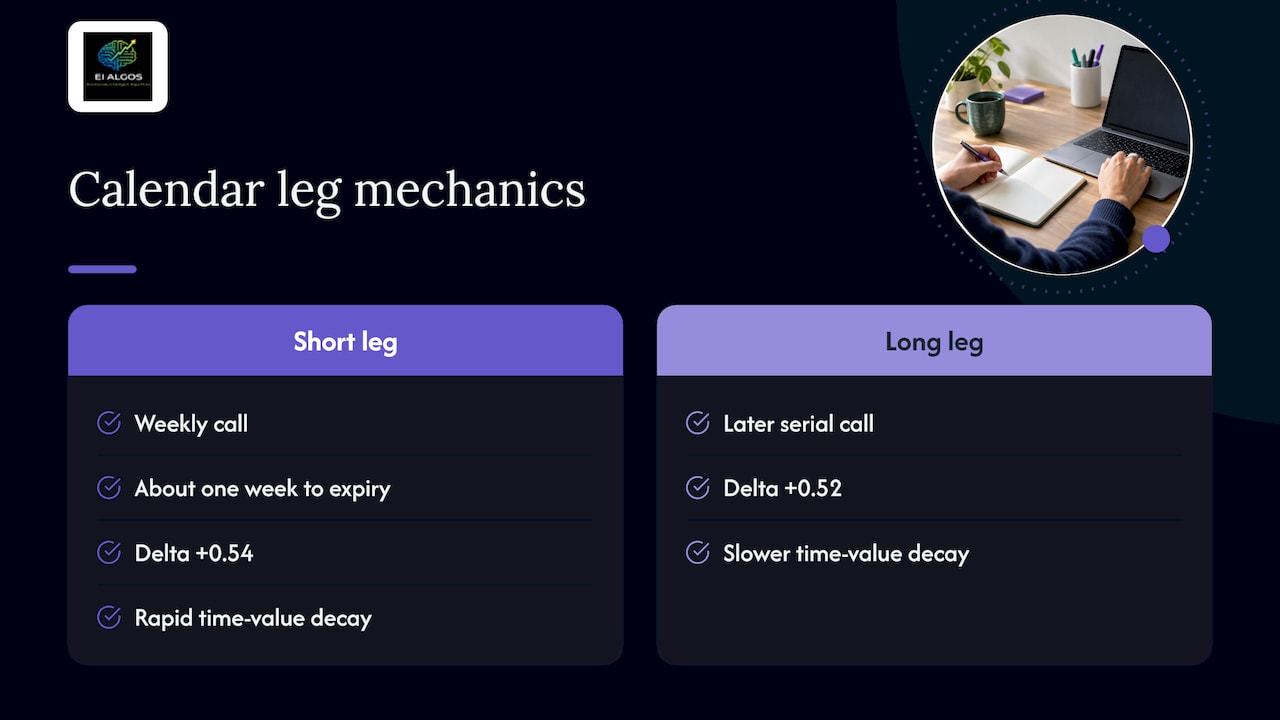
A practical example from CME Group's paper on time and volatility in E-mini S&P 500 options shows the mechanics. It pairs a weekly call with about one week to expiration (delta +0.54) against a later serial call (delta +0.52). The net spread delta is +0.02, so the position barely cares about small moves in the underlying. What it does care about is the weekly's rapid loss of time value compared with the slower decay of the longer option.
That is the baseline. Everything in management is about protecting that relationship: the short leg decaying quickly, the long leg holding its value, and the underlying staying near the strike.
The three inputs that move an open calendar
1. Distance from the strike
A calendar earns the most when the underlying sits at or near the shared strike as the short option approaches expiration. As price moves away, the spread's delta stops being neutral, the profit zone narrows and the position behaves more like a directional bet you did not intend to make.
Define "too far" in advance. Many traders use a fraction of the expected move over the short leg's remaining life, or a fixed percentage of the debit paid. Which one you use matters less than choosing it before entry and applying it every time.
2. Implied volatility across expirations
The long leg has more vega than the short leg, so a calendar generally gains when implied volatility rises and loses when it falls. The common trap is entering ahead of an event with elevated near-term volatility, then watching volatility fall across both expirations after the news. The long option loses more than the short option gains, and the spread loses money even though the stock barely moved.
Before entry, look at how volatility differs between the two expirations. Our guide to reading term structure across expirations walks through that comparison. A steep or inverted term structure changes what you should be willing to pay for the spread.
3. Days left on the short leg
Time decay accelerates in the final weeks. That is why the short leg is where most of your profit comes from, and also where gamma risk builds. Our piece on theta decay management in the final 30 days covers how decay behaves as expiration nears. Close to expiration, small price moves swing the short option's delta sharply, and our guide to controlling delta drift with gamma risk management explains why that matters for a spread that started neutral.
A monitoring routine you can repeat
Calendars do not need constant screen time. They need a consistent checklist at consistent intervals. A workable version:
- At entry: record the debit, the strike, both expirations, the break-even range from your risk graph and the exact conditions that will make you exit.
- Daily, once: check the underlying against your range, the spread's net delta and whether implied volatility has moved on either leg.
- Before any scheduled event: earnings, an economic release or an ex-dividend date. Decide in advance whether you hold through it.
- At a set number of days to short expiration: decide whether to let it expire, roll or close, using a rule written at entry.
Sticking to a schedule keeps you from checking the position every ten minutes and making reactive trades. Setting the same discipline for any recurring review is a useful habit; the idea of keeping an allocation on target through scheduled checks rather than gut feel applies to option positions too.
Drawing the position on an options risk graph before you trade helps, because you see the profit tent and where it flattens. Our walkthrough on sizing trades to 1 to 2% with an options risk graph shows how to size the debit so that a full loss stays inside your limit.
Hold, adjust, roll or close: decision rules
Use a table like this as a template. Fill in your own numbers.
| Situation | Typical response | What to write down in advance |
|---|---|---|
| Underlying near strike, volatility stable, time passing | Hold | Target profit as a % of debit |
| Underlying drifting toward one edge of the range | Consider an adjustment | The price level that triggers it |
| Short leg nearly worthless, long leg still has time | Roll the short leg | Minimum credit worth collecting |
| Volatility has dropped sharply, spread losing value | Reassess or close | Maximum loss you accept before exit |
| Underlying far outside the range | Close | Hard stop, as % of debit |
| Short leg in the money near ex-dividend | Close or roll before the date | Extrinsic value threshold |
The point of the table is not that these answers are universal. It is that each row has a pre-committed response, so you are executing a plan, not inventing one under stress.
Calendar spread adjustments
An adjustment changes the shape of the position while it is open. Common types include:
- Moving the strike. If the underlying has shifted, you can close the spread and open a new one centered on the new price, or add a second calendar at a different strike. Both cost more commissions and often more debit, so your total capital at risk rises.
- Adding a second calendar. Placing another calendar at a nearby strike widens the profit zone. It also increases your total debit, so size it against your original risk limit.
- Converting to a diagonal. Rolling the short leg to a different strike gives the position a directional tilt that matches your view. You are changing the trade's character, which is why the decision needs a written reason.
- Closing the short leg only. Leaving the long option open turns the position into a long option. Do this only when you would have bought that option on its own.
Every adjustment introduces new risk: more capital in the trade, more legs to monitor, and a temptation to rescue a position you would not open fresh. A good test is simple: would you enter this exact position today, at this price, with this much debit? If the answer is no, the adjustment is a hope, not a plan. Our options trade adjustments checklist lays out when an adjustment is worth considering and how to adjust common strategies.
Rolling a calendar spread
Rolling usually means one of two things: rolling the short leg forward to a later expiration, or rolling the whole spread to a new strike or later pair of dates.
Rolling the short leg
When the short option has lost most of its value and the long option still has time, you can buy back the short and sell a new one at the same strike in a later cycle. The credit from the new short reduces your cost basis in the trade. This is the repeatable income pattern behind many "weekly calendar" approaches.
Before you roll, check:
- Net credit. Is the new short leg paying enough to justify the added commission and exposure? Set a minimum in advance.
- Remaining life of the long leg. Selling a new short against a long option that is itself close to expiration leaves you with little time value to protect. The gap between the two expirations is what the strategy depends on.
- Volatility on the new expiration. If the new month is priced much lower than the one you are leaving, the credit will be thin.
- Event calendar. Make sure no earnings date or dividend sits inside the new short leg's life unless you want it there.
Rolling the whole position
If the underlying has moved and your original thesis has played out, closing and reopening at a new strike is cleaner than patching. Treat it as a new trade: new debit, new risk graph, new exit rules. Our guide to when to roll options covers the timing rules that apply across strategies.
One warning: rolling because you cannot accept a loss is not a roll, it is an extension of the same losing idea. If the original reason for the trade no longer holds, closing is a valid management decision.
Liquidity, exercise and assignment checks
The short leg is the one that can be exercised against you. According to the OCC's Characteristics and Risks of Standardized Options, a writer of an American-style option can be assigned an exercise at any time until they enter a closing transaction. Most U.S. equity and ETF options are American-style, so early assignment is possible on a short call or put in a calendar.
Practical checks before each roll or hold:
- Ex-dividend dates. A short call that is in the money with little extrinsic value left going into an ex-dividend date is the classic early-assignment setup. Close or roll before the date.
- Deep in-the-money short legs. The deeper the short option, the less time value remains, and the more likely exercise becomes.
- Bid-ask spreads. A calendar has two legs, so you cross two spreads on the way in and two on the way out. Wide markets can erase a good setup. Use limit orders at the spread's mid-price and check the volume and open interest of both expirations.
- Expiration week. If the short leg expires while the long leg remains, an assigned or exercised short leg leaves you with stock and an open long option. Know your broker's margin treatment before it happens.
- Index versus equity options. Cash-settled, European-style index options remove early assignment risk. Check the contract specs for the product you are trading.
If you are unsure how assignment on a spread would be handled in your account, ask your broker before opening the position.
Why reactive management costs more than the market does
Most calendar problems are not analytical, they are behavioral. Traders close winners too early because a green number feels fragile. They hold losers past their stop because the long leg "still has time." They add adjustments to avoid realizing a loss. None of these are mistakes of options math.
The fix is a pre-trade rule set and a post-trade review:
- Before entry, write the exit price range, the volatility level at which you will reassess, the maximum loss and the day count for the roll decision.
- During the trade, log every change and the reason for it. If the reason is "it felt like it was going to reverse," that is useful information.
- After the trade, compare what you did with what you planned. Over twenty or thirty trades, the pattern in your deviations tells you more than any single outcome.
If you keep a journal, this is what to put in it. Our pages on structured trade review and trader behavior analysis describe how to review decisions, not just results.
Where EI ALGOS fits
EI ALGOS is a web-based Decision Intelligence platform for self-directed traders. It does not issue trade signals or forecasts. Instead, it scores each setup on a six-factor analytical engine that looks at the psychological and behavioral side of the decision, flags behavioral errors, and offers live trade management tools and options analysis. Its AI assistant, LIANA, gives personalized feedback on your process based on your own trade history.
For calendar management, that means you can test your hold, adjust, roll and close decisions against your own pattern. Plans are published on the EI ALGOS site: Free at $0 per month, Starter at $49 per month, Pro at $129 per month and Elite at $229 per month.

Our perspective
A calendar spread rewards patience and punishes improvisation. The structure is forgiving: your loss is capped at the debit, and the math is well understood. What hurts traders is the gap between the plan they wrote and the decision they made at 2:15 on a Thursday afternoon with the short leg moving against them.
That is why we built EI ALGOS around the decision, not the signal. Our six-factor engine scores each setup, and LIANA reviews your process against your own history. A trader who sees that they roll early in every drawdown, or close winners at a third of target, can fix that pattern. A forecast cannot show them that.
If you manage calendars, start with written rules, score every adjustment against them and review the results as a set. Consistency is the edge you control.
Anantha
FAQ
What is the best way to manage a calendar spread?
Decide your exit rules before entry: a price range around the strike, a volatility level where you reassess, a maximum loss and a day count for the short leg. Then check the position at set times instead of continuously. Pre-committed rules keep adjustments from becoming reactions to noise.
When should I roll a calendar spread?
Roll the short leg when it has lost most of its value, the long leg still has meaningful time left, and the new short pays a credit above your minimum. Check ex-dividend dates and events inside the new expiration first. If the original reason for the trade no longer holds, closing is usually cleaner than rolling.
Can a calendar spread be assigned early?
Yes. A writer of an American-style option can be assigned at any time until the position is closed, according to the OCC. The risk is highest for an in-the-money short leg with little time value, especially around an ex-dividend date. Close or roll before that point.
What happens to a calendar spread if volatility drops?
The long option has more vega than the short one, so a fall in implied volatility across expirations usually reduces the spread's value even when the underlying stays near the strike. This is why entering ahead of an event, when volatility is elevated, needs a plan for the post-event drop.
Sources
- Option Calendar Spreads, CME Group
- Time and Volatility in E-mini S&P 500 Futures Options, CME Group (2013)
- Characteristics and Risks of Standardized Options, OCC
- Portfolio Drift Control: How to Keep Your Allocation on Target