
Adjust an options trade when a predefined trigger fires, not when a chart makes you nervous. The governing rule: treat every adjustment as a brand-new trade, and only execute it if that new position makes sense on its own merits, independent of what you paid for the old one. Broker guides describe three basic management paths: leave it alone, close it, or adjust it.
Three rules worth memorizing before you place a single order:
- Define your triggers in advance: a delta breach, a loss multiple, or a DTE checkpoint.
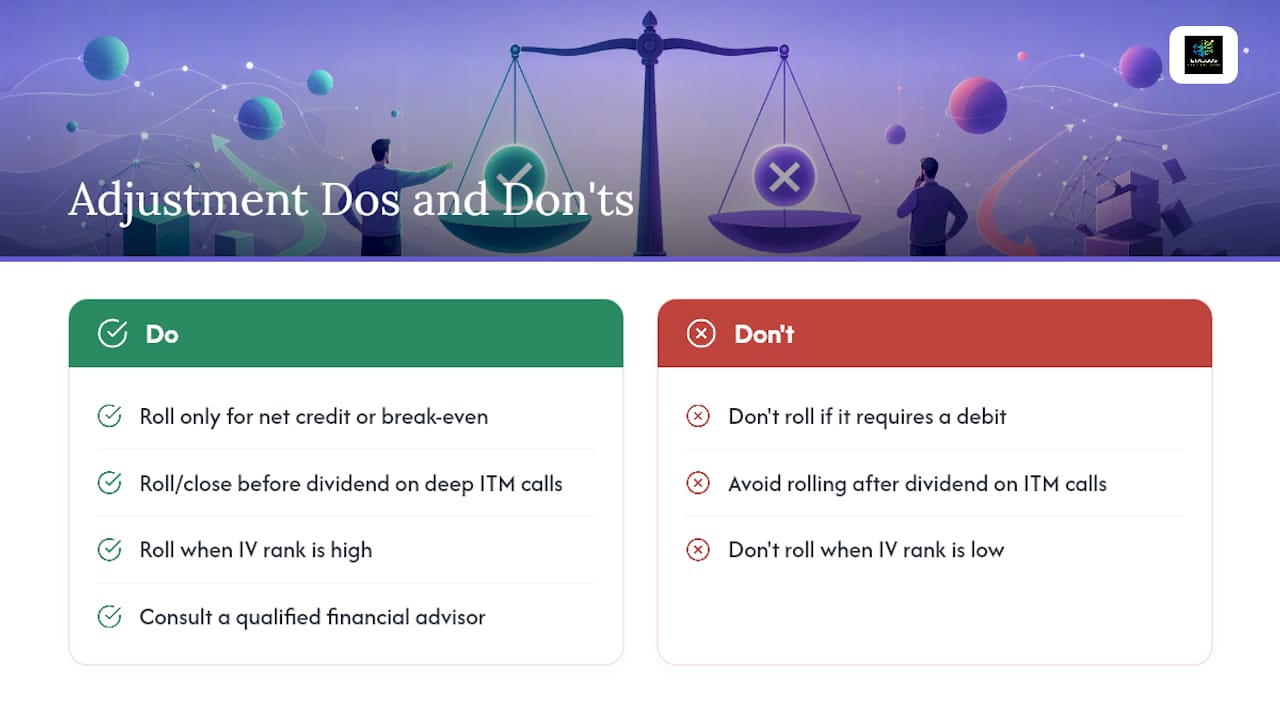
- Require a net credit (or at minimum, break-even) on any roll.
- Skip adjustments inside high-gamma windows unless the trigger explicitly calls for one.
You have exactly three legal moves once a trigger fires: close it, roll it, or hedge/convert it. Closing ends the risk. Rolling extends time or repositions strikes. Hedging adds a leg to cap damage without giving up the position entirely.
Pro Tip: Write your adjustment rules down before you enter the trade, not after it starts losing. A rule you invent mid-drawdown is not a rule, it's a rationalization.
Key Takeaways
Disciplined options trade adjustments depend on predefined numeric triggers, a net-credit rule for rolls, and treating every adjustment as an independent new position.
| Point | Details |
|---|---|
| Set triggers before entry | Define delta, loss, profit, and DTE checkpoints before the trade begins, not during a drawdown. |
| Roll only for credit | Prefer a net credit or break-even roll; a debit roll usually just delays an inevitable loss. |
| Judge the whole position | Base decisions on aggregate position Greeks and current IV rank, not any single leg. |
| Check liquidity and cost | Avoid adjustments when the bid-ask spread exceeds 10% of the mid price. |
| Log every adjustment | Record the trigger, Greeks, and net premium to build pattern recognition over time. |
Table of Contents
- When should you consider an options trade adjustment?
- What are the core ways to adjust an options position?
- How do you adjust common options strategies?
- How do Greeks and IV affect your adjustment decision?
- How do you execute an adjustment without emotional bias?
- Can better decision processes reduce bad adjustments?
- What is the right mindset for adjusting a losing trade?
- Where can you learn more about options trade adjustments?
- Frequently Asked Questions
- Sources
When should you consider an options trade adjustment?
An adjustment is justified when a number crosses a line you drew before the trade existed, not when your gut says so. Set these thresholds at entry: position delta beyond ±0.20, a loss exceeding 2 times the original credit received, a profit at 50% of max credit, or a checkpoint at 21 days to expiration (DTE). These figures come from practitioner rulesets built specifically to remove guesswork from the decision.
Numbers aren't the only trigger. Your market outlook can shift, a dividend date can raise assignment risk on a short call, or implied volatility can move enough to change the entire cost-benefit of holding the position. Capital constraints matter too. If a roll would eat margin you need elsewhere, that's a real cost even when the roll itself looks profitable on paper.
Before touching anything, run these questions:
- Would you enter this exact adjusted position today, from scratch, with no prior stake in it?
- Can the roll collect a net credit, or does it require paying out?
- Does the new position meaningfully change your margin requirement?
Pro Tip: Log the trigger and the timestamp the moment it fires, before you decide what to do about it. Traders who adjust immediately after logging tend to make cleaner decisions than those who stare at the position for twenty minutes first. That gap is where revenge adjustments are born.
What are the core ways to adjust an options position?
Every adjustment reduces to one of three actions: close, roll, or hedge/convert. Each has its own order-entry mechanics and its own reason for existing.

Close means buy-to-close a short leg or sell-to-close a long one. It's the right move when your thesis is simply wrong, when the trigger has no attractive credit-based fix, or when the position no longer matches your risk tolerance. Closing is the cleanest exit and carries no forward risk.
Roll means closing the current leg and opening a new one, simultaneously, in a different strike or expiration. Rolling up moves a short call to a higher strike. Rolling down moves a short put to a lower strike. Rolling out pushes the expiration further away to reset time decay. Rolling for at least a break-even credit is the rule that separates disciplined traders from those who bleed slowly.
Hedge or convert means adding a leg rather than replacing one, such as buying a protective put against a losing long stock position, or converting a naked short into a defined-risk spread.
Say you sold a call at $2.00 credit, now trading at $4.50 against you. Rolling it out to a further expiration for a $1.20 credit reduces your net loss to $1.30 and buys time. Closing outright locks a $2.50 loss immediately.
| Action | Best used when | Main tradeoff |
|---|---|---|
| Close | Thesis broken, no credit available on a roll | Locks in the loss or profit permanently |
| Roll | Trigger hit but credit or break-even is achievable | Extends risk exposure and ties up capital longer |
| Hedge/convert | Directional risk needs capping without full exit | Adds legs, complexity, and sometimes commissions |
How do you adjust common options strategies?
- Iron condors and strangles. When one side's short strike gets tested, roll that wing up or out for credit. If both sides are threatened, converting into a tighter iron butterfly can reduce delta exposure fast.
- Vertical spreads. Roll the short leg to a further strike, or close the whole spread if the roll requires a debit. Adding the opposite spread turns a single vertical into an iron condor, collecting extra premium.
- Covered calls and collars. Watch ex-dividend dates closely. A deep in-the-money short call near a dividend carries real early assignment risk. Roll the call up and out for credit, or buy it back if the stock has run hard.
- Straddles. A directional break usually means one side is now worthless and the other is the real position. Consider closing the dead side and managing the live side independently.
- Long options. A losing long call can sometimes be "repaired" by adding a short call above it, cutting your breakeven without extra capital. If the debit required to roll exceeds a third of your remaining premium, accept the loss instead.
Pro Tip: A simple rule of thumb across every strategy: roll up or out for a net credit; if the roll demands a real debit, close instead.
How do Greeks and IV affect your adjustment decision?
Adjust based on the position's aggregate Greeks, not any single leg. A short strangle can look fine leg by leg while the combined delta has drifted past ±0.20, which is exactly the kind of blind spot that triggers late, costly fixes. Gamma accelerates hard inside 21 DTE, meaning small stock moves swing your P&L far more than they did at 45 DTE.
Implied volatility drives roll economics directly. When IV rank sits below 30, premium is thin and rolling out often fails to generate meaningful credit, so closing tends to be the better math. High IV, by contrast, lets you collect real credit on a roll and reset your risk at the same time.
Before executing, run this cost checklist:
- Skip the trade if the bid-ask spread exceeds 10% of the mid price; slippage there erodes the entire benefit.
- Factor commissions into the credit math, especially on multi-leg rolls.
- Check whether the new position increases margin requirement, tying up capital you may need elsewhere.
- Confirm dividend and assignment dates before rolling any short call.
How do you execute an adjustment without emotional bias?
- Verify the trigger actually fired against your written rule, not your mood.
- Check aggregate Greeks and current IV rank for the position.
- Confirm liquidity: reject the trade if the spread is too wide.
- Size the new position and check margin impact.
- Enter using a mid-price limit order, never a market order on multi-leg trades.
- Log the trigger, the price, and the reasoning immediately.
Stop the adjustment if margin is insufficient, the roll needs a large debit, or the spread is too wide to fill fairly.
Pro Tip: Print this six-step sequence and keep it next to your monitor. A mechanical checklist beats willpower every time the market gets loud.
Can better decision processes reduce bad adjustments?
Treating an adjustment as a new trade forces you to ask a harder question: would you open this exact position today, or are you just avoiding admitting the first one failed? A six-factor decision checklist applied consistently removes most of that self-deception. Objective, mechanical trade-management tools reduce the emotional "revenge adjustment" pattern that quietly destroys expectancy over a full year of trading.
Eialgos scores each setup, including adjustments, against a six-factor engine that flags whether the trigger actually fired and whether your past adjustments improved or hurt outcomes. The LIANA assistant then surfaces the pattern back to you.
Log every adjustment with its trigger, the DTE, position Greeks, and net premium. That single habit builds the pattern recognition that separates a consistent trader from a lucky one.
- Score the setup before adjusting, not after.
- Compare this adjustment's data against your last five to spot repeat mistakes.
What is the right mindset for adjusting a losing trade?
Defending a thesis and defending a position are two different things, and confusing them is where most bad adjustments start. Sometimes the best adjustment is walking away and taking the loss on schedule. Using process-driven decision tools to score each choice builds the consistency that no single trade ever will.
Where can you learn more about options trade adjustments?
- The Options Disclosure Document from the OCC covers assignment and exercise rules every trader needs.
- Fidelity's trade management guide details broker-standard rolling mechanics.
- Dorian Trader's roll strategies explain the three foundational roll types in practice.
Ready to remove guesswork from your next adjustment? Eialgos scores each setup against a six-factor decision engine so you know whether a trigger genuinely justifies action, or if a platform like TradeAiFi fits better into your existing analytics stack, before you place the order.
Frequently Asked Questions
Should you always roll a losing options trade instead of closing it? No. Roll only if you can collect a net credit or reach break-even. If the roll requires a real debit, closing the position is usually the better outcome.
What is the difference between rolling up, down, and out? Rolling up moves a short call to a higher strike, rolling down moves a short put to a lower strike, and rolling out extends the expiration date to reset time decay.
How does assignment risk affect adjustment timing? Deep in-the-money short calls near ex-dividend dates carry real early assignment risk, which should push you to roll or close before the dividend date rather than after.
Does implied volatility affect whether an adjustment makes sense? Yes. Low IV rank often means thin premium, making rolls unattractive, while high IV lets you collect meaningful credit on a roll.
What should stop you from making a planned adjustment?
This article is general information, not a substitute for advice from a qualified financial advisor. Consult a qualified financial professional about your own circumstances before acting on anything here.
Sources
- Options Trade Management (Fidelity)
- Adjusting options trades mid-course (EquiCurious)
- Options Disclosure Document (The Options Clearing Corporation)