
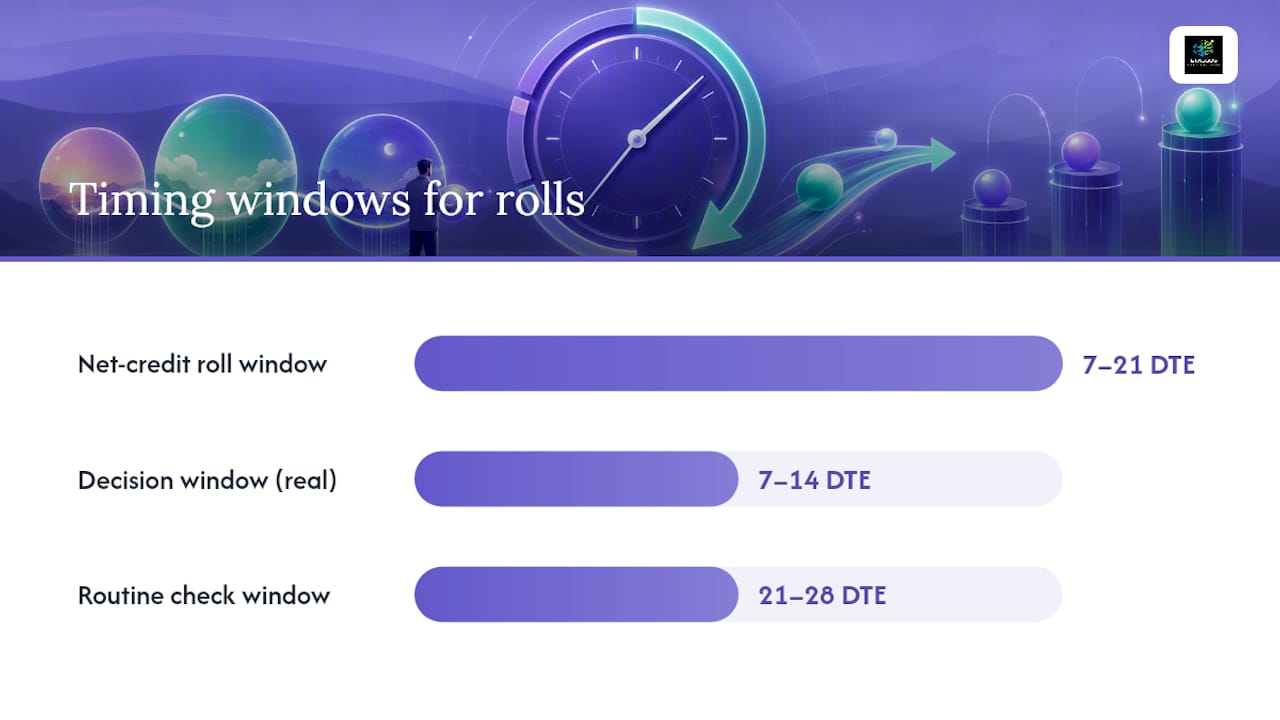
Roll when your position still has a valid thesis and you can extend it for a net credit; close it out instead if you're rolling for a debit with no real conviction. That single rule filters most bad roll decisions before they happen. The best window to evaluate a roll is 7 to 14 days before expiration, when there's still enough time value to work with but not so much that you're overpaying. Two more guardrails matter just as much as timing:
- Prefer trades that roll for a net credit, or at worst breakeven.
- Stop rolling after 2 to 3 unsuccessful attempts on the same position.
Pro Tip: Set a calendar reminder at 14 DTE for every open position. Evaluating early gives you options; waiting until the last few days leaves you reacting instead of deciding.
Key Takeaways
Roll options for a net credit inside the 7 to 21 day window, and stop after 2 to 3 unsuccessful attempts on the same position.
| Point | Details |
|---|---|
| Time your evaluation | Check positions at 21 to 28 DTE routinely, and treat 7 to 14 DTE as the real decision window. |
| Prefer net credit | Roll when the new premium exceeds the cost to close; rolling for a debit should require real conviction. |
| Use the 80% rule for verticals | Once a spread has captured roughly 80% of its value, rolling forward usually beats holding for the rest. |
| Cap your attempts | Stop rolling a position after 2 to 3 unsuccessful rolls and redeploy the capital instead. |
| Score decisions objectively | Eialgos applies a six-factor scoring engine to flag behavioral errors like rolling a broken thesis out of habit. |
This article is general information, not a substitute for advice from a qualified financial advisor. Consult a qualified financial professional about your own circumstances before acting on anything here.
Table of Contents
- When to Roll Options: Rules of Thumb That Actually Work
- How Do You Actually Place a Roll Order?
- Does the Right Time to Roll Change by Strategy?
- What Does Rolling Really Cost You?
- A 60-Second Checklist Before You Roll
- Two Worked Examples: Covered Call and Vertical Spread
- When Rolling Is the Wrong Move
- Sources
When to Roll Options: Rules of Thumb That Actually Work
Rolling decisions get easier once you stop treating them as gut calls and start running them through a few numbers. The most reliable one is time. Traders who manage positions on a schedule tend to use 21 to 28 days to expiration for routine check-ins, tighten focus at 7 to 14 DTE when a real roll decision needs to be made, and treat the final 1 to 3 days as a danger zone where gamma risk and thin liquidity can wreck your fill price.
Probability of profit gives you a second lens. Many traders consider rolling once probability of profit drops below a low threshold, or once the short option's delta climbs past a moderate range, as these indicate rising assignment risk, since that's usually where assignment risk starts outweighing the remaining premium. Neither number is a law of physics. Treat it as a trigger to reassess, not an automatic order to roll.
For vertical spreads, the 80% rule is the cleanest heuristic available: once you've captured about 80% of the maximum spread value, rolling forward usually beats squeezing out the last bit of profit and risking a reversal.
The math behind any roll comes down to one formula: net credit = premium collected on the new leg minus the cost to close the old one. Rolling for a net credit keeps the trade financially sound; rolling for a debit means you're paying to keep a losing bet alive, which only makes sense with strong, specific conviction.
How Do You Actually Place a Roll Order?
Most brokers let you roll as a single order: you close the existing leg and open the new one simultaneously, and the platform nets the two prices into one credit or debit. This is the safer default because you're never exposed to the market moving between the close and the open.
Legging in and out (closing first, then opening separately) gives you more control over each price, but it exposes you to slippage if the underlying moves while you're mid-transaction. Use a limit order either way, and set a price tolerance you're comfortable missing rather than chasing a fill.
Execution gets harder as expiration approaches. Gamma accelerates, bid-ask spreads widen, and thin open interest can leave you stuck with a bad fill or no fill at all.
- Check open interest and volume before rolling into a new strike or expiration.
- Set a limit price based on the mid, not the wide end of the spread.
- Avoid attempting a roll on expiration day itself unless you have no other choice.
Pro Tip: If the spread on your target contract looks unusually wide, wait for the next print or check a slightly different strike. A one-tick difference in liquidity can cost you more than a whole day of theta decay.
Does the Right Time to Roll Change by Strategy?
Rolling isn't one-size-fits-all. Each strategy carries different priorities and different tolerance for risk.
Covered calls: roll up and out when the stock is approaching your strike and you want to avoid assignment while still capturing extra premium. If you're fine selling the shares, letting assignment happen is often simpler than rolling.
Cash-secured puts: roll down and out to improve your breakeven when the stock has dropped, or just accept assignment if you wanted the shares anyway.
Once you've captured most of the spread's value, decide between rolling forward or buying back the whole structure and moving on.
Defined-risk multi-leg trades: rolling means adjusting several legs at once, which adds margin and execution complexity most single-leg rolls don't have.
Pro Tip: For verticals, price the roll as one combined order rather than legging each side. It's the only way to know your true net credit before you commit.
What Does Rolling Really Cost You?
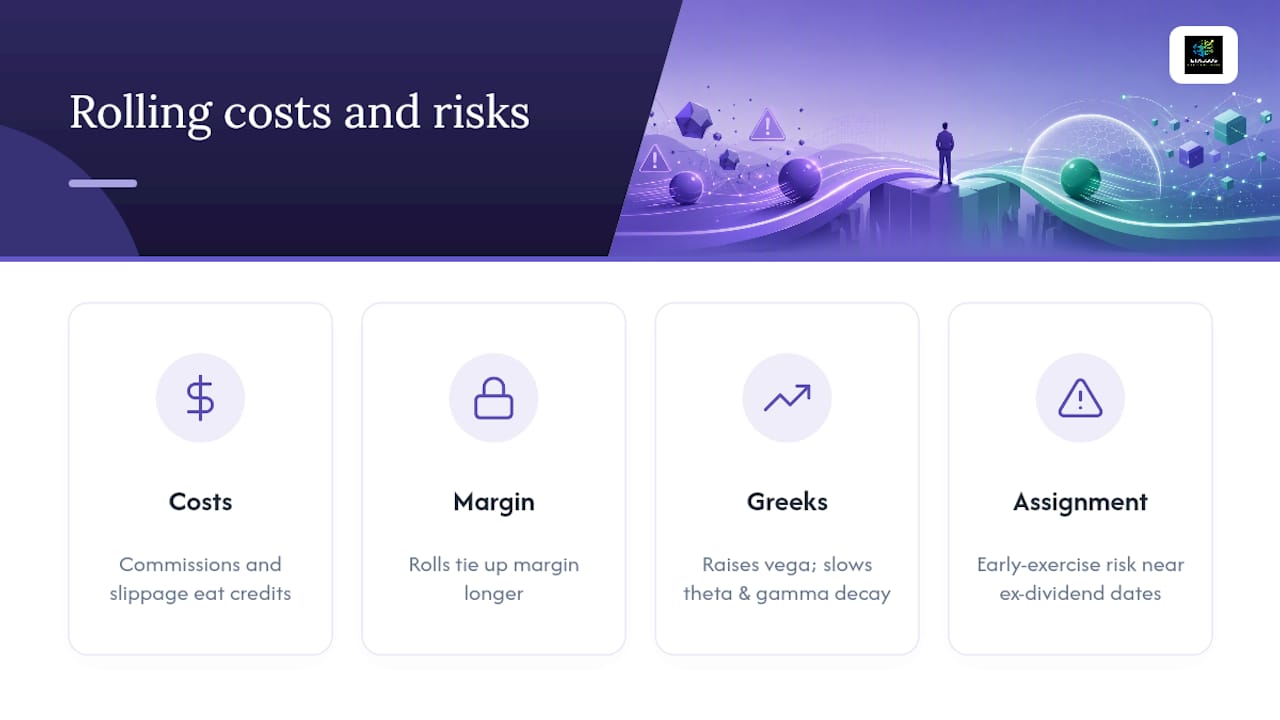
Rolling isn't free, even when it looks like a credit on the screen. Commissions and slippage eat into small credits fast, especially on multi-leg spreads where you're paying for four fills instead of two. Every roll also ties up margin longer, which matters if you're running several positions and need that capital elsewhere.
Time value cuts both ways on the Greeks. Extending duration raises vega exposure, meaning a rolled position becomes more sensitive to implied volatility swings, and it resets your theta and gamma profile back toward a slower decay curve. That's often the point of rolling, but it's not a free upgrade.
Assignment risk deserves its own scrutiny. Short calls near an ex-dividend date carry a real chance of early exercise, and rolling too late to dodge that risk can lock you into a worse strike. A portfolio risk calculator can help you see how a roll changes your total exposure before you place it, not after.
A 60-Second Checklist Before You Roll
Run through these four questions before touching the order ticket:
- Is the thesis still intact? Check for earnings surprises, guidance changes, or sector shocks that would have kept you out of this trade today.
- Can you roll for a net credit, or at least breakeven? If the only available roll is a meaningful debit, that's a signal to reconsider, not a green light.
- Are you inside the 7 to 21 DTE window with real liquidity in the new contract? Tight bid-ask spreads and reasonable open interest matter as much as the date.
- How many times have you already rolled this position? Two or three unsuccessful rolls is generally where discipline says stop and reassess.
Pro Tip: Score each question 0 or 1. Require at least 3 out of 4 to justify a roll. It's a blunt system, but it stops the "I'll just roll it one more time" spiral before it starts.
Two Worked Examples: Covered Call and Vertical Spread
Example A: Covered call roll up and out. You sold a call for $1.20 and it's now worth $0.90 to close, with the stock approaching your strike. You roll to a further expiration and higher strike, collecting $1.50 in new premium.
- Cost to close old call: $0.90
- Premium collected on new call: $1.50
- Net credit: $1.50 minus $0.90 = $0.60
- Result: your breakeven improves by $0.60, and you've bought more room before assignment.
Example B: Defensive vertical roll. Your $5 wide put spread was worth $4.10 near max value; the market bounced and it's now worth $3.30.
When Rolling Is the Wrong Move
Rolling can become a way to avoid admitting a trade went wrong, and that's the scenario to watch for. If the underlying company missed earnings, cut guidance, or faces a real structural problem, no roll fixes a broken thesis. You're just delaying the loss.
A net debit roll with no strategic reason is another red flag. Paying to extend a position without a specific catalyst is speculation, not management.
Ask yourself one honest question: would you enter this new position today, at these strikes, if you weren't already in the trade? If the answer is no, don't roll into it.
Practitioners generally treat two or three unsuccessful rolls on the same underlying as a sign the original read was wrong. At that point, closing and redeploying capital elsewhere usually beats a fourth attempt.
Pro Tip: Keep a simple log of every roll on a position. Seeing "roll #3" written down is often the nudge that stops "roll #4" from happening.
A Practitioner's View on Rolling With Discipline
I roll sparingly, usually once per position, twice at most. Net credit and a 7 to 14 day window matter more to me than squeezing extra premium out of a losing trade. The real skill isn't knowing how to roll. It's recognizing, using process signals instead of gut feel, exactly when to stop.
Turning the Roll Checklist Into a Repeatable Process
Most traders know the rules intellectually and still break them under pressure, usually because a losing position feels personal by the time it needs a decision. EI ALGOS scores each setup on a six-factor engine built to catch that exact gap between what you know and what you do, flagging behavioral errors like chasing a broken thesis before you place the order.

The decision score guide walks through how the scoring engine turns a checklist like this one into something measurable instead of a feeling. If you want to see how your own roll decisions score against your stated process, the subscription plans are worth a look. This is educational content, not trading advice. Every roll decision and its risk remain yours to make.
Sources
- How to Roll Options: When, Why & Step-by-Step Guide (2026) | Flow Proof
- When to Roll Options: Timing Tips - ThetaEdge Blog
- Rolling Options Explained: When and How to Roll Your Options | QuantWheel
- How to roll options — Britannica
- Options rolling | Robinhood