
A trading playbook is a written, rule-based template for each setup, paired with fixed risk and management rules — not a diary of what already happened. Use the checklist below to build a one-page version right now, before reading another word about theory.
Copy these five fields for each setup you trade:
- Setup name: a short label you'll use as a tag in your journal (e.g., "opening-range breakout")
- Entry checklist: 3-5 binary yes/no conditions that must all be true
- Stop in R: where you exit if wrong, defined in risk units, not dollars
- Position-sizing rule: a fixed formula tying position size to account equity and stop distance
- Invalidation rule: the specific condition that voids the setup even before your stop is hit
Pre-commitment is the entire point. Once you write "I only enter if X, Y, and Z are true," you remove the moment of live decision-making, which is exactly when fear and excitement do the most damage.
Pro Tip: Print your one-page playbook and keep it visible during trading hours. If you have to scroll or search to find a rule, you won't follow it under pressure.

Key Takeaways
A trading playbook works because it forces entry, risk, and exit decisions to happen before the trade, not during it, and rule-adherence tracking shows whether that process is actually holding.
| Point | Details |
|---|---|
| Start with one page | Copy the five-field checklist (setup, entry, stop in R, sizing, invalidation) and use it on your next trade. |
| Limit to a small number of setups | Master a small number of patterns with positive tracked expectancy before adding more. |
| Validate before scaling | Backtest 20-30 examples per setup, then paper trade or micro-size before trading full risk. |
| Track adherence, not just P&L | Rule-adherence rate predicts long-term survival better than short-term win rate. |
| Measure decision quality too | Eialgos scores the behavioral quality of a setup with a six-factor engine, complementing rule-adherence tracking rather than replacing it. |
Table of Contents
- What Is a Trading Playbook, and Why Do Rules Beat Gut Feel?
- What Belongs in Every Trading Setup Entry?
- How Do You Build a One-Page Trading Playbook Template?
- How Do You Validate a Playbook Before You Trust It?
- What Should Your Trade Journal Track to Improve the Playbook?
- What Mistakes Quietly Wreck Most Trading Playbooks?
- Can You Measure Decision Quality, Not Just Trade Outcomes?
- Process Over Prediction
- Try Eialgos Alongside Your Playbook
- Frequently Asked Questions
- Sources
What Is a Trading Playbook, and Why Do Rules Beat Gut Feel?
A playbook is not a journal. A journal records what you did; a playbook defines what you're allowed to do before you do it. Confusing the two is why so many traders keep detailed logs and still repeat the same mistakes. The journal shows you the pattern. The playbook is what prevents it next time.
The behavioral case for this is straightforward. Decisions made under live market stress are measurably worse than decisions made in a calm planning session, because stress narrows attention and pushes people toward familiar, emotionally driven shortcuts. A written playbook shifts the hard thinking to a moment when you're not staring at an open position.
This is essentially risk governance applied to your own trading account. ISO 31000 frames risk management as a cycle of defining controls, monitoring outcomes, and continually revising the approach based on evidence. That structure maps almost exactly onto a trading playbook:
- Each setup becomes a defined risk item with its own controls (entry criteria, stop, size).
- Your trade journal becomes the monitoring layer.
- Your weekly review becomes the continual-improvement step.
Tracking whether you actually followed your own rules turns out to matter more than short-term results. Rule-adherence rate is a stronger predictor of long-term survival than win rate, because it measures whether the process is being executed at all, independent of whether any single trade happened to work.
What Belongs in Every Trading Setup Entry?
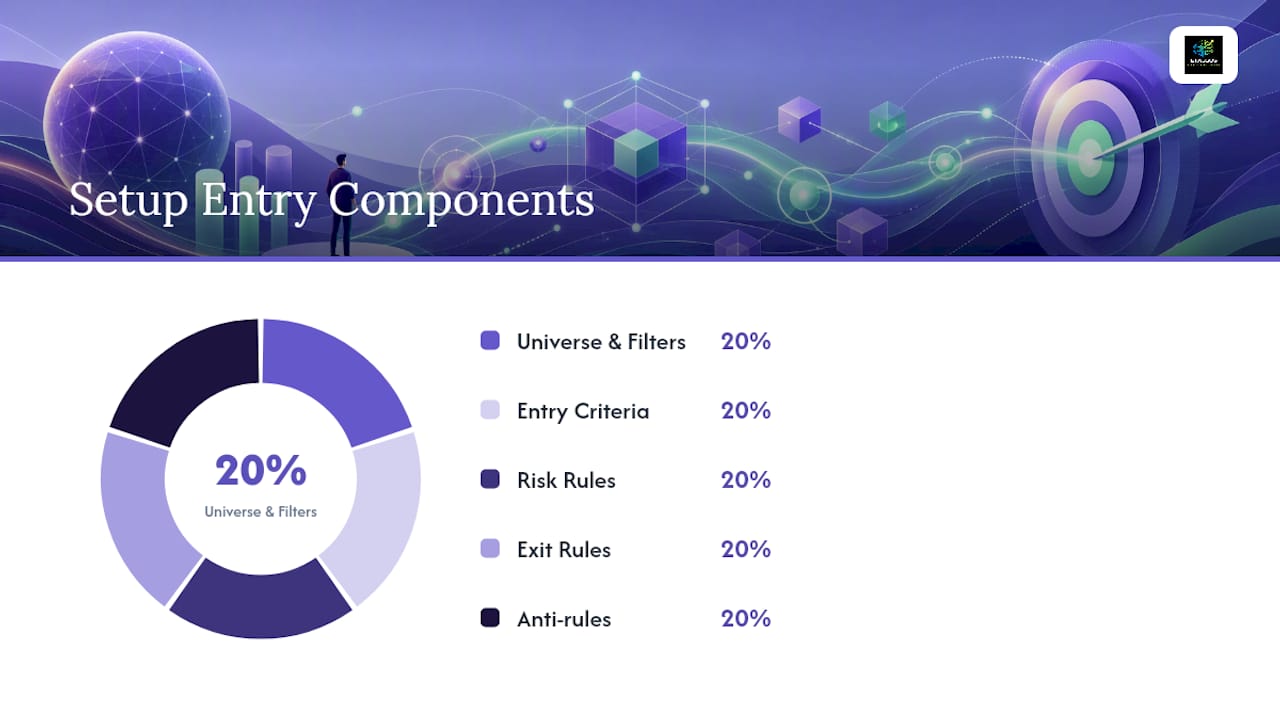
A playbook that says "buy strong stocks near support" is not a playbook. It's a vibe. Every setup you document needs five components, written specifically enough that another trader could execute your rules without asking you a clarifying question.
- Universe and market-context filters. Define what you'll even look at: index membership, average daily volume, sector, or a market regime filter (trending vs. choppy, VIX above or below a threshold). If a stock or condition doesn't clear this filter, you don't move to step two.
- Entry criteria written as binary checks. Not "the trend looks healthy" but "price closed above the 20-day moving average for three consecutive sessions." Every condition should resolve to yes or no, with no interpretation required in the moment.
- Risk rules in R terms and account-percentage limits. Define your stop distance in R (your initial risk unit) and cap position size so no single trade risks more than a reasonable percentage of account equity depending on your account size and setup confidence.
- Exit rules and trailing logic. Specify your profit target, your trailing-stop mechanism if you use one, and the exact price action that triggers a scale-out. Vague exits are where good entries go to die.
- Anti-rules. Explicit, named actions you are forbidden from taking with this setup, written in plain language: no moving the stop further away, no adding to a loser, no entering within 30 minutes of a major economic release.
For each setup, attach two or three annotated chart examples: one clean win, one clean loss where the rules were followed correctly anyway, and one near-miss that shows what the invalidation condition looks like in real time. A documented playbook that pairs written criteria with a journal for review gives you a reference you can actually audit later, instead of relying on memory that quietly rewrites itself in your favor.
Pro Tip: Write your entry criteria as if you were handing them to a stranger who has never seen your charts. If they'd need to text you a question, the rule isn't specific enough yet.
How Do You Build a One-Page Trading Playbook Template?
The full version of your playbook lives in a spreadsheet or a tool like Notion, Airtable, or Excel. It should include every field below, organized one setup per row or one setup per page depending on how many variations you trade.
Full template fields to include:
- Setup name and one-line description
- Market context filters (regime, sector, volatility conditions)
- Entry checklist (binary conditions, 3-5 items)
- Stop-loss rule (in R and in price terms)
- Position-sizing formula
- Profit target and trailing-stop logic
- Invalidation condition
- Anti-rules specific to this setup
- Journal tag used to track this setup's performance
Practical templates recommend tying each playbook entry directly to a journal tag so you can pull per-setup performance without manually sorting trades later. That single habit saves hours during monthly review.
The one-page version is a condensed pre-trade checklist you glance at before every entry:
- Does this setup match one of my defined patterns? (yes/no)
- Do all entry criteria check out? (yes/no)
- Is my stop distance calculated in R before I enter? (yes/no)
- Is my position size within my account-percentage limit? (yes/no)
- Have I confirmed no anti-rule applies to this trade? (yes/no)
- Am I trading this because of the setup, or because I want action? (yes/no)
If any answer is no, you don't take the trade. That's the whole mechanism.
Your post-trade review rubric should ask three questions for every closed position: did you follow every rule, what was the R-outcome, and what emotional state, if any, influenced execution. The full playbook is your reference library; the one-page checklist is what you actually use at the moment of entry. Keep both, but never trade off the full version live.
How Do You Validate a Playbook Before You Trust It?
Building a playbook from opinion is easy. Building one from evidence takes four steps, and skipping any of them is why most homemade trading systems quietly fail within a few months.
- Audit your last 50 to 100 trades. Tag each one by setup type, even retroactively. You're looking for which patterns you already trade with some consistency, whether you knew it or not. Most traders find they've been running two or three core setups and a long tail of one-off impulse trades.
- Identify your top setups by expectancy. For setups with a sufficient number of historical examples, calculate expectancy in R as win rate times average win minus loss rate times average loss. Audit methodology from practitioner guides recommends prioritizing setups with positive expectancy and a sample size of 20 or more before you build further rules around them.
- Backtest multiple historical examples per setup. Manually or with software, pull that many instances of the pattern and record entry, stop, exit, and R-outcome for each. This is where vague criteria get exposed fast. If you can't consistently identify the setup in hindsight, you definitely can't identify it live.
- Paper trade or micro-size before scaling up. Once a setup backtests with a positive expectancy, run it live at minimum size for another 15 to 20 trades. This step catches slippage, execution lag, and psychological friction that backtesting can't simulate.
The decision rule for changing anything in your playbook should be evidence, not emotion. Limit playbook churn to statistically meaningful drift or a genuine shift in market structure, not a single bad trade or a single lucky one. A setup that loses twice in a row hasn't failed. A setup that underperforms across 20+ tagged instances has real evidence behind a change.
What Should Your Trade Journal Track to Improve the Playbook?
Your journal exists to answer one question: is the process working, independent of whether this week's P&L looks good. That requires specific fields, not a running narrative.
Log these for every trade:
- Setup tag (matching your playbook's naming)
- Entry price, stop price, and position size
- R-outcome (profit or loss expressed as a multiple of initial risk)
- Rule-followed boolean (yes or no, no partial credit)
- One-line emotion note (rushed, confident, distracted, revenge)
From that data, four metrics matter more than raw P&L:
| Metric | What it tells you |
|---|---|
| Rule-adherence rate | Percentage of trades where every checklist item was followed before entry. |
| Expectancy (in R) | Average expected return per trade for a given setup, factoring in win rate and average win/loss size. |
| Win rate by setup | Isolates which patterns actually work, rather than blending everything into one number. |
| Profit factor | Gross profit divided by gross loss, showing whether wins meaningfully outweigh losses. |
The four-box grading system sorts every trade into one of four categories: followed rules and won, followed rules and lost, broke rules and won, broke rules and lost. That last box, breaking rules and getting rewarded for it, is the most dangerous outcome in trading. It teaches you that undisciplined behavior sometimes pays, which is exactly the reinforcement that destroys a playbook over time.
Run a quick check weekly (adherence rate, obvious red flags) and a full audit monthly, recalculating expectancy and win rate per setup once you have enough new tagged trades to matter. A dedicated journal tool makes this tagging and metric tracking far less tedious than a manual spreadsheet, especially once you're running more than one or two setups.
What Mistakes Quietly Wreck Most Trading Playbooks?
Most playbooks don't fail because the rules are wrong. They fail because the rules were never specific enough to break in a way you could notice.
- Vague criteria that can't be checked. "Looks like a good setup" isn't a rule. If you can't write it as a yes/no condition, it doesn't belong in the playbook yet.
- Too many setups at once. Trying to master six patterns simultaneously usually means mastering none. Start with one to three setups and expand only after each shows a positive tracked expectancy.
- Changing a rule after one outcome. A single win on a rule-breaking trade is the single most expensive lesson a trader can learn, because it teaches you the wrong thing at exactly the moment you're most susceptible.
- Skipping the review loop entirely. A playbook with no weekly or monthly review is just a document. The review is what makes it a system.
A short list of firm anti-rules prevents most of this damage on its own: no moving stops further away, no averaging down on a loser, no revenge trading after a loss, no trading outside your defined setups. Write these verbatim into your playbook, not as a vague philosophy but as literal, checkable prohibitions.
Pro Tip: Keep an "anti-rules" section pinned at the top of your playbook, not buried at the bottom. The rules you're most likely to break under stress deserve the most visibility, not the least.
Can You Measure Decision Quality, Not Just Trade Outcomes?
Rule-adherence tracking tells you whether you followed your checklist. It doesn't tell you why you almost didn't, or which specific behavioral pattern keeps showing up right before you break a rule. That's a different layer of measurement, and it's where most playbooks stay incomplete.
A trade can follow every rule on the checklist and still reflect a shaky decision process underneath, hesitation, overconfidence from a recent win streak, or a stop that got moved mentally before it got moved on the order ticket. Outcome-based tracking misses all of it.
Eialgos approaches this gap with a six-factor scoring engine that evaluates the psychological and behavioral quality of a setup before you enter it, rather than issuing a signal telling you what to trade. It's process measurement layered on top of the rules you already wrote.
Folded into your existing review loop, this kind of scoring can surface patterns your journal alone won't show:
- Repeated behavioral mistakes clustering around a specific time of day or market condition
- Overconfidence patterns following a winning streak, right before a rule violation
- A tendency to mentally widen stops before officially moving them
The LIANA assistant inside the platform turns these patterns into direct, personalized feedback rather than a generic dashboard, which is closer to what a process-oriented approach to trading is actually supposed to deliver: not more signals, but a clearer view of your own decision-making. Add a decision-quality check to your weekly review alongside rule-adherence rate, and you're auditing both the outcome and the thinking that produced it.
Process Over Prediction
The traders who improve fastest aren't the ones who find a better setup. They're the ones who get honest about how often they actually follow the setup they already have. That gap between the playbook on paper and the behavior in the account is where almost all the real progress lives, and it usually takes six to eight weeks of consistent tagging before the patterns become obvious enough to act on.
Give the process time before judging it by a handful of trades. A playbook is a hypothesis, not a guarantee, and the evidence to trust it or fix it only shows up after you've logged enough data to see past normal variance. For traders who want to go a layer deeper on measuring decision quality itself, the Eialgos guide walks through how that scoring works alongside a standard trading journal.
Try Eialgos Alongside Your Playbook
A playbook tells you what to do. It doesn't tell you why you hesitated on the entry or sized up right after three wins in a row, and that blind spot is exactly where most rule violations start.
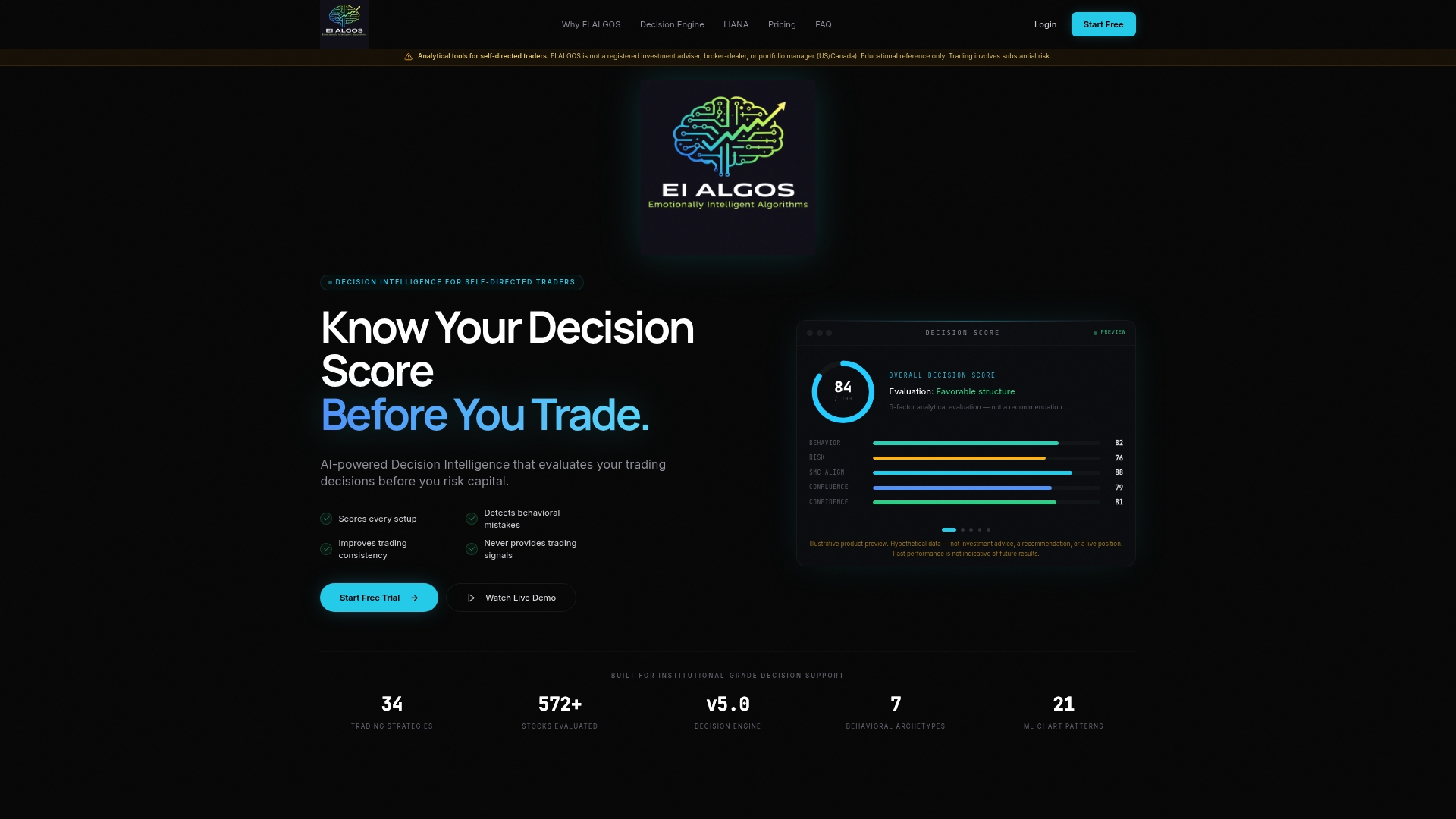
Eialgos scores each setup on six behavioral and psychological factors before you enter, so you get a read on your decision process itself, not another signal telling you what to buy. Paired with the pre-trade checklist and journal metrics covered above, it adds a layer your spreadsheet can't: a live check on whether this specific decision looks like your best process or a repeat of a pattern you've flagged before. The LIANA assistant turns that scoring into direct feedback tied to your own trading history, not a generic tip.
Eialgos offers a free tier, so you can run it alongside your existing playbook for a few weeks before deciding whether to upgrade. Start on the free plan and see what your decision scores look like on your next ten trades.
Frequently Asked Questions
What is a trading playbook in simple terms? A trading playbook is a written document that defines exactly which setups you trade, the entry criteria for each one, your risk rules, exit logic, and the specific actions you're forbidden from taking. It exists so decisions get made in advance, not during a live trade.
How is a trading playbook different from a trading plan? A trading plan often covers broader goals, capital allocation, and overall strategy across markets. A playbook is narrower and more mechanical: it's the specific, checklistable rules for each individual setup you trade repeatedly.
How many setups should a trading playbook include? Start with one to three setups you can validate with sufficient historical examples each. Adding more setups before mastering the first few usually dilutes focus rather than building an edge.
How often should I update my trading playbook? Change a rule only after review evidence shows a statistically meaningful pattern, not after a single win or loss. Weekly checks catch obvious red flags; monthly audits are where you recalculate expectancy and decide whether a rule actually needs revision.
What metrics matter most in a trading journal? Rule-adherence rate, expectancy in R, win rate by setup, and profit factor. Rule-adherence rate in particular shows whether you're executing the process you designed, independent of how any single trade turned out.
Sources
For a deeper look at the risk-governance thinking behind a playbook, ISO 31000 lays out the framework of controls, monitoring, and continual improvement that this article adapts for individual traders.
For template structure and setup documentation, the WealthBee playbook template and TraderNotion's build guide both walk through practical formats worth comparing against your own draft.
If you're still choosing where to host your journal and playbook together, Tradervue vs. TraderSync covers two common options for tagging trades and tracking per-setup performance over time.
- ISO 31000:2018 – Risk management — A practical guide
- Building a trading playbook — turning rules into a repeatable process (QuantAbundancia)
- Trading Playbook Template: Rules, Setups, and Review Process (WealthBee)
- How to build a trading playbook (TraderNotion)