
Choose TraderSync if you want AI-driven, mobile-first journaling with broad broker auto-sync and trade replay. Choose Tradervue if you value a proven, report-heavy platform with a functional free tier and mentor-sharing. And if your real problem is why you keep making the same trade mistakes, not just what your win rate is, EI ALGOS is the third option worth knowing.
Quick verdict by trader type:
- TraderSync: Best for active day traders who want the Cypher AI assistant, mobile logging, market replay, and hundreds of broker integrations without manual CSV work.
- Tradervue: Best for traders who want deep, battle-tested reporting and mentor-sharing on a free or low-cost plan, and who don't need AI or a mobile app.
- EI ALGOS: Best for self-directed traders focused on decision quality and behavioral discipline rather than raw performance metrics.
Mini pros/cons:
TraderSync
- Pro: Cypher AI, native mobile apps, market replay, and massive broker coverage make daily logging nearly frictionless.
- Con: Top features sit behind Premium/Elite tiers; message limits on the AI assistant can constrain heavy review sessions.
Tradervue
- Pro: Free tier is genuinely functional; 100+ historical reports and community/mentor-sharing are hard to match at the price.
- Con: No AI assistant, no native mobile app, and a UI that feels dated compared to newer platforms.
EI ALGOS
- Pro: Six-factor behavioral scoring and the LIANA assistant surface decision errors that pure analytics journals never flag.
- Con: Not a drop-in replacement for a traditional journal; traders who only want P&L metrics will find it a different tool entirely.
Table of Contents
- How do Tradervue vs TraderSync actually compare?
- What each platform actually does differently in daily use
- What does each platform actually cost?
- How safe is your trade data, and can you get it back?
- Which platform fits your trading workflow?
- How EI ALGOS approaches trading differently
- What user reviews actually tell you
- Key Takeaways
- The part most comparison articles skip
- EI ALGOS gives you what a journal can't
How do Tradervue vs TraderSync actually compare?
| Dimension | Tradervue | TraderSync | EI ALGOS |
|---|---|---|---|
| Best for | Report-focused traders, mentors, free-tier users | Active day traders, multi-account, mobile-first | Behavioral discipline, decision-quality improvement |
| Pricing / trial | Free tier + paid ~$29.95–$49.95/mo | Starts ~$29.95/mo; Premium/Elite tiers higher | Free plan + paid subscription tiers |
| AI & automation | None | Cypher AI assistant (message limits by plan) | LIANA behavioral coaching assistant |
| Analytics & reports | 100+ historical reports | Automated + customizable reports | Six-factor decision scoring per setup |
| Trade import / broker integrations | 80+ brokers, file-based imports | 700–950+ broker integrations, auto-sync | Manual or import; decision-focused entry |
| Market replay / session replay | Not available | Available; precision scales by tier | Not applicable |
| Behavioral / decision-intelligence | None | Pattern detection via Cypher | Core feature: behavioral error detection |
| Custom tagging / filters / search | Yes | Yes | Yes |
| Options & derivatives support | Yes | Yes | Yes, with options analysis tools |
| Data export & backups | CSV export | CSV export | Export available |
| Support & community | Mentor-sharing, community forum | Live chat, email, knowledge base | Educational support, LIANA coaching |
Who should pick what, in one line each: TraderSync suits the trader who wants the platform to do the heavy lifting on data collection and pattern spotting. Tradervue suits the trader who wants to own their analysis process with a proven report library and zero upfront cost. EI ALGOS suits the trader who already knows their stats but keeps repeating the same behavioral mistakes.
Practical migration note: Before switching platforms, export your full trade history as a CSV from your current journal. Check that the file includes timestamps, fill prices, commissions, and account identifiers. Most platforms accept CSV uploads, but column-header mismatches are the most common import failure. Keep a local backup before you delete anything from your old account.
What each platform actually does differently in daily use
AI and automation: speed vs. depth vs. behavior
TraderSync and Tradervue take fundamentally different positions on automation. TraderSync's Cypher AI scans your trade history for recurring patterns and mistakes, surfacing them in plain language. That's genuinely useful for traders who review many trades regularly and want a first-pass filter. The catch: AI message limits scale by plan, so on lower tiers you may hit a ceiling mid-review session.

Tradervue has no AI layer at all. Every insight comes from you reading the reports. That sounds like a limitation, but for traders who distrust black-box pattern matching, it's actually a feature. You see exactly what the data shows, with no algorithmic interpretation layered on top.
EI ALGOS takes a third path. Its LIANA assistant doesn't scan completed trades for patterns. It evaluates the decision behind each setup using a six-factor behavioral and psychological scoring engine, before and during the trade. The distinction matters: most journals tell you what happened; EI ALGOS tells you whether the decision was sound regardless of outcome.
Analytics and reports
Tradervue's 100+ historical reports are its clearest competitive advantage. Win rate by time of day, exit efficiency, P&L by setup type, and drawdown curves are all available without configuration. For a swing trader doing weekly reviews, that depth is hard to beat.
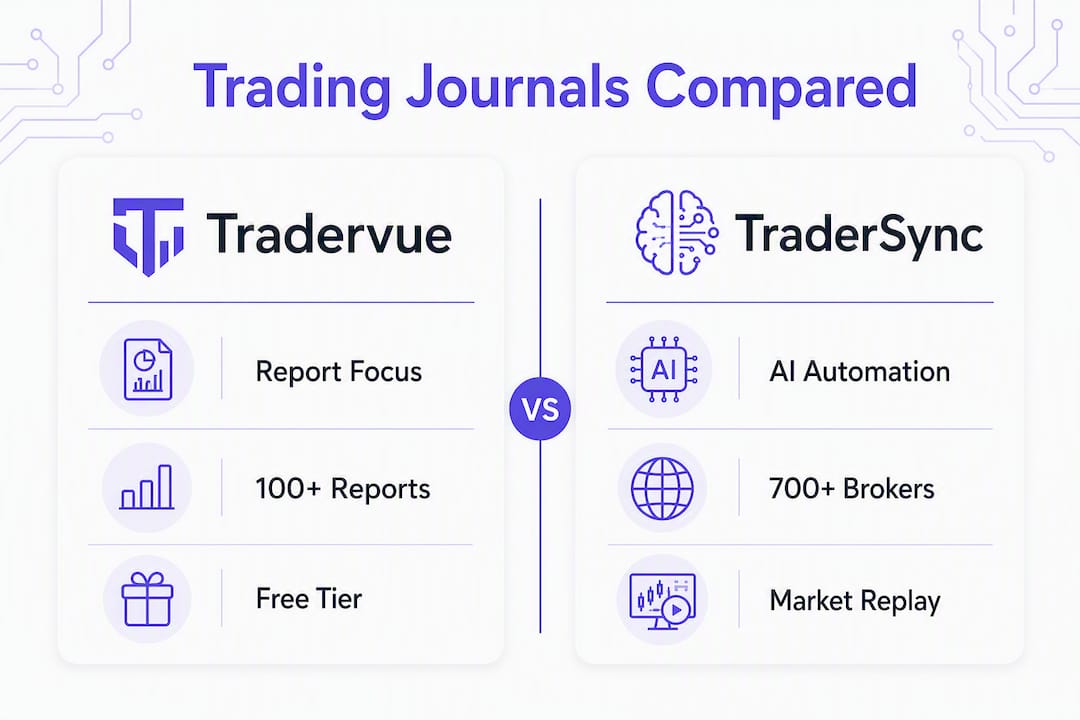
TraderSync's reports are more automated and visually modern, but the underlying metric set is comparable. Where it pulls ahead is in surfacing those metrics without manual navigation. The dashboard is built for traders who want answers fast, not traders who want to explore data.
Trade import mechanics and broker coverage
This is where the gap between the two platforms is most concrete. TraderSync supports 700–950+ broker integrations with auto-sync, meaning trades populate automatically after market close. Tradervue supports roughly 80+ brokers and relies primarily on file-based imports. Auto-sync is convenient, but it introduces a real risk: timestamp quirks from broker feeds can silently corrupt your time-of-day analysis. File-based imports force you to look at the raw data, which makes reconciliation errors visible. For traders using unusual brokers or prop firm accounts with non-standard data formats, Tradervue's CSV-first approach is often more reliable.

Pro Tip: When importing a CSV into any platform, always cross-check the first five and last five trades against your broker's trade confirmation. Timestamp offsets and fee-calculation differences are the two most common sources of silent data errors that skew your reports for weeks before you notice.
Market replay
TraderSync includes market replay, with precision settings that unlock on higher tiers. For execution-focused day traders, this is a meaningful feature: you can replay the exact price action around your entry and exit to evaluate whether your timing was sound or lucky. Tradervue has no replay feature. If execution review is part of your post-trade routine, that's a hard stop.
What does each platform actually cost?
Both platforms start at roughly the same monthly price point. Tradervue offers a functional free tier plus paid plans around $29.95–$49.95 per month. TraderSync starts around $29.95 per month, with Premium and Elite tiers priced higher for features like advanced AI message allowances, additional accounts, and higher-precision replay.
What's gated by tier on each platform:
- TraderSync: AI message volume, number of linked accounts, replay precision, and some advanced report types all scale with plan level.
- Tradervue: The free tier limits trade volume per month and restricts some advanced reports; paid tiers unlock the full report library and mentor-sharing tools.
- EI ALGOS: Free plan available; paid tiers unlock the full six-factor scoring engine, unlimited LIANA sessions, and advanced options analysis.
Trial checklist — what to actually test before you commit:
- Import 20–30 real trades from your broker and verify timestamps and fees match your statements.
- Run the three reports you use most often and check whether they require a paid tier.
- Test mobile logging if you trade away from a desktop.
- Trigger the AI assistant (TraderSync) or decision-scoring engine (EI ALGOS) on a real setup and evaluate the output quality.
- Submit a support question and measure response time.
- Export your imported trades as a CSV and confirm the file is complete and readable.
For budget-minded traders who need a free on-ramp, Tradervue's free tier remains one of the most practical starting points in the category. If cost is the primary constraint and you're willing to handle your own data maintenance, open-source tools like Ghostfolio exist as a zero-cost fallback, though they trade convenience and dedicated support for price.
How safe is your trade data, and can you get it back?
Both Tradervue and TraderSync offer CSV export, which means your trade history is portable. Before committing to either platform, verify that the export file includes: trade timestamps (with timezone), fill prices, commissions and fees, account identifiers, and trade direction (long/short).
Questions to ask support before subscribing:
- Is trade data encrypted at rest and in transit?
- What is your data-retention policy if I cancel my subscription?
- Do you offer an API for programmatic data access or bulk export?
- How do you handle US privacy regulations (CCPA) for account and trade data?
- What is your SLA for data export requests?
- Can I request a full account archive, including notes and tags, not just raw trade data?
For off-platform backups, the simplest practice is a monthly CSV export saved to local storage or a personal cloud folder. Don't rely on the platform as your only copy of your trade history. If you switch platforms, run a parallel import on the new system before closing the old account and verify the trade count matches.
Which platform fits your trading workflow?
The right choice depends less on feature lists and more on how you actually work.
Decision checklist by trader profile:
- Active day trader, multi-account: TraderSync. Auto-sync across hundreds of brokers, mobile logging, and market replay are built for this workflow. Tradervue's manual import process becomes friction at high trade volume.
- Options-focused trader: All three platforms support options, but EI ALGOS's options analysis tools and behavioral scoring are specifically designed for the decision complexity that options setups involve.
- Mentor-led or community trader: Tradervue. Its mentor-sharing and community features are purpose-built for this use case and have no direct equivalent in TraderSync.
- Budget swing trader: Tradervue's free tier. Import your weekly CSV, run the core reports, and pay nothing until you need advanced features.
- Multi-account prop trader: TraderSync, with a caveat. Verify your prop firm's data format is on the supported broker list before committing. Non-standard prop firm feeds are a known friction point.
Red flags to watch for:
- Your broker isn't on the auto-sync list and the platform has no CSV import template for it.
- No export option is documented in the pricing or FAQ pages.
- The mobile app is listed as a feature but reviews consistently flag sync failures.
- AI message limits reset monthly and your review cadence would exhaust them in the first week.
Real workflow examples: A trader running three accounts at a prop firm uses TraderSync's auto-sync to consolidate all positions into one dashboard, then runs the replay on losing trades each evening. A swing trader with 10–15 trades per week uploads a CSV from their broker every Friday, runs Tradervue's time-of-day and setup-type reports, and shares the review with a mentor. Neither workflow is wrong; they're just different tools for different rhythms.
How EI ALGOS approaches trading differently
Most journals measure what happened. EI ALGOS measures whether the decision was correct, independent of the outcome. That's a meaningful distinction for any trader who has ever taken a loss on a well-reasoned trade and a profit on a reckless one.
The platform's six-factor analytical engine scores each trade setup across behavioral and psychological dimensions: setup clarity, risk definition, plan adherence, emotional state, market context, and execution quality. A trade that wins on a poor decision scores poorly. A trade that loses on a sound decision scores well. Over time, that scoring separates skill from luck in a way that P&L curves alone cannot.
The LIANA assistant works as a process coach, not a signal provider. It reviews your scoring patterns, identifies where your decision quality degrades (specific times of day, specific market conditions, specific setup types), and provides feedback on the process rather than the outcome.
EI ALGOS feature comparison (against generic journal categories):
| Feature category | EI ALGOS capability |
|---|---|
| AI assistant | LIANA: process-coaching, behavioral pattern feedback |
| Behavioral scoring | Six-factor setup scoring per trade |
| Live trade management | Yes, with decision-support tools |
| Options analysis | Yes, integrated with decision scoring |
| Strategy pattern detection | Yes, behavioral pattern identification |
| Signal / recommendation engine | None; no trade signals provided |
What user reviews actually tell you
Aggregated reviews consistently give TraderSync higher satisfaction scores for UX and feature modernity. Tradervue draws consistent praise for reporting depth but frequent criticism for its dated interface. Neither pattern is surprising given the platforms' design philosophies.
The more useful signal is what reviewers complain about. Import reliability and support response time are the two complaints that correlate most strongly with real workflow friction. UI preferences are cosmetic. A broken import or a 72-hour support wait during a critical reconciliation is not.
Trust signals to verify before subscribing:
- Pricing page shows all tiers with feature breakdowns, not just a "contact us" for anything above the base plan.
- A documented broker list or compatibility guide is publicly available.
- Support channels are listed with realistic response-time expectations.
- The product has had a documented update or changelog entry within the last 90 days.
- Export functionality is described in the help documentation, not just mentioned in marketing copy.
On review volume: a platform with 500 reviews and a 4.2 average tells you more than one with 12 reviews and a 5.0. Small sample sizes are easily skewed by a launch-week push or a single dissatisfied user. Weight platforms with larger, older review bases more heavily, and look for patterns in the one- and two-star reviews specifically.
Key Takeaways
TraderSync is the stronger choice for active traders who want automation and AI; Tradervue holds its ground for report depth and free-tier access; EI ALGOS addresses a different problem entirely, scoring decision quality rather than tracking outcomes.
| Point | Details |
|---|---|
| TraderSync for automation | Cypher AI, 700–950+ broker integrations, mobile apps, and market replay suit high-volume day traders. |
| Tradervue for free depth | A functional free tier with 100+ reports and mentor-sharing makes it the best low-cost entry point. |
| Broker compatibility first | Verify your broker is on the auto-sync list before committing; CSV import is the reliable fallback. |
| Export before you switch | Always export a full CSV with timestamps, fees, and account IDs before migrating to a new platform. |
| EI ALGOS for decision quality | Six-factor behavioral scoring and LIANA coaching target the decision layer that analytics journals don't reach. |
The part most comparison articles skip
The framing of "which journal is better" assumes the problem is data collection and reporting. For most traders, it isn't. The data is fine. The decisions are the problem.
Every platform in this comparison will show you your win rate, your average winner, and your worst drawdown. What none of them will tell you, unless you build it yourself, is whether your decision-making process is sound on the trades where you lost. That gap is where most traders stay stuck. They optimize their journal setup, add more tags, run more reports, and still repeat the same behavioral errors because the journal is measuring outcomes, not decisions.
The conventional wisdom is that more data leads to better trading. Sometimes it does. But a trader who takes 200 trades a month and reviews them all with an AI assistant can still be systematically overtrading on low-conviction setups if the tool only measures what happened, not why the trade was taken. The review process becomes a sophisticated way of confirming existing biases rather than challenging them.
This is the actual fork in the road: do you need better data collection and reporting, or do you need a framework that evaluates the quality of your decisions before the outcome is known? The first problem is what TraderSync and Tradervue solve well. The second is what EI ALGOS is built for.
EI ALGOS gives you what a journal can't
Most traders who reach the TraderSync vs. Tradervue decision have already outgrown spreadsheets. They want structure, automation, and insight. Both platforms deliver that. But if you've used a journal for a year and your behavioral patterns haven't changed, the journal isn't the bottleneck.
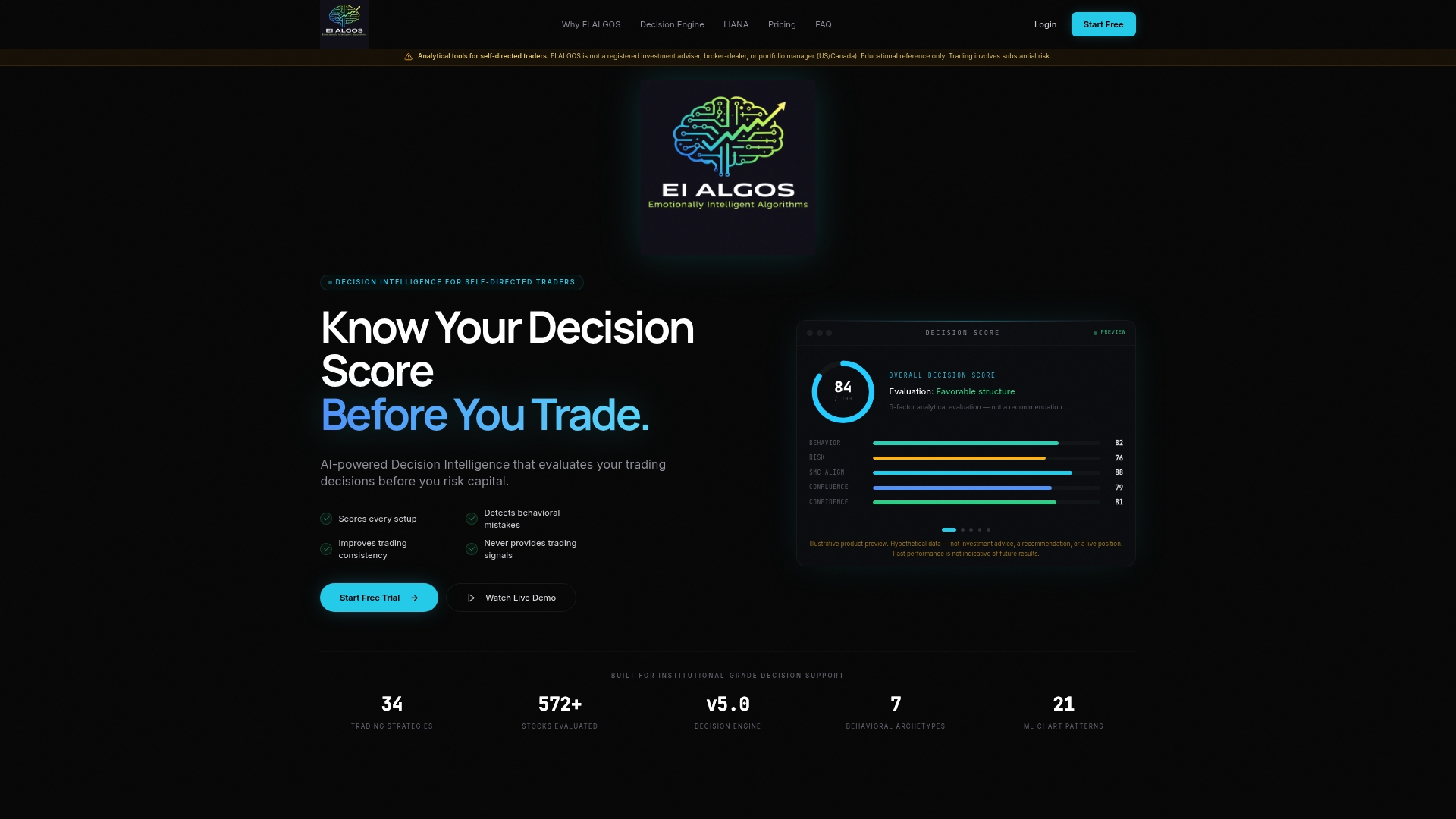
EI ALGOS scores every trade setup on six behavioral and psychological factors before and during the trade, then uses the LIANA assistant to identify where your decision quality breaks down. It doesn't replace a journal. It addresses the layer underneath: the decisions that produce the trades you later regret.
To test it in one session:
- Import or enter five recent trades where the outcome surprised you.
- Run the six-factor decision score on each setup.
- Review LIANA's process feedback and note which factor scored lowest across all five.
- That pattern is where your next improvement lives.
Start with the free plan at eialgosinc.com and run your first decision score today.