
For self-directed stock traders who want to actually improve, EI ALGOS is the best stock trading journal in 2026. It's the only platform on this list that scores your decision-making process through a six-factor behavioral engine and surfaces your specific errors through an AI assistant (LIANA), rather than just logging what happened after the fact.
If EI ALGOS isn't the right fit for your workflow, here are the strongest alternatives:
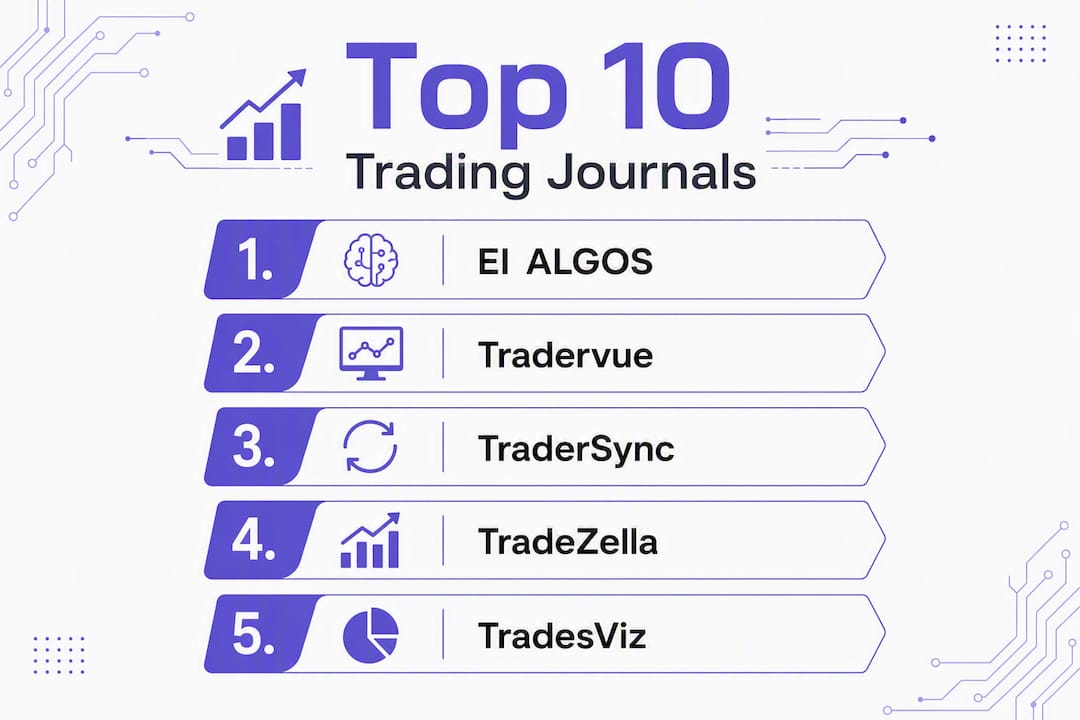
- EI ALGOS — Best for behavioral scoring and decision-process improvement. Six-factor analytical engine plus LIANA assistant pinpoints why you made a bad trade, not just that you did.
- TraderSync — Best for active traders who live on their phones. Mobile apps with near-desktop parity and integration with 700–950+ brokers.
- TradeZella — Best for equity traders who want AI-driven analytics and broad broker coverage. Consistently scored 9.4/10 in independent equity-trader tests and supports 500+ brokers.
- Stonk Journal — Best free option for beginners who can handle manual entry in exchange for zero cost.
Want to start immediately? Try EI ALGOS's free plan, run a 14-day trial on TraderSync or TradeZella, or import your last 30 days of trades into whichever platform you're testing. The comparison below will help you narrow it down fast.
Table of Contents
- How the best stock trading journals compare at a glance
- Mini-reviews of every top trading journal
- How to choose the right trading journal for your style
- How we selected and tested these journals
- Why behavioral scoring changes which journal you should choose
- Key Takeaways
- The journaling habit most traders get wrong
- EI ALGOS gives you a trading journal built around your decisions
How the best stock trading journals compare at a glance
| Feature | EI ALGOS | Tradervue | TraderSync | TradeZella | TradesViz | Trademetria | Edgewonk | WingmanTracker | Stonk Journal | RizeTrade |
|---|---|---|---|---|---|---|---|---|---|---|
| Best for | Behavioral scoring | Free stock/ETF tier | Mobile-first analytics | Equity analytics | Advanced charting | Budget traders | Psychology metrics | Community learning | Free beginners | Setup/risk discipline |
| Free plan | Yes | Yes (30 trades/mo) | Trial only | Trial only | Trial only | Yes (limited) | No | Not publicly listed | Yes (unlimited) | Not publicly listed |
| Paid tiers | Tiered monthly/annual | From $29.95/mo | Paid after trial | $24–$49/mo (annual) | Paid tiers | From ~$19.95/mo | ~$197/year | Not publicly listed | Free only | Not publicly listed |
| Broker imports | Yes | ~80 brokers | 700–950+ brokers | 500+ brokers | Yes | Yes | Limited | Not publicly listed | Manual only | Not publicly listed |
| Analytics depth | AI behavioral scoring | Advanced | Advanced | AI-driven (Zella AI) | Advanced charting | Basic–moderate | Moderate | Basic | Basic | Moderate |
| Psychology features | Yes (core feature) | Limited | Limited | Limited | Limited | No | Yes (tilt meter) | No | No | No |
| Mobile app | Web-based | Web-based | iOS + Android | Web-based | Web-based | Web-responsive | Web-based | Not publicly listed | Web-based | Not publicly listed |
| Instruments | Stocks, options | Stocks, ETFs, options | Stocks, options, futures, crypto | Stocks, options, futures | Stocks, options, futures | Stocks, options | Stocks, options, futures | Stocks | Stocks, options | Stocks, options |

Mini-reviews of every top trading journal

1. EI ALGOS
EI ALGOS operates in a category most journals don't touch: Decision Intelligence. Where other platforms record what you traded and how it performed, EI ALGOS scores how you decided using a six-factor analytical engine that evaluates the psychological and behavioral signals behind each setup.
What makes it different: The LIANA assistant doesn't just surface patterns. It gives you personalized process feedback, telling you which behavioral errors are recurring and what to do about them. If you're consistently oversizing positions after a winning streak, LIANA flags it. If your exit behavior deteriorates in the last hour of the session, the engine catches it.
Pros:
- Six-factor behavioral scoring on every trade setup
- LIANA AI assistant provides personalized, process-level feedback
- Live trade management tools and options analysis built in
Cons:
- No native iOS/Android app (web-based)
- Behavioral scoring is a different workflow than pure P&L logging; there's a learning curve
Pricing: Free plan available; paid tiers via monthly and annual subscriptions (see eialgosinc.com for current plan details).
Instruments: Stocks, options.
Best for: Self-directed traders who want to understand why their results are inconsistent, not just that they are.
2. Tradervue
Tradervue is one of the most established names in trading journals, and its free tier is genuinely useful, not a stripped-down teaser. The free plan covers 30 trades per month for stocks and ETFs with automated imports from roughly 80 brokers, which is enough for a swing trader or someone testing the platform before committing.
Pros:
- Free plan with real automated import capability
- Paid tiers from $29.95/month with deeper analytics
- Long track record and active user community
Cons:
- Free plan caps at 30 trades per month
- Psychology features are limited compared to dedicated tools
Pricing: Free (30 trades/month); paid from $29.95/month.
Instruments: Stocks, ETFs, options.
Best for: Traders who want a proven, no-cost entry point with solid broker connectivity.
3. TraderSync
TraderSync's mobile apps are the closest thing to desktop parity you'll find in this category. The iOS and Android apps aren't stripped-down companions; they let you log, review, and analyze trades with nearly the same depth as the browser version. Broker integration spans 700–950+ connections depending on the source, which covers almost any retail brokerage setup.
Pros:
- Mobile apps with near-desktop functionality
- Wide broker integration (700–950+)
- Deep analytics and reporting
Cons:
- No long-term free tier; trial only
- Can feel feature-heavy for traders who want simplicity
Pricing: Paid after trial (no permanent free plan).
Instruments: Stocks, options, futures, crypto.
Best for: Active traders who manage positions from their phones and need full functionality on the go.
4. TradeZella
TradeZella scored 9.4/10 in independent equity-trader evaluations, reflecting broad broker connections, AI-driven reporting, and analytics that go beyond basic profit and loss breakdowns. You can ask Zella AI natural-language questions about your performance and get structured breakdowns by setup type, time of day, or instrument.
Pros:
- 500+ broker connections for automated import
- Zella AI for natural-language performance queries
- Strong equity-focused analytics
Cons:
- No permanent free plan (trial only)
- Pricing at $24–$49/month (annual) is mid-range but adds up
Pricing: $24–$49/month on annual plans; trial available.
Instruments: Stocks, options, futures.
Best for: Equity traders who want AI-assisted performance breakdowns without building custom reports manually.
5. TradesViz
TradesViz is the choice for traders who think in charts. Its visualization suite is the deepest on this list: strategy-level filters, heat maps, calendar views, and multi-dimensional performance breakdowns that let you slice data by setup, session, instrument, and more. Options traders in particular find it useful for tracking complex multi-leg positions.
Pros:
- Advanced charting and strategy-level filters
- Strong options and futures support
- Highly customizable reporting
Cons:
- Interface has a steeper learning curve
- No psychology or behavioral scoring features
Pricing: Paid tiers (trial available; specific pricing not publicly listed in standardized form).
Instruments: Stocks, options, futures.
Best for: Data-driven traders who want granular visualization and are comfortable building their own analytical views.
6. Trademetria
Trademetria keeps things simple and affordable. The free plan is limited on trade volume, but the paid tier at around $19.95/month unlocks unlimited entries and a clean reporting interface that doesn't require a tutorial to navigate. It's web-first with a mobile-responsive design rather than a native app.
Pros:
- Low-cost paid tier (~$19.95/month)
- Clean, low-friction interface
- Unlimited entries on paid plan
Cons:
- No native mobile app
- Analytics are basic to moderate compared to TradeZella or TradesViz
Pricing: Free (limited); paid from ~$19.95/month.
Instruments: Stocks, options.
Best for: Budget-conscious traders who want unlimited logging and straightforward reports without paying for features they won't use.
7. Edgewonk
Edgewonk built its reputation on trading psychology, and the feature set reflects that focus. Its tilt meter tracks emotional state across sessions, and the behavior-focused metrics go beyond standard win-rate and expectancy calculations. Pricing is structured as an annual subscription at around $197/year rather than a monthly plan.
Pros:
- Dedicated psychology tools including a tilt meter
- Behavior-focused metrics designed to surface emotional errors
- One-time or annual pricing avoids monthly subscription fatigue
Cons:
- Broker import options are limited compared to TraderSync or TradeZella
- No permanent free plan
Pricing: ~$197/year.
Instruments: Stocks, options, futures.
Best for: Traders who already track P&L well and want to add a dedicated psychology layer to their review process.
8. WingmanTracker
WingmanTracker takes a community-first approach. The platform's standout feature is trade sharing: you can post setups, get feedback from other traders, and review how peers are approaching similar conditions. For traders who learn through discussion and peer review rather than solo analysis, that's a meaningful differentiator.
Pros:
- Community features for sharing trades and setups
- Peer feedback loop built into the workflow
Cons:
- Analytics depth is basic compared to most alternatives
- Pricing and broker import details are not publicly listed in detail
Instruments: Stocks.
Best for: Traders who want community accountability and peer feedback as part of their review process.
9. Stonk Journal
Stonk Journal is completely free, ad-free, and supports unlimited manual trade entries across multiple portfolios. The tradeoff is straightforward: no automated broker imports, so every trade goes in by hand. User reviews on Trustpilot praise the value but note the manual entry burden and some reported data inconsistencies.
Pros:
- Completely free with no ads
- Unlimited entries and multiple portfolio support
- Useful analytics for the price point
Cons:
- Manual entry only; no automated imports
- Some user-reported data issues
Pricing: Free.
Instruments: Stocks, options.
Best for: Beginners or budget traders who want zero cost and are willing to enter trades manually.
10. RizeTrade
RizeTrade focuses on setup-based journaling with built-in risk/reward calculators. If your trading process centers on pre-defined setups with specific entry criteria and risk parameters, the template structure keeps your logging consistent and your risk discipline visible at a glance.
Pros:
- Setup templates with integrated risk/reward calculators
- Encourages pre-trade discipline through structured entry
Cons:
- Pricing and broker import details are not publicly listed
- Less suited to discretionary or news-driven trading styles
Instruments: Stocks, options.
Best for: Traders who follow structured setups and want risk/reward discipline baked into their logging workflow.
Pro Tip: Before committing to any paid plan, import at least two weeks of real trades and generate one full performance report. If the report doesn't surface at least one insight you hadn't already noticed, the platform isn't doing its job.
How to choose the right trading journal for your style
The right journal depends on your primary goal, not the longest feature list. Start there.
Step 1: Define your primary goal. Are you trying to change a specific behavior (position sizing, early exits, revenge trading)? Or do you mainly want better analytics on what's already working? Behavior-change goals point toward EI ALGOS or Edgewonk. Analytics-depth goals point toward TradeZella, TradesViz, or TraderSync.
Step 2: Check broker compatibility first. If a journal can't import your trades automatically, you'll stop using it within a month. Verify your broker is on the supported list before anything else. Broker coverage ranges widely: from roughly 80 brokers (Tradervue) to 900+ (TraderSync).
Step 3: Run a 30-day live experiment. During that window, track three things: how consistently you log (aim for every session), how many insights the platform generates that you act on, and whether one tracked behavioral metric moves in the right direction. Those three outcomes tell you more than any feature comparison.
Step 4: Test the report you'll actually use weekly. Most traders open a journal, log trades, and never look at the reports. Open the weekly summary report on day 7 of your trial. If it's confusing or empty, the platform isn't configured for your workflow.
Step 5: Check export and data portability. Before paying for a subscription, confirm you can export your full trade history in CSV or a standard format. Platforms that make export difficult are a red flag.
Red flags to avoid:
- No export function or export locked behind the highest tier
- Broker not supported and no manual CSV import option
- Pricing not listed publicly (hard to budget)
- No trial or free plan of any kind
- Reports that require manual configuration before showing anything useful
Pro Tip: Run two journals in parallel for the first 30 days: one focused on P&L analytics (TradeZella or TraderSync) and one focused on behavior (EI ALGOS or Edgewonk). After 30 days, you'll know exactly which type of feedback actually changes your decisions.
How we selected and tested these journals
The ten platforms on this list were evaluated against seven weighted criteria:
- Automated broker imports and coverage — Does the platform connect to your broker? How many brokers does it support? Manual-only platforms were flagged.
- Analytics depth — Does the platform produce reports that surface non-obvious insights? Basic win/loss summaries scored lower than multi-dimensional breakdowns.
- Behavioral and psychology features — Does the platform track decision quality, emotional state, or behavioral patterns, not just outcomes?
- Ease of use and onboarding — Can a trader generate a useful report within the first session, without a tutorial?
- Pricing and free plan availability — Is there a genuine free tier or trial? Are paid tiers priced transparently?
- Mobile support — Is there a native app, or is the platform web-only?
- Security and data privacy — Does the platform publish a clear privacy policy? Is trade data stored securely?
Testing approach: Each platform was evaluated through live import testing where broker connectivity allowed, report generation across at least two trade sets, mobile interface review, and community/support responsiveness checks. Pricing was verified against vendor documentation and cross-referenced with independent reviews from StockBrokers.com and TradingJournal.com. User feedback was drawn from Trustpilot and community forums to validate real-world experience against vendor claims.
Data sources used:
- Vendor documentation and pricing pages (primary source for plan details)
- StockBrokers.com 2026 trading journal roundup (broker coverage, pricing cross-check)
- TradingJournal.com 2026 equity trader review (analytics scoring, TradeZella, Edgewonk, Trademetria)
- Trustpilot reviews for Stonk Journal (free-tier user experience)
- TradingToolsHub Stonk Journal review (import capability verification)
Pricing and feature details reflect information available as of early 2026. Always verify current plans directly with each vendor before subscribing.
Why behavioral scoring changes which journal you should choose
Most trading journals are sophisticated logbooks. They record what you did, calculate your win rate, and show you a P&L curve. That's useful, but it doesn't answer the question that actually determines whether you improve: why did you make that decision?
EI ALGOS is built around that distinction. Its six-factor analytical engine evaluates the behavioral and psychological signals behind each trade setup: factors like decision timing, setup quality relative to your stated criteria, position sizing consistency, and emotional state indicators. The result isn't a P&L report. It's a behavioral scorecard that tells you which part of your process is breaking down.
The LIANA assistant takes that a step further. Say you've been cutting winners short on high-conviction setups. LIANA doesn't just show you the pattern in a chart. It identifies the specific behavioral signal, contextualizes it against your historical process, and gives you a concrete process adjustment to test. That's a different category of feedback than "your average winner is smaller than your average loser."
Consider a practical scenario: a trader who consistently oversizes positions in the first 30 minutes of the session. A standard journal shows the P&L damage. EI ALGOS scores the decision quality on those early trades, flags the sizing deviation against the trader's own baseline, and LIANA surfaces the pattern with a suggested process fix. The trader now has something to test, not just something to regret.
Industry reviews consistently note that traders choose journals based on specialized needs: psychology, deep analytics, or user-friendly design. EI ALGOS addresses the psychology and process layer that most analytics-heavy platforms leave untouched.
| Approach | What it measures | What it changes |
|---|---|---|
| Standard P&L journal | Outcomes (win rate, expectancy, drawdown) | Awareness of results |
| Psychology journal (Edgewonk) | Emotional state, tilt indicators | Emotional self-regulation |
| Decision Intelligence (EI ALGOS) | Decision process, behavioral scoring, setup quality | The decision itself, before the outcome |
The distinction matters most for traders who are already technically competent but still inconsistent. If you know what to do but keep doing something else under pressure, outcome-based logging won't fix it. Behavioral scoring will.
Key Takeaways
EI ALGOS is the strongest choice for self-directed traders who want behavioral scoring and process feedback, while TraderSync and TradeZella lead for mobile workflows and equity analytics respectively.
| Point | Details |
|---|---|
| Behavioral scoring beats P&L logging | Journals that score decision quality surface the errors that outcome data alone can't explain. |
| Broker import is non-negotiable for active traders | Coverage ranges from ~80 brokers (Tradervue) to 700–950+ (TraderSync); verify your broker before committing. |
| Free options exist but have real limits | Stonk Journal is fully free with unlimited entries; Tradervue's free plan covers 30 trades/month with auto-import. |
| Run a 30-day experiment with clear metrics | Track logging consistency, insights acted on, and one behavioral metric to validate platform fit. |
| EI ALGOS leads on decision intelligence | Six-factor scoring plus LIANA assistant makes it the top pick for traders focused on process improvement over raw analytics. |
The journaling habit most traders get wrong
Traders who log every trade but never run a post-session review are doing the equivalent of keeping a food diary and never reading it. The log is not the work. The review is.
The single most overlooked step in any journaling practice is the structured post-session review: sitting down within an hour of the close, reading your notes from the session, and asking one specific question: "What did I do differently from my plan, and why?" That question, answered honestly three times a week, produces more behavioral change than a month of passive logging.
Realistic expectations matter here. Behavioral change in trading is slow. Most traders who start a journal expect to see measurable improvement in their win rate within 30 days. That's not how it works. What you'll see in 30 days is pattern recognition: the same mistakes showing up in the same conditions. The improvement comes in months 2 and 3, when you've built enough data to test a specific process adjustment and measure whether it holds.
The platforms that make this easier are the ones worth paying for. A journal that generates a useful behavioral insight in 10 minutes of weekly review is worth more than one with 50 report types you never open.
EI ALGOS gives you a trading journal built around your decisions
Every journal on this list will help you track trades. EI ALGOS does something none of the others do: it scores the quality of your decisions before the outcome is known, using a six-factor behavioral engine that evaluates setup quality, sizing discipline, timing, and psychological consistency.
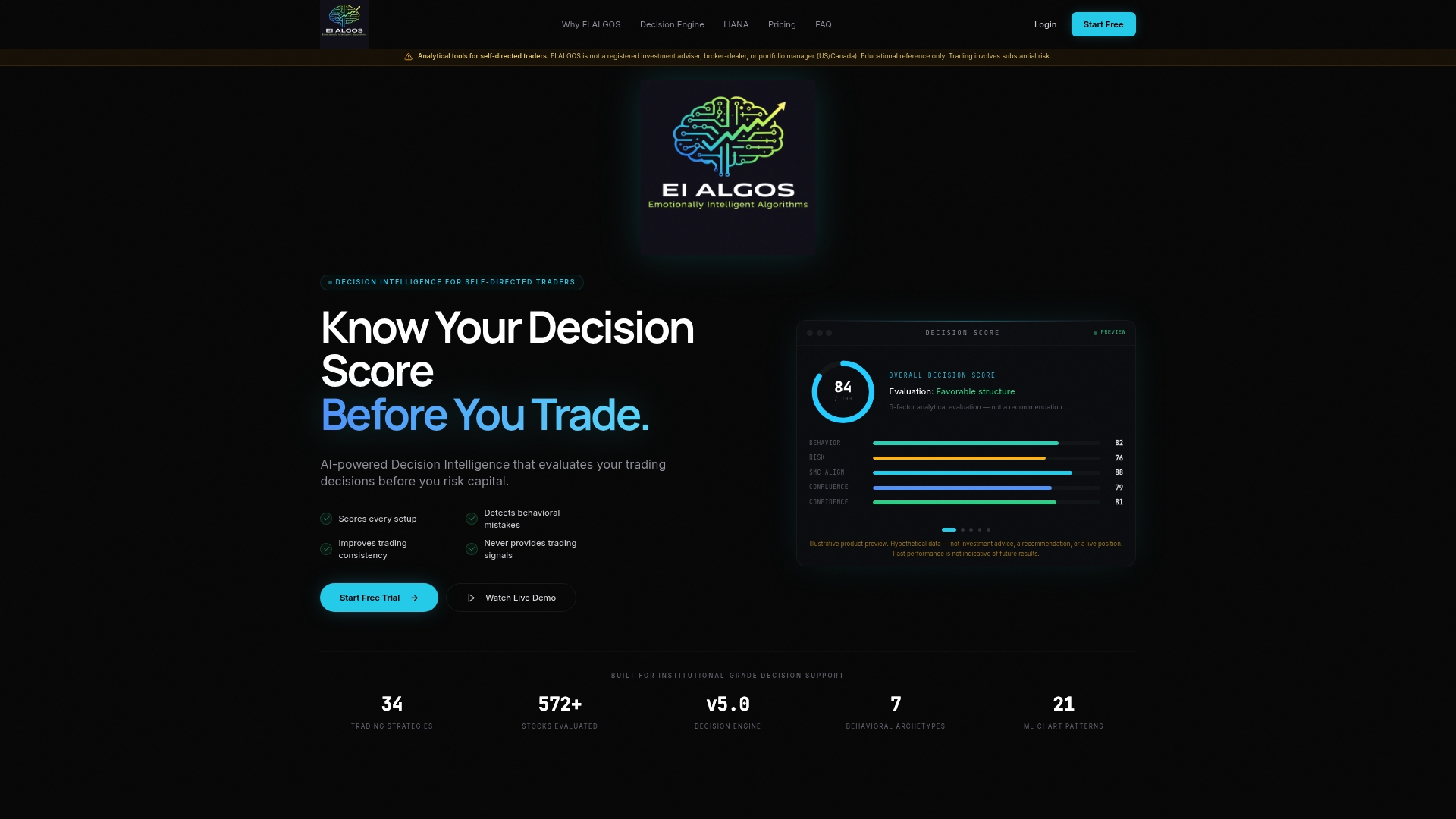
The LIANA assistant turns that scoring into personalized process feedback. You don't get a generic report. You get a specific behavioral pattern, contextualized to your own trading history, with a process adjustment to test. The platform also includes live trade management tools, options analysis, and strategy pattern detection, all within a subscription model that starts with a free plan so you can test the behavioral scoring workflow before committing to a paid tier.
If you've been logging trades without seeing your consistency improve, the issue probably isn't your strategy. It's your decision process. Start with EI ALGOS's free plan and run the behavioral scoring on your next 20 trades. The pattern will show up faster than you expect.