
The most effective trailing stop strategy for most self-directed traders is a volatility-calibrated trail using ATR(14) as the distance baseline, anchored to the nearest swing high or low, and activated only after the trade reaches a 1:1 reward-to-risk ratio. Do not activate a trail from entry. That single rule eliminates the most common reason trailing stops underperform.
Quick-start settings by timeframe:
- Scalping/intraday (1m–15m): 1–1.5× ATR(14) trail distance; activate after 1R
- Swing (1H–4H): 1.5–2× ATR(14); activate after price confirms a new swing high (long) or swing low (short)
- Position/daily: 2.5–3× ATR(14); activate after 1R or a confirmed daily close beyond structure
Asset class starting points: For stocks, a percentage-based trail often used for longer holds varies, but ATR-based trails typically adapt better to earnings volatility. Forex pairs with tight spreads respond well to 1.5–2× ATR on the 4H chart. Crypto requires wider ATR multipliers due to larger daily ranges relative to trend moves.
In a sample of qualifying swing setups, trades that converted to a trailing stop after reaching a 1:1 reward-to-risk ratio often had larger average final exits compared to those managed with fixed stops. That gap is the practical case for learning this approach.
Table of Contents
- What is a trailing stop and how do broker order types differ?
- What trailing-stop methods do traders actually use?
- When do trailing stops work, and when should you avoid them?
- How do you calculate and set a trailing stop correctly?
- What execution risks should you know before using trailing stops?
- What mistakes kill trailing-stop performance?
- The hybrid ATR-plus-structure method: a research-backed approach
- Key Takeaways
- The part most traders skip
- How Eialgosinc helps you stay disciplined with trailing stops
- Useful sources for further reading
What is a trailing stop and how do broker order types differ?
A trailing stop is a dynamic stop-loss order that moves in your favor as price advances but never moves against you. On a long trade, it ratchets upward with each new price high; if price reverses by the trail distance, the stop triggers. It locks in gains without requiring you to manually move a fixed stop.
Stop vs. stop-limit vs. trailing stop-limit
The order type you choose changes what happens when the stop triggers.
| Order Type | Trigger | Fill Behavior | Best Use |
|---|---|---|---|
| Trailing stop (market) | Price hits trail level | Fills at next available market price | Liquid stocks, major forex pairs |
| Trailing stop-limit | Price hits trail level | Places a limit order; may not fill | Low-slippage environments only |
| Fixed stop-loss | Static price level | Fills at market or limit | When trail is not needed |
A trailing stop-limit sounds safer, but in a fast gap or news spike, the limit order may sit unfilled while price continues against you. For most active traders in liquid markets, a trailing stop that fills at market is the more reliable choice. You accept a little slippage; you avoid a missed exit.
Platform checklist before you deploy a trail
Some brokers run trailing stops server-side, meaning the order lives on their servers and moves automatically even if your platform disconnects. Others require a client-side script or manual adjustment, which means a disconnect stops the trail from updating.
Before using automated trails, verify:
- Whether your broker supports server-side trailing stops
- Whether bracket orders with a trailing leg are available
- Whether guaranteed stops exist (and what they cost)
- Where the active order appears in your order book so you can monitor it
Pro Tip: Run your first trailing-stop setup on a demo account for at least two weeks. Confirm that the order moves as expected during volatile sessions, not just in calm conditions.
What trailing-stop methods do traders actually use?
Different trailing implementations suit different asset classes and timeframes. Here is the practical catalog:
- Fixed pip/dollar trail: A set dollar or pip distance that never changes. Simple to set up, easy to automate. Works well for intraday stocks with stable intraday ranges. Breaks down when volatility shifts.
- Percentage trail: Trail distance expressed as a percentage of price. Scales naturally with price level, making it useful for longer stock holds. A 5%–15% range covers most active stocks without triggering on normal daily noise.
- ATR-based trail: Distance equals a multiple of the Average True Range. Adapts to current volatility, so the trail widens in volatile conditions and tightens in quiet ones. The preferred method for forex and commodities.
- Chandelier exit: Places the stop at the highest high of a lookback window minus roughly 3× ATR. Developed by Chuck LeBeau, it keeps you in strong trends while exiting on genuine reversals. Best for swing and position traders.
- Moving-average trail: Stop follows a moving average (commonly the 20 EMA or 50 SMA). Intuitive and widely used, but lags more than ATR-based methods. Works in smooth, low-noise trends.
- Swing-low structure trail: Stop moves to just below each confirmed swing low (long) or swing high (short). Requires manual or semi-manual management but produces the most structurally logical exits. Best for traders who read price action.
- Parabolic SAR: A built-in indicator that accelerates the trail as a trend extends. Useful for capturing momentum bursts but exits early in slow, grinding trends. Better as a signal filter than a primary trail.
- Step/ladder trailing: Trail moves in fixed increments rather than continuously. Reduces the number of adjustments and prevents over-management. Suits traders who want rules without constant monitoring.
No single setting fits all markets or timeframes. Tighter trails raise win rate but cut you out of the large moves that carry most trend-following profits. Wider trails capture those moves but produce more small losses. Pick the setting that matches your edge and your tolerance for drawdown.

When do trailing stops work, and when should you avoid them?
Trailing stops are built for trending markets and tend to trigger prematurely in choppy or range-bound conditions. In a sideways market, price oscillates back and forth across the trail distance repeatedly, producing a string of small losses with no trend to compensate.
Instrument-specific notes
Stocks: Gap risk is real. Earnings announcements, FDA decisions, and macro data can gap price through your stop level overnight. A trailing stop-limit may not fill; a market stop will fill at whatever the open price is. For swing trades held overnight, size positions to absorb a gap.
Forex: Central-bank-driven pairs like EUR/USD and USD/JPY tend to trend cleanly during London and New York sessions. Low spreads make ATR-based trails efficient here. Avoid trailing during major central bank announcements (FOMC, ECB rate decisions).
Crypto: Daily ATR values are large relative to trend moves. On Bitcoin's daily chart, a 2× ATR trail reflects the asset's significant volatility, resulting in relatively wide trail distances. That is not a flaw; it reflects the asset's actual volatility. Tightening below that level produces constant premature exits.
Commodities and indices: Seasonal patterns and macro events create sharp reversals. Wider ATR multipliers (2.5–3×) and avoiding trails near scheduled reports (EIA inventory, CPI) reduce noise-triggered exits.
Practical rule: Before placing a trail, compare the ATR to recent pullback depth. If recent pullbacks are larger than your planned trail distance, the market is too choppy for a trailing approach. Use a fixed target or bracket order instead.
How do you calculate and set a trailing stop correctly?
The following checklist applies to any timeframe. The worked examples below show the math.
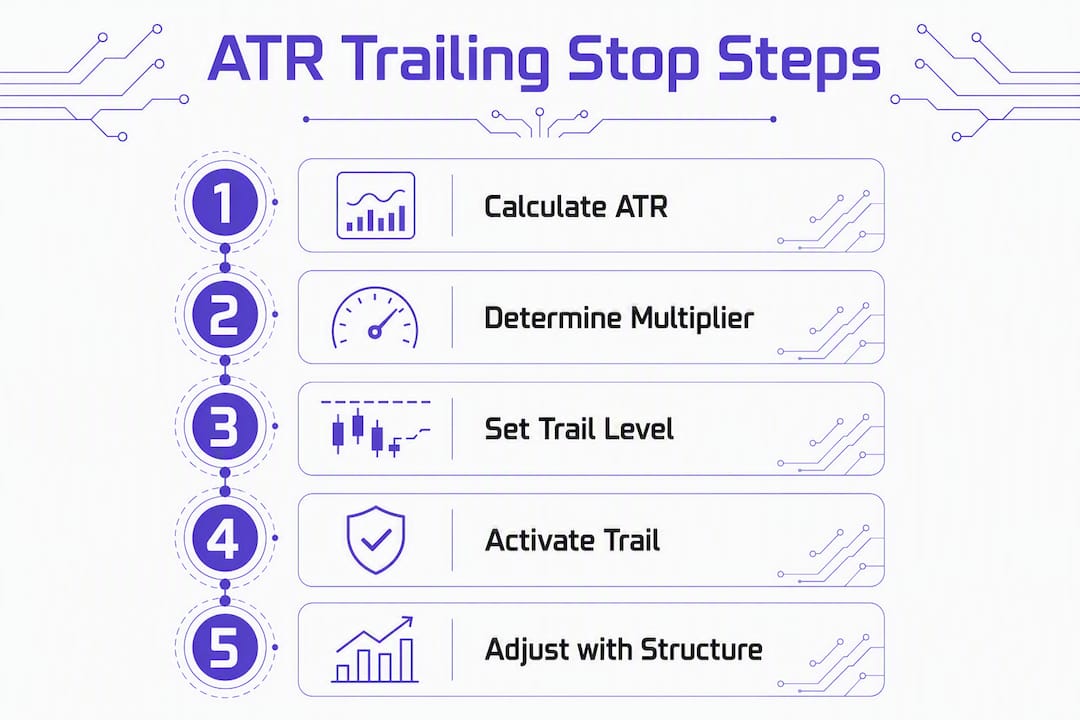
- Pick your timeframe and pull ATR(14) on that chart at the time of entry.
- Choose your ATR multiplier based on timeframe (see table below).
- Anchor to structure: place the stop just beyond the nearest swing low (long) or swing high (short), using the ATR distance as a minimum. If structure is closer than 1× ATR, use the ATR distance.
- Set your activation trigger: decide in advance whether you activate the trail after 1R profit or after price prints a confirmed swing in your direction.
- Calculate position size based on the trail distance, not a default lot size. Wider trails require smaller positions to keep dollar risk constant.
- Enter the order and confirm it appears correctly in your platform's order book.
Timeframe rules of thumb
| Timeframe | ATR Multiplier | Typical Distance (Forex) | Typical Distance (Stocks) |
|---|---|---|---|
| Scalp / 1m–15m | 1–1.5× ATR | Small pip ranges | Small percentage ranges |
| Intraday / 1H | 1.5–2× ATR | Moderate pip ranges | Moderate percentage ranges |
| Swing / 4H | 1.5–2× ATR | Larger pip ranges | Larger percentage ranges |
| Position / Daily | 2.5–3× ATR | Wide pip ranges | Wide percentage ranges |
Chandelier exit uses approximately 3× ATR anchored to the highest high over a 22-period lookback.
Worked examples
Intraday (1H, forex): EUR/USD ATR(14) = 40 pips. Multiplier: 1.5×. Trail distance: 60 pips. Entry at 1.0850 long. Initial stop: 1.0790. Activate trail after price reaches 1.0910 (1R = 60 pips). Position size at 1% account risk on a $10,000 account: $100 risk ÷ 60 pips = approximately $1.67 per pip (mini lot).

Swing (4H, stock): ATR(14) = $2.40. Multiplier: 2×. Trail distance: $4.80. Entry at $52.00. Initial stop: $47.20. Activate trail after price reaches $56.80. At $100 risk per trade: 100 ÷ 4.80 = approximately 20 shares.
Position (Daily, stock): ATR(14) = $3.50. Multiplier: 3×. Trail distance: $10.50. Entry at $120. Initial stop: $109.50. Activate after price reaches $130.50. At $200 risk: 200 ÷ 10.50 = approximately 19 shares.
Scaling out and trailing efficiency
Scaling out aggressively can undermine trailing efficiency. If you take 75% of the position off at the first target, the remaining 25% may be too small to matter even if the trend runs far. Align your scaling plan with your trail: take a partial at 1R, then trail the remainder with a wider ATR multiplier so the final leg still contributes meaningfully to overall trade expectancy.
Pro Tip: Before committing to a trail setting, run it through at least 30 historical trades on your specific instrument and timeframe. Settings that look clean on a trending month often fail in a choppy quarter.
What execution risks should you know before using trailing stops?
Trailing stops carry real-world risks that backtests often understate.
- Slippage on market stops: In fast-moving markets, your stop triggers at the trail level but fills at a worse price. On liquid instruments this is typically small; on thinly traded stocks or during news spikes, slippage can be significant.
- Gap risk: Overnight or weekend gaps can skip your stop level entirely. A stock that closes at $50 with a stop at $48 can open at $44. The market stop fills at $44, not $48. Size positions accordingly.
- Stop-limit missed fills: A trailing stop-limit places a limit order when triggered. If price gaps through the limit, the order sits unfilled and your loss continues to grow. Use market stops in liquid conditions; reserve stop-limits for slow, liquid markets only.
- Bracket orders with trailing legs: Many platforms (TD Ameritrade's thinkorswim, Interactive Brokers, TradeStation) support bracket orders that include a trailing stop as the protective leg. Set the trail distance at order entry, confirm the bracket is live, and check that the trailing leg updates correctly after partial fills.
- Server-side vs. client-side: If your broker runs trails client-side and your platform disconnects, the stop freezes at its last position. Know which model your broker uses before relying on automated trails overnight.
- Mitigations: Widen your trail distance before scheduled news events. Use a guaranteed stop if your broker offers one (note the premium cost). Always test new trail configurations on a demo account before going live.
What mistakes kill trailing-stop performance?
Most trailing-stop failures trace back to a small set of repeatable errors.
What not to do:
- Activate the trail from entry, before the trade has any profit buffer. This almost guarantees a scratch or small loss on any normal pullback.
- Move the stop to breakeven at 0.5R. This converts potential large winners into scratched trades; wait for a structural reason before tightening.
- Tighten the trail mid-trend by feel. If the trade is going well, the instinct to "protect profits" by tightening often exits you before the trend completes.
- Set a trail distance smaller than the instrument's ATR on your chosen timeframe. The market will trigger it on normal noise.
Best practices checklist:
- Predefine the activation trigger before entry and write it in your trade plan.
- Anchor the stop to a structural level, not just a round number.
- Use a process-oriented trade log to record whether you followed your activation rule on every trade.
- Backtest the setting on a minimum of 30 trades across at least two different market conditions (trending and choppy).
- Size positions to absorb the full trail distance at your standard dollar risk, not a default lot.
Pro Tip: A trading journal that tracks whether you followed your activation rule, not just the P&L, reveals behavioral patterns that pure performance data hides. Discipline adherence is the metric that predicts long-run trailing-stop performance.
The hybrid ATR-plus-structure method: a research-backed approach
The most defensible trailing-stop implementation combines ATR for distance with market structure for precise placement. ATR alone can place a stop in empty space; structure alone ignores current volatility. Together, they produce stops that trigger on real breaks rather than routine fluctuation.
The workflow:
- Measure ATR(14) on your entry timeframe at the moment of entry.
- Identify the nearest structural anchor: the most recent confirmed swing low for a long, swing high for a short.
- Set initial stop just beyond that structural level, with a minimum distance of 1× ATR. If structure is tighter than 1× ATR, use the ATR distance.
- Hold the initial stop until the trade reaches the activation trigger: either 1R profit or a confirmed new swing in your direction.
- Switch to the ATR trail at activation. The trail now moves with each new swing, always maintaining the ATR-multiple distance from the most recent extreme.
- Do not adjust subjectively. If the trade is running, let the trail manage the exit. The only permitted adjustment is widening the multiplier at a pre-planned structural level (for example, before a known resistance zone).
Discipline rules that protect the method:
- Write the activation trigger in your trade plan before entry. If you did not write it down, you do not have a plan.
- Log every trade with a decision score: did you activate on the rule, or on emotion? Tracking adherence, not just outcomes, is what separates traders who improve from those who repeat the same errors.
- Review trailing-stop outcomes by market regime (trending vs. choppy) quarterly. A setting that works in a trending quarter may need adjustment in a range-bound one.
Pro Tip: Platforms like EI ALGOS score each trade setup on behavioral and process dimensions, including whether you followed predefined rules like activation triggers. That feedback loop is what turns a good method into a consistent habit.
Key Takeaways
The most effective trailing stop approach pairs a volatility-calibrated ATR distance with a structural anchor and a predefined activation trigger, applied only after the trade reaches 1R profit.
| Point | Details |
|---|---|
| ATR multiplier by timeframe | Use 1–1.5× ATR for intraday, 1.5–2× for swing, and 2.5–3× for position trades. |
| Activation trigger | Never trail from entry; activate after 1R profit or a confirmed structural swing. |
| Market regime check | Trailing stops underperform in choppy or range-bound markets; use fixed targets instead. |
| Execution verification | Confirm whether your broker runs trails server-side before relying on automated stops overnight. |
| Eialgosinc decision scoring | EI ALGOS tracks activation-rule adherence and behavioral patterns to reduce emotion-driven stop changes. |
The part most traders skip
Most trailing-stop content focuses on the math: which multiplier, which timeframe, which indicator. That is the easy part. The harder part is that the method only works if you follow the activation rule every single time, not just when it feels right.
The trades where you deviate from the rule are almost always the ones that hurt most. You tighten the trail because the trade "feels extended." You activate early because you are nervous. You widen it because you are convinced this one is different. Each of those decisions feels justified in the moment and looks like a mistake in the journal.
What the ATR-plus-structure hybrid actually does is remove the decision. The activation trigger is written before entry. The multiplier is set before entry. The only job during the trade is to not touch it. That sounds simple, but it requires a specific kind of discipline: trusting a rule you built when you were calm, against the instinct you feel when you are in a live position.
The traders who get the most out of trailing stops are not the ones who found the perfect setting. They are the ones who built a system for tracking whether they followed their own rules, then used that data to stop making the same behavioral error twice. The setting matters. The discipline to apply it consistently matters more.
How Eialgosinc helps you stay disciplined with trailing stops
Knowing the right trailing-stop method is one thing. Applying it without second-guessing yourself mid-trade is another problem entirely.
EI ALGOS is built for exactly that gap. The platform scores each trade setup across six behavioral and process dimensions, so you know before you enter whether your decision is grounded in your rules or driven by impulse. The LIANA assistant surfaces patterns in your trade history, including whether you consistently break activation rules or tighten trails prematurely. Live trade-management tools help you track open positions against your predefined plan in real time, and the journaling and pattern-detection features flag the behavioral errors that pure P&L data never shows.
If you want a structured way to measure whether your trailing-stop discipline is actually improving, start with the EI ALGOS guide or explore the subscription plans to see which tier fits your trading volume.
Useful sources for further reading
The following references back the key claims in this article and are worth reading in full if you want to test settings or go deeper on specific methods.
- Trailing Stop — Investopedia: Clear explanation of trailing stop mechanics, order types, and when trailing stops are appropriate versus range-bound conditions.
- ATR Trailing Stop: Advanced Techniques — forex-basics.com: Detailed ATR multiplier guidance by timeframe, including Chandelier exit construction and practical forex examples.
- Trailing Stop Loss: Types, Settings, and Strategy — Arxum: Covers all major trailing methods with asset-class matching and the observational sample data on 1:1 activation.
- How to Set a Trailing Stop Loss Correctly — Zaye Capital Markets: The source for the ATR-plus-structure hybrid method and structural anchoring logic.
- Trailing Stops Guide — CompleteTradersEdge: Covers the win-rate vs. trend-capture trade-off, breakeven-stop psychology, and scaling-out effects on trailing efficiency.
- Trailing Stop Loss Order: How to Set It — TradingSim: Practical platform-level guidance on setting trailing stops, including percentage ranges for active stocks.
- Trailing Stops & Bracket Orders — DayTradingToolkit: Explains bracket order structure and why beginners should master fixed brackets before adding trailing legs.
Platform behavior varies by broker. Always verify whether your specific platform runs trails server-side or client-side, and confirm order behavior on a demo account before using automated trailing stops in live markets.