
Options Greeks explained simply: delta, gamma, theta, vega, and rho are sensitivity measures that show how an option's price reacts to moves in the underlying stock, the passage of time, changes in volatility, and shifts in interest rates. Each one isolates a single risk factor so you can see, in numbers, exactly what is driving a trade's profit or loss. Understanding them turns options pricing from a black box into a set of readable signals you can act on before you place a trade.
TL;DR:
- Delta provides an approximation of the probability an option will finish in the money, but that probability becomes less reliable for out-of-the-money options.
- Gamma spikes near expiration and at-the-money, making delta highly unstable and requiring frequent rebalancing to maintain hedge positions.
- Theta has its highest impact on near-expiration contracts, typically destroying value daily for long positions, especially when holding at the money options.
- Vega is most significant around earnings or volatility events, as implied volatility often rises before the event and collapses afterward, influencing option prices substantially.
- Greeks are linear approximations that lose accuracy during large or rapid market moves and should be combined with scenario analysis and consistent pre-trade checks.
Table of Contents
- What Are Options Greeks and Where Do They Come From?
- How Each Greek Moves Your Position: Real Numbers
- How Do Greeks Interact With Each Other?
- Using Greeks for Position Sizing and Hedging
- Where Greek-Based Analysis Falls Short
- Turning Greek Checks Into a Repeatable Process
- Delta, Gamma, Theta, Vega, and Rho Defined Plainly
- A Practical Order for Learning the Greeks
- Put Your Greek Checks Into a Repeatable Process
- Sources
- FAQ
What Are Options Greeks and Where Do They Come From?
The Greeks are not arbitrary labels. They come directly out of options pricing models, most famously the Black-Sholes model, where each Greek is a partial derivative measuring how the theoretical price shifts when one input changes while the others hold steady. That is a technical way of saying each Greek isolates one variable, so you can tell whether a loss came from the stock moving, time passing, or volatility shifting.
Delta, theta, vega, and rho are first-order Greeks, meaning they each measure a direct rate of change in the option's price. Gamma is different. It is a second-order Greek because it measures the rate of change of delta itself, not the price directly. Think of delta as your speedometer and gamma as how fast that speedometer needle is moving.
Here is a quick reference for what each one tracks and when it matters most:
- Delta measures price change per $1 move in the underlying, and it matters most for gauging directional exposure on any trade.
- Gamma measures how fast delta changes, and it matters most for at-the-money options close to expiration.
- Theta measures daily value lost to time decay, and it matters most for anyone holding options through multiple sessions.
- Vega measures price change per 1 percentage point move in implied volatility, and it matters most heading into earnings or other volatility events.
- Rho measures price change per 1 percentage point move in interest rates, and it matters most for long-dated contracts, generally a year or more out.
Calls and puts carry opposite signs on some of these. Delta runs positive for calls and negative for puts, while gamma and vega are positive for both. Theta is typically negative for long positions in either direction, since time decay works against the option buyer regardless of which side of the market they are betting on.
How Each Greek Moves Your Position: Real Numbers
Reading a Greek value only helps if you know what to do with it. Here is what each one tells you in practice, with a number attached.
-
Delta tells you directional exposure and doubles as a rough odds estimate. A call with a 0.65 delta gains roughly $0.65 for every $1 the stock rises. Traders also use delta as a rough proxy for the probability the option finishes in the money, so a 0.65 delta suggests something close to 65% odds of expiring profitable, though that shorthand breaks down for far out of the money strikes.
-
Gamma tells you how unstable that delta actually is. An at the money option with a gamma of 0.08 means delta shifts by 0.08 for every $1 move in the stock. Gamma spikes hardest right before expiration on at the money strikes, which is exactly why professional traders watching delta-neutral books track gamma so closely. High gamma forces more frequent rebalancing to keep a hedge intact, since the hedge ratio itself keeps changing.
-
Theta tells you the daily cost of holding the position. A long call with theta of negative $0.12 loses about $0.12 in value each day, all else equal, and that decay accelerates as expiration approaches. Theta is highest for at the money contracts, which is precisely why sellers of at the money premium, like covered call writers and credit spread traders, structure entire strategies around collecting it.
-
Vega tells you your exposure to fear and uncertainty pricing. A vega of 0.20 means the option gains about $0.20 in value for every one point rise in implied volatility. That matters enormously around earnings, when IV often gets bid up for weeks beforehand and then collapses the moment results are announced, a pattern known as volatility crush that catches unprepared option buyers off guard even when they call the direction correctly.
-
Rho tells you how much interest rate shifts matter, which for most traders is not much. A rho of 0.03 means the option gains about $0.03 for every one percentage point rise in rates. This Greek stays background noise for short-dated trades but becomes worth watching on LEAPS or other contracts with a year or more until expiration, where compounding rate effects add up.
A quick gut check on the tradeoff buyers face: long options collect positive vega when volatility rises, but they bleed negative theta every single day they are held, which is why buying options is fundamentally a bet that price or volatility moves faster than time erodes value.
How Do Greeks Interact With Each Other?
No Greek operates alone, and treating them as isolated numbers is where a lot of new traders get tripped up. Moneyness sets the baseline: at the money options carry the highest gamma, vega, and theta of any strike, because that is where the option's outcome is genuinely uncertain. Deep in the money or far out of the money contracts have lower gamma and vega since their fate is already largely decided.
Time to expiry changes the picture further. As expiration nears, theta accelerates on at the money options, and gamma spikes at the same time, meaning delta can swing wildly on small stock moves in the final days of a contract's life. That combination is why holding short-dated at the money options through the last week before expiration feels far riskier than the Greek values alone might suggest.
Volatility regimes compound everything. A sharp market drop typically pushes implied volatility higher at the same time, so a long put benefits from both falling price (delta) and rising IV (vega) simultaneously. That double effect can make a put's actual price gain look larger than a delta-only estimate would predict, since price and volatility rarely move independently during a real market shock.
Before entering any trade, run through a short scenario checklist:
- Check what happens to your position if the stock moves 5% in either direction tomorrow.
- Check what happens to theta and gamma if the trade is still open in the final week before expiration.
- Check what a 5 point jump or drop in implied volatility does to your vega exposure.
- Check whether your delta assumption still holds if the stock gaps past a nearby strike.
Pro Tip: Pull up your broker's risk graph and slide the volatility and time inputs manually before you place a trade. Watching how the projected profit and loss curve bends under different scenarios teaches you more about gamma and vega interaction than any formula will.
Using Greeks for Position Sizing and Hedging
Greeks earn their keep at the portfolio level, not just on a single contract. Here is a workable process:
- Calculate portfolio delta by summing the delta of every position, weighted by contracts and multiplier. Ten contracts at 0.40 delta each equal 400 shares of directional exposure, the same as owning 400 shares of stock outright.
- Add up total theta across all open positions to know your daily carrying cost. If your book bleeds $150 a day in theta, you need a clear reason that decay is worth paying for, whether that is directional conviction or an expected volatility event.
- Decide whether to delta hedge or accept the exposure. Traders running a directional thesis usually leave delta unhedged; traders isolating volatility as an edge often delta hedge to neutralize price risk and keep only vega or theta exposure.
- Match the strategy to the Greek that dominates it. A covered call is primarily a theta collection trade, a credit spread balances theta against limited gamma risk, and a long straddle is a pure vega and gamma bet with theta working against it every day.
- Run the pre-trade checklist one more time before clicking submit: portfolio delta, total theta, vega exposure, and days to expiration.
An options calculator tool can generate live Greek values for any strike and expiry, which beats trying to estimate them by hand. For a deeper walkthrough of applying these numbers to real positions, see this practical options trade analysis workflow, and pair it with a risk-reward ratio check before sizing any new position.
Where Greek-Based Analysis Falls Short
Greeks are linear approximations, and they lose accuracy on large, fast moves, exactly when you need them most. Implied volatility also tends to rise as price falls, so a vega number calculated in calm markets can understate risk once a selloff hits. Add in slippage and the transaction costs of frequent rebalancing, and paper theory starts to diverge from live results. Before trusting any Greek reading, confirm it reflects current, not stale, implied volatility, and treat every number as a directional estimate rather than a fixed outcome.
Turning Greek Checks Into a Repeatable Process
Reading Greek values is only half the job. The harder part is applying them consistently instead of skipping the check when a trade feels exciting. A six-factor decision-scoring engine can evaluate the psychological and behavioral side of a setup alongside the technical one, so a Greek check becomes one input into a fuller pre-trade review rather than an isolated glance at a number.
A workable routine looks like this: confirm your delta, theta, and vega exposure, then run the setup through a decision score before you click. The six-factor scoring model walks through exactly that pairing, and the Knowledge Hub has deeper material for traders who want to build the habit into their regular process.
Delta, Gamma, Theta, Vega, and Rho Defined Plainly
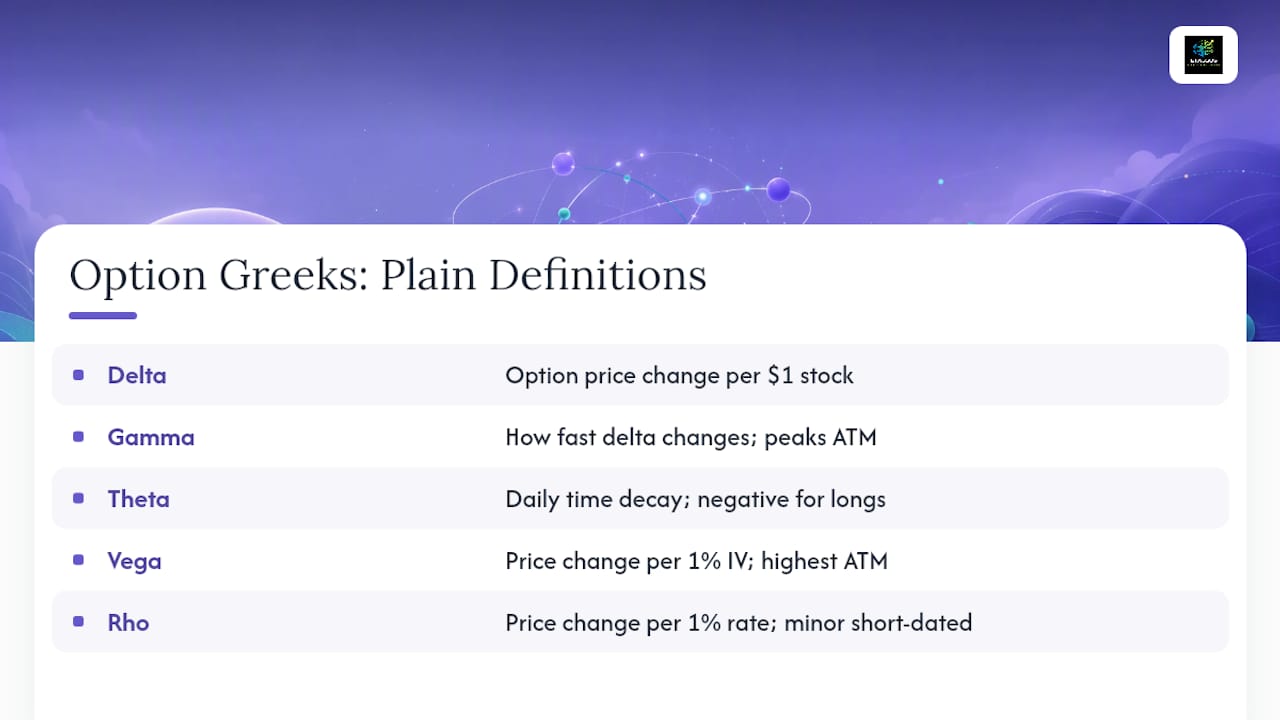
Delta measures how much an option's price moves for every $1 change in the underlying stock. Call delta ranges from 0 to positive 1, put delta ranges from negative 1 to 0, and at the money contracts typically sit near ±0.50.
Gamma measures how fast delta itself changes as the stock price moves. It peaks for at the money options and shrinks as a contract moves deep in or out of the money.
Theta measures how much value an option loses each day purely from time passing, assuming everything else stays constant. It runs negative for long positions and accelerates as expiration closes in.
Vega measures how much an option's price shifts for every one percentage point change in implied volatility. It is positive for both calls and puts and runs highest on at the money contracts with more time left until expiration.
Rho measures how much an option's price shifts for every one percentage point change in interest rates. It stays minor for short-dated trades and becomes more relevant on options expiring a year or more out.
Two more terms come up once you go past the basics: vanna measures how delta changes when implied volatility shifts, and vomma measures how vega itself changes as volatility moves. Both are second-order Greeks that matter mainly to market makers and traders running large, volatility-sensitive books, but knowing they exist helps explain why a position's risk profile can shift even when the stock price barely moves.
One more nuance worth flagging: American-style options, which can be exercised any time before expiration, carry slightly different Greek behavior near dividend dates and deep in the money strikes compared to European-style options, which can only be exercised at expiration. Most equity options traded in the US are American style, so this rarely changes your day-to-day analysis, but it explains occasional pricing quirks around dividend announcements.
A Practical Order for Learning the Greeks

Learn delta first. It is the most intuitive Greek and the one that maps most directly to a simple directional bet. Move to theta and vega next, since together they explain the core tension every option buyer and seller feels: paying for time versus getting paid for it. Save gamma for after those three click, because gamma only makes sense once you understand how delta behaves, and treat rho as a footnote until you are trading longer-dated contracts.
Paper trade with small size, rewind past scenarios to see how each Greek would have behaved, and score every trade you place, win or lose. The habit of reviewing outcomes against your own process, not just your profit and loss, is what separates traders who improve from traders who repeat the same mistake with a new ticker symbol.
— Anantha
Put Your Greek Checks Into a Repeatable Process
Knowing delta from gamma is only half the battle. What separates traders who apply that knowledge consistently from those who don't is having a process that forces the check every single time, not just when a trade feels risky. One platform builds such a process around a six-factor decision-scoring engine paired with an AI assistant that gives personalized feedback on trading patterns rather than generic signals or forecasts.
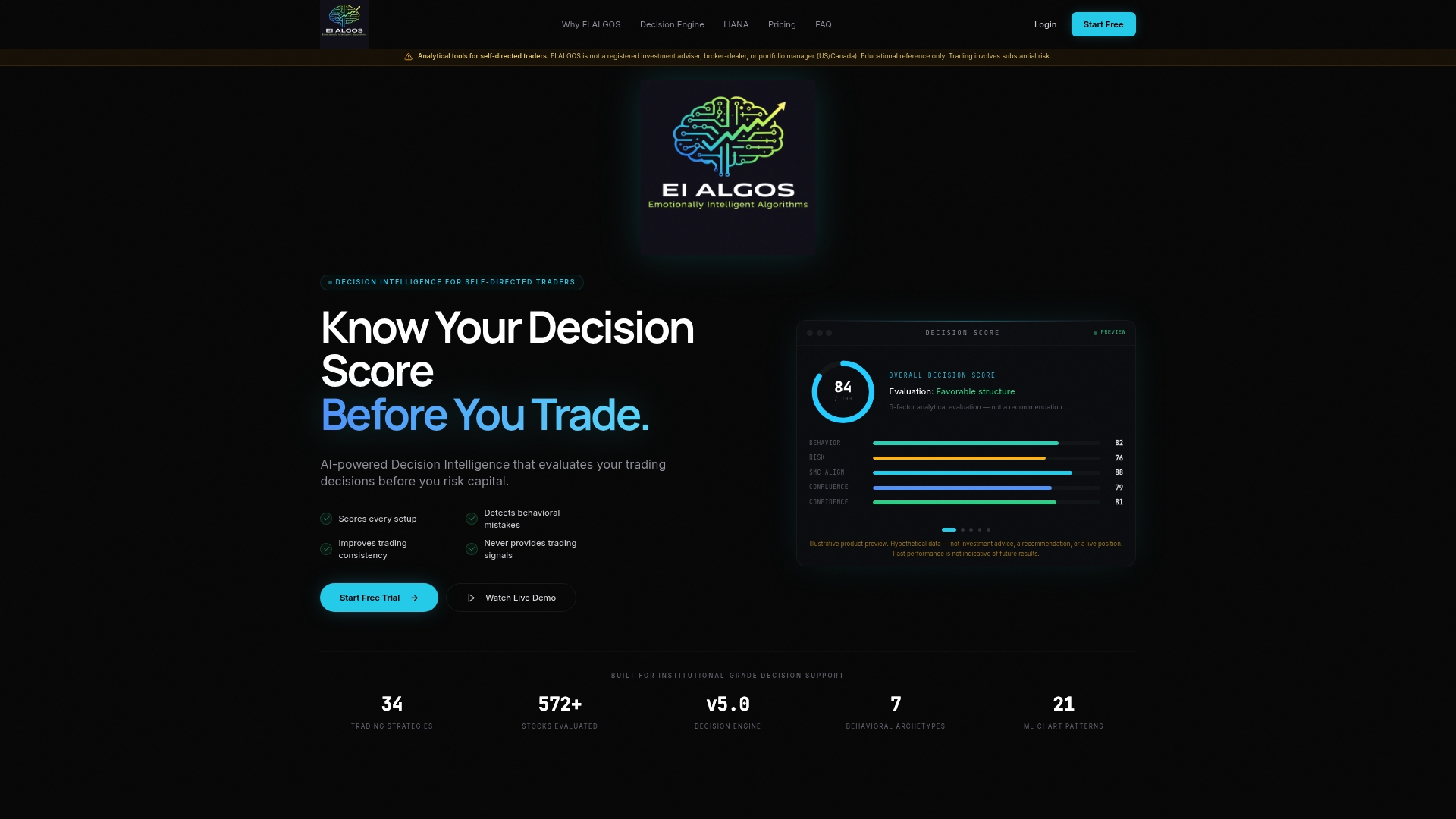
After you have your delta, theta, and vega numbers in hand, the platform lets you score the setup itself before you click submit, then review that score against the actual outcome afterward. Over time, that record shows you exactly which Greek checks you tend to skip under pressure and which ones you already handle well. If you want to see how the scoring model works in more detail, check your decision score before your next trade, or browse the Knowledge Hub for more on building the habit into your regular routine.
Sources
For deeper definitions and worked examples, consult the Options Industry Council's Greeks guide, Investopedia's Greeks primer, Optiver's explainer, and CME Group's education course.
This article is general information, not a substitute for advice from a qualified financial advisor. Consult a qualified financial professional about your own circumstances before acting on anything here.
FAQ
Why Do Most Options Traders Lose Money?
Most losses trace back to ignoring theta decay, oversizing positions relative to portfolio delta, and skipping a consistent pre-trade process rather than any single Greek being misunderstood. A structured review, like scoring a setup before entry, helps catch these habits before they compound.
What Are the Main Greeks in Options Trading?
The four most commonly discussed are delta, gamma, theta, and vega, though rho is considered a fifth Greek that matters mainly for longer-dated contracts. Together they measure sensitivity to price, the rate of that price sensitivity, time decay, and implied volatility.
What Is the 60/40 Rule for Options?
The 60/40 rule refers to a specific US tax treatment for certain broad-based index options, where 60% of gains are taxed at long-term capital gains rates and 40% at short-term rates regardless of how long the position was held. It is a tax rule rather than a Greek-related concept, and it applies only to qualifying index products, so confirm eligibility with a tax professional before relying on it.
How Are Greeks Used in an Options Strategy?
Traders use Greeks to identify which risk a strategy is actually betting on, such as theta collection in a covered call or vega exposure in a long straddle, then size the position so that risk matches their conviction and risk tolerance. Pairing that check with a decision-scoring process, like the one Eialgos offers, adds a behavioral layer on top of the numbers.
Are Options Greeks Accurate Predictors of Price?
No. Greeks are theoretical estimates from a pricing model, not guarantees, and they assume small, linear moves rather than large market shocks. Scenario analysis and risk graphs should always supplement raw Greek numbers before a trade goes live.