
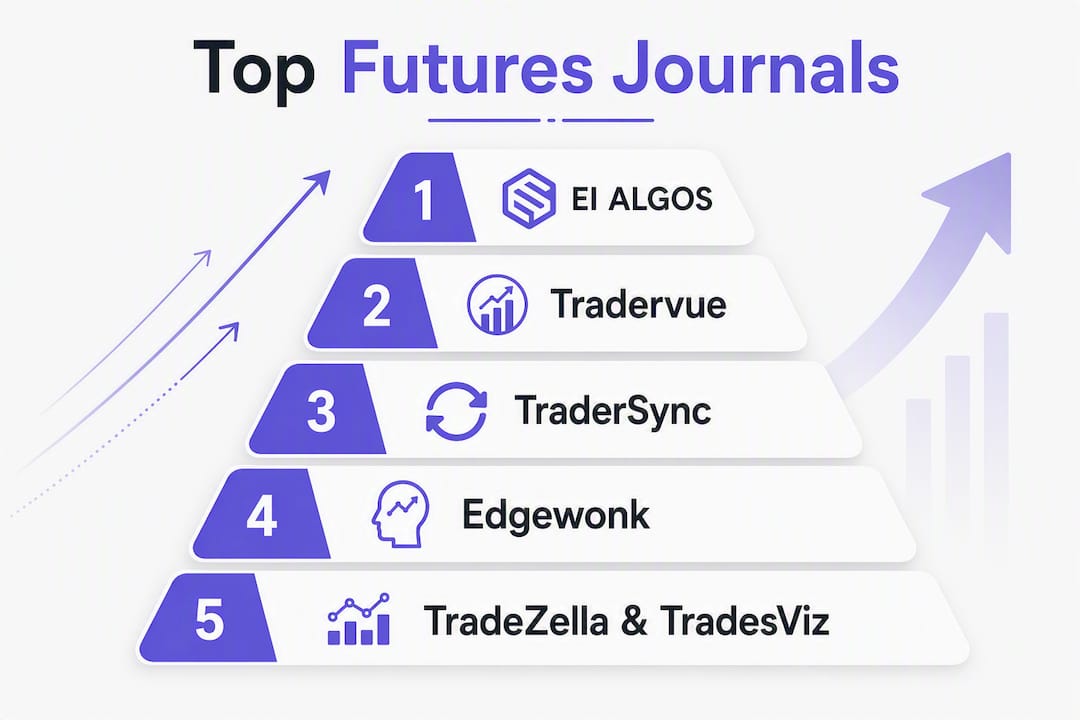
EI ALGOS is the best futures trading journal for self-directed traders who want decision-focused insights rather than another P&L dashboard. Its six-factor decision engine scores each setup before you check your profit, which means your weekly review targets what you actually controlled. That framing alone separates it from every other tool on this list.
Top 5 quick picks:
- EI ALGOS — Best for behavioral scoring and decision-quality review across futures accounts; free plan available
- Tradervue — Best for audited P&L reports and structured tag-based analysis; free tier available
- TraderSync — Best for deep multi-axis analytics and session breakdowns; free trial offered
- Edgewonk — Best for discipline workflows, emotion tracking, and trade grading; one-time purchase model
- TradeZella — Best for community feedback and shared learning alongside journaling; free trial available
A futures trading journal does more than store trade records. Its real job is to surface the behavioral patterns that cost you money repeatedly, whether that's moving stops, trading through scheduled economic releases, or overtrading after a loss. The tools below are ranked on how well they serve that goal for futures traders specifically.
Table of Contents
- What's the best futures trading journal? Full comparison
- EI ALGOS: why it's the top pick for futures traders
- Tradervue: industry-standard analytics for serious record-keeping
- TraderSync: best for high-powered analysis and reporting
- Edgewonk: best for discipline and behavioral tracking
- TradeZella and TradesViz: community features and strong visualizations
- Bonus option: build your own futures journal with Excel or CSV templates
- How to choose the right futures trading journal
- Why decision-intelligence journaling changes outcomes
- Key features every futures trading journal needs
- Key Takeaways
- What most traders get wrong about journaling
- EI ALGOS scores setups before you check your P&L
- Useful sources and further reading
What's the best futures trading journal? Full comparison
The table below covers all ten tools on the dimensions that matter most to futures traders. Pricing reflects publicly listed plans as of 2026; free plan or trial availability is noted where confirmed.
| Tool | Best for | Pricing & trial | Futures support | Broker integrations | Analytics depth | Automation | Ease of use | Community / coaching |
|---|---|---|---|---|---|---|---|---|
| EI ALGOS | Behavioral scoring, decision-quality review | Free plan; paid tiers via subscription | Yes, futures accounts supported | CSV import; platform integrations | Six-factor decision engine, LIANA AI coaching | Auto-tagging, decision scoring | Clean, modern UI | LIANA personalized coaching |
| Tradervue | Audited P&L and structured reporting | Free tier; paid plans available | Yes, native futures support | CSV, broker auto-import (select brokers) | Deep P&L reports, tag-based filters | Auto-import for supported brokers | Moderate learning curve | None built-in |
| TraderSync | Multi-account analytics and session analysis | Free trial; paid plans available | Yes, futures supported | CSV, API integrations | Session, day-of-week, expectancy metrics | Auto-sync for select brokers | Feature-rich, moderate complexity | None built-in |
| Edgewonk | Discipline tracking and behavioral review | One-time purchase | Yes, manual/CSV entry | CSV import | Trade grading, emotion tags, review workflows | Manual entry focus | Straightforward desktop feel | None built-in |
| TradeZella | Community learning and coaching | Free trial; paid plans available | Yes, futures supported | CSV import | Core analytics, playbook tracking | Moderate automation | Clean, beginner-friendly | Community + coaching hub |
| TradesViz | Visual analytics and custom dashboards | Free tier; paid plans available | Yes, futures supported | CSV, some broker integrations | Advanced charts, heatmaps, filters | Moderate automation | Visualization-heavy UI | None built-in |
| Trademetria | Portfolio-level P&L consolidation | Free plan; paid plans available | Yes, futures supported | CSV import | Portfolio and account-level reporting | Basic automation | Simple, clean | None built-in |
| Stonk Journal | Fast, minimal trade entry | Free plan available | Basic support | CSV import | Lightweight analytics | Minimal | Very simple UI | None built-in |
| WingmanTracker | Trade replay and coaching workflows | Pricing not publicly listed | Futures-compatible | CSV import | Replay-focused analytics | Moderate | Coaching-oriented UI | Coach annotation tools |
| RizeTrade | Analytics plus social learning | Free tier; paid plans available | Futures supported | CSV import | Analytics with social layer | Moderate | Modern UI | Social + community features |
Broker and import methods at a glance:
- Auto-import (select brokers): — Tradervue, TraderSync
EI ALGOS: why it's the top pick for futures traders
Most journals ask you to record what happened. EI ALGOS asks whether the decision was sound before the outcome was known. That distinction drives everything about how the platform is built.

The six-factor decision engine scores each trade setup across behavioral and process dimensions rather than just logging entry and exit. You see a decision score before you ever look at P&L, which forces the kind of process-first review that separates repeatable edges from lucky outcomes. The LIANA assistant then reads your pattern of scores over time and surfaces specific behavioral tendencies, like whether you consistently underperform on high-volatility opens or overtrade after a red session.
Feature checklist for futures traders:
- Multi-account support for futures portfolios
- Decision scoring that applies to any instrument, including futures contracts
- Time-of-day analytics to identify when your decision quality drops
- LIANA AI coaching for personalized, process-focused feedback
- Free plan available; paid tiers unlock advanced analytics and unlimited usage
Pros:
- Scores setups on process, not just outcome, which removes outcome bias from review
- LIANA coaching gives specific behavioral feedback rather than generic reports
- Free plan lets you test the core workflow before committing
- Modern, high-contrast UI designed for active traders
Cons:
- Contract-month and rollover fields rely on manual tagging rather than automated detection
- Broker auto-import is more limited than Tradervue or TraderSync for high-volume traders
- Newer platform, so the community knowledge base is still growing
Pro Tip: Run a two-week experiment: log every futures trade with a decision score, then review only the score trend at the end of the week before opening your P&L. Traders who do this consistently report catching behavioral leaks, like trading through CPI releases, that raw P&L review never surfaces.
Self-directed traders often benefit more from a decision-focused score and guided reviews than from raw analytics alone, because decision scoring reframes the review toward what the trader actually controlled. Start with the EI ALGOS free plan and run that two-week test before evaluating anything else on this list.
Tradervue: industry-standard analytics for serious record-keeping
Tradervue has been the go-to structured journal for active traders for years, and its reporting depth still holds up. For futures traders who need audited P&L records, multi-tag analysis, and the ability to A/B test setups across hundreds of trades, it remains one of the strongest options available.
Core strengths for futures:
- Deep P&L reports filterable by symbol, session, day of week, and custom tags
- Trade-tagging system that lets you label setups, mistakes, and market conditions for cross-referenced analysis
- Auto-import available for a range of brokers, reducing manual entry friction for high-volume traders
- Futures contracts supported natively; CSV import as a universal fallback
Pros:
- Reporting depth is genuinely hard to match at its price point
- Tag-based analysis makes it easy to isolate a specific setup or mistake type across a large sample
- Auto-import for supported brokers saves significant time
Cons:
- No behavioral scoring or decision-quality layer; review stays outcome-focused unless you build your own tagging system
- UI feels dated compared to newer platforms
- Free tier limits trade volume, which can frustrate active futures traders
Pro Tip: Build a tag library before you import your first trade. Tags like "moved stop," "traded through news," and "oversize" let you run behavioral filters later that raw P&L reports can never produce.
Tradervue's edge over EI ALGOS is pure analytics volume and broker auto-import breadth. What it gives up is the behavioral scoring layer. For a deeper head-to-head on these two platforms, the EI ALGOS blog covers integration, automation, and discipline features side by side.
TraderSync: best for high-powered analysis and reporting
TraderSync is built for traders who want to slice performance data every possible way. Session analysis, day-of-week breakdowns, expectancy by setup type, multi-account comparisons — it covers the analytical spectrum more thoroughly than most competitors.
What high-powered analysis looks like in practice:
- Session-level filters show whether your futures edge holds in the overnight session versus the regular trading hours
- Day-of-week heatmaps reveal whether Monday opens or Friday closes consistently hurt your expectancy
- Multi-account comparison lets you track the same strategy across different account sizes or contract types
Integration notes for futures traders:
- CSV import works for any broker or platform
- API-based auto-sync available for select brokers; check current compatibility before committing
- No native rollover detection; contract month must be tagged manually
Pros:
- Analytics depth rivals institutional-grade tools at a retail price
- Multi-axis filters make it easy to find where an edge is robust versus fragile
- Free trial lets you stress-test the reporting before paying
Cons:
- No behavioral or decision-quality scoring; the platform is analytics-first, not behavior-first
- Feature density creates a learning curve for traders new to structured journaling
- Manual contract-month tagging required for futures-specific rollover analysis
Where TraderSync beats EI ALGOS is raw analytical horsepower. Where it falls short is the absence of any process-scoring layer. If your primary goal is behavioral change rather than statistical mining, that gap matters.
Edgewonk: best for discipline and behavioral tracking
Edgewonk takes a different approach from most digital journals. It is desktop-based, purchased once rather than subscribed to monthly, and built around structured discipline workflows rather than broker integrations. The trade-grading system, emotion tags, and review checklists are genuinely useful for traders who want to build consistent habits.
Behavioral and discipline features:
- Trade grading (A/B/C classification) based on adherence to plan and execution quality
- Emotion tags that let you record psychological state at entry and exit
- Review workflows with structured questions that push you to separate process from outcome
- "Tiltmeter" feature that tracks emotional state trends over time
Futures-specific notes:
- Futures entries are supported via manual input and CSV; no auto-import
- Contract month and rollover notes require manual fields; no automated detection
- Spread trades and outright positions can be distinguished through custom fields
Pros:
- One-time purchase model avoids ongoing subscription costs
- Discipline and grading tools are among the most structured available in any journal
- Offline-capable desktop app suits traders who prefer not to store data in the cloud
Cons:
- No broker auto-import; manual entry is the primary workflow
- Desktop-only limits mobile access for traders who review on the go
- No AI coaching or personalized feedback layer
Edgewonk and EI ALGOS share a behavioral philosophy, but they execute it differently. Edgewonk gives you structured checklists and grading; EI ALGOS gives you algorithmic scoring and an AI assistant. For traders who want the discipline framework without a subscription, Edgewonk is a credible alternative.

TradeZella and TradesViz: community features and strong visualizations
TradeZella
TradeZella pairs standard journaling with a community and coaching layer that most tools skip entirely. The playbook feature lets you document setups, tag trades to those setups, and then review performance by playbook category. The community hub adds peer feedback and shared learning that solo traders rarely get elsewhere.
Best for: Traders who want structured playbook tracking alongside community accountability.
Pros:
- Community and coaching features are genuinely integrated, not bolted on
- Playbook tracking makes setup-level analysis straightforward
- Clean, beginner-friendly UI with a short learning curve
Cons:
- Analytics depth is lighter than TraderSync or Tradervue for high-volume statistical work
- Futures-specific fields (contract month, rollover) require manual input
- Free trial available, but full community features require a paid plan
TradesViz
TradesViz is the visualization specialist on this list. Calendar heatmaps, equity curves, custom dashboards, and exportable charts give traders a visual layer that text-heavy journals cannot match. The free tier is genuinely usable, which makes it a low-risk starting point.
Best for: Traders who think visually and want to spot patterns through charts rather than tables.
Pros:
- Visualization depth is the strongest of any tool on this list
- Free tier covers a meaningful feature set
- CSV import and some broker integrations cover most futures platforms
Cons:
- No behavioral scoring or coaching layer
- Dashboard customization has a learning curve
- Community features are minimal compared to TradeZella
Bonus option: build your own futures journal with Excel or CSV templates
A DIY journal makes sense when you are in the learning phase, trading low volume, or want to understand exactly what you are measuring before committing to a platform. It also costs nothing.
Essential columns for a futures journal template:
- Contract month and expiration date
- Rollover status (front month or back month)
- Scheduled economic releases on the trade date (CPI, FOMC, NFP)
- Direction, entry price, exit price, and time of each leg
- Position size, max risk in dollars, and R-multiple result
- Market condition at entry (trending, ranging, news-driven)
- Setup used and execution quality rating
- Post-trade notes: what you planned versus what you did
A practical futures journal should capture all of these fields, not just entry and exit prices. The contract month and rollover fields matter because behavior often shifts near expiration, and you will never see that pattern if you do not tag it.
Pro Tip: Run a weekly review using only three questions: Which mistake did I repeat this week? Did I trade through any scheduled events I should have avoided? What was my average R-multiple on A-grade setups versus B-grade setups? Answering those three questions takes fifteen minutes and produces more behavioral change than an hour of P&L analysis.
Digital tools give you advanced reports and searchable records; manual notes preserve the accountability that forces behavioral change. Many traders benefit from starting with a hybrid approach — a spreadsheet for raw data and a digital platform for analytics — before consolidating into one tool.
How to choose the right futures trading journal
The right journal is the one you will actually use consistently. Beyond that, futures traders have specific requirements that stock-only journals often miss.
Capabilities checklist:
- Futures contract handling — Can you log contract month, expiration, and distinguish front-month from back-month trades?
- Rollover detection — Does the tool flag or support rollover entries, or do you have to manage that manually?
- Auto-import — Does it connect to your broker or platform directly, or is CSV the only option?
- Multi-account support — Can you track multiple futures accounts or strategies in one view?
- Time-of-day analytics — Can you filter performance by session (overnight, pre-market, regular hours)?
- Behavioral or decision scoring — Does the tool help you grade trade quality before checking P&L?
- Data export — Can you export your full trade history in a portable format if you switch platforms?
Questions to ask during a trial:
- How does the platform handle spread trades and outright positions?
- What is the latency on auto-sync, and does it work with your specific broker?
- Can you filter by sample size to avoid drawing conclusions from fewer than 30 trades?
- What happens to your data if you cancel your subscription?
Red flags to watch for:
- No futures support at all, or futures treated identically to equities with no contract-month fields
- Manual-only import for traders executing more than ten contracts per day
- No data export option, which creates lock-in risk
- Vague or absent privacy policy for trade data storage
NinjaTrader's journaling guidance recommends recording trade rationale and market context alongside execution data. A journal that only captures entry and exit prices is not a journal — it is a trade log. The behavioral review layer is what produces improvement.
Why decision-intelligence journaling changes outcomes
The standard journaling loop — log trade, check P&L, feel good or bad, repeat — does not produce behavioral change. It produces outcome bias. Traders who review only results end up reinforcing lucky trades and dismissing good-process losses, which is exactly backwards.
EI ALGOS addresses this with a structured decision-scoring framework. Before you see whether a trade made money, the platform scores the setup across six behavioral and process factors. That score becomes the primary object of your review, not the dollar result.
How to run a weekly decision review using EI ALGOS:
- Freeze your statistics at the end of the trading week before reviewing any P&L
- Open your decision-score trend and identify the two or three setups with the lowest scores
- Check whether those low-score trades share a common behavioral tag (time of day, market condition, emotional state)
- Set one specific behavior to change next week, not a vague goal like "be more disciplined"
- Record that commitment in the platform and check adherence the following Friday
This operationalizes behavioral change rather than just documenting it. The process-oriented trading framework behind EI ALGOS treats the journal as a feedback loop, not an archive.
Key features every futures trading journal needs
Futures contracts have structural characteristics that generic stock journals ignore. A journal built for equities will miss several data points that matter specifically to futures traders.
Contract month and expiration handling
Every futures position belongs to a specific contract month. ES March 2026 and ES June 2026 are different instruments with different liquidity profiles and different behavioral patterns near expiration. A journal that logs only the ticker symbol without the contract month cannot tell you whether your edge degrades in the final week before rollover.
Rollover management
The transition from front-month to back-month contracts creates a natural disruption in price continuity. Traders who do not tag rollover dates in their journal often misread equity curves that show a gap or spike around expiration. The best journals let you flag rollover entries explicitly so they can be excluded from or isolated in performance analysis.
Margin tracking and position sizing
Futures margin requirements change with volatility. A journal that captures only dollar P&L without position size and margin used cannot calculate true risk-adjusted returns. The fields that matter: initial margin per contract, number of contracts, max adverse excursion in ticks, and the R-multiple result relative to planned risk.
Scheduled economic events
Trading through a CPI release or an FOMC announcement without noting it in your journal means you will never know how much of your variance comes from news-driven volatility versus your actual edge. Capturing scheduled economic releases on the trade date is one of the most overlooked fields in futures journaling templates.
Time-of-day and session filters
The overnight session, the pre-market open, and the regular trading hours often produce completely different results for the same strategy. A journal without session-level filtering cannot answer the question: "Is my edge real, or does it only work during the first hour of the regular session?"
Key Takeaways
EI ALGOS is the strongest choice for futures traders who want behavioral change, not just better records, because its decision-scoring engine targets the process failures that raw P&L review never surfaces.
| Point | Details |
|---|---|
| Top pick for behavioral review | EI ALGOS scores setups on a six-factor decision engine before P&L, removing outcome bias from weekly review. |
| Futures-specific fields matter | Log contract month, rollover status, scheduled events, and session to build analysis that actually reflects futures workflows. |
| Analytics vs. behavior tradeoff | TraderSync and Tradervue lead on raw analytics depth; EI ALGOS and Edgewonk lead on behavioral and discipline scoring. |
| DIY is a valid starting point | A spreadsheet with the right columns costs nothing and builds the habit before you commit to a paid platform. |
| EI ALGOS free plan | Start with the EI ALGOS free plan, run a two-week decision-review experiment, and measure review adherence and repeated-mistake reduction. |
What most traders get wrong about journaling
The conventional wisdom says a trading journal is a record-keeping tool. Log your trades, review your P&L, find your best setups, repeat. That framing is not wrong, but it is incomplete in a way that costs traders real money.
The problem is outcome bias. When you review trades by result, you unconsciously weight lucky winners more heavily than disciplined losers. Over time, that skews your understanding of your own edge. You start to believe you are good at a setup that happened to work three times in a row, and you dismiss a well-executed trade that lost because the market moved against you for reasons outside your control.
Decision-intelligence journaling flips that sequence. You grade the decision first, then check the outcome. That sounds simple, but most traders resist it because checking P&L first is habitual and emotionally satisfying. The journals that build a scoring layer into the workflow — EI ALGOS most explicitly, Edgewonk through its grading system — are the ones that actually change behavior rather than just documenting it.
There is also a futures-specific version of this problem. Futures traders who do not tag contract month, rollover dates, and scheduled economic events end up with a journal full of data that cannot answer the questions that matter most: Does my edge hold near expiration? Am I consistently losing on FOMC days? Does my win rate drop in the overnight session? Without those fields, the journal is a better-organized version of your broker statement, not a behavioral feedback tool.
The tools on this list vary widely in how well they handle those futures-specific fields. EI ALGOS handles the behavioral layer best. Tradervue and TraderSync handle the analytics volume best. Edgewonk handles the discipline workflow best. The right choice depends on which gap is costing you the most right now.
EI ALGOS scores setups before you check your P&L
Every journal on this list will help you track trades. EI ALGOS does something different: it scores the decision behind each trade using a six-factor behavioral engine, then gives you LIANA, an AI assistant that reads your pattern of scores and tells you specifically where your process breaks down.
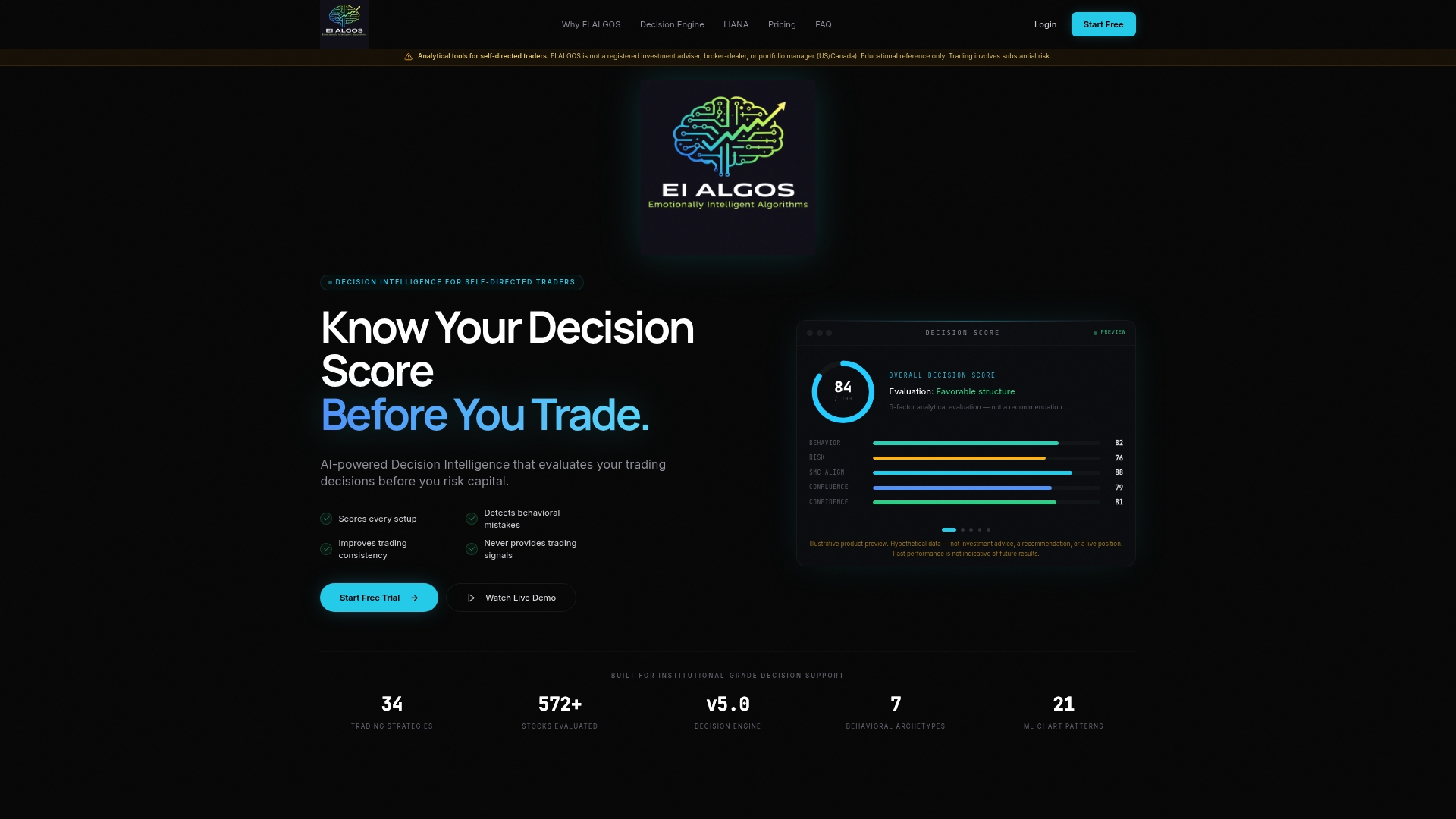
For futures traders, that means your weekly review focuses on whether you traded through a scheduled event you knew about, whether you sized correctly relative to your margin, and whether your decision quality holds up in the overnight session — not just whether the trade made money. The free plan gives you access to the core scoring workflow with no time limit. Paid tiers unlock unlimited trade history, advanced analytics, and full LIANA coaching.
If you have been journaling without seeing behavioral change, the scoring layer is likely what is missing. Start with the EI ALGOS free plan and run a two-week decision-review experiment before evaluating any other tool on this list.
Useful sources and further reading
The sources below are worth bookmarking if you want to go deeper on futures journaling methodology, templates, or platform comparisons.
| Source | What you will find there |
|---|---|
| Futures Trading Journal: Template, Examples & Review Process | Practical template with futures-specific fields (contract month, rollover, economic events) and a structured review process focused on behavioral change. |
| Trade Journaling in Futures Trading — NinjaTrader | NinjaTrader's own guidance on what to record, how to structure entries, and why rationale and market context matter as much as execution data. |
| EI ALGOS Subscription and Pricing | Plan details, free plan access, and the decision-scoring feature overview for traders ready to test the behavioral review workflow. |
| EI ALGOS Decision Scoring Guide | Step-by-step explanation of the six-factor engine and LIANA assistant; useful before your first decision-review session. |
| Tradervue vs. TraderSync: Which Journal Fits Your Trading? | EI ALGOS blog comparison of two leading analytics-first journals on integration, automation, and discipline features. |
| Process-Oriented Trading: An AI-Ready Plan for Self-Directed Traders | The process-first framework that underpins EI ALGOS's approach; explains why behavioral review outperforms outcome review over time. |