
For most self-directed traders who want behavioral scoring, decision-intelligence, and cost control, Eialgos is the strongest TradeZella alternative available. Its six-factor analytical engine scores each trade setup on psychological and behavioral factors before you execute, which no standard trading journal does.
Here is a practical shortlist to match your situation:
- Eialgos (recommended): Best for options traders and systematic traders who want automated decision scoring and behavioral error detection, not just trade logging.
- Mobile-first automated journals (e.g., TraderSync): Best for active traders who need a native mobile app and broad broker auto-sync across US brokers.
- Psychology-first customizable journals (e.g., Edgewonk): Best for traders who want deep psychology tagging, a one-time or lower annual cost, and offline control.
- DIY options (Notion, Excel/Google Sheets, manual journaling): Best for budget-conscious traders with low trade volume who are willing to build and maintain their own system.
Your immediate next step: sign up for the Eialgos free plan, run your first five trades through the decision score, and check whether the behavioral error flags match your actual trading mistakes. That single test tells you more than any feature comparison.
Table of Contents
- How do the best TradeZella alternatives compare side by side?
- How do these alternatives actually differ on features that matter?
- How to choose the right alternative during your free trial
- When does a DIY journal make sense, and when should you upgrade?
- Key Takeaways
- What actually separates a good journal from a useful one
- Eialgos gives you decision intelligence, not just trade logs
- Useful sources and further reading
How do the best TradeZella alternatives compare side by side?
The table below maps each category against the factors that most affect your daily workflow. Pricing reflects publicly available information; always verify current plans directly with each provider.
| Category | Best for | Pricing & trial | Analytics & reporting depth | AI coach / automated insights | Backtester / market replay | Broker integrations / auto-sync | Platform type | US availability |
|---|---|---|---|---|---|---|---|---|
| Eialgos | Options traders, behavior-focused systematic traders | Free plan; paid tiers (monthly/annual) | Six-factor decision scoring, behavioral error detection, options analysis | LIANA assistant: personalized decision feedback | Strategy pattern detection | Broker sync + CSV import | Web SaaS | Yes — US brokers supported |
| Mobile-first automated journal | Active traders needing mobile access | Free tier; monthly subscription option | Trade metrics, performance stats, risk reports | Basic automated insights | Limited or none | Broad broker support, native mobile app | Mobile + web SaaS | Yes — wide US broker list |
| Psychology-first journal | Traders focused on psychology tagging | Annual one-time or annual subscription option | Deep psychology metrics, custom tags | Rule-based coaching prompts | Backtesting module | CSV import; limited auto-sync | Desktop/web | Yes |
| DIY (Notion/Sheets/manual) | Budget traders, low trade volume | Free (Notion/Sheets) or near-zero | Raw metrics only; no automation | None | None | Manual CSV only | Local files / templates | Yes |
| TradeZella | Standard US broker traders | $39/month | Trade and P&L metrics, charts, reporting | No AI, but standard statistics | None | Broker auto-sync (limited list) | Web SaaS | Yes |
Third-party reviewers note that TradeZella has a $39/month price point that pushes cost-sensitive traders toward alternatives with free tiers or annual pricing. Eialgos offers a free plan, making it accessible without an upfront commitment.
Pro Tip: Before comparing pricing, confirm whether the free tier of any platform lets you test the specific feature you care about most. Some platforms gate broker auto-sync or AI insights behind paid plans, so a "free trial" may not reveal the feature's actual quality.
How do these alternatives actually differ on features that matter?
Analytics depth: signals vs. decision intelligence vs. raw metrics
Standard trading journals report what happened: win rate, average R, drawdown. Eialgos reports why it happened by scoring each setup across six behavioral and psychological factors before the trade closes. That distinction matters for traders who already know their stats but keep repeating the same mistakes.
Mobile-first automated journals deliver solid performance dashboards and risk reports. They answer "how did I do?" well. Psychology-first journals add custom tagging for emotional states and rule adherence, which is useful but still retrospective. DIY spreadsheets give you raw numbers and nothing else unless you build the formulas yourself.
AI coaching: personalized vs. rule-based vs. absent
Eialgos's LIANA assistant analyzes your decision patterns over time and surfaces personalized feedback tied to your specific behavioral errors, not generic tips. That is a different category from rule-based coaching prompts, which fire when you break a predefined rule you set yourself. Both are useful; they solve different problems. DIY options offer no AI layer at all.
Backtesting and market replay
Psychology-first journals typically include a backtesting module for reviewing historical setups. Mobile-first platforms vary: some offer session replay, others do not. Eialgos focuses on live trade management and strategy pattern detection rather than tick-data replay, which suits traders who want real-time decision support over historical simulation. If tick-level replay is your primary need, a dedicated backtesting platform is a better fit than any journal.
Broker auto-sync and data portability
Mobile-first journals lead on broker integration counts, with native connections to a wide range of US brokers. Psychology-first journals typically rely on CSV import. Eialgos supports broker sync and CSV import. The practical risk with any auto-sync tool: test it with your specific broker during the trial, because integration quality varies by broker even within the same platform. Always confirm your data exports cleanly in a standard CSV format before committing to any platform.
How to choose the right alternative during your free trial
Run this checklist on every platform you trial before migrating historical data.
- Import a real trade batch. Upload at least 20 trades via CSV or broker sync. Check that entry price, exit price, and P&L match your broker statement exactly.
- Run a reporting query. Pull a performance report filtered by setup type or session. If the filter options are too limited for your strategy, that is a workflow problem you will hit daily.
- Test auto-sync. If the platform claims broker auto-sync, execute one live trade and confirm it appears without manual intervention within the stated sync window.
- Trigger an AI insight. Ask the AI coach a specific question about a losing trade. A useful response names a behavioral pattern; a weak response gives generic advice like "review your risk management."
- Check data export. Download your trades as a CSV before your trial ends. If the platform restricts export or requires a paid plan to access your own data, that is a red flag.
Red flags to abort a switch:
- Your broker is not supported and CSV import requires manual reformatting every session.
- Pricing tiers are not published; you only see them after entering payment details.
- Data export is locked behind a paid tier.
Pro Tip: Run a live trading week on the free plan before migrating any historical data. Historical imports take time and create switching costs. Validate the platform on fresh trades first, then decide whether the migration effort is worth it.
When does a DIY journal make sense, and when should you upgrade?
DIY journals built in Notion, Excel, or Google Sheets have a real place in a trader's toolkit, but that place is narrower than most beginners assume.
A Notion template or Google Sheet works well when you trade fewer than 20 times per month, you want full control over what you track, and you are willing to spend 30–60 minutes per week on manual data entry and formula maintenance. The cost is effectively zero, and the customization ceiling is high. Traders in community forums frequently share CSV-ready spreadsheet templates that cover the basics: entry, exit, R-multiple, setup tag, and notes.
The upgrade threshold arrives when any of these conditions appear:
- You trade more than 20–30 times per month and manual entry is consuming meaningful time.
- You want automated performance reports without building pivot tables.
- You need behavioral or psychological scoring that a spreadsheet cannot generate.
- You want AI-driven feedback on your decision patterns.
At that point, a hosted platform pays for itself in time saved and insight quality. The Reddit community discussion around TradeZella alternatives shows that pricing sensitivity is the primary driver for staying DIY, not feature preference. If cost is the only barrier, Eialgos's free plan removes it.
Key Takeaways
Eialgos is the strongest TradeZella alternative for traders who want behavioral scoring and decision intelligence, not just trade logging.
| Point | Details |
|---|---|
| Recommended pick | Eialgos scores each setup on six behavioral factors and flags decision errors, which standard journals do not do. |
| When to choose a hosted alternative | Pick a mobile-first or psychology-first journal when broker auto-sync breadth or offline control matters more than behavioral scoring. |
| When DIY makes sense | Notion or Google Sheets works for traders under 20–30 trades per month who want zero cost and full customization. |
| Trial before migrating | Run a live week on any free plan before importing historical data to validate fit without switching costs. |
| Eialgos free plan | Eialgos offers a free plan, so you can test decision scoring and LIANA feedback before committing to a paid tier. |
What actually separates a good journal from a useful one
Most traders evaluate a journal by its feature list. The more useful test is whether the platform changes a decision you would have made badly.
That is the standard Eialgos is built to meet. A journal that logs trades accurately but never surfaces a behavioral pattern you did not already know is a spreadsheet with a better interface. The platforms worth paying for are the ones that show you something about your own process that you could not see on your own.
The practical implication: during any trial, do not just import trades and run reports. Make a live trade, note your reasoning, then check whether the platform's feedback matches or challenges your self-assessment. That gap, or the absence of one, is the real signal.
Eialgos gives you decision intelligence, not just trade logs
Most trading journals tell you what happened. Eialgos tells you why, scoring each setup through a six-factor behavioral engine and surfacing the decision errors that cost you consistency. For options traders and systematic traders who have already optimized their technical process, that behavioral layer is where the next improvement comes from.
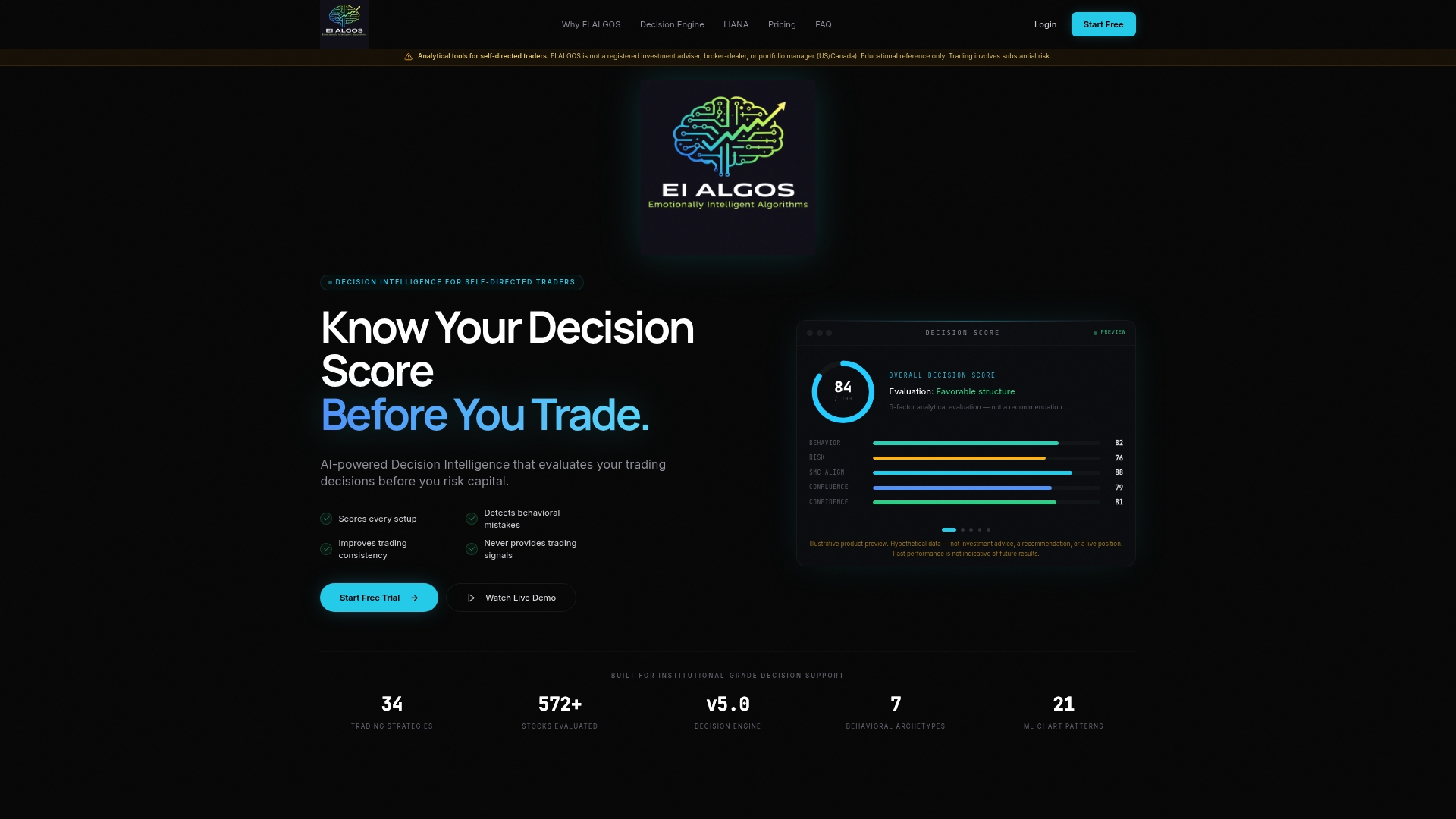
The free plan is live now. You do not need to migrate historical data or commit to a subscription to see whether the decision score reflects your actual trading behavior. Sign up at Eialgos and run your first decision score today. If you want to understand the full scoring methodology before trialing, the Eialgos guide walks through the six-factor engine and LIANA in detail. For AI-driven trading tools that complement your journal workflow, TradeAiFi is worth reviewing as a partner resource.
Useful sources and further reading
- EI ALGOS — Know Your Decision Score Before You Trade
- Tradervue vs TraderSync: Which Journal Fits Your Trading?
- [Tradezella review and alternatives: Tradezella Review &...] (https://fundedxprop.com/examiner/tradezella-review-alternatives-prop-traders-2026)
- Best TradeZella Alternatives for 2026
- Good trading journal besides Tradezella? : r/Daytrading
- discord.gg