
Personalized trading feedback, in the decision-intelligence sense, is a scored, behavior-specific analysis of your trade setups and execution patterns, produced by a six-factor analytical engine and delivered through an AI assistant (LIANA), with zero trade signals involved. It tells you how you decided, not what to trade next.
Here is what a complete feedback system delivers:
- Decision score: a per-trade rating across six behavioral and process factors
- Behavioral signals: flags for overtrading, pre-event concentration, holding duration bias, and overconfidence patterns
- Action rules: one prioritized replacement rule per identified leak, validated over a one-week measurement window
Start this week: open a free account on Eialgos, run your last ten trades through the decision-score engine, and let LIANA name your first behavioral leak.
Key Takeaways
Process-focused personalized trading feedback, scored by a six-factor engine and delivered through an AI assistant, is the most direct way to identify and fix the behavioral leaks that cause consistent options losses.
| Point | Details |
|---|---|
| Define the feedback correctly | Personalized trading feedback scores your decision process, not your P&L, using behavioral signals and a six-factor engine. |
| Event-driven losses are documented | Retail option traders lose an estimated 5–9% around average earnings events and 10–14% around high-attention announcements (MIT/IDE). |
| One rule at a time | Write one replacement rule per identified leak, measure binary compliance for one week, then move to the next behavior. |
| Process goals outperform outcome goals | Compliance scores tied to controllable actions produce stronger performance stability over 30–90 day measurement windows. |
| Eialgos + LIANA | Eialgos scores setups with a six-factor engine and LIANA delivers prioritized rule suggestions; start with the free tier at eialgosinc.com. |
Table of Contents
- What is personalized trading feedback, and why do options traders need it?
- How does a personalized feedback platform generate your insights?
- Which metrics should your trader feedback system actually track?
- How do you turn feedback into real process changes?
- What does the research say about event-driven losses and process improvement?
- How do you evaluate a personalized feedback provider?
- What should you expect for pricing, trials, and data security?
- A retail options trader uses feedback to avoid a pre-earnings loss
- The case for process-first decision intelligence
- Eialgos gives you a decision score before you trade
- Sources
What is personalized trading feedback, and why do options traders need it?
Process-focused feedback scores each trade setup against a defined set of behavioral criteria, tracks whether you followed your own rules, and diagnoses the specific dispositional leaks (overtrading, disposition effect, attention-driven event trading) that erode returns over time. It is not a P&L report. It is a behavioral audit.
The behavioral failure modes it targets are well-documented:
- Overtrading: excessive turnover driven by boredom or overconfidence, not edge
- Disposition effect: holding losers too long and cutting winners too early
- Attention-driven event trading: buying options ahead of earnings because the stock is in the news, not because the setup is sound
- Overconfidence: perceived information advantage that does not translate to better pre-fee returns, as NBER working paper w26911 confirms through combined survey and transaction-record analysis
Statistic callout: Research from MIT's IDE finds that retail option traders lose an estimated 5–9% of their option investments around earnings announcements on average, and 10–14% for high expected-announcement-value events, after accounting for transaction costs.
Focusing on process rather than P&L builds psychological resilience. When you measure what you control (rule adherence, position sizing, entry timing), a losing week does not feel like evidence that you are a bad trader; it becomes data.
How does a personalized feedback platform generate your insights?
The data inputs a quality system needs are specific. Trades, timestamps, position sizing, holding duration, event exposures (earnings dates, economic calendar), realized P&L, estimated bid-ask costs, and self-reported pre- and post-trade notes all feed the engine.
Eialgos's six-factor analytical engine processes those inputs across these dimensions:
- Behavioral signals: flags for overtrading frequency, disposition-effect patterns, and attention-driven entries
- Decision score: a per-setup composite rating reflecting process quality, not outcome
- Execution quality: entry timing relative to your stated rules and price levels
- Event concentration: position size and option exposure ahead of earnings or scheduled announcements
- Risk sizing: position size relative to account and volatility (ATR-based or percentage-of-equity)
- Transaction-cost estimate: bid-ask impact and commission drag per trade
The LIANA assistant then converts those scores into plain-language pattern summaries, surfaces the highest-priority rule suggestion, and prompts you with follow-up questions to validate whether the pattern is real or a one-off.
The data flow is straightforward: capture → score → insight → rule suggestion → track compliance.
When evaluating any provider, ask these questions upfront:
- What are the exact definitions of each scoring factor?
- Which brokers can you connect via OAuth read-only access?
- How long is trade data retained, and can you export it?
- Is the methodology documented and auditable?
Which metrics should your trader feedback system actually track?
High-value signals separate a useful feedback system from a dashboard that just mirrors your brokerage statement. The metrics below are the ones that reveal behavioral leaks, not just outcomes.
| Metric | What it reveals | Action to take |
|---|---|---|
| Decision score (per trade) | Overall process quality for that setup | Review any trade scoring below your baseline threshold before sizing up |
| Setup adherence rate | How often you follow your own entry rules | Set a weekly minimum (e.g., 80%) and treat misses as data, not failures |
| Entry timing bias | Tendency to chase entries after the move starts | Add a "wait for confirmation" rule to your pre-trade checklist |
| Pre-event concentration | Option exposure ahead of earnings or news | Cap total notional in any single event window at a fixed percentage |
| Holding duration after adverse move | Disposition effect in real time | Write an explicit exit rule: "If price moves X% against me, I exit" |
| Turnover rate | Overtrading frequency | Set a maximum trade count per week and track compliance daily |
| Estimated transaction costs | Bid-ask drag and commission leakage | Target wide-spread options only when edge clearly justifies the cost |
| MAE/MFE ratio | Whether you are exiting too early or too late | Use MAE/MFE data to calibrate stop-loss and profit-target levels |
| Post-event realized return | Sensitivity of returns to earnings outcomes | Compare pre-event vs. post-event P&L to isolate event-driven losses |
Attention-driven trading deserves a specific flag. Research on availability heuristics links recent news, social media, and short-form video to increased speculative activity in options. A quality feedback system should detect when your pre-event concentration spikes in the same week that media coverage of a stock surges, because that correlation is a behavioral signal, not a coincidence.
Pro Tip: Track your decision score and your P&L in parallel for 30 days. If your score is high but P&L is negative, the system may need adjustment. If your score is low and P&L is also negative, execution is the problem, and feedback is exactly the right fix.
How do you turn feedback into real process changes?
Structured feedback loops consistently accelerate behavioral change. The protocol below converts a raw score into a durable habit.
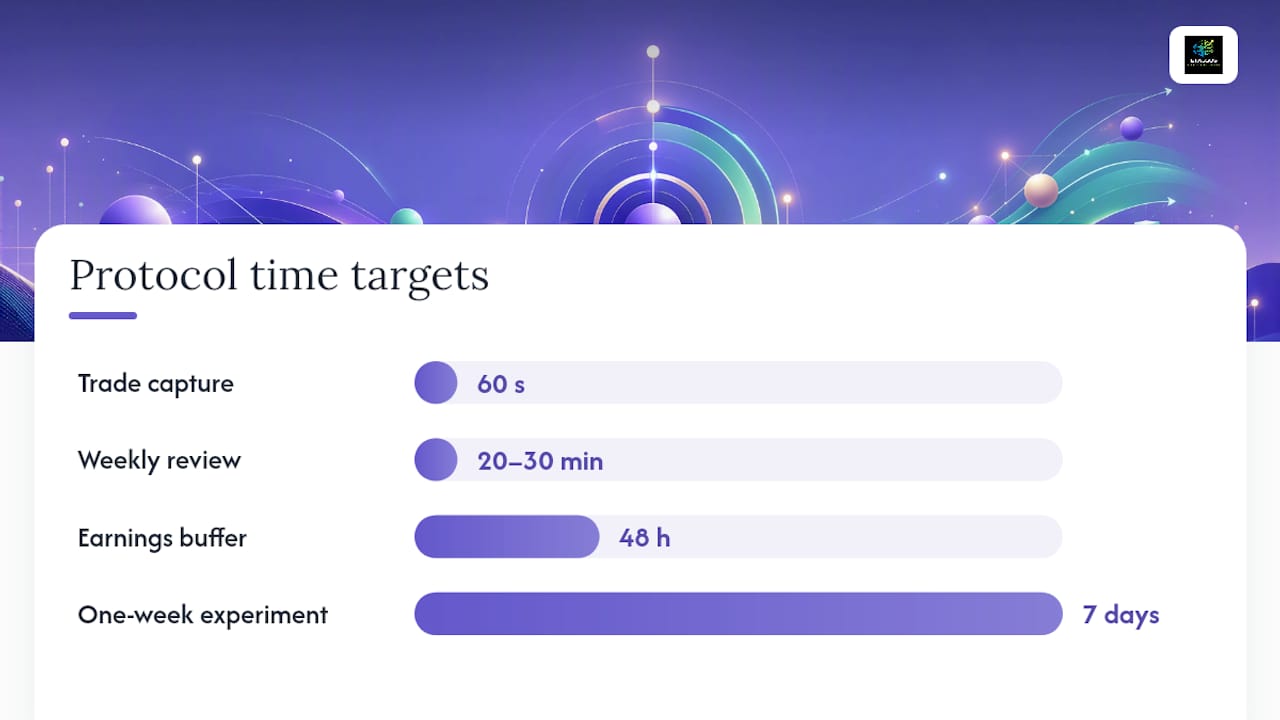
- Capture every trade within 60 seconds of closing it: entry reason, exit reason, emotional state, and rule adherence (yes/no).
- Weekly review (20–30 minutes): pull your decision scores, sort by lowest, and identify the one behavior that appears most often.
- Name the leak: write it in one sentence. "I buy options the day before earnings when the stock is trending on social media."
- Write one replacement rule: "If an earnings announcement is within 48 hours, I reduce position size by 50% unless my decision score is above my baseline."
- Run a one-week experiment: apply the rule to every qualifying trade. Score compliance as binary (followed/not followed) per trade.
- Measure compliance: at the end of the week, calculate your compliance rate. Process goals tied to controllable actions produce stronger performance and psychological benefits than outcome targets.
- Repeat: once compliance hits 80%+ for two consecutive weeks, move to the next leak.
A simple if-then rule template: "If [trigger condition], then [specific action], and I will measure compliance for seven trading days."
Pro Tip: Change one rule at a time. Traders who try to fix three behaviors simultaneously rarely fix any of them. One rule, one week, binary compliance score.
What does the research say about event-driven losses and process improvement?
The evidence on retail option losses is specific and sobering. The MIT/IDE study estimates roughly $3 billion lost in its sample window, with per-trader losses of 5–9% around average earnings events and 10–14% around high-attention announcements. A higher expected announcement value coincides with a substantial increase in pre-announcement news coverage, which feeds the attention loop directly.
Statistic callout: Retail option traders lose an estimated 10–14% of their option investment around high expected-announcement-value earnings events after transaction costs, per the MIT/IDE study.
The NBER working paper adds a behavioral layer: traders who self-report a perceived information advantage do not produce better pre-fee returns, yet they trade more. That is overconfidence in measurable form, and it is exactly what a decision score can surface.
Expected outcomes from applying process feedback consistently include:
- Reduced pre-event option concentration as the feedback loop makes the pattern visible
- Lower transaction-cost leakage as bid-ask awareness improves entry selectivity
- Improved rule adherence rates, which research on process goals links to stronger performance stability over 30–90 day windows
How do you evaluate a personalized feedback provider?
Use this checklist before committing to any platform:
- Methodology transparency: can the provider explain each scoring factor in plain language?
- Broker integrations: does it connect to your broker via read-only OAuth (no trading permissions)?
- Sample outputs: does the demo show a real decision score, a named behavioral leak, and a specific rule suggestion?
- Trial access: is there a free tier or a no-credit-card trial long enough to complete one full weekly review cycle?
- Data privacy: where is your trade data stored, how long is it retained, and can you delete it on request?
- Pricing clarity: are tier limits (trade count, feature access) stated upfront?
Eialgos meets that bar. The six-factor engine is documented, and LIANA's rule suggestions are tied directly to your scored trade history, not generic advice. For options traders specifically, the event-concentration flag and the transaction-cost estimate are the two features that address the largest documented loss sources. You can review the full platform capabilities and subscription tiers before entering a credit card.
For traders who also want to pair process feedback with execution strategy, options strategies for volatile markets offers practical guidance on managing event risk at the strategy level.
What should you expect for pricing, trials, and data security?
Feedback platforms in the U.S. market typically follow a tiered SaaS model:
- Free tier: limited trade history, basic decision score, no LIANA prompts. Enough to verify the scoring logic before upgrading.
- Monthly subscription: full feature access, unlimited trade scoring, LIANA assistant, weekly review reports, and broker integration.
- Annual plan: same features at a lower per-month cost, typically with priority support.
During a free trial, test these three things specifically: does the live decision score update after each trade? Does the weekly report name a specific behavioral leak (not a generic tip)? Does LIANA offer a rule suggestion you can implement immediately?
On data security, ask every provider these questions before connecting your broker:
- Is the broker connection read-only OAuth (no order-placement permissions)?
- Is trade data encrypted at rest and in transit?
- Can you export your full trade history and delete your account on request?
- Is the platform compliant with U.S. data-handling standards?
Eialgos uses read-only broker connections, meaning the platform can read your trade history but cannot place, modify, or cancel orders.
A retail options trader uses feedback to avoid a pre-earnings loss
Here is how the feedback loop works in practice, compressed into one earnings cycle.
- Capture: A trader connects their broker account and imports 60 days of options trades. The decision-score engine flags a pattern: position size in the week before earnings is consistently 2–3x the trader's normal size.
- Flag: LIANA surfaces the pre-event concentration signal and links it to the trader's three largest single-week losses, all of which occurred in earnings weeks.
- Rule: The trader writes one replacement rule: "Cap total options notional in any earnings week at 1% of account equity per position."
- Test: Over the next two earnings cycles, the trader applies the rule. Compliance score: 8 of 10 qualifying trades followed the rule.
- Result: The two non-compliant trades both produced losses above the trader's average. The six compliant trades produced mixed results, but none exceeded the trader's maximum acceptable loss threshold.
The lesson is not that the rule guaranteed profits. It is that the rule made the loss distribution manageable and gave the trader a structured feedback loop to validate over the next cycle.
For traders who want to automate rule enforcement after validating a rule change, QuantGenie offers no-code algorithm building as a next step.
The case for process-first decision intelligence
Most traders track P&L obsessively and their process almost never. That imbalance is the core problem. A losing week feels like evidence of a bad strategy when it is often evidence of a broken execution habit, and those two diagnoses require completely different responses.
The six-factor engine in Eialgos and the LIANA assistant are built to function as a process coach, not a signal generator. The distinction matters because a signal generator removes your agency. A process coach builds it. You still make every decision. The platform shows you the behavioral pattern behind those decisions so you can change the ones that cost you.
One realistic limitation: feedback improves behavior, and better behavior improves the probability of good outcomes over a large sample. It does not guarantee profits on any individual trade or week. Traders who expect a decision score to replace edge will be disappointed. Traders who use it to measure and improve their execution will find it one of the most practical tools in their process.
For a deeper look at how to build a process-oriented trading plan, the Eialgos blog covers the full framework.
Eialgos gives you a decision score before you trade
The single sharpest contrast between Eialgos and a generic trading journal or a signal service is this: Eialgos scores your decision process before the outcome is known, so you can measure whether you traded well regardless of whether you made money.
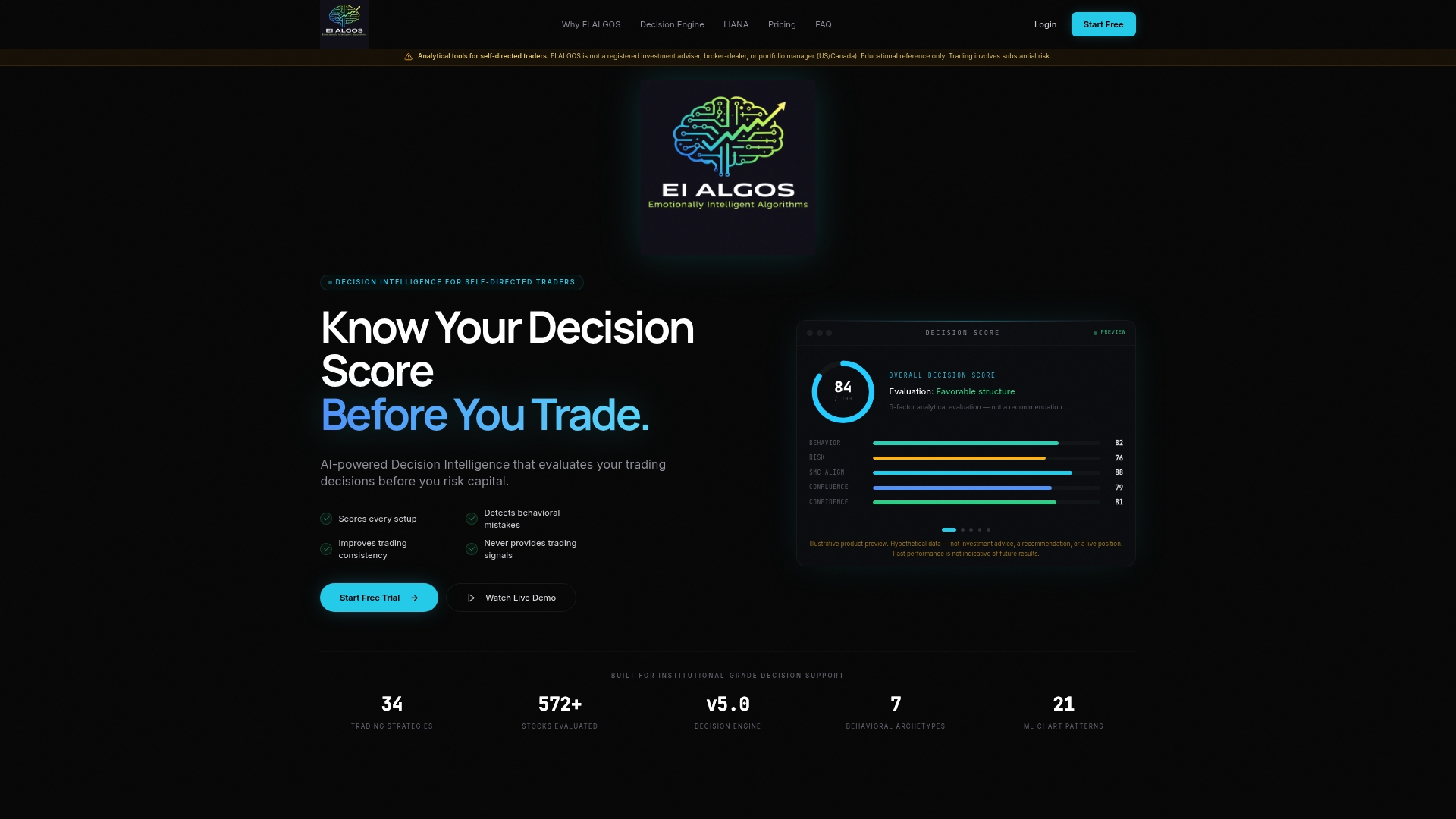
Start with the free tier at Eialgosinc. Connect your broker via read-only OAuth, run your last 30 trades through the engine, and let LIANA name one behavioral leak this week. The subscription page shows every tier and what each unlocks. No long-term contract is required to start, and the free tier gives you enough to verify the scoring logic before upgrading.
Sources
- Losing is Optional: Retail Option Trading and Expected Announcement
- NBER working paper w26911
- 4 Feedback Loops for Better Trading Results | For Traders
- Process Goals vs. Outcome Goals: How Pro Traders Measure Success | DayTradingToolkit
- Journal of Applied Business and Economics (availability heuristics study)
This article is general information, not a substitute for advice from a qualified financial advisor. Consult a qualified financial professional about your own circumstances before acting on anything here.