
Yes: AI that recognizes patterns in your own trading decisions can materially improve discipline and consistency. It does this by scoring your setups and flagging the behavioral errors you repeat, not by predicting where the market goes next. This article is strictly about decision-pattern AI, the kind that studies how you trade, not chart-pattern AI that studies what the market does. Read on and you'll get:
- A working definition of behavioral decision intelligence
- The exact data fields and metrics to track
- A step-by-step scoring workflow
- A four-week implementation checklist
Key Takeaways
AI pattern recognition trading improves discipline by scoring your decision process, not by predicting the market, and it requires consistent, honest input data to work.
| Point | Details |
|---|---|
| Scope matters | This is decision-pattern AI, not price-pattern AI; it scores your process, not the market. |
| Data quality drives results | Capture rationale, timestamps, and plan deviations for every trade, or the model has nothing useful to score. |
| Weekly review is non-negotiable | Track decision score, plan adherence, and abandoned-versus-executed low-score trades every week. |
| Explainability checks catch drift | Sample flagged trades weekly and compare AI reasoning to your own before adjusting thresholds. |
| Eialgos maps directly to this workflow | Its six-factor engine and LIANA assistant handle the scoring and feedback steps described throughout this guide. |
This article is general information, not a substitute for advice from a qualified financial advisor. Consult a qualified financial professional about your own circumstances before acting on anything here.
Table of Contents
- What Is AI Pattern Recognition Trading in This Context?
- What This AI Actually Helps You With (and Where It Stops)
- What Data and Metrics Do You Need to Feed the Model?
- How Do You Score and Act on Every Trade?
- How Do You Know the AI Is Improving Your Decisions?
- What's the Four-Week Checklist to Get Started?
- Why Process-First Traders Win With Behavioral AI
- How Eialgos Puts This Workflow Into Practice
- Sources
What Is AI Pattern Recognition Trading in This Context?
Here, "AI pattern recognition trading" means software that studies your trade history, your pre-trade notes, and your timing habits, then flags the psychological patterns that hurt your results. It has nothing to do with software that scans candlestick formations to call the next breakout. Those are two different products solving two different problems, and confusing them wastes your time.
Eialgos built its platform around this distinction. Its six-factor analytical engine scores each trade setup on the behavioral and process dimensions behind the decision, not the price action around it. The LIANA assistant then turns those scores into plain-language feedback, pointing out which biases showed up and when.
A few proof points worth knowing before you trust any system with your trade log:
- The six-factor engine evaluates setups across process dimensions rather than issuing buy/sell calls.
- LIANA delivers personalized, ongoing feedback instead of one-time reports.
- Eialgos maintains a Knowledge Hub with templates for structuring this kind of self-review.
- This guide is written by Anantha, drawing on published behavioral finance research alongside practitioner workflows.
What This AI Actually Helps You With (and Where It Stops)
Behavioral AI earns its keep in a handful of specific ways. It catches biases you can't see in real time, because loss aversion and overconfidence tend to distort judgment exactly when the stakes are highest. It also forces pre-commitment: you write your rationale before the trade, which makes it harder to rationalize an impulsive entry after the fact.
- Bias detection across recurring patterns like revenge trading or size creep.
- Rule enforcement by comparing your stated plan against your actual execution.
- Consistent journaling, since the system requires structured input every time.
- Growth tracking over weeks and months, not just single trades.
What it won't do: predict the next move in your ticker, guarantee profits, or fix a trader who inputs garbage data. It also needs periodic recalibration; your risk tolerance and instruments change, and static thresholds go stale.
A common flag looks like this: you enter a position ten minutes before your planned time, size larger than usual, on a setup you didn't pre-log. That's a textbook FOMO pattern, and it's exactly the kind of thing engagement-driven trading apps can quietly encourage, according to the FCA's research on digital engagement practices.

Pro Tip: Log the trades you almost took but didn't. Skipped setups reveal your discipline wins just as clearly as executed ones reveal your slips.
What Data and Metrics Do You Need to Feed the Model?
Garbage in, garbage out applies harder to behavioral AI than almost any other trading tool. The model can only score what you actually record.
Start with the essential trade fields: timestamp, instrument, direction, size, entry and exit price, your pre-trade rationale, your planned stop and target, your actual stop and target, and any deviation flags between plan and execution.
Layer behavioral signals on top of that:
- Journaling sentiment (confident, rushed, uncertain, tilted)
- Reaction time between signal and order
- Intraday noise exposure (how many charts or alerts you checked before entering)
- Plan deviations (stop moved, size changed, exit ignored)
- Frequency of impulsive entries per week
From these raw inputs, a decision engine derives the metrics that matter: a composite decision score, your risk-reward ratio, your win-loss holding time ratio, and your plan adherence rate. Large-scale analysis of trading logs shows these specific ratios reliably separate winning traders from losing ones, which is exactly why they belong in your model's feature set.
How Do You Score and Act on Every Trade?
The workflow only works if you run it the same way every time. Five steps, repeated until it's muscle memory.
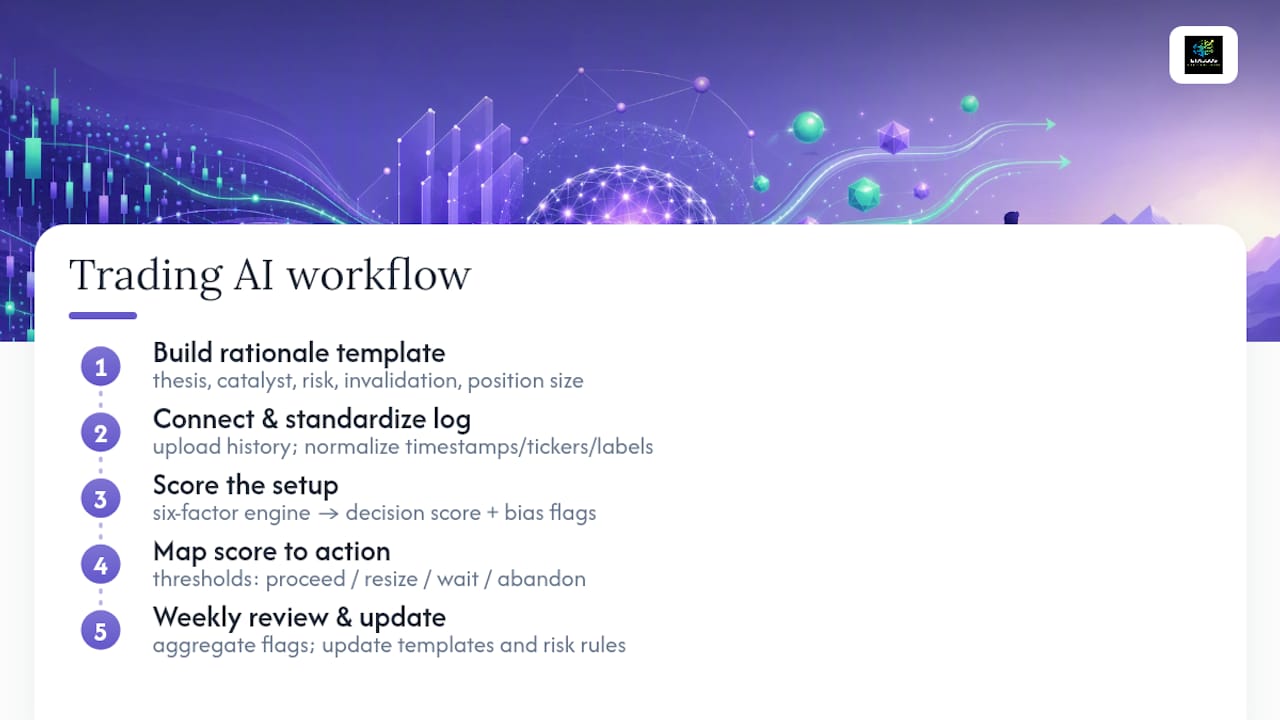
Step 1: Build your rationale template. Before you can score anything, you need a form that forces the same fields every trade: thesis, catalyst, risk level, invalidation point, position size logic. Skipping this step is the single most common reason behavioral AI programs fail before they start.
Step 2: Connect and standardize your trade log. Upload your history or connect your broker feed, then normalize timestamps, instrument tickers, and label conventions. Inconsistent formatting is a quiet killer of model accuracy.
Step 3: Let the engine score the setup. A platform like Eialgos runs each entry through its six-factor engine, producing a decision score and a list of bias flags, things like anchoring, overconfidence, or impulsive sizing. Practitioner writeups on forcing pre-trade rationale through similar multi-dimension AI validation report meaningfully fewer impulsive trades once the habit sticks.
Step 4: Map the score to an action. Set simple thresholds. A high score means proceed as planned. A middling score means revise size or wait for confirmation. A low score means abandon the setup entirely. Lock in your execution rules ahead of time so you're not negotiating with yourself mid-session, an approach that mirrors what industry commentary calls using AI as a behavioral buffer between impulse and execution.
Step 5: Run a weekly review. Aggregate your flags, look for repeat offenders, and update your templates or risk rules accordingly. Options traders in particular benefit from a structured post-trade breakdown since multi-leg positions hide more decision points than a simple long or short.
Pro Tip: Don't just track your win rate. Track how often your executed trades matched your pre-trade plan. That adherence number moves faster than your P&L and tells you sooner whether the process is working.
How Do You Know the AI Is Improving Your Decisions?
Track a small set of numbers weekly rather than obsessing over daily P&L, which is noisy and slow to reflect behavior change.
- Average decision score across all trades that week
- Plan-adherence rate (executed trades matching pre-trade rationale)
- Ratio of abandoned-to-executed low-score trades
Benchmark your risk-reward ratio and win-loss holding time ratio against the patterns identified in published behavioral trading research, then validate the model itself. Pull a sample of flagged trades each week and compare the AI's reasoning against your own.
A useful reference point: Behavioral Performance Attribution research found Model Explainability Ratios show a substantial explanatory power of behavioral bias on retail returns, ranging significantly across measured datasets. That's a meaningful chunk of your outcomes traced directly to psychology, which is precisely the lever this whole approach is built to pull.
What's the Four-Week Checklist to Get Started?
Behavioral AI programs stall when traders try to build the perfect system on day one. Sequence it instead.
- Week 1: Design your trade-rationale form and pick a capture tool, spreadsheet, app, or platform.
- Week 2: Clean up historical logs, map your fields, and connect your data source to whatever process-oriented system you're building around.
- Week 3: Run initial scoring with conservative thresholds and write down your action rules in plain language.
- Week 4: Start weekly reviews, adjust templates based on what you learn, and log every lesson.
Three pitfalls sink most attempts: sloppy input data, treating the AI as a one-time setup instead of an ongoing loop, and skipping explainability checks that catch model drift before it compounds into bad habits.
Pro Tip: Keep a running "explainability sample" folder, five to ten flagged trades a week where you write down whether you agree with the AI's read. Disagreement patterns tell you when to adjust thresholds, not just when the model is wrong.
Why Process-First Traders Win With Behavioral AI
Most retail traders chase signals when they should be auditing their own decisions. Signals promise an edge; process delivers one. AI in this context isn't a fortune teller, it's a training partner that keeps score on your discipline the way a coach tracks reps, not results.
The traders who benefit most treat this as iterative work. Your first month of scores will expose more flaws than you expect. That's the point, not a failure.
— Anantha
How Eialgos Puts This Workflow Into Practice
Everything described above, the rationale capture, the scoring, the weekly review, is exactly what Eialgos was built to run.
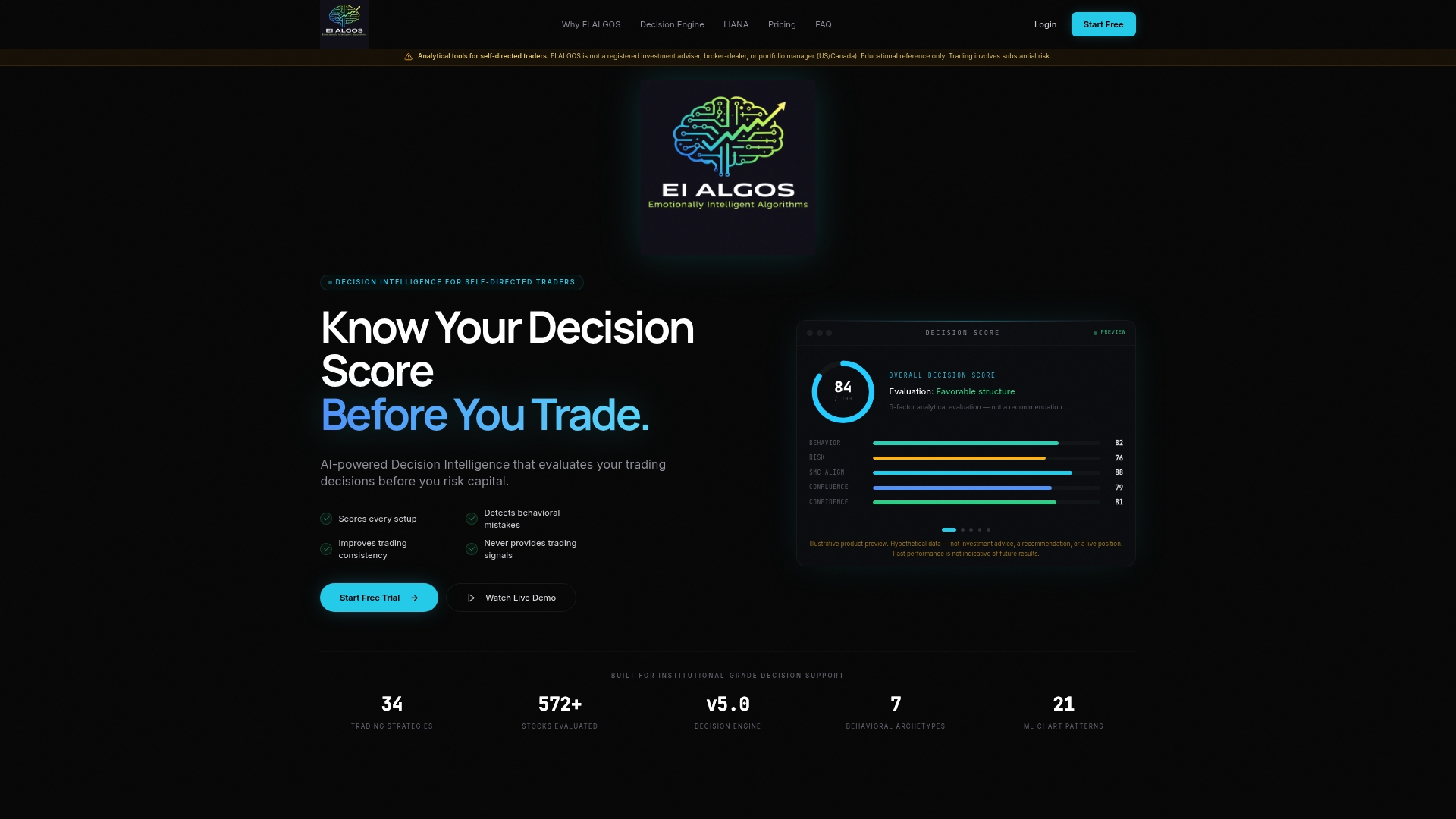
Its six-factor analytical engine maps directly onto the scoring step, generating a decision score and bias flags on every setup you log. The LIANA assistant then handles the interpretation layer, turning raw flags into specific, personalized feedback instead of leaving you to guess what a low score means. If you want the templates referenced throughout this guide, the Knowledge Hub has structured starting points for the rationale form and review cadence. Traders exploring complementary AI-driven platforms sometimes compare architectures against tools like TradeAiFi, though Eialgos remains focused specifically on your decision process rather than market signals.
You can start scoring trades on a free tier before committing to anything. When you're ready for unlimited scoring and the full feature set, check the subscription plans to see what fits your trading volume.
Sources
- Trading Psychology definition — Investopedia
- Behavioral performance attribution of retail investors’ portfolio returns — Springer (DOI)
- Empirical evidence of prospect theory and behavioral metrics — PMC article
- Playing the market: a behavioural data analysis of digital engagement practices and investment outcomes — FCA
- A retail investor’s self-discipline journey: Using AI to block 80% of bad trades — FMZ Quant blog