
A Decision Intelligence self-directed trading platform scores the quality of your trading decisions before you act, rather than telling you what to buy or sell. Eialgos, through its six-factor scoring engine and LIANA assistant, turns that score into deterministic guidance: full size, reduced size, or stand aside. It's not a broker, and it doesn't issue trade signals. It builds process discipline.
TL;DR:
- Platforms should refresh data frequently and provide clear explanations of what influences their scores to ensure reliable and transparent decision-making.
- A high composite score does not predict future price moves; it only indicates current decision quality and should be used as a filter, not a signal.
- Long-term behavioral data improves score accuracy, making calibration over multiple months essential before relying on the platform fully.
- Most decision intelligence tools do not handle trade execution, so traders must maintain discipline and follow rules based on the scores rather than overriding them.
- Data privacy and security policies should be explicit, especially regarding the storage, export, and use of behavioral and trade data, to avoid privacy gaps.
Table of Contents
- What a Decision Intelligence Self-Directed Trading Platform Actually Does
- Inside the Six-Factor Score, the Behavioral Layer, and LIANA
- How to Evaluate a Decision-Intelligence Platform Before You Subscribe
- Building a Score-Before-You-Click Routine
- How Eialgos Implements This in Practice
- Where Traders Get Tripped Up Adopting These Tools
- Regulatory Considerations for Decision Intelligence Tools
- How Your Trading Data Gets Stored and Used
- When Decision Intelligence Helps, and Where It Stops
- Explore the Decision Intelligence Approach with these platforms
- Sources
What a Decision Intelligence Self-Directed Trading Platform Actually Does
A Decision Intelligence platform is not an execution broker. It doesn't route orders, and it doesn't hand you a buy or sell alert. Instead, it evaluates the quality of a setup and the psychological state behind your decision to take it, then hands you a score you can act on. That distinction matters because most trading software conflates "what the market might do" with "whether you should act on it right now." Those are different questions, and only one of them is inside a trader's control.
The scoring mechanism behind this kind of platform works by combining multiple data layers, typically trend, momentum, volatility, and sentiment, into a single composite reading. TechTarget's overview of decision intelligence describes this as turning raw multivariate data into decision models that nontechnical users can actually read, rather than a dashboard full of indicators nobody has time to reconcile. Weighting shifts depending on the phase, so a signal that matters in a trending market can be muted in a choppy one.
The practical output usually breaks into three parts:
- A composite score summarizing setup quality across the tracked factors
- An execution-window layer flagging whether conditions currently favor acting at all
- A deterministic action suggestion, such as reduced size or no exposure, based on how the score and window line up
Decision terminal frameworks describe this routing as a verdict block: "in play," "selective," or "stand aside," paired with a specific action. That structure narrows the decision space without removing your judgment on order-level execution.
Inside the Six-Factor Score, the Behavioral Layer, and LIANA
The six-factor engine behind Eialgos breaks a setup into distinct categories, each scored independently before being combined into one composite decision score. Rather than one opaque number, the idea is that you can see which factor dragged a setup down, whether it was weak momentum, poor timing relative to the broader trend, or unfavorable volatility conditions, and adjust accordingly.
What separates a behavioral decision intelligence platform from a generic scoring tool is the psychological layer sitting on top of the technical one. This is where the platform tracks:
- Recurring behavioral errors, like chasing entries after a missed setup or oversizing after a losing streak
- Consistency scoring across your trade history, measuring whether your actual behavior matches your stated plan
- Coaching-style feedback that flags the gap between what you intended to do and what you actually did
An assistant, like LIANA, can sit inside that behavioral layer. Rather than generating new signals, LIANA analyzes your own trading patterns over time and surfaces personalized observations, for instance, that your win rate drops sharply on trades taken within the first ten minutes of the session open. That's process feedback, not a market call.
Pro Tip: Ask any decision intelligence platform to show its work. If it can't explain which factor moved a score, or when it last refreshed its data, that's a transparency gap worth taking seriously before you trust the number.
Before trusting any composite score, verify four technical points: whether the platform explains what drove a given score, how often the underlying data refreshes, whether you can export your logs, and where the data actually comes from. One decision terminal analysis makes a useful distinction here: when these systems generate a written explanation, that narrative should describe a decision that was already calculated numerically. The text explains; it doesn't decide. If a platform's explanation feels like the primary output and the score feels like an afterthought, the determinism has been inverted.
How to Evaluate a Decision-Intelligence Platform Before You Subscribe
Choosing between self-managed trading tools that all claim to improve your decisions requires a checklist that goes past the marketing page. Here's a prioritized sequence for evaluating any platform in this category, Eialgos included.
- Data quality and provenance. Ask what feeds the trend, momentum, volatility, and sentiment inputs, and how often they refresh. A platform pulling stale sentiment data once a day isn't giving you a live decision score.
- Explainability of the score. You should be able to see which factor contributed what, not just a final number. Opaque composite scores are a red flag, not a feature.
- Testing and validation methodology. Look for evidence of walk-forward validation, not just a backtest with a clean equity curve. Validation guidance for algorithmic trading software recommends weighing realistic execution assumptions, commission modeling, and drawdown behavior over headline returns.
- Integrations and exportability. Can you pull your logs out in a usable format? Structured, exportable logs matter both for your own review process and for accountability if something goes wrong.
- Security. Basic account protections, encrypted data handling, and clear policies on who can access your trade history.
- Pricing shape. Free tier versus paid tiers, and whether the free tier is a genuine trial or a crippled demo.
Weighted scorecard example: discretionary traders might weight explainability and behavioral feedback at 40%, data quality at 25%, and pricing/usability at 20%. Systematic traders often flip that, weighting testing rigor and data provenance closer to 50% combined, since their process depends more on consistency than intuition.
Run a small verification test before committing: work through a demo task, check the sandbox if one exists, export a sample log, and only then commit limited real capital to a constrained live test. Algorithmic trading validation practices treat this staged approach as standard risk management, not caution for its own sake. Watch for platforms that resist any of these checks. Opaque scoring with no export option and no stated refresh cadence is a pattern worth walking away from.
Building a Score-Before-You-Click Routine
Turning a decision score into a repeatable trading routine takes three checkpoints: before the trade, during it, and after.
- Pre-trade. Check the composite score and the execution-window layer before you size anything. If the score is strong but the window flags poor conditions, that's your cue to wait or reduce size, not force the entry.
- Trade management. Convert the score into deterministic rules ahead of time. A strong score might justify full size and a wider stop; a marginal one gets half size and a tighter stop. Deciding this before you're in the trade removes the improvisation that usually costs money.
- Post-trade review. Log the score you saw, what actually happened, and a short behavioral note, did you follow the size and stop the score implied, or did you deviate? Schedule a weekly or monthly calibration session to review that log for patterns.
Pro Tip: Treat your first month on any decision-intelligence platform as a walk-forward test, not a performance sprint. Small live size, strict logging, and a genuine review habit will tell you more about whether the tool fits your process than any single week of results.
Start with reduced size regardless of how confident a score looks. A practical guide on scoring trades before entry walks through exactly this staged sizing approach, and research on converting AI trade analysis into operational rules makes a similar point: analysis only has value once it's converted into a rule you actually follow under pressure, not just a report you read afterward.

How Eialgos Implements This in Practice
Eialgos runs on the six-factor scoring engine described above, with LIANA layered on top to translate raw scores into behavioral feedback specific to your own trade history. The Eialgos platform documents this scoring methodology and its educational resources through a dedicated knowledge hub, rather than leaving traders to reverse-engineer what a score means.
Case studies, detailed testimonials, and internal performance data specific to Eialgos are not exhaustively published here, and that's worth naming directly. Any platform in this category, Eialgos included, should be evaluated against the checklist above rather than accepted on reputation alone. Ask for the explanation behind a score before you trust the score itself.
Where Traders Get Tripped Up Adopting These Tools
The most common mistake is treating the composite score as a signal instead of a filter. A high score describes decision quality under current conditions. It does not predict where price goes next, and traders who forget that distinction end up sizing up on a "good score" the same way they used to size up on a hot tip.
A second pitfall is skipping the calibration period. Behavioral scoring engines get more useful the longer they have your trade history to work with. Expecting sharp, personalized feedback in week one, before LIANA or any similar assistant has seen enough of your patterns, sets up disappointment that has nothing to do with the platform's actual value.
Overreliance on any single number is a third trap. A composite score that combines four or six factors will occasionally produce a strong reading built on one dominant factor masking weakness elsewhere. That's exactly why explainability matters: if you can't see the breakdown, you can't catch when the average is hiding a problem.
Finally, some traders adopt a decision-intelligence tool and then keep trading exactly as before, glancing at the score but never actually changing size or standing aside when it says to. The tool only works if its output changes behavior. A platform can hand you a perfect verdict and it will still do nothing if you override it every time out of habit.
Regulatory Considerations for Decision Intelligence Tools
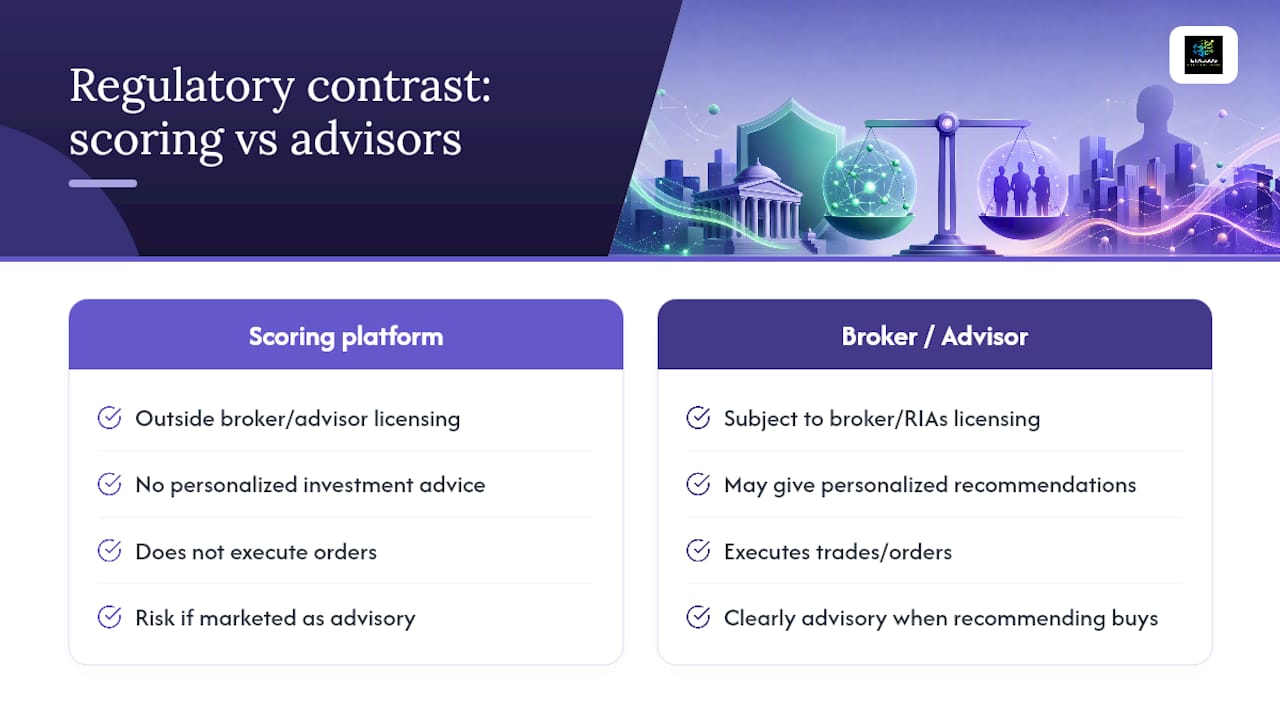
A platform that scores decision quality and provides behavioral feedback occupies a different regulatory position than a broker executing trades or an advisory service issuing recommendations. Because such platforms don't provide personalized investment advice or execute orders, they generally fall outside the licensing regimes that apply to broker-dealers and registered investment advisors in the United States.
That distinction is precisely why the "not a signal service" framing matters, and it's worth understanding as more than marketing language. A tool that scores your own setup and behavior, without recommending a specific security or directing your trade, sits in a different category than one telling you what to buy. Traders should still read any platform's terms of service carefully, since the line between educational scoring and advisory guidance can blur depending on how a specific feature is marketed.
Data handling is the other compliance dimension worth attention. Any platform processing your trade history and behavioral patterns should be transparent about what it stores, for how long, and under what security standard. This overlaps heavily with data privacy practice, and it's worth treating platform selection as partly a compliance decision, not just a features comparison. Ask directly how a platform positions itself relative to advisory regulation, and treat vague answers as a reason to keep looking.
How Your Trading Data Gets Stored and Used
Your trade history, behavioral scores, and interaction patterns with an assistant like LIANA constitute sensitive financial data, even when no brokerage account is attached to the platform. That data reveals your risk tolerance, your discipline gaps, and your trading patterns in detail a broker statement never would.
A platform worth trusting should be explicit about a few things: whether your data is used solely to serve your own account or aggregated for other purposes, whether it's encrypted in transit and at rest, how long trade logs are retained, and whether you can export or delete your history on request. Exportability matters here for a second reason beyond your own review process: it's also a privacy safeguard, since it confirms you retain control over your own behavioral data rather than being locked into one vendor's format.
Look for platforms that separate the data feeding your personal score from any data used to improve the platform's general models. Those are different uses with different privacy implications, and a platform that blurs them together without disclosure hasn't earned the trust its scoring claims to build. If a platform's privacy policy doesn't address retention periods or export rights in plain language, treat that omission the same way you'd treat an unexplained score: as a gap, not a technicality.
When Decision Intelligence Helps, and Where It Stops
Decision Intelligence tools help most the traders who already want discipline and need a structured way to measure it. If you're chasing a system that predicts price, this isn't that, and no honest platform in this category will claim otherwise.
The score reduces noise; it doesn't remove responsibility. Execution, sizing, and every order-level choice still belong to you. Used well, a decision-intelligence platform becomes a permanent fixture in your testing and sizing routine, not a one-time fix.
— Anantha
Explore the Decision Intelligence Approach with these platforms
If the checklist above resonates, some platforms are built around exactly those priorities: explainable scoring, behavioral feedback through an assistant, and documented workflows instead of black-box outputs. A six-factor engine can break down what's driving your score, and an educational hub can give you the theory behind it so you're not just trusting a number blind.
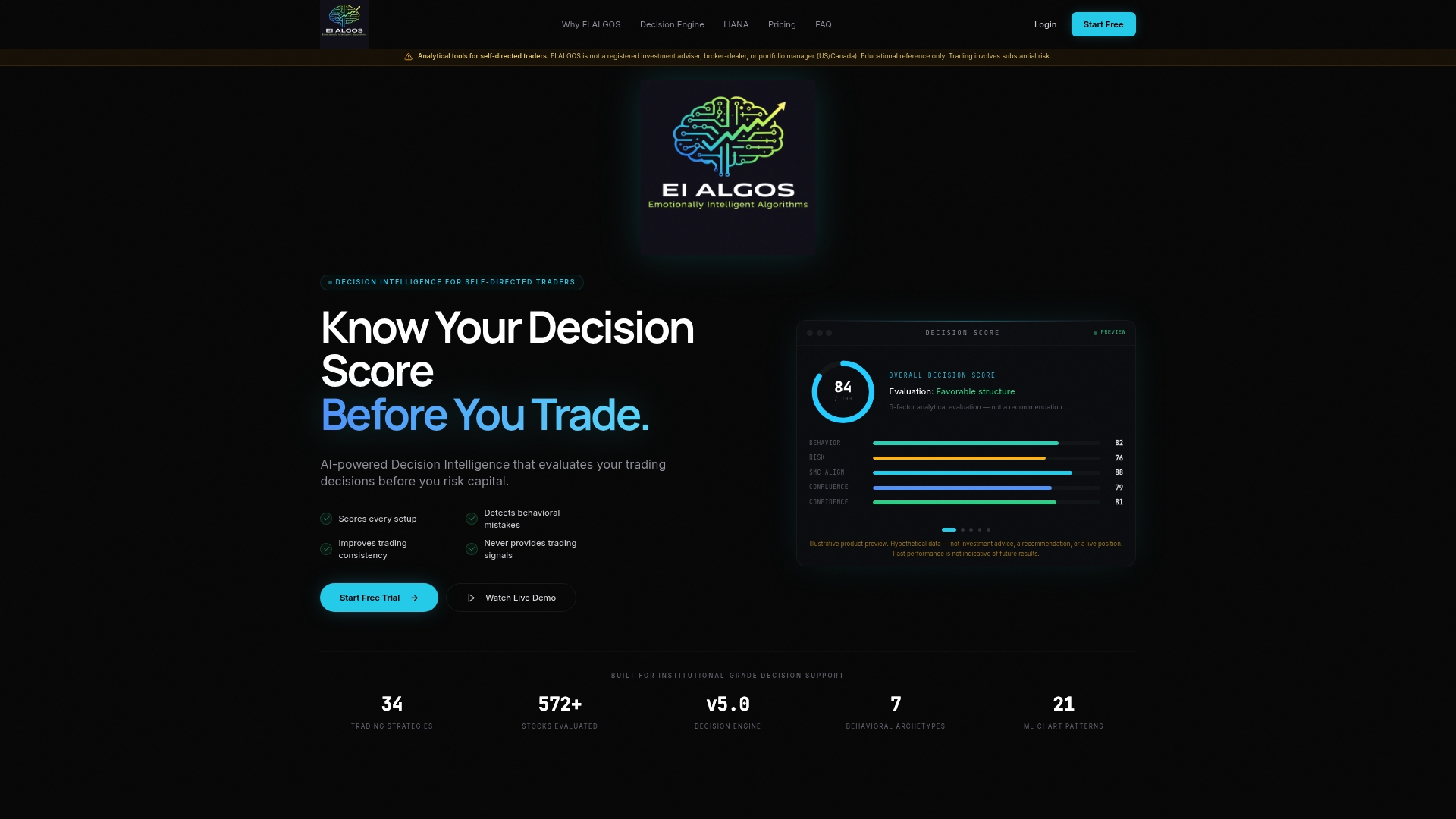
Rather than another signal service promising to call the next move, such platforms score your process and show you where it breaks down. That's a fundamentally different value proposition than what execution-focused tools offer, and it's worth experiencing directly rather than taking on description alone. Start by browsing the Knowledge Hub to see the pillar concepts behind the scoring methodology, then check the subscription options if you're ready to run your own setups through the six-factor engine.
Sources
- What is Decision Intelligence and Why is it Important? | TechTarget
- Decision Terminal: what it is, why it exists, and how to use it
- Algorithmic Trading Software: Essential Validation Steps