
An AI assistant for trading decisions is software that helps you think through a trade: it organizes information, scores or challenges a setup, and flags patterns in your own behavior. The best ones support your judgment. They do not replace it. If you trade for yourself, the most useful assistant is the one that improves your process, not the one that promises to predict the next move.
TL;DR
- An AI trading assistant analyzes data and your inputs, then returns a rationale, a score, or a summary. You still make the call.
- There are three types: signal and forecast tools, autonomous bots, and decision-support assistants. They solve different problems.
- Regulators warn that AI output can be inaccurate, overconfident or made up, so use it to test your thinking, not to outsource it.
- Behavioral feedback (overtrading, chasing, holding losers) is where an assistant can help most, because those mistakes repeat.
- Check transparency, data handling and whether the tool tells you what to buy before you subscribe.
Table of Contents
- What an AI assistant for trading decisions actually does
- Signals, bots and decision support are not the same thing
- Where an assistant helps most: your own behavior
- What a good decision-support assistant should do
- Risks to know before you rely on any AI
- A simple way to use an assistant in your routine
- Our perspective
- How EI ALGOS fits this approach
- Choosing between tool types
- FAQ
- Sources
What an AI assistant for trading decisions actually does
The phrase covers a lot of products. At the simple end, a chatbot answers market questions in plain language. At the complex end, several AI agents split the work of a trading desk.
Research frameworks show how the complex version is built. The academic TradingAgents project describes analysts for fundamentals, sentiment, news and technicals. Researchers then debate bullish and bearish views. Traders turn the result into decisions with rationales, and risk managers check exposure against set limits. Another academic design, P1GPT, runs news, social media, technical indicators and fundamentals through five layers, from input to decision, and ends with buy, hold or sell recommendations plus a risk assessment.

The pattern is the same in all of them: gather information, weigh it, explain the output. What differs is what happens next. Some systems stop at an explanation. Others go on to act.
Regulators have noticed the retail version of this. The Ontario Securities Commission reports that platforms for self-directed investors have begun adding AI analysts as an add-on to support decision-making. That is the category most US self-directed traders will meet first.
Signals, bots and decision support are not the same thing
Before you compare tools, sort them by what they ask you to do.
| Type | What it gives you | Your role | Main risk |
|---|---|---|---|
| Signal or forecast tool | Predictions, price targets, buy and sell alerts | Follow or ignore the alert | You inherit someone else's logic without knowing your own weaknesses |
| Autonomous trading bot or agent | Executes trades on its own rules | Supervise and fund it | Malfunction, hallucination, loss of control |
| Decision-support assistant | Scores setups, reviews your process, points out your patterns | Make every decision yourself | Only as useful as the data and trade history you give it |
Forbes makes a related point in a November 2026 piece on using AI for stock trading: AI works best as a research tool to evaluate opportunities, analyze risks and challenge your existing thesis, not as an autonomous adviser that picks investments.
That framing is the useful one. Ask of any tool: does it make me a better decision-maker, or does it make decisions for me?
Where an assistant helps most: your own behavior
Most traders who lose money do not lose because they lacked one more indicator. They lose because they break their own rules. They enter late after a run-up, move a stop, add to a loser, or trade five times on a day that offered one clean setup.
These errors are patterns, and patterns are what software is good at finding. A journal that you fill in by hand depends on your honesty in the moment. An assistant that reads your trade history can compare what you planned with what you did, over dozens or hundreds of trades.
There is a research reason to take bias seriously. A University of Hawaii study on machine behaviorism argues that biases seen in humans, such as the disposition effect (selling winners too early and holding losers too long), also show up in LLM-based agents. The same study reports that LLM agents in Chinese and US markets showed significant disposition effects. If AI models can inherit these habits, a tool that merely mimics a typical trader will not fix yours. You need one built to measure behavior against your own plan.
Three behaviors are worth tracking first:
- Overtrading. Count trades per day and per setup quality. Our guide on how to recognize overtrading shows the early signs.
- Recency and availability bias. Recent winners or headlines pull you toward the same setup. See the availability heuristic in trading.
- Emotional execution. Entries and exits that depart from your plan after a loss. Emotional trading breaks down the causes and fixes.
What a good decision-support assistant should do
Use these criteria when you evaluate any AI assistant for trading decisions.
It explains its output
A score or a summary without reasons is not decision support. You should be able to see which factors drove the result, so you can agree, disagree or adjust. This matters beyond convenience. A peer-reviewed article in PMC by Hansen and Borch describes critical model uncertainty: the inability to explain how and why some models, especially deep neural networks, reach their predictions. FINRA's 2020 AI report, as summarized by a securities law firm, says explainability may be especially important where AI has autonomous decision-making features. Pick tools that show their work.
It works from your trades, not the crowd's
Generic output gives everyone the same answer. Forbes notes that popular chatbots may often recommend the same US large-cap growth stocks, creating a crowded trade. The SEC inquiry coverage raises the same herding concern: if many AI agents train on similar data, they could converge on the same trades and amplify volatility. If you want to see how crowded behavior plays out among traders, the psychology of prop trading is a good read on why many people end up making the same moves at the same time.
The practical answer is to use an assistant that adapts to your history, so your feedback is about your habits.

It does not pretend to know the future
Forbes also notes that generative AI is strong at organizing known information and screening data but cannot reliably predict the future. Models trained on historical relationships can fail exactly when those relationships break. A tool that frames itself as a process coach rather than a predictor is making a claim it can keep.
It keeps you in control of every trade
CNBC reports that letting an AI agent influence or make investing decisions can add risk, since the technology can malfunction or act against your goals, and that agentic trading without solid experience is risky because of hallucinations. A decision-support tool sidesteps that: it never touches your orders.
It treats your data carefully
FINRA's report flags data privacy, cybersecurity and recordkeeping as challenge areas for AI applications. Before you connect trade history, read how the provider stores and uses it, and whether you can export or delete it.
Risks to know before you rely on any AI
This is safe-use guidance, and it applies to every AI tool in this space.
- Output can be wrong. The joint SEC, NASAA and FINRA Investor Alert from January 2024 warns that AI-generated information may rely on inaccurate, incomplete or misleading data, and that even with accurate input it can be faulty or made up.
- Confidence is not accuracy. Forbes observes that generative AI can present conclusions with great confidence when assumptions are shaky. A polished answer is not necessarily a correct one.
- Chat can push you to act. The same alert cautions that chatbot interactions can encourage misinformed, emotional or impulsive decisions. Slow down after any AI-prompted idea and check it against your plan.
- Models can be biased and opaque. The OSC report lists model bias, herding, poor data quality and black-box governance as risks.
- Be wary of guaranteed returns. The investor alert also covers AI-themed investment fraud. Any product that promises guaranteed profit is a red flag. Confirm your broker or adviser through official regulator tools, and talk to a registered professional about decisions that depend on your finances.
It is fair to note the upside the OSC also lists: lower-cost access to personalized guidance and better decisions around diversification and risk management. The conclusion is not to avoid AI. It is to give it a narrow, checkable job.
A simple way to use an assistant in your routine
Here is a workflow that keeps the decision with you.
- Write the plan first. Define entry, stop, target and size before you open the assistant.
- Score the setup. Ask the assistant to rate the setup against defined factors, not to tell you whether to buy.
- Read the reasons. If the score is low, find which factor dragged it down. Decide whether the plan or the score is wrong.
- Manage the trade by rules. Keep stops and exits tied to your plan, and review any deviation afterward.
- Review weekly. Look at repeat behaviors: late entries, oversized positions, revenge trades.
- Run a longer audit. Our 30-day behavioral trading analysis walks through how to spot bias in a month of trades.
Over time, the review step matters more than any single score. It is how a setup becomes a habit you can trust.
Our perspective
We built EI ALGOS around one belief: most traders do not need another opinion about the market. They need a clear view of their own decisions.
That is why we do not publish trade signals or predictions. A signal asks you to trust someone else's read. Decision intelligence asks a better question: how good was your process on this setup, and where does it usually slip?
Our six-factor analytical engine scores each setup on the psychological and behavioral factors behind the decision. LIANA, our assistant, turns your own history into personalized feedback, so you can see your patterns and refine your process over time. The goal is consistency and discipline you can measure.
If you are choosing an AI assistant, pick the one that makes you more accountable to your own plan. That is where lasting improvement comes from.
Anantha
How EI ALGOS fits this approach
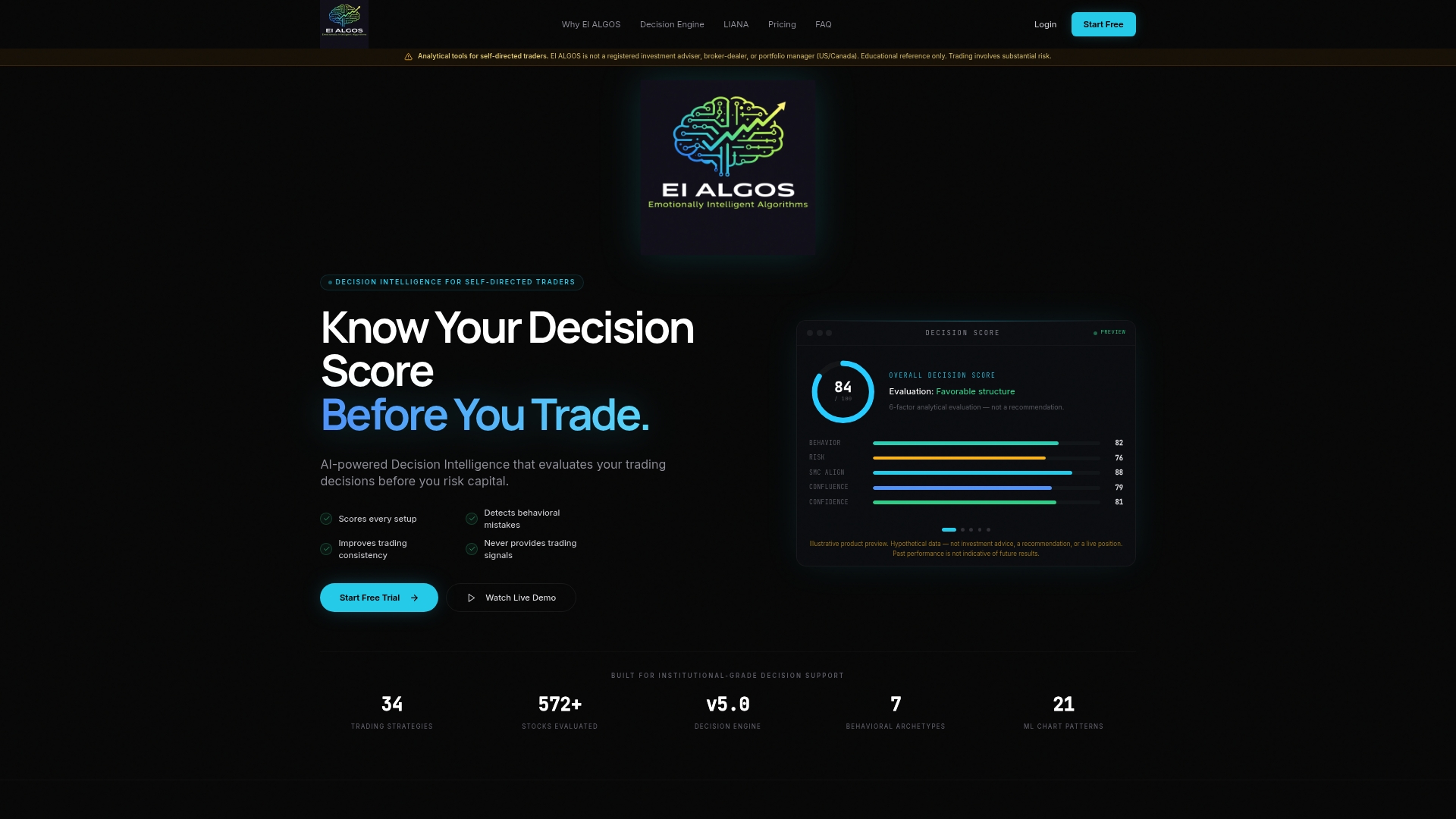
EI ALGOS is a web-based Decision Intelligence platform for self-directed traders. It scores trade setups on a six-factor engine, detects behavioral errors, offers live trade management tools and options analysis, and detects strategy patterns. LIANA gives personalized process feedback. It does not give signals or recommendations.
You can start on the Free plan at $0 per month. Paid plans are Starter at $49 per month, Pro at $129 per month and Elite at $229 per month. See the current plans and what each includes.
Want to see how the assistant works before you decide? Read about LIANA, our AI trading coach, or see how EI ALGOS works. If you keep a journal, the AI-coached trade review shows what your trades say about you.
Choosing between tool types
Match the tool to the problem you have.
- You cannot find setups. A screener or research assistant helps with idea generation. Treat results as leads to verify.
- You find setups but execute badly. You need behavioral feedback and trade management structure. That is decision support. Read more on behavioral AI for trading.
- You want hands-off trading. That is automation, with the supervision and malfunction risks described above. It is a different job from improving your own skill.
- You are new. Start with feedback on process and risk control before anything else. Our overview of AI trading tools for retail traders and of trading psychology software can help you compare by type.
Whatever you choose, ask the same questions: Can I see why it produced this output? Does it learn from my data or serve everyone the same answer? Does it respect my control over orders? How does it handle my data?
FAQ
What is an AI assistant for trading decisions?
It is software that helps you evaluate a trade by organizing information, scoring or challenging a setup, and sometimes reviewing your own behavior. A decision-support assistant leaves the final choice to you. It differs from a signal service or an automated bot, which tell you what to do or do it for you.
Can an AI trading assistant predict the market?
No tool can reliably predict the future. Forbes notes that generative AI is good at organizing known information but cannot reliably forecast, and models trained on past relationships can fail when conditions change. A better use is to improve how you evaluate setups and manage risk.
Is it safe to let AI make my trades?
It adds risk. CNBC reports that agents can malfunction or act against your goals, and that hallucinations are a concern without solid experience. A safer path is to keep every order in your own hands and use AI for analysis and feedback. For advice on your own finances, talk to a registered professional.
How can AI help with trading psychology?
It can compare your plan with your actual trades across many entries and flag repeat errors such as overtrading, moving stops or chasing. That turns vague feelings about discipline into patterns you can fix. Our trader behavior analysis page explains profiles, patterns and drift.
What should I check before using an AI trading assistant?
Check whether it explains its output, whether it adapts to your trade history, whether it claims guaranteed results, and how it stores your data. Regulators warn that AI information can be inaccurate or made up, so treat any guarantee as a warning sign.
Sources
- Artificial Intelligence and Retail Investing, Ontario Securities Commission
- TradingAgents: Multi-Agents LLM Financial Trading Framework
- P1GPT: a multi-agent LLM workflow module
- How To Use AI For Stock Trading Without Following The Crowd, Forbes
- Machine Behaviorism: Exploring the Behavioral Dynamics of LLM-based agents, University of Hawaii
- The absorption and multiplication of uncertainty in machine-learning-driven finance, PMC
- FINRA Issues Report on Artificial Intelligence in the Securities Industry, Herskovits Law
- Is agentic trading safe? What the SEC inquiry means for investors, Alabama Gazette
- Agentic trading: How AI agents can trade stocks, CNBC
- Artificial Intelligence (AI) and Investment Fraud, Investor.gov
- Psychology of Prop Trading