
A trading feedback loop is a repeatable cycle: you plan a trade, execute it, review how you decided (not only how it ended), and change one specific thing in your process. Run it consistently and every trade becomes data about your own behavior. Skip the review step and the market's feedback, which is noisy and often misleading, is all you learn from.
This guide covers what the term means, how a personal loop differs from market-level feedback trading, how to build a loop step by step, what to track besides profit and loss, and how to avoid reacting to a handful of trades.
TL;DR
- A trading feedback loop is plan, act, review, refine. The review has to grade your decision process, not just the P&L.
- Market feedback is loosely tied to your actions, so a good decision can lose and a poor one can win. Track process quality separately from results.
- Change one variable at a time, and judge changes over a sample of trades, not a single session.
- "Feedback trading" in academic papers is a different thing: market-wide behavior where price moves drive more trading.
- Eialgos scores each setup on a six-factor engine so your review rests on consistent data. A free plan is available.
Table of Contents
- What a trading feedback loop actually is
- Feedback loop vs. feedback trading: two different ideas
- Why trading makes learning hard
- How to build a trading feedback loop step by step
- What to track besides profit and loss
- How to avoid overreacting to a few trades
- Negative feedback in your own process
- Put the loop into practice with Eialgos
- A weekly review template
- FAQ
- Sources
What a trading feedback loop actually is
In plain terms, a feedback loop means your past results shape your next decisions. The useful version is deliberate: you decide what to look at, compare it to what you expected, and adjust.
The idea comes from deliberate practice. One professional chapter on trader performance describes the essence of that practice as a "learning loop": chess champions enter one when errors in a practice game lead them to replay it with other lines of attack. Traders can do the same with their own decisions. You cannot replay a market, but you can replay your reasoning.
A simple version has four beats:
- Plan. Write the setup, entry, stop, target and size before you click.
- Act. Execute the plan, and record any deviation as it happens.
- Review. Compare what you did to what you planned, and what you felt to what you wrote.
- Refine. Choose one change, set a rule for it, and watch it in the next batch of trades.
This is the same plan, act, review and refine cycle that trading psychologist Brett Steenbarger is credited with describing as a performance loop, where journals and quantified reviews act as a trader's training log. Used consistently, it builds a personal dataset that supports deliberate practice and measurable improvement.
Feedback loop vs. feedback trading: two different ideas
Search results for this phrase mix two concepts, and it helps to separate them.
Your personal loop is about one trader learning. Outcomes shape future behavior, and you control how well that learning works.
Feedback trading is a market-level phenomenon. As one explainer puts it, traders' decisions can move prices, and price moves can influence other traders' decisions. It is often linked to George Soros's reflexivity theory, which holds that traders' beliefs can affect prices, and prices can then affect the facts traders respond to.
The market-level version has real research behind it:
- A 2014 paper in Scientific Reports found that the probability of a price bouncing off a support or resistance level rises with the number of previous bounces, which the authors read as quantitative evidence of self-reinforcing beliefs.
- A laboratory study by Bao, Hommes, Sonnemans and Tuinstra found that markets with positive expectation feedback do not converge to fundamentals, showing under-reaction in the short run and over-reaction in the long run. Trend-following rules performed well there, while in negative feedback markets they performed poorly.
These findings describe how crowds behave. They are useful context for reading price action, but they do not tell you how to improve your own process. For that you need the personal loop, and the rest of this article is about it.
Why trading makes learning hard
Most skills improve quickly because feedback is immediate and tied to what you did. Trading is different. Adam Grimes, a well-known trader, points to the psychological term "wicked learning environment": an environment where the feedback you receive is loosely connected to your actions. In a "kind" environment, feedback is immediate, consistent and directly tied to what you did.
The practical consequence is that the market does not tell you whether a profitable trade came from skill or luck. Grimes notes the feedback looks the same either way, and learning to separate the two is one of the core challenges of building competence.
That is why a P&L-only review misleads. Consider two trades:
- You break your own rules, oversize, and the trade works. You collect a reward for a habit that will eventually hurt you.
- You follow your plan exactly, and the trade is stopped out. You feel pressure to change something that was not broken.
If profit and loss is your only feedback signal, the loop will teach you the wrong lessons. The fix is to create a second signal that measures the decision itself.
How to build a trading feedback loop step by step

1. Record every trade before and after
The journal is the loop's memory. Steenbarger's approach, as described in a TraderFeed post on trading journals, is to record market activity, your thoughts and feelings, and outcomes, then review regularly, set specific goals and actions, and track those changes in later sessions.
Record at minimum:
- The setup and why you took it
- Entry, stop, target and position size, written before execution
- What you were feeling at entry and during the trade
- What actually happened, including any exits you did not plan
2. Grade the decision separately from the result
Give each trade a process grade before you look at the P&L. Did you follow your entry criteria? Was the size within your risk rule? Did you honor the stop? A trade can be an A for process and a loss for money. That combination is a success for your loop.
3. Review on a schedule
Pick fixed times: a short end-of-day check and a longer weekly review. Look for patterns, not stories. Which setups produce your best-graded trades? Where do your rule breaks cluster: after a loss, late in the day, or on a particular setup type?
4. Treat emotions as data
Steenbarger argues that emotions in trading are valuable signals that reveal what you believe and expect, not distractions to suppress. If you note "anxious" at entry on every oversized trade, you have found a testable link between a feeling and a behavior.
5. Change one thing, then measure it
Pick a single adjustment with a clear rule, such as "no entries in the first 10 minutes unless the setup score meets my threshold." Run it for a defined number of trades, then compare. If you change five things at once, you will not know which one helped.
If your adjustment involves a strategy rule, it helps to test a strategy before trading it live, so you refine the idea against historical data before it costs you real money.
What to track besides profit and loss
The central question is how to measure decision quality independently of the outcome. A workable set of metrics:
| Metric | What it tells you |
|---|---|
| Plan adherence rate | How often entry, stop and size matched the written plan |
| Process grade by setup type | Which setups you execute well, regardless of P&L |
| Risk per trade vs. your rule | Whether sizing discipline holds under pressure |
| Stop honored (yes/no) | Whether you let losses run past your plan |
| Emotional state at entry | Which feelings precede your rule breaks |
| Time of day and trade number | Fatigue, overtrading and revenge-trade patterns |
| Result by process grade | Whether good process is actually paying off over time |
The last row matters most. Over enough trades, high-process-grade trades should outperform low-grade ones. If they do not, the problem may be your strategy, not your discipline, and you now have evidence to look at it.
Self-monitoring has research support. A 2004 experimental study by Nowaczyk found that miscalibration reduces trading performance while self-monitoring enhances it, with winner's curse traps as the major channel. Related laboratory work by Bregu found that overconfidence leads to higher trading volume and weakly damages profits. Tracking your trade count and your confidence against your results is a direct way to catch both.
How to avoid overreacting to a few trades
A loop only works if its adjustments are proportionate. Three trades in a row that lose money tell you very little. Three trades in a row where you broke your size rule tell you a lot. That distinction is the whole point of grading process.
Use these guardrails:
- Set a minimum sample. Decide in advance how many trades you need before changing a rule, for example a few dozen of one setup type. Write that number down.
- Change rules only from process evidence. A losing streak with high process grades is a reason to keep going or lower size, not to rewrite the plan.
- Respond to losing streaks by reducing exposure. One practitioner's approach is to treat a run of stop-outs as a reason to reduce exposure, use pilot positions or wait, which keeps you in the game while you gather more data.
- Keep one change active at a time. Otherwise the signal gets buried.
- Be careful with who is watching. A study of 178 traders and more than 400,000 trades on a social trading platform found that close to real-time monitoring can increase traders' disposition effect. Traders closed winners earlier, apparently to please investors. Reviewing on a schedule, not tick by tick, protects against the same urge in your own trading.
The evidence that traders do adjust is encouraging. A UCLA Anderson working paper on individual day traders found that they take smaller gambles or quit after unsuccessful day trades, and concluded that individuals do learn from experience. The goal of a deliberate loop is to make that learning faster and aimed at the right target.
Negative feedback in your own process
In engineering terms, a negative feedback loop pushes a system back toward a target. In trading, that is the behavior you want: a deviation from your plan triggers a correction.
You can build this in on purpose:
- If you break the size rule once, the next trade is half size.
- If you take two unplanned entries in a day, you stop for the day.
- If a setup's process grade drops below your threshold across a week, you pause that setup and review it.
This is the opposite of the pattern where a bad outcome compounds into a worse one, such as a loss that leads to a revenge trade, which leads to a larger loss. A written correction rule interrupts that sequence before emotion does the deciding.
It also shows why retail behavior is worth studying. A 2024 paper in the Journal of Futures Markets found that retail investors respond to short-term intraday returns in a contrarian fashion, and on average this led to significant losses on the day they opened a position, mainly due to the bid-ask spread and poor timing. Reactive, short-horizon decisions carry costs. A loop that records why you entered, and whether it matched a plan, helps you see when you are reacting to the last few ticks.
Our perspective
Most trading tools are built around the market: what might price do next? We built Eialgos around a different question: how did you decide? A feedback loop is only as good as the signal it feeds on, and for most self-directed traders the missing signal is a consistent read on decision quality.
That is why our platform does not give trade signals or recommendations. It scores each setup on a six-factor analytical engine focused on the psychological and behavioral side of the decision, so you can see your own patterns and behavioral errors in the data. Our LIANA assistant is designed to give personalized feedback on your process, based on your own trade history, so each review builds on the last.
We believe a trader who understands their own process can improve consistency over time. Every trade then becomes useful information, whether it wins or loses.
Anantha
Put the loop into practice with Eialgos
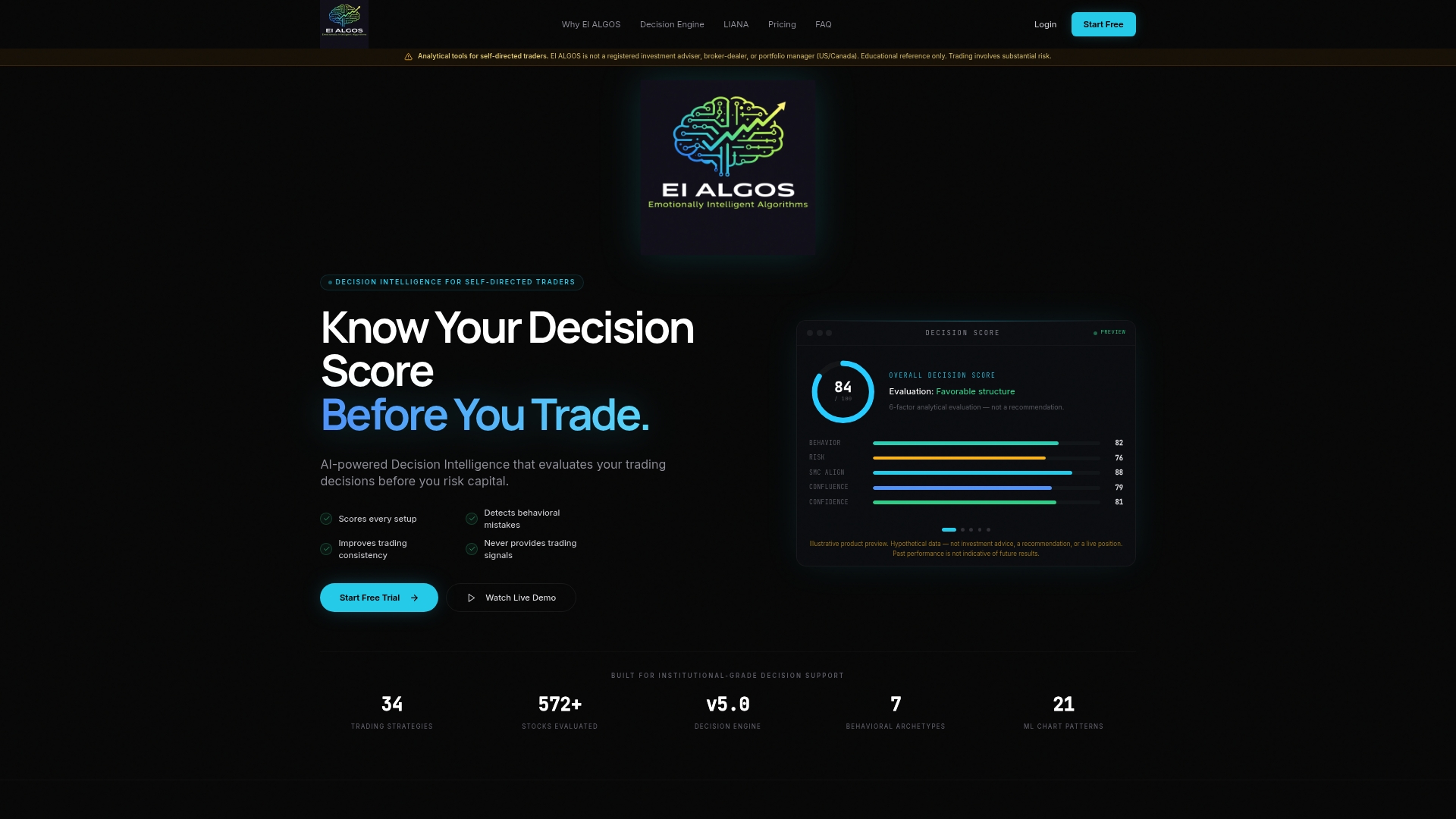
Manual journaling works, but it takes discipline to grade every trade the same way. Eialgos is a web-based Decision Intelligence platform that scores your setups on a six-factor engine, detects behavioral errors, offers live trade management tools and options analysis, and spots strategy patterns. LIANA, our AI assistant, gives personalized feedback on your process.
You can start on the Free plan at $0 per month. Paid plans are Starter at $49 per month, Pro at $129 per month and Elite at $229 per month, with advanced features and unlimited usage on the upgrades. See the plans and start free.
A weekly review template
If you want to start today, use this 30-minute routine once a week.
- Pull the week's trades. List every trade with its setup type, size and process grade.
- Count rule breaks. How many trades broke a rule? Which rule?
- Sort by grade, then by result. Compare your A-grade and C-grade trades. Note whether the A-grade group performed better.
- Find one pattern. Time of day, a setup type, an emotional state, or the trade after a loss.
- Write one rule. Make it specific and measurable. Add it to your plan.
- Set the check date. Decide how many trades you will run before you judge the change.
Keep the output short. A one-page summary you will actually read beats a long report you will not.
FAQ
What is a trading feedback loop?
It is a cycle of planning a trade, executing it, reviewing both your decision process and the outcome, and making one deliberate change. The aim is to learn from your own decisions instead of from profit and loss alone.
Is a trading feedback loop the same as feedback trading?
No. A feedback loop is a personal learning process. Feedback trading is a market-level pattern where price changes influence traders' decisions, which in turn influence prices. Academic papers on feedback trading study crowd behavior, not individual improvement.
How many trades do I need before changing my strategy?
There is no universal number, so set your own minimum before you start, and base it on the setup type you are testing. Change a rule only when process-graded evidence across that sample points the same way. A short losing streak with good process grades is not enough on its own.
What should I track besides profit and loss?
Track plan adherence, process grade, risk per trade against your rule, whether you honored your stop, and your emotional state at entry. Then compare results by process grade over time to see whether good process is paying off.
Sources
- Enhancing Trader Performance, chapter 1 (Wiley)
- Feedback Loop Psychology in Trading (Capital.com)
- Memory effects in stock price dynamics (Scientific Reports)
- Individual Expectations, Limited Rationality and Aggregate Outcomes (Tinbergen Institute)
- Why Trading Is So Challenging: Adam Grimes (Better System Trader)
- Brett N. Steenbarger: Psychology Behind Successful Trading (EBC)
- TraderFeed: Using Trading Journals to Improve Trading
- Judgmental overconfidence, self-monitoring and trading performance (TSE)
- Overconfidence and (Over)Trading (Journal of Behavioral and Experimental Economics)
- The Feedback Loop (Nick Schmidt)
- The side effect of scrutinising traders in social trading platforms (LSE)
- Learning from Experience (UCLA Anderson)
- Feedback Trading: The Intraday Case of Retail Derivatives (Journal of Futures Markets)
- Evidence-Based Trading: How to Test Before You Trade