
Trading error detection for a self-directed trader comes down to one habit: judge every trade against your written plan, not against its profit or loss. Log each trade with the plan beside it, flag every deviation, and count how often the deviations happen. A trade that made money can still be an error. A trade that lost can be a clean one. This guide shows you how to tell them apart and build a review routine that catches repeat mistakes early.
TL;DR
- An error is a deviation from your trading plan, not a losing trade. Winners can be errors, and losers can be flawless.
- Sort every trade into one of four buckets: followed the plan or broke it, crossed with a win or a loss.
- Journal the plan, the risk, the execution and a rule-compliance check for every trade, so patterns show up in the data.
- Track the percentage of trades that met your pre-trade criteria. A rising number signals progress even when P&L is flat.
- Cut reliance on willpower with checklists and hard rules, and review on a fixed schedule.
Table of Contents
- What counts as a trading error
- The mistakes self-directed traders repeat
- How to review your trades to detect recurring errors
- Measure process quality, not just profit
- Build safeguards into your trading plan
- Perspective: errors live in the decision, not the click
- Put detection on autopilot with EI ALGOS
- FAQ
- Sources
What counts as a trading error
Start with a definition you can test. One experienced market technician writes that an error is any time a trader does not follow their trading plan, and that without a plan every trade is a mistake. The same source points out that errors have nothing to do with profits and losses. An error can happen on a winning trade, and a losing trade can be executed perfectly.
That definition changes how you review. Three things get mixed up all the time:
- A losing trade. The price moved against you. This may be normal variance inside the risk you defined.
- An execution mistake. You meant to do one thing and did another: wrong size, wrong order type, a mistyped price, a stop placed in the wrong spot.
- A decision error. You took, held, sized or exited a trade in a way your plan does not allow, even if the click itself was clean.
Execution mistakes are the ones people picture first, such as a typo in an order ticket. Decision errors are harder to spot because nothing looks broken. The order filled as intended. The problem was the choice.
Good decision versus good outcome
A useful test comes from trading education: a good decision follows your written rules using the information you had at entry, while a good outcome is just a trade that made money. You control the decision. The outcome is the decision plus everything you do not control, including the next price move.
Crossing the two gives four outcomes for any trade:
| Won | Lost | |
|---|---|---|
| Followed the plan | Process win | Valid setup, unfavorable outcome |
| Broke the plan | Invalid setup, favorable outcome | Process loss |
The bottom-left cell is the dangerous one. A trade that broke your framework but happened to pay rewards behavior you cannot repeat safely. Most traders never flag it, because winners rarely get reviewed. Error detection means reviewing them anyway.
The mistakes self-directed traders repeat
Most recurring errors fall into a short list. Knowing the list helps you design the fields and flags in your journal.
Emotion-driven decisions
Common behavioral mistakes include FOMO, revenge trading and loss aversion. The same source notes that decision fatigue and emotional activation make discipline harder as a session wears on. That matters for detection: errors cluster late in the day, after a loss, or after a big win. Your journal should record time of day and what happened just before the trade.
Overtrading
Taking more trades than your plan calls for is one of the easiest errors to count and one of the hardest to stop in the moment. If you want a breakdown of the triggers behind it, this list of common overtrading causes helps you name which one is yours. Naming the trigger lets you write a rule against it.
Overconfidence and information overload
Academic research on retail traders finds that biases such as overconfidence lead many to value order flow data highly, yet the performance benefit is limited. Participants capture only a fraction of its theoretical value and may increase their cognitive load or overtrading. More inputs do not automatically mean better decisions. If you add a data feed, add a rule for how it changes a decision, or it becomes one more way to deviate.

Weak risk controls and sizing
In practice this means no defined stop, position size set by feel, or a stop moved after entry. These are all plan deviations, so they are all detectable if the plan states the stop and the size before you enter.

How to review your trades to detect recurring errors
Detection is a repeatable routine, not a feeling that you made a mistake. Here is a process that works for stocks and options alike.
- Write the plan before the trade. Entry condition, initial stop, exit rule and the reason for entry. Without these, you have nothing to compare against.
- Log the trade immediately. Capture the fields in the template below while the details are fresh.
- Mark compliance. For each rule, mark yes or no. Any "no" is a deviation.
- Tag each deviation. Use a short list: early exit, moved stop, oversized, chased entry, no setup, revenge trade, other. Fixed tags make counting possible.
- Classify the trade. Use the four-bucket table above, regardless of P&L.
- Review in batches. Once a week, count the tags. Once a month, look for combinations, such as oversizing after a loss.
What to record in your journal
A practical journal template published in 2026 breaks the record into seven groups of fields:
- Trade identity: trade ID, account, instrument, direction and strategy version.
- Trade plan: entry condition, initial stop, exit rule and reason for entry.
- Position risk: quantity, initial planned dollar risk and percentage of account equity.
- Execution: order and fill times, time zone, actual prices and partial fills.
- Costs: commissions, transaction fees and any financing or borrowing charges.
- Outcome: net profit or loss, result in R and holding time.
- Process review: rule compliance, deviations, relevant market conditions and screenshots.
The process review group does the detection work. It is what separates execution problems from strategy results. Add two fields of your own: your emotional state in a word, and what you did in the previous hour. Those two often explain the deviations the other fields only record.
Is it my process or normal uncertainty?
This is the hardest call in trade review. Use a simple sequence of questions:
- Did the setup meet every pre-trade criterion in the plan at the time of entry?
- Was the size within the planned dollar risk?
- Did you exit by the rule, or by the stop you set?
- Did the loss stay inside the risk you accepted before entering?
If all four answers are yes, the loss is uncertainty, and the correct response is to change nothing. If any answer is no, you found an error, even if the trade won. One reason this matters: deviations distort the statistics of your system, so you are no longer trading the system you think you are. Changing a sound strategy because of losses that were pure variance, or keeping a flawed habit because it paid, are both costly outcomes of skipping this step.
Measure process quality, not just profit
P&L is noisy over short periods. Process metrics are not. Traders can score execution separately from outcome, for example by tracking the percentage of trades that fully met their pre-trade criteria. A rising compliance score points to improvement even when P&L is temporarily flat because of variance.
A starter dashboard of four numbers is enough:
| Metric | How to calculate it | What it shows |
|---|---|---|
| Compliance rate | Trades with zero deviations divided by total trades | Overall discipline |
| Top deviation | The most common deviation tag this month | Where to focus first |
| Invalid-win count | Plan-breaking trades that made money | Hidden risk you are being paid for |
| Planned-risk adherence | Trades within planned dollar risk divided by total | Sizing discipline |
Set a compliance target you can reach, such as improving by a few points each month, and review it on a fixed schedule. If you like to plan in blocks, a one-page 90 day plan with three to five goals is a simple way to put a process target, like raising compliance rate, next to your other goals.
Build safeguards into your trading plan
Once you detect an error, fix the system around it instead of promising yourself to try harder. Decision fatigue depletes a finite cognitive resource, and checklists and structural rule enforcement can reduce reliance on willpower while you trade.
Turn each frequent deviation tag into one safeguard:
- Chased entry: add a pre-trade checklist item that confirms the setup criteria are met before you place the order.
- Moved stop: place the stop at entry and write down that it only moves by a defined rule.
- Oversizing: calculate size from planned dollar risk before every trade, not after.
- Revenge trading: set a daily loss limit and a cooling-off rule after a stop-out.
- Overtrading: cap the number of trades per session.
Constraints can work in your favor. Academic work on retail investors finds that financial constraints such as leverage limits can discipline behavioral biases, improve market timing and reduce the disposition effect. You can apply the same idea by hand: a smaller maximum position size or a hard daily loss limit works like a built-in constraint on yourself.
Change one safeguard at a time. Then watch the matching deviation count over the next 20 or so trades. If it falls, keep the rule. If it does not, the rule is not addressing the real trigger, so go back to your tags and look for the combination you missed.
Perspective: errors live in the decision, not the click
We built EI ALGOS around one observation: most traders already know what a trade error looks like in theory. What they lack is an honest, consistent way to see their own.
That is why our platform does not issue trade signals or market predictions. Signals tell you what the market might do. They say nothing about whether your next decision will follow your own process. We focus on the second question, because it is the one you can actually change.
Our approach is to score each setup on a six-factor analytical engine that looks at the psychological and behavioral side of the decision. Our platform is designed to help you detect behavioral errors, see patterns across your strategy and trade history, and refine your process over time. LIANA, our AI assistant, is designed to give personalized feedback on your own patterns rather than generic advice.
Manual journaling with a spreadsheet is a good start, and the routine in this article works. Where we add value is speed and consistency: the review happens on every setup, so the pattern shows up while you can still act on it.
Anantha
Put detection on autopilot with EI ALGOS
If you want the review routine above built into your workflow, EI ALGOS is a web-based Decision Intelligence platform for self-directed traders. It scores trade setups on a six-factor engine, flags behavioral errors, offers live trade management tools and options analysis, and includes LIANA for personalized process feedback. It does not give signals or recommendations.
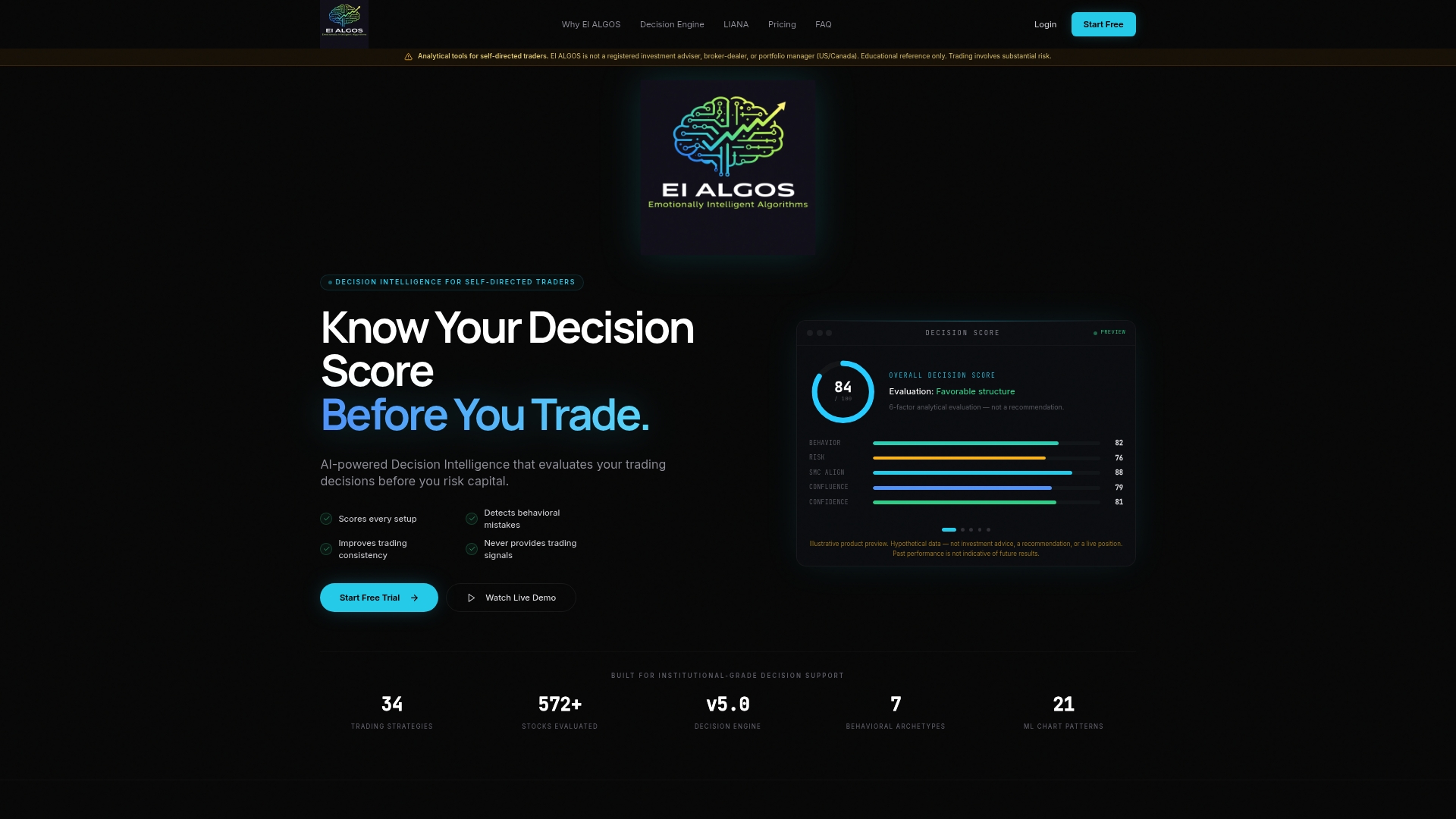
Plans are published on our site: Free at $0 per month, Starter at $49 per month, Pro at $129 per month and Elite at $229 per month. Start with the free plan to see how your own setups score, then upgrade when you want more. See EI ALGOS plans.
FAQ
What is the difference between a trading error and a losing trade?
A losing trade is an outcome. A trading error is a deviation from your plan, such as breaking an entry rule, moving a stop or oversizing. You can lose money on a trade that followed every rule, and you can win on one that broke several.
How often should I review my trades for errors?
Log and tag each trade right after you close it, then review the tags weekly and look for combinations monthly. Frequent short reviews catch a habit while it is still small. Keep the schedule fixed so it does not depend on how the week went.
What should I record besides entry and exit prices?
Record your plan, planned dollar risk, fill times, costs, rule compliance and any deviations, plus your emotional state and what happened just before the trade. The process review fields matter most, because they separate execution problems from strategy results.
How do I know if my process is improving?
Track the share of trades that met all your pre-trade criteria. If that percentage rises month over month, your process is becoming more consistent, even if profits are flat for now. Pair it with your count of plan-breaking trades that happened to win.
Sources
- Types of Trading Mistakes and How to Reduce Them
- Good Decision vs Good Outcome in Trading, Explained
- Trading Discipline: How to Actually Stick to Your Strategy
- How do retail investors use order flow data?
- Trading Journals and Performance Measurement
- How to Keep a Trading Journal That Improves Results
- Common Overtrading Causes List
- Quarterly Planning for Busy Teams