
Trading decision intelligence evaluates and scores your trading setups on behavioral and process factors, not market forecasts, so you can catch impulsive trades, lower unnecessary turnover, and build real discipline. The approach works by scoring your decision process directly, giving you feedback you can act on before the next trade rather than after a loss. Platforms like EI ALGOS, with its LIANA assistant, apply this model without issuing buy or sell signals.
TL;DR:
- Log every trade with its setup, size, risk, emotional state, and checklist status, then tag strategies so weekly reviews reveal where discipline slips.
- Allow 30 to 90 days of consistent logging to establish a useful baseline; early scores are not an instant fix or evidence of better returns.
- Scores track setup quality, sizing, risk, emotional state, timing, and rule adherence; they measure discipline, not whether a strategy has a profitable edge.
- Choose a platform that explains its scoring, supports options, lets you export your records, and offers a free or low cost baseline period before commitment.
- Test one adjustment at a time; for flagged impulse entries, halve position size for 30 days and compare results with your baseline.
Table of Contents
- What trading decision intelligence is and how it differs from signal-based tools
- Why behavioral scoring works: research evidence and common trader biases
- Core components: the six-factor analytical engine explained
- How to use decision intelligence in your trading routine: a step-by-step checklist
- Choosing and integrating a Decision Intelligence platform
- Comparison of decision intelligence approaches versus traditional quantitative methods
- Limitations and risks associated with relying on trading decision intelligence
- Future trends and emerging technologies in trading decision intelligence
- Author perspective: who benefits most and what realistic outcomes look like
- Try EI ALGOS: what the platform offers and how to start
- FAQ
- Sources
What trading decision intelligence is and how it differs from signal-based tools
Trading decision intelligence measures the quality of your decision process: how you size positions, whether you follow your own rules, and how emotional state shapes your entries and exits. This is a different category from signal services or algorithmic strategy tools, which tell you what to trade. Decision intelligence tells you how well you traded, regardless of the outcome.
For options traders, this distinction carries extra weight. Options positions carry defined and sometimes asymmetric risk, and brokers already require an account-approval process before you can trade spreads, uncovered calls, or other complex structures. A process-focused scoring system adds a second layer of protection by flagging the behaviors that lead to account-approval violations or forced liquidations before they happen.
A few things set this category apart:
- It scores your behavior and process, never the market or a specific ticker.
- It never issues buy, sell, or hold recommendations.
- It applies to any asset class or strategy you already trade, including options and margin positions.
- It generates feedback you can use the same day, not a retrospective report months later.
Regulators have pushed for exactly this kind of friction and transparency. The SEC's own guidance on self-directed investors calls for clearer options-account approval steps and more disclosure at the point of trade, which is the same moment decision intelligence scoring is designed to reach you.
Why behavioral scoring works: research evidence and common trader biases
Behavioral scoring is not a marketing concept. It is built on decades of research showing that most retail underperformance traces back to process, not market knowledge.
Investors with above-average confidence traded significantly more per month and underperformed their peers by a measurable margin monthly, according to the landmark study on individual investor behavior by Barber and Odean. Overconfidence drove more trades, and more trades drove worse returns. That single finding is the foundation for why scoring your own behavior, rather than chasing better signals, tends to move the needle.
Common destructive patterns show up again and again:
- Overtrading: confidence spikes after a win lead to oversized positions on the next setup.
- The disposition effect: selling winners too early while holding losers far past the original stop.
- Revenge trading: re-entering a position immediately after a loss to "win it back."
- Checklist drift: skipping your own entry rules because a setup "feels right."
The SEC's review of investor behavior names these same patterns and recommends education and clearer disclosure as the remedy. SEC commentary on predictive analytics goes further, warning that platform features optimized for engagement can push traders toward more activity rather than better decisions. Transparent, personalized feedback on your own patterns is the recommended alternative to opaque nudges.
Core components: the six-factor analytical engine explained
Behavioral scoring breaks your trading process into discrete, measurable categories rather than a single vague "discipline score." Each factor isolates one habit so you know exactly what to fix.
- Setup quality: whether the trade matched your predefined criteria or was improvised.
- Position sizing discipline: whether size stayed consistent with your risk plan or ballooned after a win.
- Risk management: whether a stop or defined-risk structure was in place before entry.
- Emotional state: whether the trade followed a loss, a win streak, or a neutral state.
- Timing consistency: whether entries and exits followed your planned triggers or came early or late out of impatience.
- Process adherence: whether you logged, reviewed, and followed through on your own checklist.
Higher scores mean closer alignment with your own stated rules. A low score on position sizing, for example, points to one corrective action: cap size at a fixed percentage of account value for the next set of trades, no exceptions. A low score on emotional state points to a cooling-off rule after any loss exceeding your normal risk unit.
This is where a tool like LIANA becomes practical rather than theoretical. Instead of a raw number, you get a plain-language note tying a specific score to a specific pattern, such as flagging that three of your last five low-scoring trades followed a losing trade the same day. That turns an abstract score into a concrete behavior to change.

Pro Tip: Review your lowest-scoring factor weekly before adding any new strategy or instrument to your routine.
How to use decision intelligence in your trading routine: a step-by-step checklist
Decision intelligence only works if you feed it consistent data and review it on a schedule. A loose, occasional glance at your scores will not change behavior.
- Log every trade with context: entry reason, position size, defined risk, emotional state before entry, and whether your checklist was fully followed.
- Tag each trade by strategy: covered call, credit spread, 0DTE, swing entry, so patterns show up by strategy type, not just in aggregate.
- Review weekly: compare your six factor scores against the prior week and identify the single lowest score to target.
- Review monthly: track turnover, win rate by setup type, and average position size against your baseline.
- Run a 30-day experiment: if impulse entries are flagged, cut position size in half on any setup tagged "impulsive" for 30 days and compare outcomes to your baseline period.
- Add friction at the trade ticket: a short acknowledgment step before submitting an order, confirming the setup matches your checklist, reduces impulsive entries without slowing you down meaningfully.
Pro Tip: Track one metric change at a time. Changing size, strategy, and review cadence all in the same month makes it impossible to know what actually worked.
Choosing and integrating a Decision Intelligence platform
Not every analytics tool that calls itself "AI-powered" is built for process feedback. A few criteria separate genuine decision intelligence from repackaged signal services.
- Options support: the platform should tag and score strategies specific to options, not just equity trades.
- Transparent scoring: you should see why a score moved, not just the number itself.
- Exportable data: your trade history and scores should be yours to take with you.
- A clear non-signal stance: a platform recommending trades is a signal service wearing a different label.
- Privacy practices: your trade data and account details should stay under your control.
Expect a baseline period of 30 to 90 days before scores become genuinely useful. Early weeks establish your normal patterns, so later weeks can show real deviation. A platform without a free or low-cost entry point to build that baseline before committing is a reasonable thing to avoid. Watch for red flags like opaque scoring methodology, vague claims about "predictive accuracy," or any inability to export your own trading history.
Comparison of decision intelligence approaches versus traditional quantitative methods
Traditional quantitative trading methods, backtesting, factor models, and algorithmic execution, optimize for finding an edge in price data. They ask: what pattern in the market predicts a profitable move? Decision intelligence asks a different question entirely: what pattern in your own behavior predicts a mistake?
A quant model might tell you that a mean-reversion setup has worked historically on a given instrument. It says nothing about whether you will size that trade correctly, follow through on the exit, or abandon the plan after two losing trades in a row. Decision intelligence fills exactly that gap.
The two approaches are not competing for the same job. A trader using a quantitative strategy still benefits from scoring their adherence to that strategy's rules, since the best backtested system produces mediocre results if it is only followed half the time. Where quantitative methods require market data, historical pricing, and statistical modeling expertise, decision intelligence requires only consistent logging of your own trades and the discipline to review the output. That lower technical barrier is part of why it fits self-directed retail traders better than institutional-style quant infrastructure, which demands resources most individual traders do not have.

Limitations and risks associated with relying on trading decision intelligence
Behavioral scoring is a feedback mechanism, not a guarantee of better returns. A trader can follow every rule, score perfectly on all six factors, and still lose money if the underlying strategy has no edge. Decision intelligence measures discipline, not profitability, and conflating the two is a common misread of what the scores mean.
The system also depends entirely on honest, consistent input. A trader who skips logging losing trades, or fudges the "emotional state" field to avoid an uncomfortable pattern, gets a score that reflects wishful thinking rather than reality. Garbage in still produces garbage out, even in a behaviorally focused system.
There is also a risk of over-indexing on the score itself. Chasing a perfect six-factor score can become its own form of rigidity, discouraging a trader from reasonably adapting to a genuinely unusual market condition. And no scoring engine replaces a defined-risk plan or the account-approval safeguards brokers already require for options trading. It works alongside those structures, not in place of them.
Finally, a 30 to 90 day baseline period means the tool offers limited value to someone looking for an instant fix. Traders expecting overnight transformation in results, rather than a gradual tightening of process, are likely to abandon the habit before the data has a chance to show a pattern.
Future trends and emerging technologies in trading decision intelligence
Personalization is the clearest direction this category is heading. Early behavioral scoring treated every trader against the same generic rulebook. Newer systems increasingly weight factors based on each trader's own history, so a trader whose biggest leak is oversized positions after a win gets different emphasis than one whose biggest leak is holding losers too long.
Conversational AI feedback, in the style of LIANA, is becoming the standard interface rather than a differentiator. Instead of a dashboard full of numbers, traders increasingly expect plain-language explanations tied to specific trades: why a score dropped, what pattern triggered it, and what a reasonable adjustment looks like.
Expect deeper integration with options-specific risk modeling, since assignment risk, margin usage, and strategy-specific behaviors (0DTE trading in particular) are a growing share of retail options activity. Scoring engines that can isolate behavioral patterns by strategy type, rather than treating all trades the same, are likely to become the baseline expectation rather than an advanced feature.
Regulatory attention is also shaping where this technology goes. As the SEC continues to scrutinize engagement-optimized platform features, tools built around transparent, investor-centered feedback are positioned to align with where oversight is heading, rather than against it. For traders who want a head start on the behavioral side of this shift, resources like this practical guide to behavioral finance biases lay out simple rules worth building into a routine now.
Author perspective: who benefits most and what realistic outcomes look like
This approach fits a specific trader best: someone who already has a strategy and a broker relationship but suspects their own behavior, not their analysis, is the leak. Rule-based swing traders and options traders managing multiple strategies tend to see the clearest gains, because scoring by strategy tag reveals which setups actually erode their edge.
Realistic outcomes are modest and gradual: a measurable drop in turnover, tighter position sizing after losses, and a trading journal that actually explains decisions instead of just recording fills. Expect the first meaningful pattern after 30 to 60 days of consistent logging, not after a single week.
— Anantha
Try EI ALGOS: what the platform offers and how to start
We built our platform around a simple premise: your trading results improve faster when you can see your own patterns clearly, not when you're handed another set of signals to follow. Our six-factor engine scores each setup on process and behavior, our LIANA assistant turns those scores into plain-language feedback you can act on the same day, and nothing in the system tells you what to buy or sell.
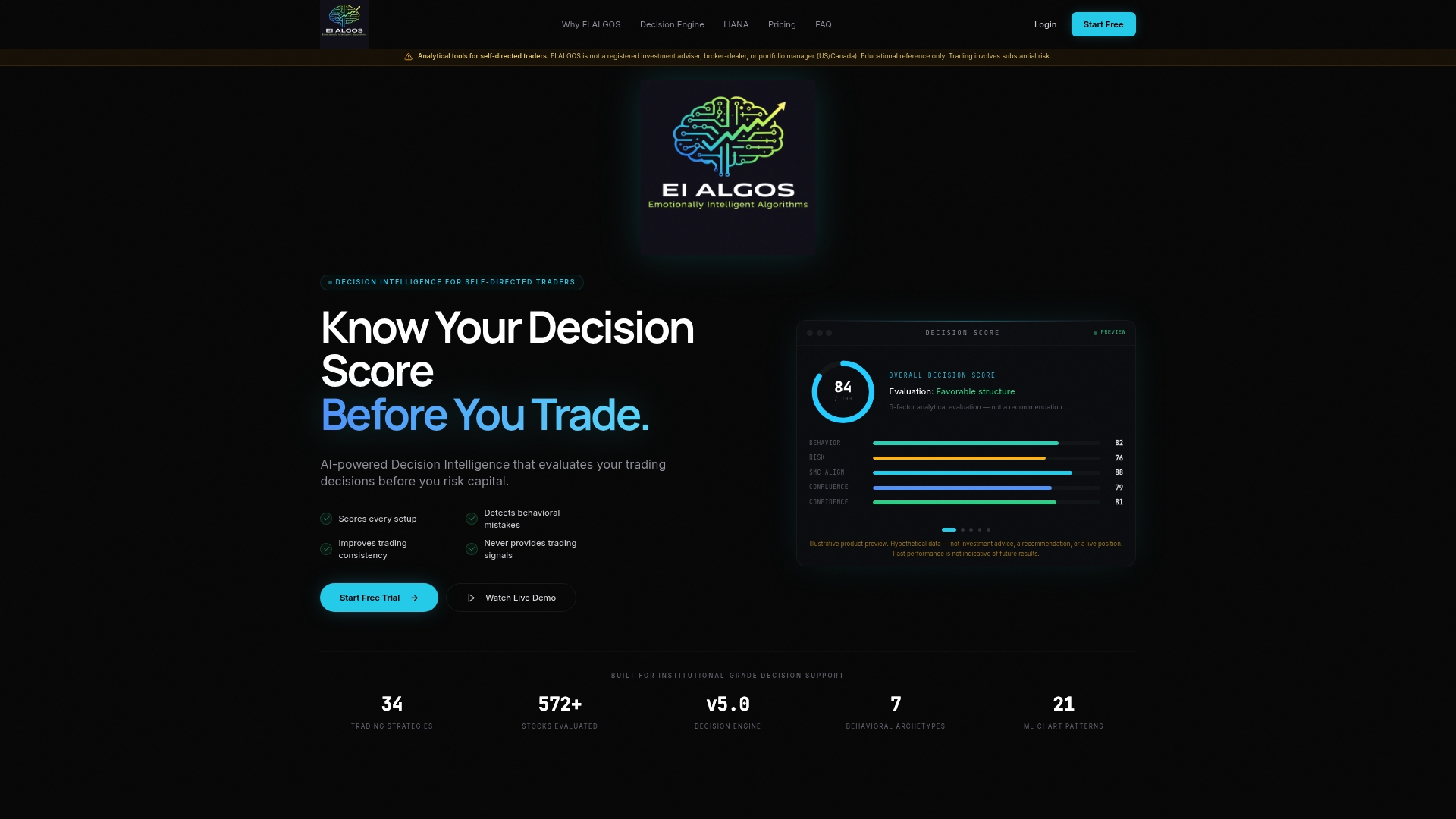
Here's what getting started looks like:
- Our platform offers a free plan to log trades and see baseline scoring with no commitment. Paid plans with advanced features and varying levels of usage are also available; current prices and details are on our pricing page.
In your first 30 days, expect to establish a baseline across all six factors rather than dramatic score changes. Visit EI ALGOS to start your free plan and begin logging your next trade with full context.
This article is general information, not a substitute for advice from a qualified financial advisor. Consult a qualified financial professional about your own circumstances before acting on anything here.
FAQ
What is trading decision intelligence?
Trading decision intelligence scores your trading process, such as position sizing, risk management, and emotional state, instead of predicting market direction. It gives you feedback on how well you followed your own plan rather than a buy or sell recommendation.
How is this different from a trading journal?
A trading journal records what happened; decision intelligence scores how well your process held up against your own rules across defined behavioral factors. The scoring adds a structured, repeatable layer a plain journal entry does not provide on its own.
Does decision intelligence replace risk management for options traders?
No. It works alongside the account-approval and risk-disclosure requirements brokers already apply to options trading, adding a behavioral layer that flags patterns like oversized positions or impulsive entries before they lead to account violations.
How long before I see results from behavioral scoring?
Most traders need a baseline period of 30 to 90 days before scores reveal a clear, actionable pattern. Expect gradual tightening of process, such as reduced turnover or more consistent position sizing, rather than an immediate shift.
What does EI ALGOS cost to try?
EI ALGOS offers a free plan alongside paid tiers with deeper factor breakdowns and additional usage options; current pricing details are available on the pricing page.
Sources
Behavioral scoring draws on several distinct categories of data, and the quality of the output depends on how much of this gets captured consistently.
Trade-level data forms the foundation: entry and exit prices, position size, instrument type, and strategy tag. Process data adds the layer signals-based tools never capture: whether a checklist was followed, what time of day the trade was placed, and how it compares to your typical holding period. Self-reported context, such as emotional state before entry or the reason for the trade, turns raw numbers into a behavioral pattern rather than a spreadsheet of fills.
Account-level data matters too, especially for options and margin traders: available buying power, margin usage, and assignment or exercise events all feed into risk-related scoring factors. Outcome data closes the loop: realized profit and loss, holding time, and whether a stop was honored or moved.
None of this requires market-wide signals, order flow data, or proprietary pricing feeds the way institutional systems rely on. The inputs come almost entirely from your own trading activity and your own stated intentions at the time of the trade, which is also why the output stays specific to your patterns rather than a generic market view.